Rare Vintage, Antiques and Art Collector / Curator / Personal Shopper From Japan
Monumental Bronze Shishi / Dragon Ryu Kōro Incense Burner — Temple / Shrine Courtyard Grade (10‑go Scale)
Monumental Bronze Shishi / Dragon Ryu Kōro Incense Burner — Temple / Shrine Courtyard Grade (10‑go Scale)
Couldn't load pickup availability
Have a reasonable price in mind? Submit your best offer and our concierge will review it personally.
Monumental Bronze Shishi Kōro Incense Burner — Temple / Shrine Courtyard Grade (10‑go Scale)
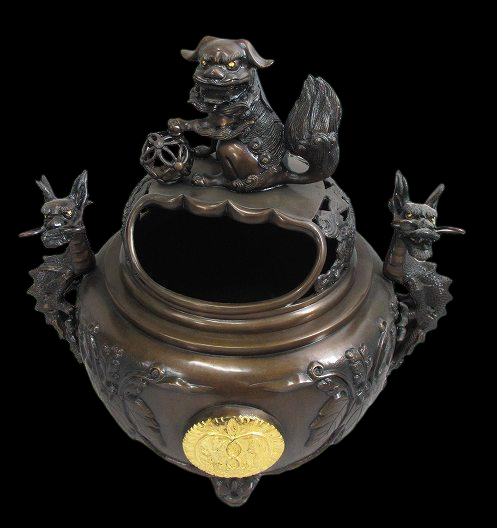
A true temple‑presence object: this monumental bronze Shishi kōro is built at a scale and density that reads as architectural—an exterior‑grade incense burner intended for shrine precincts, memorial halls, or formal ceremonial placement rather than ordinary household use. The composition is classic and authoritative: a seated Shishi (guardian lion‑dog) crowns the pierced lid, the body is gripped by dragon‑form handles, and the entire vessel is anchored on three clawed feet that lift the base for stability and airflow.
In Japanese Buddhist material culture, incense is not “fragrance”—it is offering, purification, and atmosphere made visible. The kōro is the vessel that converts resin and wood into sacred smoke: a physical metaphor for transmutation from the earthly to the devotional. The Shishi motif intensifies that function. Shishi and komainu are threshold guardians—figures associated with warding impurity, misfortune, and intrusive energies. Placed above the vented lid, the Shishi presides over the rising smoke like a sentinel, reinforcing the idea that this burner “guards” the space it perfumes.
This piece’s proportions and construction language point to an institutional class: thick‑walled cast bronze, multi‑part assembly, and a lid designed for high ventilation. The front gilt medallion (or crest‑like plaque) acts as a visual “north star”—an axial cue that helps orient the vessel within a courtyard or altar arrangement. The tripod claw feet are not decorative afterthoughts; they are functional engineering, distributing mass and keeping the base elevated so heat and ash can be managed safely during extended burning.
Collectors prize this category for one reason: it does what smaller objects cannot. A 10‑go class kōro is a centerpiece implement—an anchor sculpture with ritual legitimacy. It reads as Buddhist art even before incense is lit, and once used, it becomes a living object: patina deepens, surfaces acquire narrative, and the piece takes on the quiet gravity associated with temple metalwork.
Identification (Collector‑Safe)
- Object Type: Shishi Kōro — Japanese incense burner / censer
- Tradition: Buddhist temple implements (butsugu), with shrine‑grade exterior placement
- Motifs: Shishi finial (guardian lion‑dog), dragon handles, tripod claw feet
- Intended Use: incense offering / ceremonial fumigation in a precinct or memorial setting
- Period (best estimate): Modern continuation casting, likely Late Shōwa to Heisei (exact workshop undocumented)
Material & Construction
- Material: Cast bronze (copper‑alloy)
- Finish: Natural bronze patina with applied gilt accent / medallion
- Build: Heavy wall thickness; multi‑part casting typical of large metal implements
- Lid: Pierced / openwork ventilation to support long, even smoke release
- Base: Tripod configuration for stability, airflow, and heat separation from surfaces
Dimensions
- Overall height: approx. 42.5 cm
- Mouth diameter: approx. 30.3 cm
Condition
- General: long‑term inventory / storage wear, light surface marks consistent with handling
- Structural: no crack claims noted; please confirm from photos before purchase
- Finish: patina intact; gilt medallion appears retained and legible
Why This Reads as Museum‑Scale
- Monumental scale for its category (courtyard/precinct class)
- Strong iconography (guardian finial + dragons + tripod base)
- Material authority (bronze mass, thick casting language, patina potential)
- Display legitimacy (ritual implement and sculptural object simultaneously)
Collector’s Resonance
- Temple/shrine restoration or ceremonial installation
- Advanced Buddhist art collectors seeking a true centerpiece implement
- Architectural buyers (courtyard / gallery / cultural venue)
- Museum or institutional display as Japanese religious metalwork
Confidence & Verification Notes
- Exact foundry/workshop and alloy specification are not documented in the listing extract.
- “Late Shōwa–Heisei continuation casting” is a form‑based estimate, not a signed attribution.
- All weights/dimensions are logistics estimates unless the seller supplies measured weight.
HS Code Guidance (Customs)
Recommended classification (typical): HS 8306.29 — Statuettes/ornaments of base metal (often used for decorative/ritual bronze objects).
Common alternate used by some brokers: HS 7419.80 — Other articles of copper (bronze = copper alloy).
Final classification can vary by importing country and broker; confirm with your forwarder using photos + intended use (“ritual incense burner / bronze ornament”).
Authenticity & Stewardship
Evaluated under the Japonista Authentication Framework™:
- Material, carving, and surface-study comparison
- Iconographic and stylistic verification
- Condition and stability review (surface integrity)
- Construction assessment and handling-risk evaluation
Guaranteed 100% Authentic. Covered by the Japonista Lifetime Authenticity Warranty™.
A Note on Stewardship and Collecting
At Japonista, we approach Buddhist statues, sacred images, and ritual objects not merely as collectibles, but as cultural and spiritual artifacts deserving of respect, understanding, and careful presentation. Every piece we offer is thoughtfully examined, researched, and curated with sensitivity to its origin, meaning, and historical role.
Our role is not only to offer access to rare and meaningful objects, but to serve as responsible custodians—connecting the right works with collectors who value depth, intention, and authenticity.
Inquiries, Availability, and Private Consideration
Some of the cultural and heritage works may allow room for discussion, while others are held firmly due to rarity, condition, or cultural importance. All inquiries are reviewed personally and discreetly, and we welcome thoughtful questions or expressions of interest.
If you are exploring a particular theme, deity, lineage, or period—or seeking guidance in building a focused collection—our concierge team is always available to assist with quiet expertise and care.
Concierge Support & Collector Guidance
Japonista Concierge™ provides personalized assistance for collectors seeking deeper understanding, thoughtful acquisition, or long-term curation strategies. Whether your interest is devotional, scholarly, or aesthetic, we are here to help guide your journey with clarity and respect.
For select high-value or historically significant works, private reservation or structured payment arrangements may be available on a case-by-case basis. Please reach out to discuss eligibility and discreet options.
Before Proceeding
We kindly encourage collectors to review our shop policies and house guidelines, available through the links in our website footer, which outline shipping, handling, and conditions specific to vintage, sacred, and collectible works.
A Closing Note
Thank you for exploring Japonista’s collection of Oriental Cultural Heritage and arts. We are honored to share these meaningful works and to help place them where they may continue to be appreciated, studied, and respected.
If you have questions or wish to explore related works, please feel free to contact Japonista Concierge™ at any time.