Rare Vintage, Antiques and Art Collector / Curator / Personal Shopper From Japan
Broke City Gold COTÉ MER Kimono Obi Denim Jacket, One of One Japanese Patchwork Harajuku Streetwear Wagara Remake
Broke City Gold COTÉ MER Kimono Obi Denim Jacket, One of One Japanese Patchwork Harajuku Streetwear Wagara Remake
Couldn't load pickup availability
Have a reasonable price in mind? Submit your best offer and our concierge will review it personally.
Experimental Japanese denim trucker reconstructed with vintage obi brocade, asymmetrical kimono sleeves, exposed zippers and Broke City Gold x COTÉ MER graphics
A spectacular one-of-one Japanese remake jacket combining deep indigo-blue denim with a mosaic of richly woven kimono and obi textiles.
The conventional denim trucker silhouette has been dismantled and rebuilt into a piece of wearable textile art. Its front retains the familiar structure of a classic denim jacket, while the sleeves and back erupt into a dense collage of gold brocade, florals, geometric motifs, Japanese graphics, oversized lettering and dramatic exposed hardware.
Across the upper back appears the Broke City Gold name in distressed gold lettering. The sleeves carry bold COTÉ MER branding, visually connecting the garment to the experimental Tokyo fashion world in which vintage Japanese textiles are cut apart, repositioned and transformed into contemporary streetwear.
No two sections repeat in exactly the same way. Every sleeve panel, brocade fragment and patterned block contributes a different texture, color and cultural reference, producing an intentionally irregular composition that feels closer to assemblage art than conventional denim.
Design Character
This jacket lives between several visual languages at once.
Its blue denim body recalls an American trucker jacket, but the surface has been radically transformed through Japanese textile patchwork. Lustrous obi brocades introduce ceremonial gold, copper, vermilion, ivory, green, violet and black, while graphic textile fragments add bold monochrome typography and urban energy.
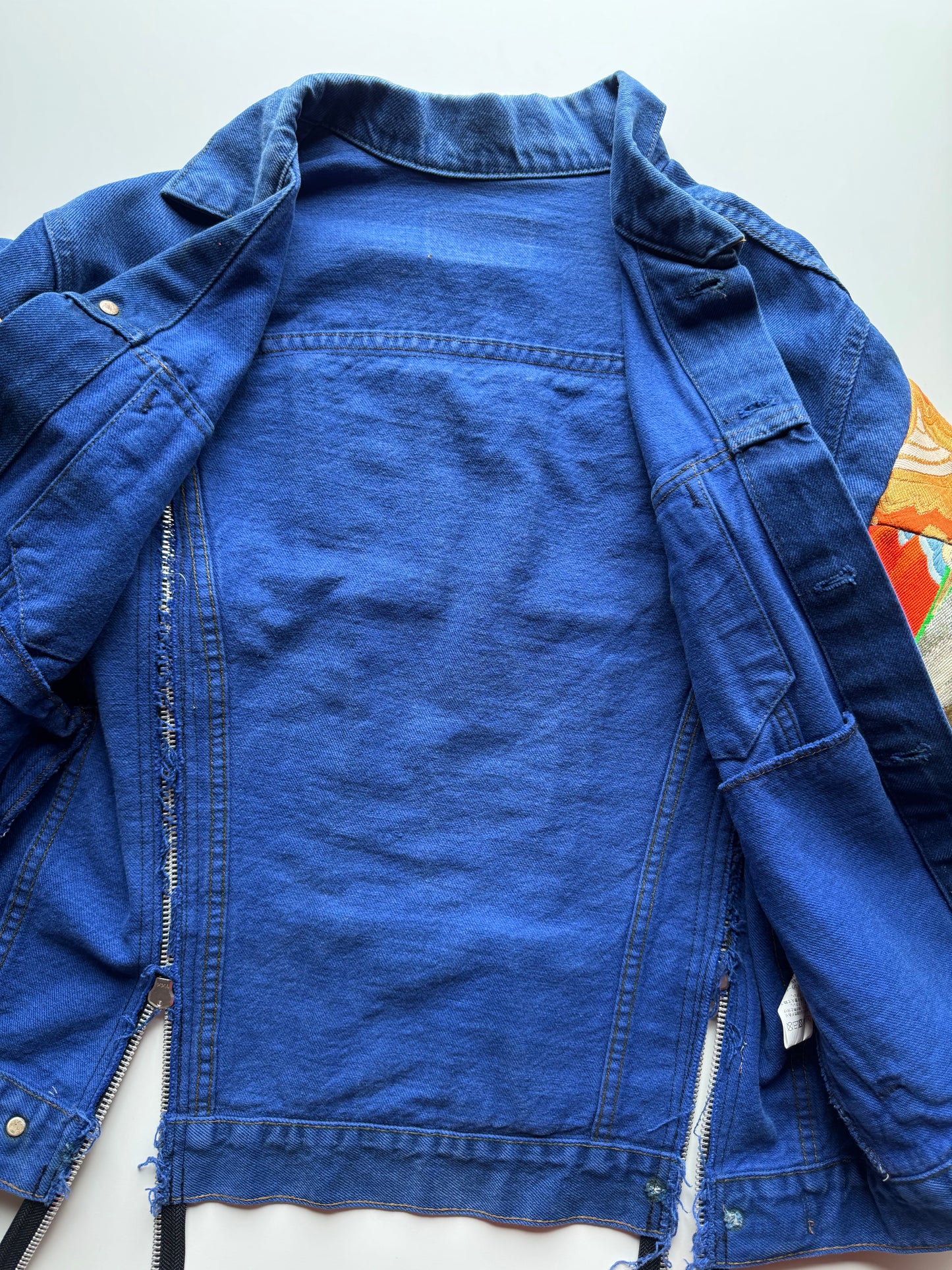
The front appears relatively restrained. A pointed collar, metal buttons, chest pockets and paneled denim construction preserve the recognizable architecture of a classic trucker jacket. The sleeves then fracture that familiarity through asymmetrical bands of brocade, black graphic cloth, Japanese lettering and contrasting green rib-knit cuffs.
The back becomes the principal statement surface.
A large rectangular patchwork field occupies most of the center, framed by twin vertical exposed zippers. The zipper tapes continue below the hem as long free-hanging extensions, giving the piece a deconstructed, almost industrial finish.
Above the textile mosaic, the faded gold Broke City Gold inscription appears directly on the denim yoke. It acts as a maker’s mark while maintaining the jacket’s distressed, underground character.
Identification
Branding: Broke City Gold and COTÉ MER
Garment type: Reconstructed denim trucker jacket
Style: Japanese kimono remake / obi patchwork streetwear
Base garment: Appears to be constructed from a Levi’s denim trucker jacket, supported by the visible red pocket tab and classic Type III-style front construction
Primary color: Deep indigo blue
Secondary colors: Gold, copper, rust, black, ivory, red, green, violet and silver
Closure: Metal button front
Back details: Large obi patchwork panel with twin exposed zippers
Sleeves: Mixed kimono and obi brocade, graphic fabric and printed branding
Cuffs: Contrasting green striped rib knit
Production: Handmade reconstructed garment
Origin: Japan
Exact production year: Unconfirmed
Broke City Gold has been documented as a creative project associated with musician K.A.N.T.A. and designer Norio Sato, with the kimono-applied denim jacket identified as one of the project’s defining forms. The project described its kimono jackets as handmade and one of a kind rather than standardized production garments.
The Denim Trucker Foundation
The body begins with a classic blue denim jacket structure.
The front retains two pointed chest-pocket flaps, vertical seam construction, a turn-down collar and a row of aged metal buttons. The lower body has the cropped, squared proportions associated with traditional trucker jackets.
The denim has been washed to a saturated medium-to-deep blue. Areas around the seams, pocket edges, collar and hem display natural tonal variation that gives the body more depth than a flat modern indigo finish.
This relatively familiar foundation allows the textile alterations to remain the focal point. From the front, the jacket still reads as denim outerwear. From the back and side, it transforms into a dense mixed-media composition.
Japanese Obi Brocade Patchwork
The large back panel is assembled from numerous rectangular and irregular sections of Japanese decorative textile.
Several pieces display the dense metallic weaving associated with formal obi brocade. Motifs include stylized flowers, hexagonal crests, radiating floral medallions, scrolling foliage, geometric bands, fan-like forms and layered textile patterns.
The palette moves rapidly across the surface:
- Gold and ivory floral brocade
- Vermilion and cream geometric sections
- Black grounds with red and gold ornament
- Bright green and silver angular forms
- Copper and orange woven florals
- Violet satin and metallic thread
- Pale olive chrysanthemum-like motifs
- Multicolored decorative bands
Some patches have been arranged in clean rectangular blocks, while others interrupt adjoining patterns at unexpected angles. The effect resembles a textile archive compressed into a single garment.
Because the components were cut from different reclaimed fabrics, their precise fiber content varies. The jacket combines cotton denim with silk-rich or synthetic-blend kimono and obi textiles, metallic threads, printed fabric, rib knit and metal hardware.
Back Composition
The back is the visual nucleus of the garment.
A rectangular panel begins below the denim yoke and extends almost to the lower hem. Its central section contains a large red-and-gold floral medallion on black, surrounded by fragments in green, orange, violet, cream and metallic gold.
The patchwork is framed by two long silver-tone zippers set into black zipper tape. Their pullers sit near the lower section of the textile field, while the open zipper tails extend dramatically below the jacket.
These hanging elements exaggerate the jacket’s vertical movement and reinforce its reconstructed character. Rather than hiding the garment’s hardware, the design makes the mechanics of assembly part of the visual language.
The blue denim remains exposed around the panel, preventing the dense brocade from overwhelming the garment’s structure. The result is a controlled collision between workwear and ceremonial textile.
Broke City Gold Branding
The upper back bears a faded gold inscription reading:
BROKE CITY GOLD
Its distressed surface complements the washed denim rather than appearing as a newly applied, glossy logo.
Placed above the brocade panel, the lettering functions almost like the title of an artwork. The contrast is striking: an urban English-language name floating above fragments of formal Japanese textile traditionally associated with celebration, ceremony and refined dress.
The Broke City Gold project has explicitly identified kimono-applied denim as central to its aesthetic, positioning the design as a meeting point between Japanese heritage material and contemporary street culture.
COTÉ MER Graphic Sleeves
The sleeves are built from several different textile systems.
Upper sections feature ornate kimono and obi brocades in gold, rust, black, cream and muted floral colors. Some panels show large radiating motifs, while others contain chrysanthemums, leaves and scrolling decorative forms.
Across the forearms are broad black sections printed with oversized silver lettering:
COTÉ MER
Additional lower-sleeve panels incorporate monochrome Japanese typography, graphic imagery, brush-like marks and occasional yellow or blue accents.
The arrangement differs between the left and right sleeves. This asymmetry is fundamental to the piece. One arm emphasizes gold circular ornament and green geometric textile; the other introduces black floral brocade, copper leaves and more pronounced graphic branding.
The sleeves terminate in green rib-knit cuffs with contrasting pale stripes. The sporty ribbing acts as a visual full stop after the complexity of the patchwork.
COTÉ MER continues to describe its kimono-remake garments as handmade one-of-one pieces made by transforming vintage Japanese textiles into contemporary streetwear.
Construction and Craftsmanship
The garment demonstrates a highly labor-intensive reconstruction process.
Individual textile fragments were first selected for differences in pattern, color, scale and sheen. They were then cut, arranged and stitched across the original denim structure.
The sleeves involve multiple curved and straight joins, requiring the woven textiles to conform to the shape and movement of the arms. The back patchwork has been assembled separately before being integrated into the denim body and bordered with exposed zipper hardware.
Construction details include:
- Reclaimed blue denim trucker body
- Individually cut kimono and obi textile panels
- Metallic woven brocade
- Mixed straight and shaped patchwork seams
- Contrasting graphic-fabric inserts
- Twin back-panel zippers
- Extended zipper tapes below the hem
- Original-style denim chest pockets
- Metal button front
- Green striped rib-knit cuffs
- Distressed gold back branding
- COTÉ MER sleeve typography
- Intentional raw and deconstructed finishing
Small irregularities in pattern alignment, thread tension and patch shape are part of the handmade construction and distinguish the jacket from digitally printed imitation patchwork.
Motifs and Textile Language
The textiles bring together multiple Japanese decorative traditions without reproducing a single complete kimono composition.
Floral forms resembling chrysanthemums and stylized blossoms appear throughout the sleeves and back. Chrysanthemum motifs are historically associated with longevity, refinement and the autumn season.
Hexagonal and radiating geometric patterns contribute a sense of structure. Gold and silver threads introduce the brilliance associated with formal obi, while black grounds allow red, orange and ivory motifs to appear especially vivid.
Because the original textiles have been fragmented and rearranged, traditional motifs are encountered in partial form. A flower may continue only to the edge of a patch; a geometric band may abruptly meet a completely different pattern.
This fragmentation gives the jacket its contemporary power. The textiles retain their Japanese visual identity, but their original hierarchy has been dismantled and rewritten into a new urban object.
Period and Fashion Context
The garment is most consistent with the late-2010s Japanese remake and Harajuku streetwear movement.
Broke City Gold was documented in Tokyo fashion media during this period, including street-style appearances featuring denim and kimono jackets. The project also collaborated within Japan’s broader sneaker, music and street-fashion culture.
The exact production year of this individual jacket is not established, but its dual branding, graphic treatments, oversized zipper details and densely reconstructed kimono textiles align closely with Broke City Gold’s documented creative direction.
It should be regarded as a contemporary Japanese designer remake rather than an antique or conventional vintage denim jacket.
Condition
Good pre-owned condition with signs of previous wear and handmade reconstruction consistent with the garment’s deconstructed character.
The denim displays natural fading, tonal variation and light surface wear, particularly around seams, pocket edges, collar and hem.
The brocade sections show minor rippling, scattered thread movement and occasional surface irregularities expected from reclaimed woven textiles. The different fabrics naturally react to tension and light in different ways.
Some raw edges, loose thread ends, extended zipper tapes and irregular seams are intentional components of the design. Light fraying is visible near portions of the lower denim and reconstructed areas.
The printed sleeve graphics remain strong and clearly legible. The metallic brocades retain vivid gold, copper, red, green and ivory coloration.
The metal buttons and long exposed zippers are present. No major structural tear or extensive loss is apparent in the photographed areas.
As with any one-of-one reconstructed garment, the photographs form an important part of the condition description and should be examined carefully before purchase.
Approximate Flat Measurements
Back length from upper collar area to hem: approximately 59–60 cm / 23.2–23.6 in
Body width laid flat: approximately 59–60 cm / 23.2–23.6 in
Underarm sleeve length to cuff: approximately 50–52 cm / 19.7–20.5 in
Measurements were taken with the garment laid flat and may vary slightly according to positioning, patchwork tension and the natural structure of the denim.
Please compare these measurements with a jacket that fits comfortably, particularly when planning to layer the piece over knitwear or a sweatshirt.
Silhouette and Styling
The jacket has a cropped, boxy silhouette with substantial visual weight through the sleeves and back.
Its blue denim front can be styled as an anchor against black trousers, wide-leg denim, cargo pants or minimalist tailoring. When viewed from behind, the brocade mosaic becomes the dominant feature, making the piece especially effective in layered streetwear styling.
The warm metallic textiles work well with earth tones, black, olive, indigo and muted neutrals. Bright colors can also be pulled directly from the patchwork, including vermilion, lime green, violet and copper.
Because each sleeve is different, the jacket changes character according to the viewing angle. One side emphasizes formal gold textile; the other foregrounds graphic branding and floral brocade.
It is equally compelling as:
- Harajuku streetwear
- Japanese designer fashion
- Festival or performance outerwear
- Gallery-event clothing
- Editorial styling
- Gender-neutral statement fashion
- A display piece within a kimono-remake collection
- Wearable textile art
Collecting Appeal
This jacket sits at the intersection of Japanese textile heritage, American denim culture and independent Tokyo streetwear.
Its strongest collecting attributes include:
- Broke City Gold back branding
- COTÉ MER sleeve graphics
- Probable Levi’s trucker foundation
- Handmade one-of-one construction
- Extensive Japanese obi brocade
- Asymmetrical reconstructed sleeves
- Large central patchwork back panel
- Twin exposed zipper treatment
- Strong Harajuku and underground-fashion identity
- Distinct visual appearance from every angle
- Wearable proportions despite elaborate construction
- No identical mass-produced counterpart
The jacket is particularly attractive to collectors who value process and material rather than conventional luxury branding. Its appeal comes from the evidence of transformation: visible seams, interrupted motifs, exposed hardware and textiles that retain traces of their previous lives.
Comparable garments are difficult to value through ordinary denim categories because each uses a different combination of source jacket, kimono fabric, construction and graphic treatment.
Care
The garment combines fabrics with very different care requirements.
Denim, metallic brocade, printed cloth and rib knit may react differently to moisture, friction and heat. Repeated machine washing could distort the patchwork, damage metallic threads or cause dye transfer between adjoining sections.
Professional specialist cleaning is strongly recommended.
Store the jacket on a broad padded hanger to support the shoulders. Avoid prolonged direct sunlight, which may fade the indigo denim and weaken older textile fibers. Allow the garment to air naturally after wear rather than sealing it immediately inside plastic.
Shipping and Purchase Policy
This one-of-one reconstructed jacket is sold in its photographed, as-is condition.
Please review all photographs, measurements and condition details carefully before purchasing. Variations in stitching, raw edges, extended zipper tapes, mismatched patterns and textile irregularities are integral to the handmade design.
Due to the collectible and individually constructed nature of the garment, all sales are final. Returns, exchanges, cancellations and post-delivery condition claims are not accepted.
Worldwide shipping is available from Japan by tracked EMS or another suitable insured international service.
Orders are normally prepared for dispatch within 3–5 business days. The jacket will be folded carefully, protected against moisture and packed securely to reduce pressure on the brocade and exposed zipper hardware.
Import duties, local taxes, customs fees and destination-country handling charges are the responsibility of the buyer.
Reasonable offers may be considered. Some prices are flexible, while others remain firm.
#BrokeCityGold #CoteMer #KimonoJacket #ObiJacket #KimonoRemake #JapaneseStreetwear #HarajukuFashion #TokyoStreetwear #PatchworkJacket #DenimJacket #UpcycledFashion #ReworkedDenim #OneOfOneFashion #JapaneseDenim #WagaraFashion #ObiBrocade #KimonoTextile #WearableArt #DesignerStreetwear #AvantGardeFashion #UnisexJacket #StatementJacket #TextileArt #JapaneseFashion #ReconstructedFashion #IndigoDenim #BrocadeJacket #SlowFashion #ArtToWear #Japonista
broke city gold, cote mer jacket, kimono denim jacket, obi patchwork, japanese streetwear, harajuku jacket, one of one jacket, upcycled denim, wagara fashion, designer denim, remake jacket, statement jacket, unisex streetwear
Material Tags
cotton denim, Japanese obi textile, kimono brocade, metallic thread, woven jacquard, printed cotton, graphic fabric, rib knit, polyester thread, metal buttons, metal zippers, zipper tape, mixed reclaimed textiles