Rare Vintage, Antiques and Art Collector / Curator / Personal Shopper From Japan
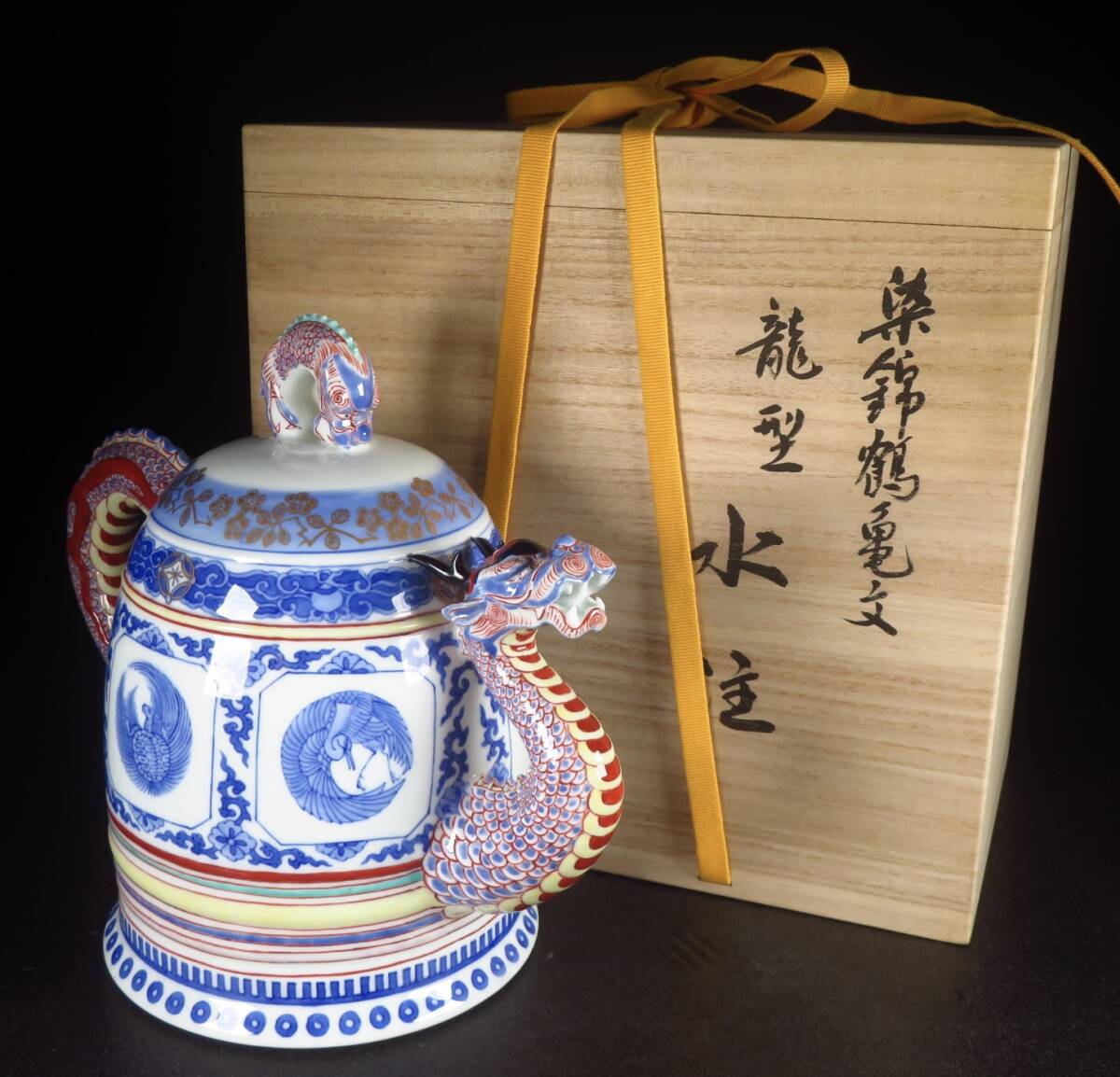
Kutani Ware Dragon-Spout Ritual Ewer — Polychrome & Gilt Porcelain — Signed Imperial Workshop — Meiji to Taisho Period — 28.5 cm
Kutani Ware Dragon-Spout Ritual Ewer — Polychrome & Gilt Porcelain — Signed Imperial Workshop — Meiji to Taisho Period — 28.5 cm
Couldn't load pickup availability
Have a reasonable price in mind? Submit your best offer and our concierge will review it personally.
Overview & Cultural Context
This Kutani ware dragon ewer represents a highly specialized branch of Japanese decorative ceramics in which functional vessel forms were transformed into sculptural statements. Unlike standard vases or figural ornaments, dragon-form water ewers required advanced spatial planning, as the body, handle, spout, and lid were all integrated into a continuous symbolic composition. Such works were never produced casually; they were conceived as prestige objects reflecting both technical confidence and cultural literacy.
In East Asian visual culture, the dragon is inseparable from water, rainmaking, and the regulation of vital forces. Within Japan, this symbolism was absorbed and localized, particularly during the late Edo to Meiji periods, when dragons became common in elite architectural ornamentation, ritual implements, and decorative arts associated with authority and protection. A dragon ewer such as this bridges that symbolic tradition with the refined domestic culture of tea, display, and seasonal presentation.
Kutani ware, originating in Kaga Domain, is renowned for its bold enamel palette and disciplined decorative density. Dragon ewers are especially rare within the Kutani corpus because their complex geometry magnifies every technical risk: uneven glaze pooling, imbalance, or visual overload would immediately compromise the piece. The successful execution seen here indicates a workshop capable of precise enamel control and confident figural modeling.
Rather than functioning purely as a utilitarian water vessel, this object should be understood as a ceremonial or display-grade ewer. Its presence suggests placement within a tokonoma, tea room shelving, or collector cabinet where symbolic resonance outweighed practical daily use. Such hybrid objects were favored during the Meiji–Taishō transition, when decorative ceramics increasingly served as markers of cultivated taste rather than everyday necessity.
Technique, Material & Form
The body of the ewer is constructed in ceramic and finished with layered polychrome overglaze enamels characteristic of Kutani production. The dragon’s sinuous form doubles as a handle, while the vessel body remains visually stable and grounded. This dual-function design demands exceptional planning during the modeling stage, as structural integrity must be preserved through firing.
Hand-painted enamel detailing emphasizes scale patterning, facial expression, and rhythmic movement along the dragon’s body. The saturated blues, reds, and iron tones reflect late Kutani decorative preferences, while the controlled restraint in negative space prevents visual congestion. The lid and spout are proportionally integrated, reinforcing the object’s unity rather than appearing as afterthoughts.
WHY THIS PIECE MATTERS
• Dragon ewers are significantly rarer than Kutani figurines or vases
• Complex sculptural geometry reflects high workshop capability
• Symbolism aligns with water, protection, and cultivated authority
• Ideal for display-grade collections rather than casual décor
• Increasingly scarce in intact condition on the secondary market
KEY FACTS:
Object Type: Dragon-form water ewer / decorative vessel
Material: Ceramic with polychrome overglaze enamels
Technique: Hand-modeled, hand-painted
Origin: Japan (Kutani ware tradition)
Period: Late Meiji to Taishō period (c. early 20th century)
Length: approx. 28.5 cm
Height: approx. 24 cm
Weight: approx. 1,962 g
Condition: Well-preserved with strong surface presence
Accessories: Original storage box included
Iconography & Symbolic Function
Dragons in Japanese art are guardians of water sources, symbols of benevolent authority, and intermediaries between heaven and earth. When rendered as functional vessels, their symbolism becomes active rather than static—suggesting flow, circulation, and protection. In this context, the ewer embodies regulated power: strength contained within disciplined form.
The dragon’s posture and expression avoid aggression, favoring vigilance and command. This aligns with Japanese interpretations of the dragon as a stabilizing force rather than a chaotic one. Such imagery was especially valued in cultured domestic settings where balance, continuity, and auspicious presence were sought.
Collector Significance & Rarity
Dragon-form ewers occupy a narrow niche even among Kutani collectors. Their scarcity arises from the technical difficulty of production and the limited audience capable of appreciating their hybrid nature. Surviving examples in intact condition, with strong enamel presence and no structural compromise, are increasingly difficult to source.
For collectors, this piece functions as an architectural anchor within a display environment. It commands attention without overwhelming adjacent works and rewards close inspection through layered detail. Its rarity lies not in excess ornamentation, but in the disciplined synthesis of sculpture, vessel, and symbol.
Shipping & Handling
This item qualifies for standard international parcel shipping with professional packing.
Confidence & Verification Notes
Attribution is based on stylistic analysis, material construction, and established Kutani ceramic conventions.
Authenticity & Stewardship
Evaluated under the Japonista Authentication Framework™:
- Material, carving, and surface-study comparison
- Iconographic and stylistic verification
- Condition and stability review (surface integrity)
- Construction assessment and handling-risk evaluation
Guaranteed 100% Authentic. Covered by the Japonista Lifetime Authenticity Warranty™.
A Note on Stewardship and Collecting
At Japonista, we approach Buddhist statues, sacred images, and ritual objects not merely as collectibles, but as cultural and spiritual artifacts deserving of respect, understanding, and careful presentation. Every piece we offer is thoughtfully examined, researched, and curated with sensitivity to its origin, meaning, and historical role.
Our role is not only to offer access to rare and meaningful objects, but to serve as responsible custodians—connecting the right works with collectors who value depth, intention, and authenticity.
Inquiries, Availability, and Private Consideration
Some sacred works may allow room for discussion, while others are held firmly due to rarity, condition, or cultural importance. All inquiries are reviewed personally and discreetly, and we welcome thoughtful questions or expressions of interest.
If you are exploring a particular theme, deity, lineage, or period—or seeking guidance in building a focused collection—our concierge team is always available to assist with quiet expertise and care.
Concierge Support & Collector Guidance
Japonista Concierge™ provides personalized assistance for collectors seeking deeper understanding, thoughtful acquisition, or long-term curation strategies. Whether your interest is devotional, scholarly, or aesthetic, we are here to help guide your journey with clarity and respect.
For select high-value or historically significant works, private reservation or structured payment arrangements may be available on a case-by-case basis. Please reach out to discuss eligibility and discreet options.
Before Proceeding
We kindly encourage collectors to review our shop policies and house guidelines, available through the links in our website footer, which outline shipping, handling, and conditions specific to vintage, sacred, and collectible works.
A Closing Note
Thank you for exploring Japonista’s collection of Buddhist statues, sacred art, and spiritual artifacts. We are honored to share these meaningful works and to help place them where they may continue to be appreciated, studied, and respected.
If you have questions or wish to explore related works, please feel free to contact Japonista Concierge™ at any time.