Rare Vintage, Antiques and Art Collector / Curator / Personal Shopper From Japan
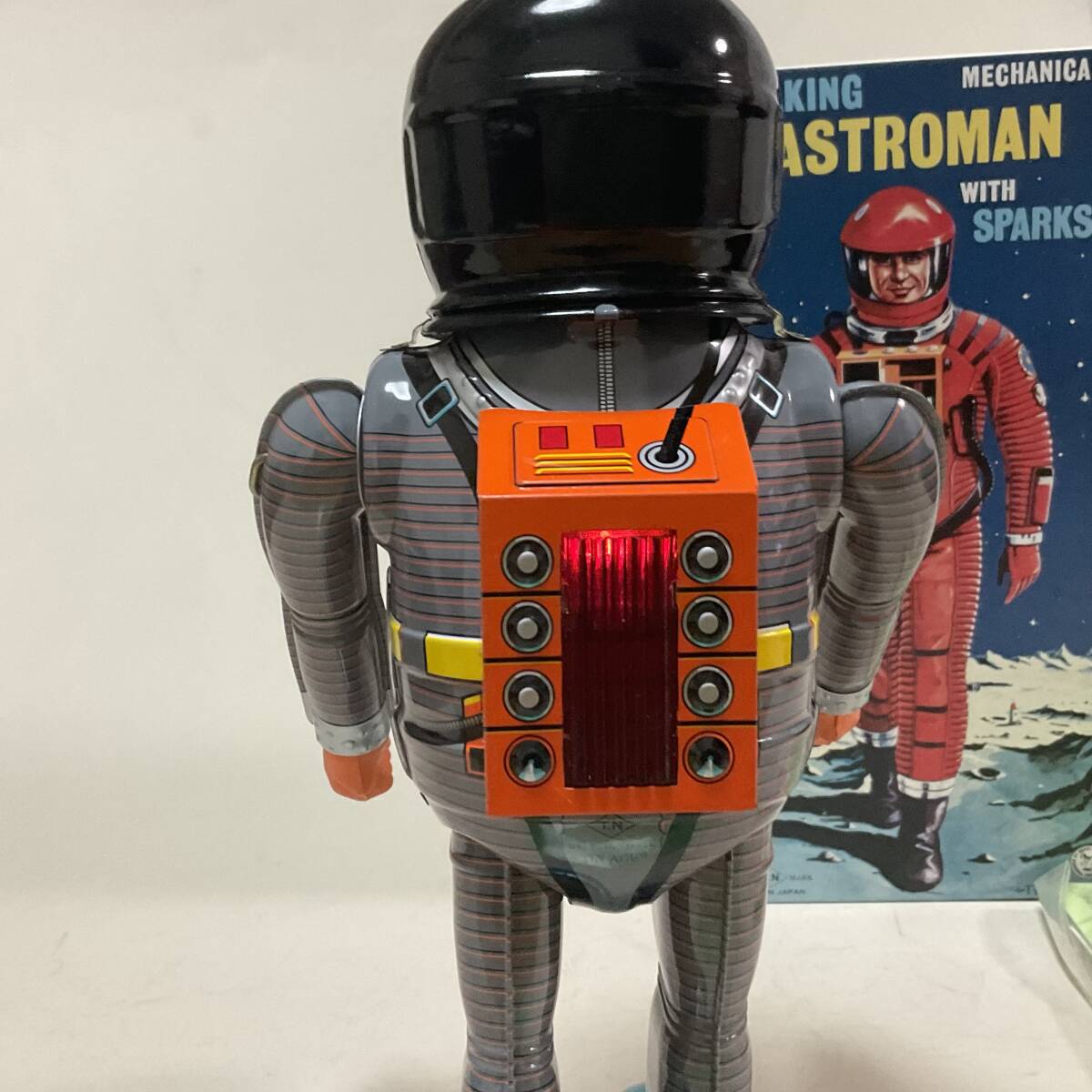
Astroman Grey Walking Mechanical Tin Robot with Sparks Boxed with Papers Space Age Vintage-Style Collectible
Astroman Grey Walking Mechanical Tin Robot with Sparks Boxed with Papers Space Age Vintage-Style Collectible
Couldn't load pickup availability
Have a reasonable price in mind? Submit your best offer and our concierge will review it personally.
CURATORIAL OVERVIEW — WHAT THIS OBJECT ACTUALLY IS
“Astroman” is the kind of object that explains, in one glance, why tin robots became a collector category rather than a childhood footnote. It is not chasing realism. It is chasing belief—the belief that the future can be friendly, wearable, and mechanical, like a walking poster from the space age. The suit is the story: ribbed lines like pressure tubing, a chest panel like instrumentation, and a helmet visor that makes the figure read instantly as “astronaut” even when it’s standing still.
The crucial detail is the format: walking mechanical. This transforms the robot from shelf sculpture into performance object. You wind it (or engage the mechanism), set it down, and it does what mid-century design promised: it moves forward with purpose. The spark-action motif adds the final bit of theatrical physics—an engineered illusion of energy—like a tiny stage effect built into the toy’s identity.
-
Object: “Astroman” walking mechanical tin robot (grey version) with original box and paperwork/inserts (as shown).
-
Type: Wind-up / mechanical walking tin robot with spark action styling (classic space-age robot format).
-
Era positioning: Design language originates in mid-century space-age tin robots; this example presents as a later commemorative/reissue-type release based on the unusually clean set, modern insert board, and “near unused” listing cue.
-
Included: Robot + box + inner insert/tray pieces + paperwork sheet(s).
-
Condition (declared): Near-unused presentation; expect light storage/handling marks at most.
-
Core value drivers: Blue colorway rarity feel, crisp box art, completeness (papers + insert), and clean mechanism function.
ICONOGRAPHY & THEMATIC ANALYSIS
This blue version carries a different emotional temperature than the classic red:
-
Blue = technical calm rather than heroic heat. It reads like “engineering,” “oxygen,” “night sky,” and “systems.”
-
The suit’s line-work creates a diagram effect—as if the body is a schematic.
-
The astronaut faceplate is intentionally minimal: it doesn’t emote; it represents. That’s why these designs age well: they are symbols first, characters second.
The box art matters as much as the figure because it completes the myth. Tin robots are half object, half packaging-era graphic design. When the box survives cleanly, you effectively have a miniature exhibition: “This is what the future looked like when printed ink was the special effect.”
MATERIAL & CRAFT ASSESSMENT
Tin robots live and die on four practical craft signals:
-
Lithography crispness: saturation, line sharpness, and panel detail are the visual core.
-
Metal integrity: dents, edge rub, and foot wear show quickly on walkers.
-
Mechanism health: smooth walking cadence and reliable action are the difference between “nice” and “serious.”
-
Insert + papers: at this tier, completeness is not optional; it is provenance.
This example’s presentation (robot seated cleanly in box with paperwork visible) signals a collector-preserved life rather than heavy play—exactly what buyers want when they are buying nostalgia as an archive.
HISTORICAL CONTEXT — WHY THESE SURVIVE AT ALL
Walking tin robots are inherently fragile survivors. They are motion toys: motion causes scuffs; scuffs become dents; dents become “why did we keep this?” Most were used hard, then discarded when plastic figures became dominant. The sets that remain clean and boxed usually survived because someone recognized their odd power early: they aren’t just toys, they are industrial-era dreams—space-age optimism translated into household scale.
Even when a later release, the collectible appeal remains real because it preserves a disappearing design language: bright tin lithography, mechanical movement, and packaging that treats a toy like a product from a future that never fully arrived.
COLLECTOR RELEVANCE
This piece cross-pollinates multiple collector tribes:
-
Tin robot canon collectors (iconic silhouette + action format)
-
Space-age decor collectors (strong shelf presence, clean geometry, color pop)
-
Box-and-paper purists (the archive value of complete sets)
-
Variant hunters (blue colorway feels scarcer and more “designed” than default reds)
Collector logic here is simple: the more “complete and clean” it is, the more it stops being “a toy” and becomes a preserved product artifact.
SUMMARY — WHY THIS PIECE MATTERS
Astroman in blue is a compact museum-grade argument for why mid-century space-age design still sells: clarity, optimism, and mechanical theater. Boxed with papers, it reads as an archival set—an object that doesn’t just remind you of the future; it shows you what the future used to look like.
Authenticity & Collectible Stewardship
Evaluated under the Japonista Collectibles Authentication Framework™:
-
Period, manufacturer, and production-era assessment
-
Material, paint, lithography, and surface-wear analysis
-
Mechanical, structural, and component integrity review (where applicable)
-
Design, iconography, and cultural-context verification
Guaranteed 100% Authentic.
Every piece is backed by the Japonista Lifetime Authenticity Warranty™ and curated with collector-grade scrutiny.
A Note on Collecting & Preservation
At Japonista, we approach vintage and modern toys not merely as nostalgic objects, but as design artifacts, cultural touchstones, and expressions of their era—from postwar ingenuity and Showa imagination to contemporary pop and designer movements.
Each work is carefully examined, researched, and presented with respect for its original intent, historical context, and collector relevance, balancing preservation with the honest character earned through time and play.
Our role is not only to offer access to meaningful collectibles, but to act as thoughtful custodians—connecting the right pieces with collectors who value history, originality, and lasting significance.
Inquiries, Availability, and Private Consideration
Some collectible works may allow room for discussion, while others are held firmly due to rarity, condition, provenance, or cultural importance. All inquiries are reviewed personally and discreetly, and we welcome thoughtful questions or expressions of interest.
If you are exploring a specific theme, franchise, maker, era, or mechanical category—or seeking guidance in building a focused collection—our team is always available to assist with informed, quiet expertise.
Concierge Support & Collector Guidance
Japonista Concierge™ offers personalized assistance for collectors seeking deeper understanding, strategic acquisitions, or long-term curation across vintage and modern collectibles.
Whether your interest lies in nostalgia, design history, mechanical fascination, or pop-culture legacy, we are here to support your collecting journey with clarity, care, and discretion.
For select high-value or historically significant pieces, private reservation or structured payment arrangements may be available on a case-by-case basis. Please contact us to discuss eligibility and options.
Before Proceeding
We kindly encourage collectors to review our shop policies and house guidelines, available through the links in our website footer, which outline shipping, handling, and condition standards specific to vintage, mechanical, and collectible works.
A Closing Note
Thank you for exploring Japonista’s collection of vintage and modern toys, robots, and cultural collectibles. We are honored to share these enduring objects of imagination and design—and to help place them where they may continue to be appreciated, studied, and enjoyed.
If you have questions or wish to explore related works, please feel free to contact Japonista Concierge™ at any time.