Rare Vintage, Antiques and Art Collector / Curator / Personal Shopper From Japan
Astro Boy Tetsuwan Atom Osaka Buriki Limited Walking Doll Boxed Unused Vintage Style Character Figure Display Collectible
Astro Boy Tetsuwan Atom Osaka Buriki Limited Walking Doll Boxed Unused Vintage Style Character Figure Display Collectible
Couldn't load pickup availability
Have a reasonable price in mind? Submit your best offer and our concierge will review it personally.
This is a boxed Astro Boy figure produced in the tradition of Japanese tin-toy culture—where “character” isn’t only sculpted, it’s staged. The presentation matters: the illustrated box front, the fitted inserts, the separated boots, the sense that the object is an event you unbox rather than a loose figure you toss on a shelf.
The “walking” or “marching” concept is also its own miniature genre: a figure designed with forward momentum in mind, echoing the classic era when toys were engineered to move and perform, not merely pose. Even when collectors keep these as display pieces, that implied motion is the charm—it feels like a character caught mid-story.
Because it’s boxed and appears unused, this one reads less like a casual figure and more like a small archival capsule: character history, packaging art, and object-design in one unit.
-
Object: Astro Boy (Tetsuwan Atom) walking doll / marching figure — Osaka Tin limited model
-
Category: Vintage-style character collectible (tin-toy culture lineage; display-forward figure)
-
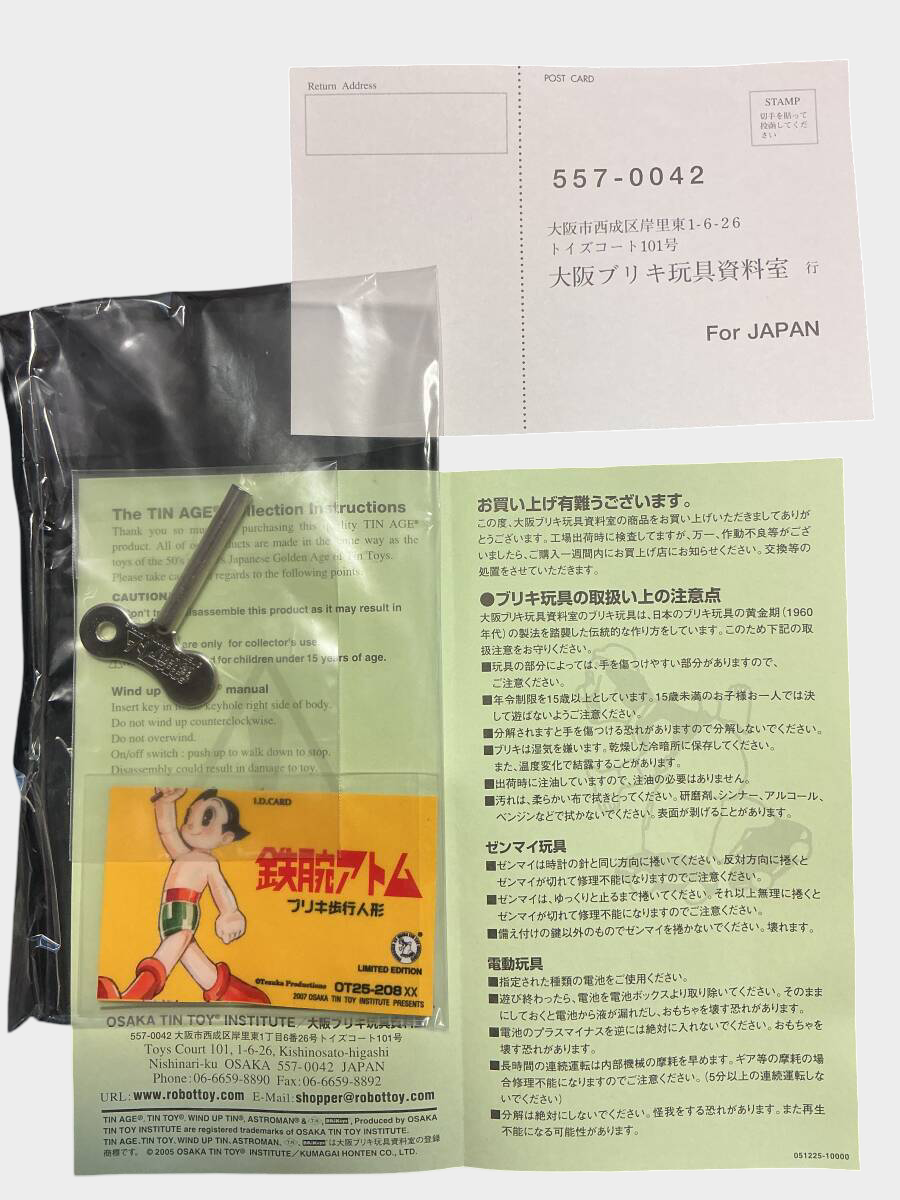
Format: Boxed figure with separate boots/shoes stored in inner tray (photo-defined)
-
Condition): Unused (photo shows clean body, intact inserts, box present)
-
Value drivers: Osaka Tin provenance, boxed completeness, “walking/marching” format, artwork-front box presence, and condition purity
ICONOGRAPHY & THEMATIC ANALYSIS
Astro Boy is not just “a character”—he’s a symbol of Japan’s postwar future-imagination: optimism built from machinery, innocence paired with power, and the idea that technology can be moral if the heart is right. That’s why Astro Boy collectibles sit in a different emotional tier than many franchise goods. They aren’t only nostalgic; they’re foundational.
The box art does a lot of work here: it frames Astro Boy as heroic and kinetic, emphasizing forward motion and the “bright future” vibe that made the character iconic across generations. In a collection, boxed Astro Boy objects read like cultural signage—instantly recognizable, emotionally warm, and visually clean.
MATERIAL & CRAFT ASSESSMENT
Key collector checks for this type of piece:
-
Box integrity: edge crush, surface rub, and corner wear (box condition is value)
-
Insert completeness: fitted trays and internal supports present and unbroken
-
Figure surface: paint cleanliness, face clarity, torso shine (no scuffs/haze)
-
Accessories: boots/shoes present (photo shows them stored separately)
-
Mechanism status (if applicable): if it’s truly a walking action format, buyers will want to know whether it’s tested or display-only
Museum-commercial positioning: describe it as a boxed display collectible with the “walking” format as a design feature—without overpromising mechanical performance unless tested.
HISTORICAL CONTEXT — WHY THESE SURVIVE AT ALL
Character objects like this survive when they were treated as “kept” items rather than “used” toys—stored with packaging intact, preserved like printed matter. Astro Boy is especially likely to survive in boxed form because collectors often recognize its historical weight: early modern manga/anime identity, international recognition, and the design language of mid-century optimism.
Osaka Buriki-associated items also tend to be treated as adult collectibles from day one—acquired for display, collection building, or nostalgia-driven archiving. That’s exactly the category where unused examples still appear—and where boxed integrity becomes the difference between “nice” and “serious.”
COLLECTOR RELEVANCE
Best-fit buyer profiles:
-
Astro Boy / Tezuka-focused collectors
-
Tin-toy culture collectors (Buriki lane)
-
Box-art collectors (packaging as art)
-
Interior display curators building a “retro character” shelf with clean, iconic silhouettes
Conversion trigger: show box corners, insert tray, boots/accessories close-up, and face paint close-up in crisp lighting.
SUMMARY — WHY THIS PIECE MATTERS
A boxed, unused Astro Boy walking-format collectible hits three collector nerves at once: character history, packaging art, and that classic “toy-as-performance” design language. The Osaka Buriki association strengthens the object’s credibility in the tin-toy collector universe, while the clean boxed presentation makes it display-ready and giftable.
Authenticity & Stewardship
Evaluated under the Japonista Manga & Media Canon Authentication Framework™:
-
Creator, studio, publisher, and production-context verification
-
Medium assessment across print, animation, objects, and licensed works
-
Period accuracy, edition legitimacy, and release lineage review
-
Condition evaluation appropriate to paper, film, plastics, and mixed media
Guaranteed 100% Authentic.
Every work is curated under the Japonista Lifetime Authenticity Warranty™, with standards aligned to cultural, academic, and collector-level scrutiny.
A Note on Tezuka, Postwar Thought, and Ethical Imagination
Tetsuwan Atom is not merely a character; it is a philosophical construct born from postwar Japan’s confrontation with technology, trauma, and hope. Through manga and animation, Tezuka Osamu articulated questions of life, empathy, responsibility, and coexistence between human and machine long before they entered mainstream discourse.
At Japonista, we approach works related to Tezuka’s universe as primary cultural texts, not nostalgia-driven merchandise. Attention is given to authorship, medium, and historical positioning, distinguishing between original works, period materials, and later interpretations or licensed expressions.
Wear, aging, and material fragility are preserved when honest, understood as part of the object’s passage through time rather than defects to be erased.
Inquiries, Availability, and Private Consideration
Some works may allow thoughtful discussion, while others are held firmly due to cultural importance, scarcity, or archival relevance. All inquiries are reviewed personally and discreetly, with transparency regarding edition type, period, and condition sensitivity.
Collectors building media history archives, manga study collections, or canon-focused libraries are encouraged to consult with our team.
Concierge Support & Collector Guidance
Japonista Concierge™ provides informed guidance on:
-
Original vs later production distinctions
-
Manga, animation, and cross-media formats
-
Preservation of paper, film, and early plastics
-
Contextual placement within postwar Japanese culture
Our role is to support collecting that honors meaning and authorship, not speculation alone.
Before Proceeding
We kindly encourage collectors to review our shop policies and house guidelines, available through the links in our website footer, which outline shipping, handling, and conditions specific to vintage, sacred, and collectible works.
A Closing Note
Thank you for exploring Japonista’s archive of Tetsuwan Atom and Tezuka Osamu–related works. These objects carry not only stories, but ethical imagination and cultural memory—and we are honored to steward them with the seriousness they command.
If you have questions or wish to explore related items, please feel free to contact Japonista Concierge™ at any time.