Rare Vintage, Antiques and Art Collector / Curator / Personal Shopper From Japan
Asakusa Toy BIG X Tin Speedboat w/ Sofubi Pilot Head — Showa Japanese Retro Hand-Crank Propeller Boat
Asakusa Toy BIG X Tin Speedboat w/ Sofubi Pilot Head — Showa Japanese Retro Hand-Crank Propeller Boat
Couldn't load pickup availability
Have a reasonable price in mind? Submit your best offer and our concierge will review it personally.
Asakusa Toy “BIG X” Tin Speedboat w/ Sofubi Pilot Head (Hand-Crank Propeller)
Curatorial Spine
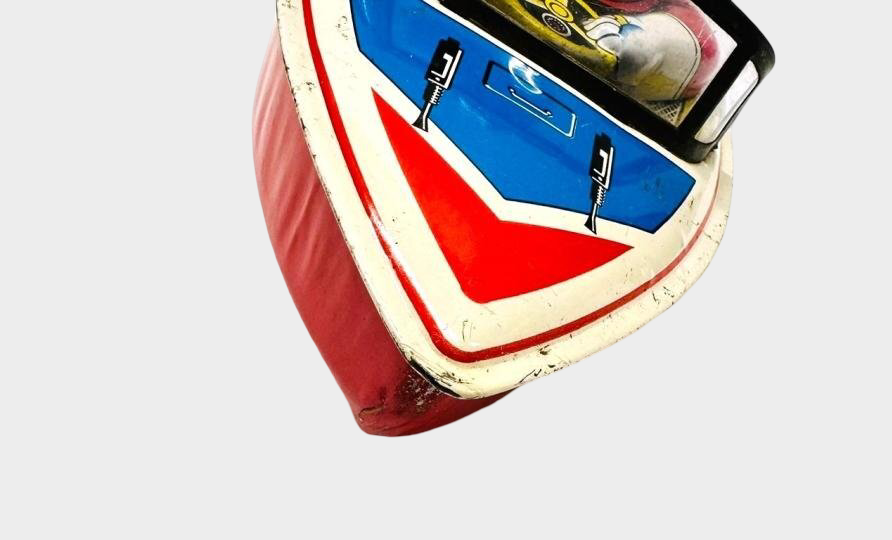
Showa-era Japanese tinplate “BIG X” speedboat by Asakusa Toy / Asakusa Toys, featuring a soft-vinyl (sofubi) pilot head and a hand-crank mechanism that spins the rear propeller. A large-format character vehicle that fuses mid-century toy modernism (bold lithography, crisp geometry, display-first scale) with Tezuka-adjacent/Showa TV-manga hero culture—built to read like a graphic object even when stationary.
🕊️ Big X — the forgotten keystone of early Japanese sci-fi
Big X is one of the most misunderstood—and historically crucial—works in early Japanese animation. Created by Osamu Tezuka and adapted into an anime in 1964, Big X sits quietly between Astro Boy and the explosion of giant heroes, yet it tackles themes that neither fully dared at the time: guilt, inheritance, militarism, and ethical restraint.
If Astro Boy is optimism and Tetsujin 28-go is raw postwar anxiety, Big X is Japan’s first anime about responsibility for power.
🧠 What Big X is actually about (beneath the surface)
At the narrative level, Big X follows a boy, Akira, who inherits Big X, a secret Nazi-developed chemical that grants flight, super strength, and near invulnerability. Unlike robots or aliens, Big X is purely human enhancement—and that is the key.
The story is explicitly rooted in World War II legacy. Akira’s father was involved in wartime research; the power Akira receives is not a blessing, but a burden passed down from an immoral past. This framing was radical for a children’s series in 1964.
Big X is not a savior born of hope—he is a survivor of historical wrongdoing.
🧩 Comparison with same-era icons (this is where Big X matters)
🧸 Astro Boy
-
Theme: optimism, coexistence, technological hope
-
Power source: benevolent science
-
Moral axis: “technology can be good if guided by empathy”
Big X rejects this.
Technology here is already tainted. Power exists because of war. The question is not can it be good? but can it ever be cleansed?
🤖 Tetsujin 28-go (Gigantor)
-
Theme: loss of control
-
Power source: military robot
-
Moral axis: “we built weapons before we built ethics”
Big X is more intimate and disturbing.
The weapon is inside the body. There is no cockpit, no distance. Akira is the weapon. This internalization of violence anticipates much later anime psychology.
👽 Ultraman
-
Theme: defense, spectacle, organized response
-
Power source: alien savior
-
Moral axis: “protect Earth at all costs”
Big X predates this heroic clarity. There is no patrol force, no cheering public, no clean enemy. The conflicts are covert, morally gray, and personal—closer to espionage than superheroics.
🎨 Aesthetic and symbolic differences
Visually, Big X lacks the toyetic clarity of later heroes:
-
No giant robot silhouette
-
No iconic transformation gimmick
-
No exaggerated monster battles
Instead, his design is plain, almost uncomfortable. This visual restraint mirrors the story’s refusal to glamorize power. Big X flies alone, often at night, often in secrecy—an image closer to a fugitive conscience than a champion.
🧭 Why Big X didn’t dominate—and why that matters
Big X underperformed commercially for one main reason:
It treated children as moral inheritors, not just dreamers.
In contrast:
-
Astro Boy invited children to imagine a better future
-
Ultraman invited them to cheer defense and unity
-
Tetsujin 28-go let them process fear externally
Big X asked:
“What if the sins of adults become your responsibility?”
That question was too heavy for mass merchandising—but historically invaluable.
🧠 Big X’s long shadow (even if it’s invisible)
Big X quietly influenced:
-
Later “burdened hero” archetypes
-
Human-enhancement anxiety in anime
-
Ethical sci-fi where power is inherited, not chosen
You can trace its DNA in much later works that grapple with:
-
inherited guilt
-
wartime science
-
personal responsibility over spectacle
It is proto-Evangelion thinking, decades early—without the mecha.
🏛️ Position in Japanese retro anime history
Big X occupies a rare position:
| Era | Archetype | Representative |
|---|---|---|
| Early 60s optimism | Child + hope | Astro Boy |
| Postwar anxiety | Weaponized tech | Tetsujin 28-go |
| Moral inheritance | Human burden | Big X |
| Late 60s spectacle | Giant savior | Ultraman |
Because it does not fit cleanly into toy, monster, or robot categories, Big X became a historical hinge rather than a franchise engine.
🕯️ Why Big X matters today
Big X feels uncannily modern now. In an age of inherited crises—war legacies, environmental damage, technological overreach—its central question resonates again:
What do you do when power comes from a past you did not choose, but must answer for?
That makes Big X not just retro anime—but unfinished business in Japanese sci-fi history.
Object Details
-
Maker / brand (stated): Asakusa Toy
-
Series / character (stated): BIG X
-
Construction (stated + visible): Tin boat body + sofubi head pilot
-
Mechanism (stated): Turn the handle/crank → rear screw/propeller rotates
-
Condition (stated): Used; scratches and dirt present
Design & aesthetic analysis
-
Profile: classic Showa “speed craft” silhouette—wide bow, tapered stern, high visual stability.
-
Deck graphics: bold, simplified iconography designed for legibility at distance (the “display toy” principle).
-
Twin rear fins: lightning-bolt motif reads like a toy-era abstraction of speed and power—strong shelf presence.
-
Pilot treatment: sofubi head makes the piece feel half-vehicle, half-figure—bridging tin toy collecting with sofubi character culture.
-
Color architecture: red hull wall + bright deck fields create a “poster object” effect; it photographs extremely well for Shopify hero images.
Materials & construction
-
Hull/body: lithographed tinplate with rolled edges and folded seams
-
Pilot: soft-vinyl head (typical Showa character presentation)
-
Mechanism: manual crank linkage to rear propeller (less failure-prone than zenmai, and often preferred for display play)
-
Fins / rear elements: tin litho panels (high risk area for bends—survival matters)
Mechanism note (why this matters)
Hand-crank toys are a sweet spot: interactive without spring fatigue. The “turn handle → prop spins” feature is easy to demonstrate on video, and it upgrades listing credibility immediately (buyers love a simple, provable action
Condition
Condition Tier: B− (displayable survivor)
-
Expected: scuffs, edge wear, small paint loss, handling marks, light oxidation risk points
-
Positive: graphics remain visually strong; overall form reads clean and presentable
-
Note: for boats, fin edges + bow lip are the first places to show bends—photograph these explicitly for buyer confidence.
Cultural / franchise positioning
BIG X sits in the early-Showa superhero continuum—an era when Japanese character design leaned into clarity, motion, and symbolic speed more than realism. Putting the hero into a speedboat is quintessential: it turns the character into an emblem of modern leisure and kinetic progress. This object therefore functions as both a toy and a compact historical surface—an artifact of how Showa Japan packaged heroism as everyday motion.
Authenticity & Stewardship
Evaluated under the Japonista Authentication Framework™:
- Material, carving, and surface-study comparison
- Iconographic and stylistic verification
- Condition and stability review (surface integrity)
- Construction assessment and handling-risk evaluation
Guaranteed 100% Authentic. Covered by the Japonista Lifetime Authenticity Warranty™.
A Note on Stewardship and Collecting
At Japonista, we approach Buddhist statues, sacred images, and ritual objects not merely as collectibles, but as cultural and spiritual artifacts deserving of respect, understanding, and careful presentation. Every piece we offer is thoughtfully examined, researched, and curated with sensitivity to its origin, meaning, and historical role.
Our role is not only to offer access to rare and meaningful objects, but to serve as responsible custodians—connecting the right works with collectors who value depth, intention, and authenticity.
Inquiries, Availability, and Private Consideration
Some of the cultural and heritage works may allow room for discussion, while others are held firmly due to rarity, condition, or cultural importance. All inquiries are reviewed personally and discreetly, and we welcome thoughtful questions or expressions of interest.
If you are exploring a particular theme, deity, lineage, or period—or seeking guidance in building a focused collection—our concierge team is always available to assist with quiet expertise and care.
Concierge Support & Collector Guidance
Japonista Concierge™ provides personalized assistance for collectors seeking deeper understanding, thoughtful acquisition, or long-term curation strategies. Whether your interest is devotional, scholarly, or aesthetic, we are here to help guide your journey with clarity and respect.
For select high-value or historically significant works, private reservation or structured payment arrangements may be available on a case-by-case basis. Please reach out to discuss eligibility and discreet options.
Before Proceeding
We kindly encourage collectors to review our shop policies and house guidelines, available through the links in our website footer, which outline shipping, handling, and conditions specific to vintage, sacred, and collectible works.
A Closing Note
Thank you for exploring Japonista’s collection of Oriental Cultural Heritage and arts. We are honored to share these meaningful works and to help place them where they may continue to be appreciated, studied, and respected.
If you have questions or wish to explore related works, please feel free to contact Japonista Concierge™ at any time.