Rare Vintage, Antiques and Art Collector / Curator / Personal Shopper From Japan
Antique Japanese TOA Diving Helmet Bronze Shōwa Era Commercial Diver Helmet Industrial Maritime Artifact Authentic Patina
Antique Japanese TOA Diving Helmet Bronze Shōwa Era Commercial Diver Helmet Industrial Maritime Artifact Authentic Patina
Couldn't load pickup availability
Have a reasonable price in mind? Submit your best offer and our concierge will review it personally.
Antique Japanese TOA Commercial Diving Helmet
Shōwa Period (c. 1930s–1950s)
Cast bronze with glass viewports
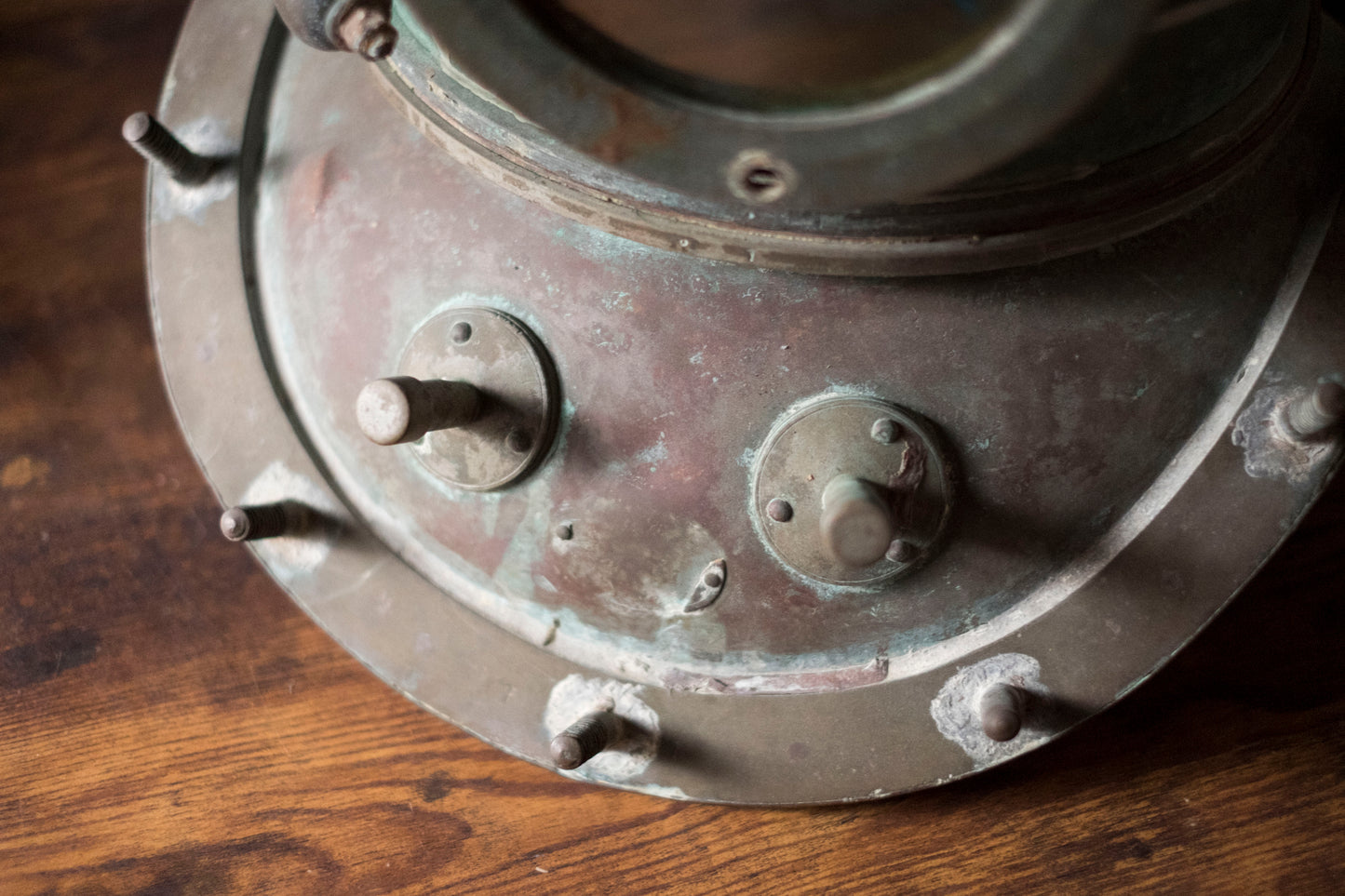
A substantial and visually compelling example of a Japanese commercial diving helmet attributed to TOA, executed in cast bronze with multiple reinforced glass viewports. The helmet retains its original structural configuration, including a rounded dome form and bolted neck assembly.
The surface displays a richly developed verdigris patina, indicative of prolonged marine exposure. Minor abrasions and oxidation are consistent with age and functional use.
Such helmets were employed in industrial underwater operations during Japan’s mid-20th century maritime expansion. The present example stands as both a utilitarian artifact and a sculptural object of industrial design.
Object Type: Japanese Commercial Diving Helmet (Surface-Supplied Hard Hat System Component)
Maker: TOA (TOA industrial diving equipment lineage, Tokyo)
Country of Origin: Japan
Era: Shōwa Period (c. late 1930s–1950s, with possible overlap of pre-war tooling into early post-war production)
Primary Material:
- High-copper cast bronze alloy (likely tin bronze with trace zinc content)
Secondary Materials:
- Machined brass/bronze viewport rings
- Thick pressure-resistant glass (pre-acrylic era)
- Marine-grade fasteners (bronze or early steel variants)
Manufacturing Method:
- Sand-cast dome body
- Post-cast machining of threading surfaces and viewport housings
- Manual finishing consistent with mid-20th century industrial production
Functional System Role:
Part of a surface-supplied diving system, where:
- Air is pumped from the surface
- Helmet maintains positive pressure
- Diver operates tethered via umbilical
Original Operational Context:
- Harbor reinforcement and dredging
- Ship hull maintenance
- Salvage recovery
- Underwater construction in high-current coastal zones
Condition Profile:
- Naturally developed verdigris patina across copper-rich surfaces
- Oxidation layers stable and visually dense
- Structural integrity intact
- Wear consistent with prolonged marine exposure and storage aging
Micro-Qualifiers:
Early production form with dense bronze casting integrity
Collector-grade example retaining original patina
Strong architectural presence suitable for interior display
Overview — The Weight of Submerged Labor
Before lightweight composites and digital instrumentation, there was weight—literal, uncompromising weight. This TOA diving helmet is not merely an object; it is a vessel of pressure, a boundary between breath and water, a tool that allowed human presence in an environment fundamentally hostile to it.
Its form is not aesthetic by intention, yet it has become aesthetic by survival.
Material — Bronze as Memory
Bronze is not just a metal here—it is a recorder of time. The green patina spreading across the surface is not decay; it is evidence. Evidence of oxygen, salt, moisture, and years interacting with a copper-rich alloy designed to resist, not surrender.
Unlike iron, which flakes and collapses, bronze transforms slowly, stabilizing into a skin that protects what lies beneath. This is why maritime engineers favored it—because it ages without disappearing.
What you see is not damage.
What you see is history made visible.
Construction — Engineering for Pressure
Every curve of this helmet serves a purpose:
- The rounded dome distributes external pressure evenly
- The thick glass ports act as controlled visual apertures
- The neck ring system ensures a sealed interface with the diving suit
This is pre-digital engineering—solved through physics, not electronics.
The helmet was part of a system where:
- Air was manually or mechanically pumped from above
- The diver’s survival depended on constant pressure balance
- Failure was immediate and unforgiving
There is no redundancy in such systems. Only precision.
Design Philosophy — Japanese Industrial Restraint
Where Western helmets often embraced polished brass and visual authority, Japanese helmets like this TOA example embody something quieter:
A philosophy of function-first minimalism rooted in:
- Practical necessity
- Material honesty
- Structural balance
It does not attempt to impress.
It simply endures.
And in that endurance, it becomes visually profound.
Historical Context — Japan Beneath the Surface
During the Shōwa era, Japan’s coastline became a site of intense industrial activity:
- Ports expanding
- Ships requiring constant maintenance
- Infrastructure extending into the sea
Divers were not explorers—they were workers.
This helmet belonged to that world.
A world where visibility was limited, communication was minimal, and the only constant was pressure.
Human Element — The Invisible Diver
Every mark on this helmet suggests something unseen:
- A descent into cold water
- The muffled sound of air being pumped through a hose
- The slow, deliberate movement required under pressure
The diver inside was not visible to the surface—only connected by lifeline and trust.
This object is the interface between two worlds:
- Above: air, light, sound
- Below: silence, weight, resistance
Collector Relevance — Object to Presence
This helmet now exists beyond function.
It operates in three simultaneous roles:
- Artifact — A preserved piece of maritime history
- Sculpture — A form shaped by necessity, now visually commanding
- Atmosphere — A presence that alters the space around it
Placed in an interior, it does not blend—it anchors.
Comparative Position — Global Context
Relative to:
- DESCO (USA) → More modular, more polished
- Siebe Gorman (UK) → Earlier innovation, more refined engineering
TOA helmets represent:
→ Heavier casting
→ Less ornamentation
→ Greater raw industrial presence
They are less common internationally, making them undervalued but highly distinctive in global collections.
Summary — Compressed Depth
This is not simply a helmet.
It is:
- Pressure made solid
- Labor made visible
- Time made material
An object that once allowed a human to stand where humans are not meant to stand.
Authenticity & Stewardship
Evaluated under the Japonista Maritime & Diving Heritage Authentication & Provenance Framework™
Each object is assessed through a structured, cross-disciplinary review:
• Object typology and period attribution (nautical instruments, ship fittings, diving apparatus, naval equipment)
• Material analysis across brass, copper, bronze, steel, glass, rubber, and composite components
• Manufacturing and maker identification, including foundry marks, engraved plates, and workshop signatures
• Functional and mechanical assessment where applicable (valves, gauges, seals, joints)
• Surface condition and patina evaluation, distinguishing age-consistent oxidation from later alteration
• Provenance indicators, including maritime usage context or collection history where available
Guaranteed 100% Authentic.
All works are curated and backed by the Japonista Lifetime Authenticity Warranty™, with emphasis on material integrity, historical accuracy, and responsible documentation.
A Note on Navigation, Depth & Human Ingenuity
Maritime and diving objects were created at the edge of human capability—where navigation depended on precision, and survival relied on engineering.
From shipboard instruments to early diving helmets, these objects reflect a convergence of craft, science, and risk. Each component—glass port, weighted fitting, pressure mechanism—was designed with purpose under demanding conditions.
At Japonista, these works are approached as functional artifacts of exploration. Wear, salt exposure, oxidation, and structural aging are read as part of their operational history rather than imperfection.
They are records of movement across oceans and descent into depth—material traces of environments few objects endure.
Inquiries, Availability, and Private Consideration
Maritime and diving antiques are often singular due to survival rates, condition, and construction variation. Larger or mechanically complex pieces may be especially limited.
All inquiries are handled with discretion. We welcome thoughtful discussion regarding maker attribution, functional components, restoration history, and display considerations.
Collectors, institutions, and designers building maritime-focused collections may consult with us for deeper guidance.
Concierge Support & Collector Guidance
Japonista Concierge™ provides tailored support for maritime collectors:
• Object identification and dating across nautical and diving categories
• Material preservation guidance, particularly for metals exposed to marine environments
• Display strategies for both decorative and large-format industrial objects
• Mechanical stabilization considerations for legacy equipment
• Acquisition planning for building cohesive maritime collections
For rare or large-scale works, private reservation or structured acquisition arrangements may be available.
Before Proceeding
We encourage collectors to review our shop policies and handling guidelines available through the links in our website footer. These outline shipping logistics, condition disclosure, and care considerations specific to heavy, fragile, or mechanically complex objects.
Understanding these guidelines ensures safe handling and long-term preservation.
A Closing Note
Maritime and diving artifacts are shaped by environments defined by pressure, motion, and uncertainty. They carry the marks of salt, depth, and time.
What remains is not only the object, but the evidence of its endurance.
At Japonista, we steward these works as records of exploration and engineering, ensuring they continue forward with context, integrity, and respect for the conditions that formed them.
If you have questions or wish to explore related items, please feel free to contact Japonista Concierge™ at any time.