Rare Vintage, Antiques and Art Collector / Curator / Personal Shopper From Japan
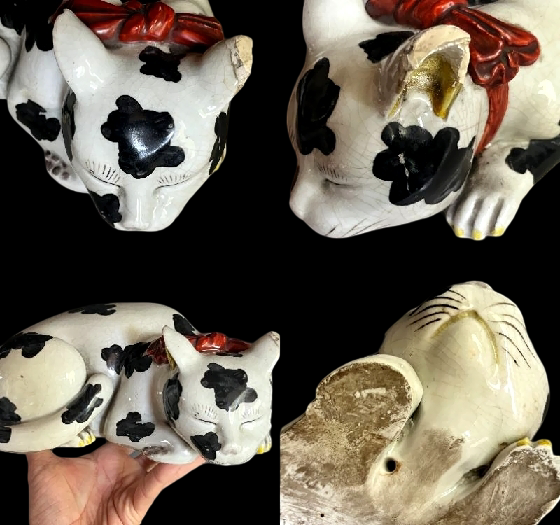
Antique Japanese Sleeping Cat Okimono — Black & White “Cow Cat” Ceramic Figure — Hand-Painted Lucky Cat Ornament, Edo-Meiji Taste
Antique Japanese Sleeping Cat Okimono — Black & White “Cow Cat” Ceramic Figure — Hand-Painted Lucky Cat Ornament, Edo-Meiji Taste
Couldn't load pickup availability
Have a reasonable price in mind? Submit your best offer and our concierge will review it personally.
A quietly charming sleeping-cat okimono in black-and-white “cow cat” patterning, finished with hand-painted details and an unmistakably time-softened surface. Compact but sculptural, it reads as an interior accent piece with genuine age—an object that feels collected, not manufactured.
Object Overview
This sleeping-cat okimono presents a calm, time-softened presence—black-and-white “cow cat” patterning with hand-painted accents, modeled in a fully relaxed posture that reads as interior atmosphere rather than loud décor. It is compact, sculptural, and distinctly collected in tone.
There are objects that shout, and objects that breathe. This sleeping cat belongs to the second category—an okimono made for the hush of a shelf, the corner of a tokonoma, or the kind of curated cabinet where the eye rests between louder works. The posture is the entire point: the cat is fully surrendered to sleep, paws tucked, face softened, tail curled into the body’s rhythm. In Japanese interiors, this kind of figure functions less as “decor” and more as atmosphere—an image of calm that quietly reorganizes the room.
The surface is what gives it authority. The black-and-white patterning recalls a “cow cat” coat (a playful modern nickname), yet the finish itself is convincingly old: gentle dulling across the glaze, small scuffs in high points, and the kind of micro-wear that accumulates through decades of handling and display. The charm isn’t perfection—it’s the evidence of a life lived around the object. It has the intimacy of something once purchased as a personal talisman rather than as a generic collectible.
This piece is also honest about its age. The original description notes visible wear consistent with long-term storage and time. There is damage and repair present around an ear area. That does not diminish the form; rather, it confirms the object’s continuity—kept, handled, and cared for enough to be mended. For collectors, these are the exact signals that separate “vintage-style” from truly time-marked work.
Stylistically, the seller suggests it may evoke Kyoto ceramics, Kutani, Imari, or even Satsuma sensibilities—yet stops short of a definitive attribution. That restraint is appropriate. Without a clear maker mark, kiln documentation, or provenance, the correct posture is: appreciate it for what it is, and let the object speak through its quality. In that way, it becomes an ideal “entry anchor” for a collector who wants the feeling of period Japanese ornament without forcing an uncertain label.
As an interior object, it does something surprisingly modern: it softens hard architecture. On a console table, it reads as a quiet punctuation mark. In a library, it becomes a subtle companion. In a shop or studio, it signals taste without trying. And because the motif is a sleeping cat—an archetype of comfort—it lands across cultures instantly.
If you collect Japanese okimono, cats, or small ceramic figures with genuine character, this is the kind of piece you don’t overthink. You simply place it somewhere it can be seen, and let it do its work: calm the room and reward attention.
Cultural & Symbolic Significance
Cats in Japanese decorative culture often symbolize comfort, domestic protection, and good fortune. A sleeping cat motif emphasizes peace and ease—an object chosen to soften a space, quiet a shelf, and hold attention through stillness.
Material, Finish & Craft Considerations
Ceramic construction with glazed surface and layered hand-painting. The finish shows honest age: small scuffs at high points and a gentle dulling consistent with long-term display. These surface signals help the piece read as period or genuinely time-worn rather than newly produced.
Condition
Age wear and scuffs are present. The listing indicates damage and repair around an ear area. Please review all photos carefully for the most accurate view of restoration and surface condition.
Dimensions
- Width: approx. 16.0 cm
- Depth: approx. 7.0 cm
- Height: approx. 11.0 cm
Collector / Interior Relevance
For collectors, the appeal is straightforward: a characterful Japanese okimono with real patina and a universally legible motif. It suits buyers who prefer objects that feel lived-with—small sculptures with the quiet authority of age. As décor, it functions as an anchor accent for shelves, alcoves, and curated vignettes, pairing naturally with wood, lacquer, textiles, and ceramics.
Confidence & Verification Notes
Attribution and period are not definitively documented in the listing. Any stylistic references are interpretive only. Condition statements are based on listing notes and visible photos; please confirm details directly from images before purchase.
Explore Our Services
If you would like white-glove packing, multi-item consolidation, or destination-specific shipping strategy, explore our Concierge Logistics options.