Rare Vintage, Antiques and Art Collector / Curator / Personal Shopper From Japan
Antique Japanese Samurai Horse Scroll, Signed Tosa-Style Musha-e Painting, Edo Meiji Warrior Kakejiku
Antique Japanese Samurai Horse Scroll, Signed Tosa-Style Musha-e Painting, Edo Meiji Warrior Kakejiku
Couldn't load pickup availability
A commanding hand-painted portrait of an armored Japanese warrior riding a black horse, rendered in the refined historical style of traditional musha-e and yamato-e painting.
Description
A black horse steps forward with controlled energy.
Its rider sits upright in layered armor, one hand gathering the reins while the other rests near his weapon. Vermilion cloth flashes against deep black, olive green, muted gold, and warm earth tones. Nothing in the composition is hurried, yet the entire scene feels poised at the threshold of action.
This striking Japanese hanging scroll presents a mounted warrior in an intentionally archaic and heroic manner. Rather than depicting the chaos of battle, the artist concentrates on presence: the warrior’s alert expression, the carefully arranged armor, the powerful curve of the horse, and the disciplined relationship between rider and mount.
The result is both martial and ceremonial.
The warrior is portrayed as an embodiment of courage, loyalty, composure, and inherited authority. His horse is richly equipped with red textile coverings and ornamental tack, creating a bold silhouette against the softly aged golden ground.
A vertical inscription at the lower right appears to associate the painting with the Tosa artistic tradition and bears the name Fujiwara Mitsuaki, or possibly an alternate reading of the characters 光秋. The precise artist and period remain unverified, but the work clearly participates in the visual language of Japanese historical warrior painting.
Mounted as a traditional kakejiku, the composition has a tall, elegant presence suited to a tokonoma alcove, study, martial arts space, private gallery, library, or interior shaped by Japanese antiques and wabi-sabi character.
This is not merely an image of physical strength.
It is a portrait of strength under control.
Artwork Identification
Object Type: Japanese hanging scroll
Japanese Term: 掛軸, kakejiku or kakemono
Subject: Armored warrior mounted on a black horse
Genre: 武者絵, musha-e or warrior painting
Stylistic Association: Tosa-style historical figure painting and yamato-e tradition
Origin: Japan
Probable Period: Late Edo to Meiji period style
Working Date: Approximately nineteenth to early twentieth century
Artist: Unconfirmed
Inscription: 土佐中納言 藤原光秋画, approximate reading
Medium: Pigments on silk or finely woven textile, not laboratory tested
Mounting: Traditional textile-mounted hanging scroll
Primary Colors: Black, vermilion red, olive green, muted gold, brown, ivory, and gray
The Mounted Warrior
The central figure is shown in a three-quarter position, seated securely upon a compact black horse.
His body turns slightly while his gaze moves outward, creating the impression that he has noticed something beyond the visible scene. His expression is serious but not theatrical. The artist gives him rounded facial features, sharply observed eyes, tied-back hair, and the composed bearing expected of a military retainer or legendary hero.
The armor combines broad shoulder guards, layered lamellar sections, protective sleeves, a chest plate, cords, and textile components. Green and black dominate the armor, while vivid red garments emerge around the neck, waist, and lower body.
A sword is secured at the warrior’s side. Additional military equipment appears around the body and saddle, though the exact configuration is partly obscured by the overlapping armor, reins, and horse furniture.
The rider is not depicted attacking, fleeing, or charging.
He appears ready.
That distinction gives the painting its quiet authority.
The Black Horse
The horse is almost entirely black, creating a dramatic visual foundation beneath the brighter armor.
Its head is turned slightly toward the viewer. White eyes, a red brow covering, decorative tassels, and carefully painted tack give the animal a highly expressive presence.
The front legs are lifted in a measured stepping motion, while the rear legs remain grounded enough to preserve the rider’s stability. This controlled movement prevents the image from becoming static without transforming it into a chaotic battle scene.
The red saddle cloth and body covering create a powerful contrast with the black coat. Fine linear details describe the mane, tail, hooves, bridle, reins, tassels, and ornamental fittings.
The horse is not treated as background equipment.
It is the warrior’s partner within the composition.
Together, rider and mount create a single sculptural silhouette.
Musha-e: The Japanese Warrior Image
Japanese warrior painting, commonly described as musha-e, celebrates heroes from military chronicles, legends, clan histories, temple narratives, and theatrical traditions.
Such works could portray famous commanders, loyal retainers, archers, mounted warriors, tragic heroes, guardians, or figures drawn from the great conflicts of Japan’s past.
In many examples, the warrior was valued not only for military power but also for qualities such as:
- Loyalty
- Courage
- Discipline
- Readiness
- Filial duty
- Strategic intelligence
- Self-command
- Protection of family or clan
- Acceptance of responsibility
- Dignity under pressure
This scroll belongs to that broader heroic visual tradition.
Unlike densely populated battle screens, the present painting isolates one rider and horse against an open ground. The empty space magnifies the figure and allows every piece of armor, cloth, tack, and gesture to carry greater visual weight.
Tosa-Style Character
The work has qualities associated with traditional Japanese yamato-e and Tosa-style figure painting:
- Clear, controlled outlines
- Carefully separated areas of color
- Decorative treatment of armor and textiles
- Historical subject matter
- Restrained spatial depth
- Emphasis on costume and status
- A warm, largely unpainted or lightly colored ground
- Narrative clarity without excessive scenery
- Fine ornamental detail
- Formal rather than naturalistic composition
The figure’s rounded facial treatment and the precise organization of costume differ from the explosive brushwork associated with some Kano, Nanga, or later popular prints.
Instead, the image has a deliberately courtly and historical tone.
The warrior is not merely caught in an event. He is presented for remembrance.
Inscription and Attribution
A vertical inscription appears near the lower-right edge of the painted field.
It appears to read:
土佐中納言 藤原光秋画
A provisional interpretation is:
“Painted by Fujiwara Mitsuaki, styled Tosa Chūnagon.”
The reading of 光秋 as Mitsuaki is plausible. Kōshū may also be possible if the characters were used as an art name.
The wording visually resembles an attribution or signature formula associated with traditional Japanese painter lineages, where an artistic affiliation, official title, Fujiwara clan designation, and personal name could be combined.
However:
- The precise reading has not been professionally authenticated.
- The named painter has not been securely matched to a documented historical biography.
- No accompanying certificate, box inscription, lineage paper, or provenance document has been provided.
- The inscription may represent an original signature, an attribution, a traditional workshop designation, or a later reference to an earlier model.
- The work should not be considered a verified painting by a formally catalogued Tosa master without specialist examination.
The inscription remains an important and visually compelling feature, but it is presented responsibly rather than as a guaranteed attribution.
Possible Historical Subject
The warrior’s identity is not written in a clearly readable title elsewhere on the scroll.
His archaizing armor and mounted presentation suggest that the artist may have intended a hero from Japan’s classical military past, potentially connected with:
- The late Heian period
- The Genpei War
- The Kamakura period
- Medieval warrior chronicles
- Clan foundation legends
- Temple histories
- Tales of mounted archery
- Celebrated loyal retainers
- Legendary military ancestors
Possible viewers may be reminded of famous figures such as Minamoto warriors, Taira commanders, mounted archers, or regional clan heroes. However, no specific identity should be assigned without a recognizable crest, title inscription, documentary record, or matching historical composition.
The mystery strengthens the work’s atmosphere.
He stands not only as one named man, but as the distilled image of the mounted Japanese warrior.
Color and Composition
The composition is built around a small but forceful palette.
Black anchors the horse, hair, armor lacing, boots, and shadowed equipment.
Vermilion red animates the neck covering, saddle cloth, garments, tassels, and horse furniture.
Olive green gives the armor an aged, military solidity.
Muted gold and ochre unite the background, armor plates, weapon fittings, and textile tones.
Ivory and pale gray articulate the horse’s eyes and hooves, the warrior’s garments, and smaller ornamental details.
The warm golden ground contains little scenery. A few faint grasses or marks emerge behind the rider, but the artist leaves most of the field open.
This negative space performs an important function.
It turns the rider into an emblem.
The eye moves first to the warrior’s face, then downward across the armor, reins, sword, and red cloth, finally following the black legs of the horse toward the lower edge.
The lifted foreleg adds movement without disturbing the painting’s formal dignity.
Materials and Technique
The central painting appears to have been executed with opaque and translucent pigments on a finely woven textile support, likely silk.
Visible characteristics include:
- Fine woven surface
- Delicate line drawing
- Flat areas of mineral-style color
- Controlled black outlining
- Layered washes
- Fine decorative patterning
- Gold-colored textile borders
- Traditional scroll mounting
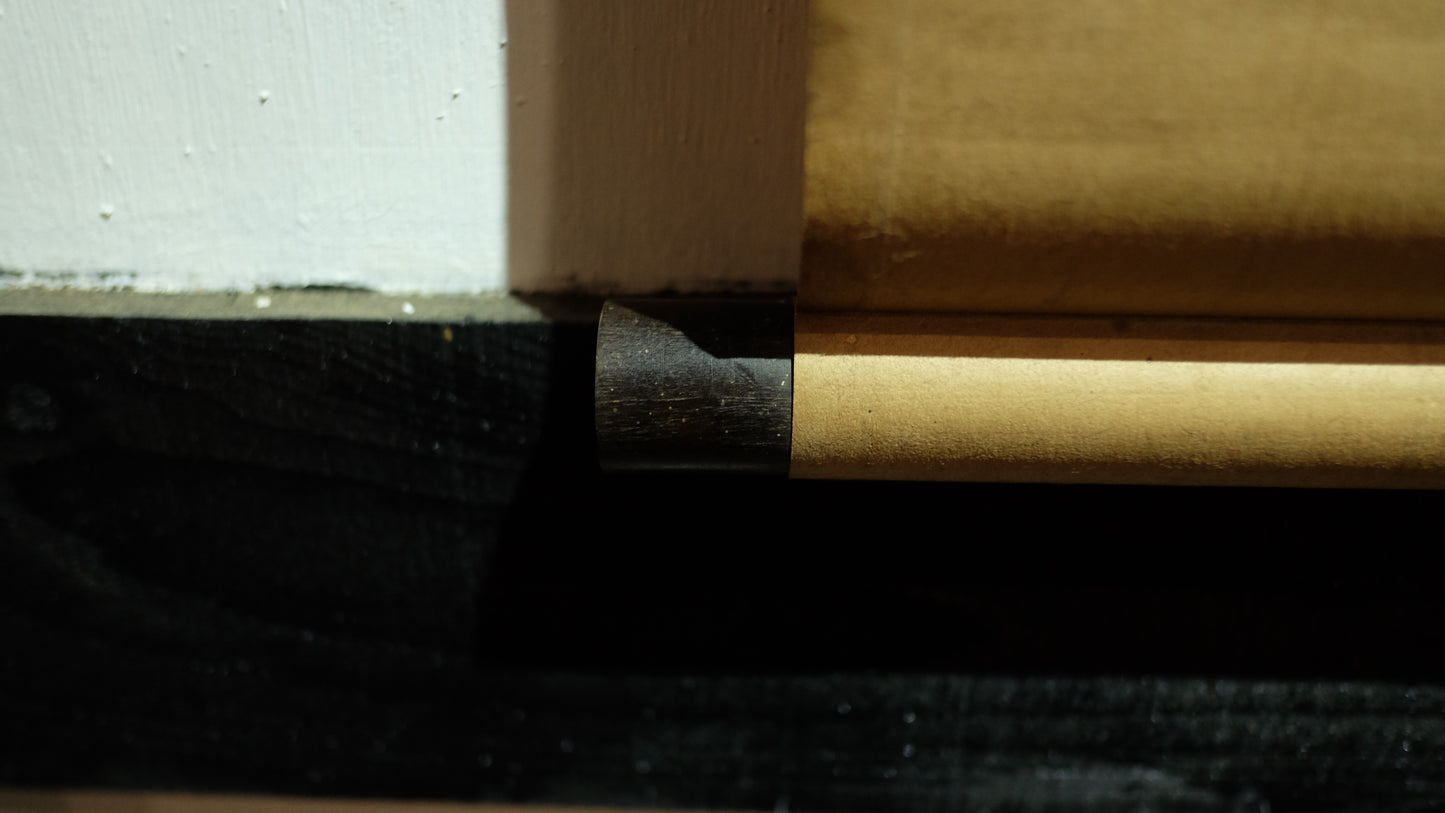
- Wooden lower roller with dark end fittings
- Suspension cord at the upper edge
The exact pigment composition, textile fiber, age, and presence of metallic materials have not been scientifically tested.
The painting appears hand-executed rather than mechanically printed, based upon the visible brush variation, line quality, color application, and irregularities shown in the photographs.
Mounting
The painting is mounted in a restrained traditional format that complements the subject without competing with it.
The visible mounting includes:
- A narrow gold-patterned textile strip above the painted field
- A corresponding gold-patterned strip below
- Warm gray-brown textile surrounding the image
- A broader brown upper and side field
- A pale lower section
- A traditional cylindrical roller
- Dark roller-end fittings
- An upper suspension cord
- Hand-finished stitching visible along portions of the outer edge
The mounting has aged into a quiet palette of tobacco brown, warm beige, gray, and faded gold.
This patina gives the scroll an unmistakably historical presence.
Rather than appearing pristine or newly manufactured, it carries the softly weathered atmosphere expected of an old object that has been rolled, stored, handled, and displayed over time.
Estimated Period
The original description proposed a date between approximately 1850 and 1880.
From photographs alone, a precise decade cannot be guaranteed.
A responsible commercial attribution is:
Late Edo to Meiji period style, probably nineteenth to early twentieth century.
Elements supporting an older attribution include:
- Traditional textile mounting
- Aged silk-like support
- Historical musha-e subject
- Muted naturalistic pigments
- Considerable overall toning
- Older stitching and construction
- Wear consistent with rolling and storage
- Archaizing signature formula
- Period-style armor representation
- Absence of modern printed texture
A physical inspection of the backing paper, textile fibers, adhesives, roller, pigment, seals, and mounting construction could potentially narrow the date.
Why This Scroll Matters
A Strong Samurai Subject
Mounted warrior paintings have immediate visual authority and appeal to collectors of samurai history, Japanese armor, martial culture, and military art.
A Complete Rider-and-Horse Composition
The rider and horse are presented together as one balanced unit, rather than as a fragmented battle detail.
Bold but Refined Color
Black, vermilion, olive green, and muted gold create a palette that is dramatic without becoming garish.
Signed or Inscribed
The visible inscription adds historical interest and creates an important avenue for future research.
Tosa-Style Association
The work carries the refined line, decorative color, and historical focus associated with traditional yamato-e figure painting.
Genuine Wabi-Sabi Presence
Toning, softened textiles, creases, and patina give the piece an authentic aged atmosphere impossible to reproduce convincingly through mass production.
Dramatic Vertical Format
The tall kakejiku proportions make the work ideal for narrow walls, alcoves, stair landings, libraries, and martial arts interiors.
Collector Research Potential
The inscription, armor, weaponry, and possible literary subject offer opportunities for further identification by specialists in Japanese painting and military history.
Why You Will Love It
- Hand-painted Japanese warrior art
- Mounted samurai on a black horse
- Striking red and black color contrast
- Signed or inscribed lower-right field
- Traditional kakejiku format
- Historical musha-e subject
- Tosa-style figure painting
- Detailed armor and horse equipment
- Strong masculine visual presence
- Quiet, disciplined energy
- Aged textile and natural patina
- Suitable for Japanese and Western interiors
- One distinctive vintage work available
- Excellent focal piece for a dojo, study, or library
- Rich visual storytelling without crowded scenery
Symbolism
The mounted warrior carries layers of meaning beyond battle.
The horse represents movement, rank, readiness, and the power to cross difficult ground.
Armor represents preparedness and responsibility, not merely aggression.
The sword signifies authority, discipline, protection, and the burden of decision.
Red evokes courage, vitality, ceremonial power, and the force of life.
Black contributes gravity, strength, mystery, and visual control.
The rider’s posture expresses balance between action and restraint.
The image can therefore be appreciated as a symbol of:
- Courage before uncertainty
- Loyalty to one’s principles
- Mastery over fear
- Strength guided by discipline
- Readiness without recklessness
- Protection of home and family
- Endurance through adversity
- Focus under pressure
- Respect for history and ancestry
Ideal Display Spaces
This scroll would be especially powerful in:
- A martial arts dojo
- A kendō or iaidō practice space
- A Japanese-style study
- A tokonoma alcove
- A private library
- A collector’s room
- A traditional reception space
- A wabi-sabi interior
- A Japandi home
- A dark wood office
- A gallery wall of Asian antiques
- A samurai-themed room
- A tea room with historical decor
- A hotel or ryokan interior
- A Japanese restaurant
- A cultural center
- A military-history collection
- A contemplative reading room
The palette would pair beautifully with black lacquer, aged timber, tatami, natural plaster, stone, leather, bronze, iron, antique textiles, or subdued neutral walls.
Ideal For
- Collectors of Japanese art
- Samurai enthusiasts
- Japanese armor collectors
- Martial artists
- Kendō practitioners
- Iaidō practitioners
- Horse-art collectors
- Military-history enthusiasts
- Interior designers
- Collectors of kakejiku
- Students of yamato-e
- Admirers of Tosa-style painting
- Wabi-sabi interiors
- Japandi interiors
- Historical art collections
- Meaningful milestone gifts
- Retirement gifts for martial artists
- Gifts for dojo instructors
- Collectors of equestrian art
- Buyers seeking powerful masculine decor
Item Details
Object: Japanese hanging scroll
Format: Kakejiku or kakemono
Subject: Armored mounted warrior
Horse: Black horse with red ceremonial or military furnishings
Genre: Musha-e, Japanese warrior painting
Style: Tosa-style or yamato-e influenced historical figure painting
Inscription: Appears to read 土佐中納言 藤原光秋画
Provisional Name Reading: Fujiwara Mitsuaki, possibly Kōshū
Artist Attribution: Unverified
Origin: Japan
Estimated Period: Late Edo to Meiji period style
Possible Date Range: Nineteenth to early twentieth century
Medium: Pigments on silk or fine textile, visually assessed
Mounting: Traditional textile-mounted scroll
Roller: Wooden roller with dark end fittings
Seal: A faint red mark may be present beneath the inscription, but it is not sufficiently legible for identification
Primary Motifs: Samurai, armor, sword, horse, reins, military tack, red saddle cloth, historical costume
Quantity: One scroll
Condition
This is an antique or vintage textile-mounted artwork with substantial visible signs of age, storage, rolling, handling, and display.
The photographs show:
- Overall toning and age-darkening
- Uneven coloration across the mounting
- Horizontal creases and rolling lines
- Surface waviness and undulation
- Scattered spots and foxing
- Areas of discoloration
- Small marks and abrasions
- Darkening around portions of the painted field
- Wear along the outer textile edges
- Visible stitching along the mounting perimeter
- Creasing across the lower section
- A large irregular discolored area in the upper mounting
- Minor stains and old moisture-like tidelines
- Small scattered dark marks
- Gentle rubbing or pigment loss in isolated areas
- Natural variation within the golden background
- Possible old repairs or reinforced areas
- Softening and wear to the suspension cord
- Age-related wear to the lower roller and fittings
The main painted subject remains remarkably strong and legible.
The warrior’s face, armor, sword, garments, reins, horse, red textile furnishings, inscription, and principal colors remain clearly visible.
The black, red, green, gold, and ivory pigments retain considerable visual impact despite the overall age and toning.
The work has not been professionally conserved, scientifically dated, pigment-tested, fiber-tested, or formally authenticated to our knowledge.
Please inspect every photograph carefully. The photographs form an essential part of the description and condition report.
Additional detail photographs may be requested before purchase.
Care and Display
Traditional Japanese scrolls are sensitive to light, moisture, heat, pressure, and prolonged display.
For responsible long-term care:
- Avoid direct sunlight
- Avoid strong ultraviolet light
- Keep away from damp walls
- Avoid kitchens, fireplaces, and smoke
- Maintain a stable indoor environment
- Handle only with clean, dry hands
- Support the scroll while unrolling
- Never pull the scroll open by one edge
- Do not flatten aggressively
- Do not iron or steam the painting
- Do not apply water or household cleaners
- Avoid touching the painted surface
- Display for limited periods where possible
- Allow the scroll to rest rolled between display periods
- Store around an appropriate inner support
- Wrap in acid-free material if professionally advised
- Consult a Japanese-scroll conservator before treatment
The age-related wrinkles and undulation are part of the scroll’s current state. Any flattening, cleaning, remounting, or repair should be undertaken only by a qualified specialist.
Final Words to the Collector
The horse moves, but the rider remains composed.
That tension is the heart of this painting.
The warrior has not yet entered battle. No enemy appears before him. No arrows cross the sky. No dust clouds obscure the road.
Instead, we encounter the moment before action, when courage is still inward and every decision remains possible.
His armor carries the weight of history. His sword rests ready at his side. The black horse steps forward beneath a vivid field of red, alive with motion but held in perfect control by the reins.
This is the samurai ideal distilled into one image:
Strength without noise.
Readiness without panic.
Authority without display.
Across generations, Japanese warrior imagery has spoken to those who value loyalty, focus, endurance, protection, and the discipline required to remain steady when circumstances begin to move.
The aged silk and weathered mounting deepen that message.
Time has softened the textiles, darkened the ground, and left creases upon the surface, yet the warrior still rides.
For the collector, this scroll offers historical atmosphere, visual power, and an intriguing inscription worthy of continued study.
For the martial artist, it can become a reminder that technique begins with composure.
For the interior, it creates an unmistakable point of gravity.
For the person beginning a demanding chapter, it offers a silent command:
Sit firmly. Hold the reins. Move forward.
Offers
Some objects in our collection allow limited room for negotiation, while others are offered at a firm price.
Respectful and reasonable offers are welcome. Should you have a particular figure in mind, please send us a message. Every proposal will be considered carefully, although acceptance cannot be guaranteed.
We are also happy to assist with questions regarding measurements, condition, display, packing, combined purchases, or international shipping.
Product Representation and Questions
We make every reasonable effort to photograph and describe our items accurately.
Colors, silk textures, pigments, patina, stains, and tonal variations may appear slightly different depending upon photography, lighting, screen calibration, and viewing conditions.
Vintage textiles and pigments frequently contain subtle irregularities that cannot be fully conveyed through photographs.
Please contact us before purchasing should you have questions regarding condition, measurements, materials, inscription, attribution, mounting, age, provenance, packing, or shipping.
We would much rather clarify any uncertainty before payment than leave a concern unresolved afterward.
Condition and Sales Policy
This item is antique or vintage and is sold in its present condition, as photographed and described.
Please do not expect factory-new condition. Toning, creasing, foxing, staining, fading, textile distortion, historic repair, edge wear, rubbing, patina, and other characteristics of age may be present.
All sales are considered final except where otherwise required by applicable law or Etsy policy.
By purchasing, the buyer confirms that they have reviewed the photographs, description, condition report, dimensions, estimated attribution, shipping terms, and shop policies.
Shipping
We ship worldwide from Japan using Japan Post EMS wherever service is available.
Shipping and handling charges are calculated through the listing’s shipping settings. Should your destination not appear among the available options, please contact us for assistance or a manual quotation.
The scroll will be carefully rolled around appropriate support, protected against movement and moisture, and packed for international transportation.
Import duties, customs taxes, brokerage fees, and destination-country charges are the responsibility of the buyer unless otherwise required by law.
Tracking
Tracking information will be provided after dispatch.
Please allow approximately three to five business days after shipment for tracking activity to become visible, depending upon postal processing and the destination country.
International delivery times may vary because of customs inspections, local postal conditions, public holidays, weather, transport disruptions, or circumstances beyond our control.
Store Policies
Please review our complete shop policies before completing your purchase.
Payment confirms that the buyer understands and accepts the photographed condition, listing description, estimated attribution, shipping terms, and the natural limitations involved in purchasing antique and vintage objects online.
#JapaneseSamurai #SamuraiScroll #SamuraiHorseArt #JapaneseWarriorArt #MushaE #JapaneseKakejiku #AntiqueJapaneseArt #TosaStyle #YamatoE #MountedSamurai #HorsebackWarrior #EdoPeriodArt #MeijiPeriodArt #JapaneseArmor #SamuraiPainting #JapaneseHangingScroll #MartialArtsDecor #KendoDecor #IaidoDecor #DojoWallArt #WabiSabiDecor #JapandiArt #AsianAntiqueArt #EquestrianArt #HistoricalPainting #WarriorWallArt #JapaneseHistory #SilkScrollPainting #BushidoArt #SamuraiCollector