Rare Vintage, Antiques and Art Collector / Curator / Personal Shopper From Japan
Antique Japanese Amida Raigō Scroll | Amitabha with Kannon & Seishi | Gold Buddhist Kakejiku | Pure Land Temple Art
Antique Japanese Amida Raigō Scroll | Amitabha with Kannon & Seishi | Gold Buddhist Kakejiku | Pure Land Temple Art
Couldn't load pickup availability
Amida Buddha’s Welcoming Descent into the Pure Land
A sacred vision emerges from a midnight field.
This antique Japanese Buddhist hanging scroll depicts Amida Nyorai, the Buddha of Infinite Light, descending through celestial clouds with two attendant bodhisattvas traditionally identified as Kannon and Seishi.
The composition belongs to the revered tradition of raigō-zu, or “welcoming descent paintings.” These images visualize the compassionate arrival of Amida Buddha from the Western Pure Land to receive the faithful and guide them toward rebirth in paradise.
Against the scroll’s deep indigo-black ground, Amida appears in aged gold tones beneath an immense circular halo. Two crowned bodhisattvas move through curling clouds below, their halos, jewelry, flowing robes, and ritual presence illuminated by restrained metallic pigments. Scattered blue and pale petal-like accents shimmer across the darkness, giving the image the atmosphere of a celestial night suspended outside ordinary time.
This is not merely a representation of a Buddhist deity. It is an image of arrival, reassurance, and spiritual passage.
Artwork Details
Origin: Japan
Subject: Amida Nyorai with two attendant bodhisattvas
Traditional Identification: Amida Buddha with Kannon and Seishi
Iconographic Type: Raigō-zu, Welcoming Descent of Amida
Tradition: Japanese Pure Land Buddhism
Format: Traditional Japanese hanging scroll, kakejiku or kakemono
Medium: Hand-painted pigments with gold and metallic details on a fine silk ground
Estimated Period: Likely late Meiji to early Shōwa period, approximately late 19th to early 20th century
Mounting: Pale beige textile mounting with subdued green-gray brocade borders
Primary Colors: Midnight black, deep indigo, aged gold, cream, muted rose, brown, and cobalt blue
Artist: Unidentified
Signature or Seal: No clear signature or seal is visible in the supplied photographs
The restrained outer mounting allows the extraordinary darkness of the central painting to command the eye. Its pale textiles form a quiet architectural frame around a devotional image filled with shadow, light, and spiritual gravity.
The Sacred Raigō Tradition
Museum collections identify raigō-zu as paintings of Amida descending from the heavens with bodhisattvas to welcome a believer into the Western Pure Land. In the classic triadic composition, Kannon and Seishi accompany Amida, with Kannon often presenting a lotus seat and Seishi appearing in an attitude of prayer or reverence.
Such paintings were not created as ordinary decoration. They were devotional furnishings used in Buddhist practice, memorial observance, and contemplation of life’s final transition. Historical examples were sometimes displayed beside the dying, transforming the room into a symbolic threshold between the present world and Amida’s paradise.
In this scroll, that ancient promise is expressed with unusual restraint. There is no crowded procession, elaborate architecture, or dazzling celestial court. Instead, Amida and the bodhisattvas emerge from darkness with solemn quietness, giving the painting an intimate and deeply meditative character.
Amida Nyorai, Buddha of Infinite Light
Amida stands at the center of the composition, elevated above the attendant figures and enclosed by a monumental circular halo.
His right hand is raised in a sacred gesture, while the other descends naturally at his side. His body is rendered primarily in aged gold and warm brown tones, with fine linear details defining his robes, face, and posture.
The towering figure is calm and motionless, yet the surrounding clouds and trailing celestial forms create the sensation of descent. This balance between stillness and movement is central to the power of the painting.
Amida is not shown enthroned inside a distant paradise. He has entered the viewer’s world.
The immense halo creates a luminous boundary around his head and shoulders. Even after centuries of surface aging and pigment change, it remains the visual anchor of the scroll, a pale ring suspended against an almost limitless night.
Kannon and Seishi Bodhisattvas
Below Amida appear two richly adorned bodhisattvas moving among clouds.
Their elaborate crowns, circular halos, jewelry, long scarves, and flowing garments distinguish them from the simpler monastic appearance of the central Buddha. They are traditionally understood as Kannon Bosatsu, the embodiment of compassion, and Seishi Bosatsu, the embodiment of wisdom and spiritual strength.
One attendant appears to carry or present a lotus form, recalling Kannon’s role in offering a lotus seat upon which the departing soul may be received. The companion figure participates in the descent with a quieter, prayerful presence.
Together, the three form the Amida Triad, a powerful union of infinite light, compassion, and wisdom.
The bodhisattvas do not appear rigid or earthbound. Their garments and celestial scarves arc around them, while the clouds below seem to carry them gently through the darkened sky.
A Night Sky Filled with Celestial Signs
One of the scroll’s most distinctive qualities is its extraordinarily dark background.
The nearly black field is animated by scattered touches of deep blue, pale white, and muted metallic color. These marks may be read as celestial petals, fragments of light, or symbolic particles moving through the heavenly atmosphere.
They punctuate the darkness without disturbing it.
The effect is almost cosmic. Amida’s halo resembles a moon or ring of light, while the attendants appear to materialize from clouds beneath him. The painting seems to preserve the exact instant when an unseen spiritual world becomes visible.
The dark ground also intensifies every surviving trace of metallic pigment. Under changing light, the halos, outlines, clouds, and garments appear and disappear, making the scroll feel different throughout the day.
Clouds as the Threshold Between Worlds
The lower half of the composition is filled with rolling celestial clouds painted in cream, muted pink, brown, gold, and blue.
These are not ordinary weather clouds. Within Buddhist painting, clouds often mark the movement between earthly and divine realms. Here they form a bridge beneath the figures, supporting the descent without giving them physical weight.
The clouds curl into rhythmic spirals, creating a soft counterpoint to the still vertical presence of Amida.
Their layered forms also lend the composition depth. Some clouds appear luminous and close, while others recede into the dark ground. Fine gold and blue accents thread through them, suggesting sacred energy moving within the atmosphere.
Spiritual Meaning
The raigō image addresses one of humanity’s oldest fears with an image of welcome.
Amida does not wait in a remote heaven. He descends personally, accompanied by compassionate attendants, to receive the faithful at the end of life. The image therefore represents more than death. It speaks of protection, transition, hope, and the belief that no sincere soul must cross the final threshold alone.
For a Buddhist practitioner, the scroll may serve as a focus for contemplation, remembrance, chanting, or devotional practice.
For a collector, it offers a powerful example of Japanese religious iconography.
For someone creating a memorial space, it may provide a gentle visual language for grief, continuity, and spiritual reassurance.
For an interior, it introduces silence, history, and an extraordinary depth of atmosphere.
Period and Dating
The painting and mounting present as an antique or early vintage Japanese devotional scroll, most plausibly associated with the late Meiji through early Shōwa period, approximately the late 19th to early 20th century.
The aged silk ground, subdued metallic pigments, dark devotional palette, textile selection, horizontal fold history, and traditional mounting construction all contribute to this dating.
The work may preserve an older iconographic model, as religious painters frequently continued established Buddhist compositions across generations. Its visual language draws upon much earlier raigō traditions while the physical object reflects a later period of Japanese temple and household devotion.
The precise artist, workshop, temple association, and date remain unidentified.
Artistic Qualities
The painting’s strength lies not in decorative brightness, but in controlled revelation.
From a distance, the figures appear as golden presences emerging from darkness. At closer range, delicate contour lines become visible across the faces, hands, robes, crowns, jewelry, halos, lotus forms, and drifting clouds.
Particularly compelling details include:
- The enormous ring halo surrounding Amida
- The restrained gold-on-black palette
- The fine linework within Amida’s robes and hand gesture
- The elaborate crowns of the attendant bodhisattvas
- The muted pink and cream modeling of the celestial clouds
- The deep cobalt-blue accents scattered across the night ground
- The long, curling scarves that suggest movement through the air
- The contrast between Amida’s upright stillness and the attendants’ flowing poses
- The softened metallic surface created by age
- The understated pale mounting that allows the painting to remain dominant
The extensive age marks have changed the original visual surface, but they have also given the scroll an almost archaeological presence. The sacred figures seem not simply painted upon the darkness, but recovered from it.
A Compelling Work for the Interior
This scroll possesses a rare ability to command a room without overwhelming it.
Its tall, narrow format makes it particularly suitable for:
- Meditation rooms
- Buddhist altars
- Memorial spaces
- Private chapels
- Japanese-inspired interiors
- Wabi-sabi and Japandi rooms
- Tea rooms
- Libraries and studies
- Collector galleries
- Quiet entry halls
- Spiritual counseling or healing spaces
- Rooms designed for contemplation and stillness
Against a dark wall, the gold and cream pigments would appear to float. Against plaster, wood, stone, or a neutral wall, the scroll becomes a solemn architectural centerpiece.
Soft directional lighting will reveal different elements across the surface, including halos, robe lines, metallic clouds, and scattered blue accents.
Direct sunlight and strong humidity should be avoided to help protect the historic pigments and textile mounting.
Why This Scroll Is Exceptional
A Deeply Revered Buddhist Subject
The welcoming descent of Amida is among the most emotionally powerful themes in Japanese Pure Land art. It is an image concerned not with judgment, but with compassionate arrival.
An Unusually Dark and Atmospheric Composition
The midnight ground gives this work a haunting visual identity. The figures appear gradually, rewarding sustained viewing and changing with the surrounding light.
A Complete Sacred Triad
Amida is accompanied by two crowned bodhisattvas, forming the classic triadic structure associated with Kannon and Seishi.
Visible Gold and Metallic Pigment
Despite extensive age-related wear, metallic details remain visible throughout the halos, bodies, jewelry, clouds, and garment lines.
Authentic Age and Wabi-Sabi Character
The creases, pigment losses, darkening, abrasions, and softened textiles are unmistakable records of the scroll’s long physical life.
A Meaningful Collector’s Piece
This work will appeal to collectors of Japanese Buddhist art, Pure Land iconography, antique kakejiku, sacred painting, devotional textiles, and objects carrying strong historical atmosphere.
Condition
This is an antique Japanese hanging scroll with substantial visible age and wear.
The central painting shows pronounced horizontal fold lines and creasing across the full image. There are areas of pigment loss, abrasion, fading, darkening, surface cracking, and localized disruption to painted details.
Wear is particularly visible across portions of Amida’s face, halo, torso, robes, and lower body, as well as across the attendant bodhisattvas and cloud formations. Several horizontal folds interrupt the figures, and some areas display losses that expose the underlying support.
Additional characteristics visible in the photographs include:
- Tonal variation across the dark ground
- Scattered pigment loss
- Fine cracking
- Surface scuffs and scratches
- Small marks and pale spots
- Wear to metallic details
- Localized discoloration
- Possible historic stabilization or repair
- Creasing and waviness to the mounting
- Age toning to the pale outer textile
- Edge wear and minor textile irregularities
- Natural changes associated with rolling, storage, handling, and display
The lower cloud forms and attendant figures retain significant decorative detail, while Amida’s silhouette, halo, hand gesture, robes, and central presence remain clearly readable.
This scroll is offered for its historical, spiritual, and atmospheric character. It is not a pristine object and will be most appreciated by a collector who values authentic age, devotional history, and the beauty of an unrestored antique surface.
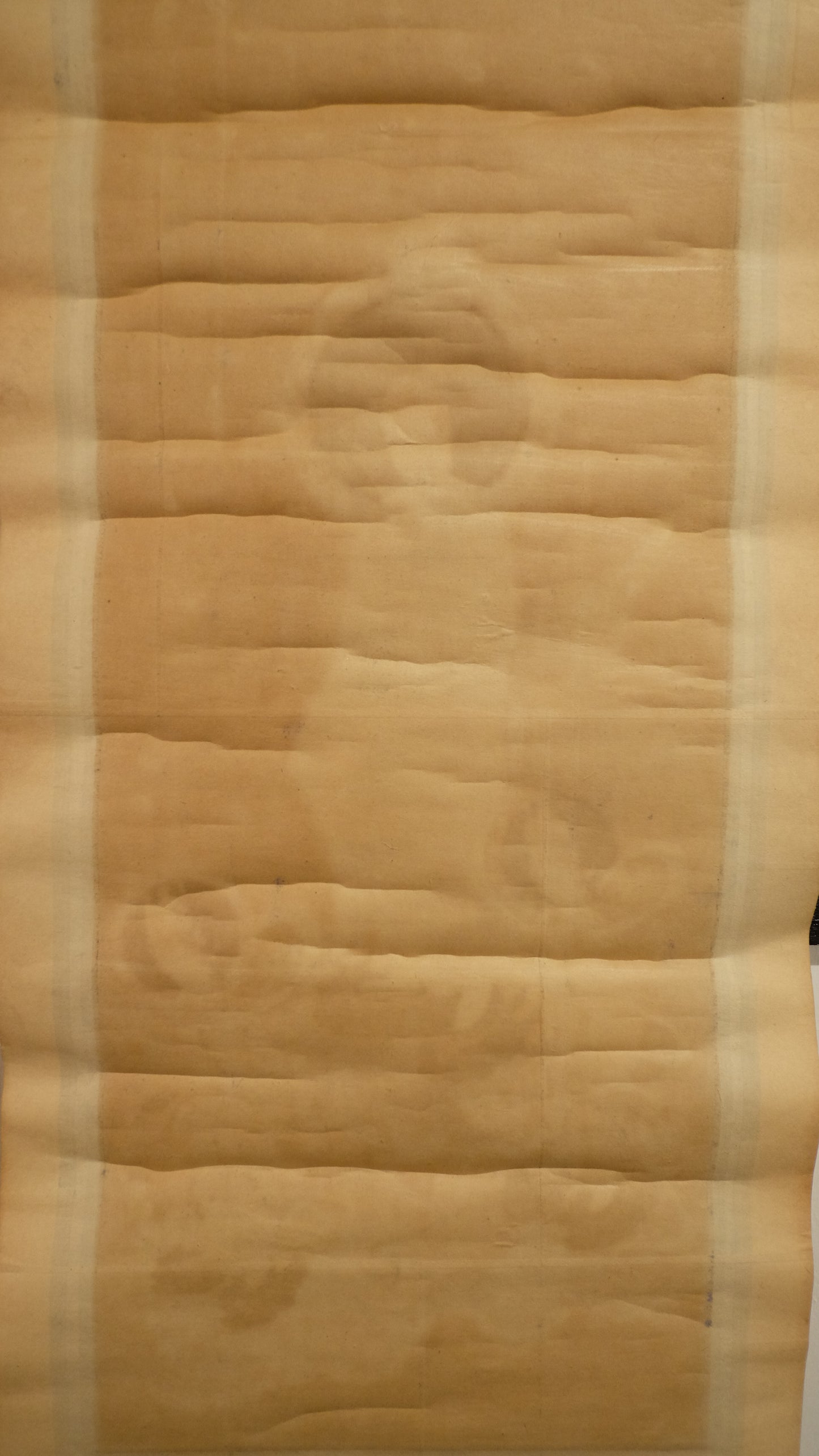
Please examine every photograph carefully, as the images form an essential part of the description and provide the most complete record of the scroll’s present condition.
Final Words to the Buyer
There are Buddhist paintings that describe paradise, and there are paintings that make its approach feel almost present.
This scroll belongs to the latter.
Amida stands within a ring of light while Kannon and Seishi rise through clouds below. The surrounding darkness does not feel empty. It feels expectant, filled with quiet signs that another realm is drawing near.
The age of the painting has softened its brilliance, but not its emotional force. Its worn gold, fractured surface, deep blue traces, and weathered silk give the image a gravity that a newly made object could not imitate.
Displayed in a meditation room, memorial space, altar, gallery, or contemplative interior, this scroll becomes more than wall decoration. It becomes an image of accompaniment.
🌙 Let the darkness hold light.
🪷 Let the lotus carry hope.
✨ Let Amida’s descent offer reassurance, remembrance, and peace.
Offers
Some pieces in our collection have room for negotiation, while others are offered at firm prices. Respectful offers are always welcome and will be considered seriously on a case-by-case basis.
Should you have a particular figure or budget in mind, please contact us directly. We will be happy to explore what may be possible and assist with any questions before purchase.
Product Representation and Questions
We make every effort to represent our items accurately through detailed photography and written descriptions.
Because antique and vintage objects may show subtle variations in color, texture, wear, construction, and previous restoration, please review all photographs carefully. Screen settings, camera exposure, and lighting conditions may also affect the appearance of colors and metallic pigments.
Questions are warmly welcomed before purchase. We would always prefer to clarify a detail in advance rather than leave a concern unresolved after payment.
Condition and Sales Policy
This item is offered as is and as photographed.
It is an antique, previously owned object and should not be expected to appear new. Age-related wear, pigment loss, fading, creases, marks, abrasions, textile waviness, repairs, discoloration, and other signs of historical handling may be present.
All sales are final. Returns, exchanges, refunds, and post-purchase claims are not accepted except where otherwise required by applicable law.
By completing the purchase, the buyer confirms that the photographs, description, dimensions, condition information, and shop policies have been reviewed and accepted.
Gallery Availability
This item may also be displayed or offered through our local gallery and may sell in real time outside Etsy.
Please contact us before purchasing if you would like confirmation of current availability. We will respond as promptly as possible and appreciate your understanding in the event of a simultaneous sale.
Shipping and Tracking
Worldwide shipping is available from Japan through a tracked international service, typically Japan Post EMS where available.
Shipping and handling charges are calculated according to the destination, parcel dimensions, weight, insurance requirements, and protective packing materials. Should your destination not appear in the listing calculator, please contact us for assistance.
Tracking details will be provided after dispatch. Postal tracking may require several business days to become active after the parcel enters the international network.
The scroll will be carefully rolled, wrapped, supported, and packed to help protect the historic painting and mounting during transit.
#AmidaBuddha #RaigoScroll #PureLandBuddhism #AmitabhaBuddha #JapaneseScroll #JapaneseHangingScroll #Kakejiku #KannonBodhisattva #SeishiBodhisattva #BuddhistArt #JapaneseBuddhistArt #GoldBuddhaPainting #AntiqueJapaneseArt #BuddhistScroll #TempleArt #SacredArt #DevotionalArt #MeditationArt #MemorialArt #SpiritualWallArt #BuddhistHomeAltar #AsianAntiqueArt #JapaneseReligiousArt #LotusClouds #CelestialBuddha #JodoBuddhism #AmidaTriad #VintageJapaneseArt #CollectorArt #WabiSabiDecor