Rare Vintage, Antiques and Art Collector / Curator / Personal Shopper From Japan
Antique Japanese Maki-e Lacquer Choshi Sake Ewer Pair | Pine Plum Gold Urushi Ceremonial Pourers with Wood Box
Antique Japanese Maki-e Lacquer Choshi Sake Ewer Pair | Pine Plum Gold Urushi Ceremonial Pourers with Wood Box
Couldn't load pickup availability
Have a reasonable price in mind? Submit your best offer and our concierge will review it personally.
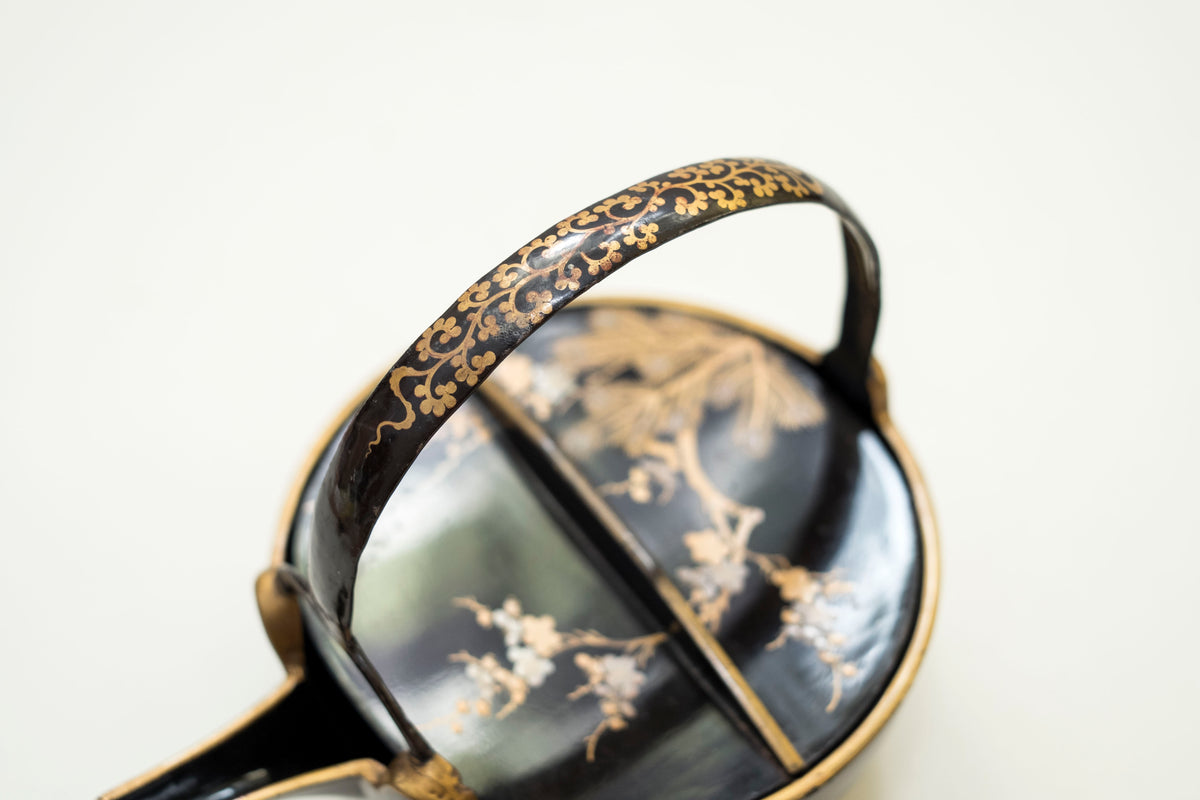
Matched Japanese lacquer choshi with arched handles, removable lids, gold maki-e pine and plum decoration, gilded rims and fitted divided wooden storage box
Introduction
Elegant at first glance and increasingly fascinating the longer one looks, this matched pair of Japanese lacquer choshi, traditional handled sake ewers, belongs to a world in which practical dining vessels were treated as works of decorative art.
Each piece has a low, rounded body finished in deep brown-black lacquer, an elongated pouring spout, a sweeping overhead handle and a fitted circular lid. Across those dark glossy surfaces, fine gold decoration introduces branches of pine and flowering plum, motifs long associated in Japan with endurance, renewal, longevity and auspicious celebration.
The contrast is beautiful.
Dark lacquer provides depth.
Gold catches the light.
Delicate botanical imagery floats across the curved forms.
Then the high arching handles rise above each vessel, giving the pair an almost architectural silhouette.
These are far more than ordinary serving pieces. Their form belongs to Japanese ceremonial sake culture, where choshi were traditionally used for formal pouring and presentation. Displayed today, they preserve that sense of occasion while functioning as refined examples of Japanese lacquer craftsmanship.
The presence of two coordinated vessels and their fitted divided wooden storage box gives the group an especially complete and compelling character.
Choshi: The Japanese Ceremonial Sake Ewer
The correct identification of these pieces is not simply “lacquer bowls.”
They are choshi, handled pouring vessels traditionally associated with sake service.
The form is immediately recognizable once its components are understood.
A broad, shallow vessel forms the body.
A narrow spout projects horizontally from one side.
A tall arched handle bridges the vessel from front to back.
A fitted lid protects the contents while leaving the ewer easy to carry and pour.
This shape allowed the choshi to function gracefully at a dining setting or ceremonial gathering without adopting the tall bottle form associated with more familiar sake containers.
Their low center of gravity makes the vessels stable.
The overhead handle creates visual height.
The narrow spout controls the pour.
The covered form preserves both warmth and presentation.
It is an object in which utility and ceremony meet beautifully.
A Matched Pair
Finding one old lacquer choshi is interesting.
Finding two preserved together is considerably more satisfying.
The matching scale, dark lacquer ground, gold botanical decoration, lid construction and handle treatment allow these vessels to read as a deliberate set rather than two unrelated pieces assembled later.
Placed side by side, they form a balanced composition.
The handles create twin arches.
The spouts project outward.
The circular lids repeat one another.
The gold decoration moves across both surfaces without making the vessels identical in every detail.
That balance between repetition and variation is particularly attractive.
They feel related rather than mechanically duplicated.
This quality is important in Japanese decorative arts, where coordinated objects often achieve harmony through shared visual language instead of exact industrial uniformity.
The Deep Lacquer Ground
The dominant color is an exceptionally rich dark brown-black.
Depending on the light, it can appear almost black in shadow and reveal warmer chestnut undertones along curved surfaces and edges.
That depth is one of lacquer's great visual pleasures.
Unlike ordinary opaque paint, traditional lacquer develops a surface that seems to contain light rather than simply reflect it.
The rounded bodies emphasize this effect.
Highlights roll gently across the lacquer.
The sides disappear into deep shadow.
Gold maki-e decoration then emerges from that darkness almost as though suspended above it.
The photographs capture this particularly well on the side view, where pine and plum imagery appears to glow against the vessel's curved body.
Gold Maki-e Decoration
The botanical ornament is applied in the visual tradition of maki-e, the celebrated Japanese technique in which metallic powder is used to create decoration over lacquer.
Here, the gold-toned imagery is restrained rather than overwhelmingly dense.
That is an important part of the pair's elegance.
Fine pine needles are rendered in delicate linear strokes.
Branches extend around the body.
Small blossoms punctuate the composition.
Additional floral and scrolling motifs decorate the lids and handles.
The decoration does not completely cover the lacquer.
Instead, empty dark areas remain around the imagery.
That negative space gives the gold room to breathe.
From a distance, the vessels appear almost minimalist.
At close range, their decorative refinement becomes increasingly apparent.
Pine and Plum
The visible botanical imagery strongly suggests two especially important Japanese seasonal motifs: matsu, pine, and ume, plum.
Pine remains green through winter and has traditionally carried associations of endurance, longevity and steadfastness.
Plum is one of the earliest blossoms to emerge from winter's cold.
Its flowers therefore became symbols of resilience, renewal and the arrival of spring.
Together, pine and plum belong to the broader vocabulary of auspicious Japanese decoration often encountered on objects made for celebration, hospitality and formal presentation.
The symbolism feels particularly appropriate on sake vessels.
Such pieces were not merely containers.
They participated in moments of welcome, ceremony, union and festivity.
The Pine Motif
The pine decoration is especially attractive.
Rather than reducing the tree to a simplified emblem, the artist has rendered clusters of fine needles radiating from the branch structure.
Against the dark lacquer, the gold pine needles become almost feather-like.
Their delicate linear quality contrasts with the rounded mass of the vessel.
On one ewer, the pine sweeps around the side wall beneath the handle.
On the lid, additional foliage contributes to the impression that the botanical composition continues across separate components.
The effect is light and rhythmic.
A dense cluster of gold appears.
Then the lacquer opens again into darkness.
Then another branch reappears.
This visual cadence gives the vessels surprising movement despite their compact, stable shapes.
Plum Blossoms
The smaller flowering branches introduce a softer note.
Clusters of tiny blossoms travel across the body and lid in gold.
Their scale is deliberately modest.
They do not compete with the larger pine motif.
Instead, they animate the darker spaces between major elements.
Seen together, pine and plum establish an elegant seasonal dialogue.
One represents endurance.
The other renewal.
Both were deeply suited to auspicious domestic and ceremonial objects.
Decoration on the Handles
The handles deserve particular attention.
They are not simply functional black arches.
Gold scrolling and floral ornament continues across the upper surface of each handle, transforming a structural component into another decorative field.
This is a small detail, but an important one.
It demonstrates that the vessels were designed to be appreciated from multiple viewpoints.
Viewed from above, the handles remain ornamented.
Viewed from the side, their dark arcs frame the gold-decorated body.
Viewed from the front, they form an almost perfect semicircular crown above the vessel.
The repetition of this feature across both choshi gives the pair considerable visual unity.
The Arched Handle Form
The handles rise dramatically above the low bodies.
That change in proportion gives these relatively compact vessels a much stronger presence than their footprint alone would suggest.
A low bowl-shaped body might otherwise appear quiet and horizontal.
The handle introduces verticality.
The result is almost calligraphic.
A rounded dark body.
A projecting spout.
A single line rising into an arch.
It is an extraordinarily efficient piece of design.
Very little material is required to produce a memorable silhouette.
This is one reason traditional Japanese serving forms remain so appealing within contemporary interiors.
They combine practical clarity with sculptural intelligence.
The Lids
Each vessel includes a fitted round lid.
A raised linear grip crosses the lid, allowing it to be lifted without disturbing the main handle.
The lid design also provides another surface for maki-e ornament.
Pine and blossom motifs appear across these upper planes, framed by fine gold edging.
When closed, lid and vessel become one coherent composition.
When removed, as demonstrated in the photographs, the simplicity of the underlying bowl-shaped body becomes clearer.
The removable lid also allows the craftsmanship of the individual components to be appreciated separately.
Gold Rim Accents
Fine gold edging traces the rims, spout and surrounding boundaries.
These narrow lines are easy to overlook in photographs, yet they play an important visual role.
They define shape.
Around the circular body, gold separates dark lacquer from surrounding space.
Along the spout, it creates a crisp highlight.
Around the lid, it clarifies the overlap between one component and another.
Because the gold is restrained to narrow borders, it creates refinement rather than excess.
The vessels remain dark and sophisticated.
The Pouring Spouts
Each choshi has a short projecting spout that emerges directly from the rounded body.
The form is compact and deliberately understated.
Rather than resembling the long curved spout of a teapot, the choshi spout is broad at its base and tapers toward the opening.
This preserves the visual emphasis on the central vessel and its sweeping handle.
The interior of the spout appears dark lacquered as well, maintaining visual continuity.
When displayed as a pair, the orientation of the spouts can be used creatively.
They may face outward.
They may point in the same direction.
They may angle slightly toward one another.
Each arrangement changes the character of the display.
Ceremonial Sake Culture
Sake vessels in Japan developed into an astonishing variety of forms.
Some were intended for everyday drinking.
Others belonged to more formal presentation traditions.
Choshi occupy the latter world.
The handled ewer is associated with pouring rather than drinking directly.
Its form naturally introduces a gesture between two people.
One person holds the vessel.
Another receives the sake.
The object therefore becomes part of an exchange.
Hospitality.
Respect.
Celebration.
Ritual.
That social quality gives old sake vessels an appeal extending beyond their original function.
Even when displayed rather than used, they remain objects built around human interaction.
Wedding and Auspicious Associations
Traditional handled sake vessels are closely associated with formal Japanese occasions, including celebratory and matrimonial settings.
The auspicious botanical vocabulary seen here reinforces that ceremonial character.
Pine has long represented longevity.
Plum represents resilience and renewal.
Gold suggests celebration and dignity.
Paired vessels naturally evoke harmony and companionship.
For this reason, the group has particularly strong decorative symbolism when displayed as a pair.
It works beautifully in interiors where the intention is not simply “Japanese decor,” but objects with a deeper cultural narrative.
A Beautiful Exercise in Restraint
What makes these pieces sophisticated is what the decorator chose not to cover.
Many forms of Japanese decorative art can be extraordinarily dense.
Every surface may be occupied.
These choshi take the opposite approach.
The dark lacquer ground remains dominant.
Gold appears selectively.
This produces calm.
A pine branch is allowed to stand alone.
A handful of plum blossoms can occupy an entire curved panel.
The vessel's own shape remains visible beneath the decoration.
That restraint allows both form and ornament to succeed.
Neither overwhelms the other.
Wabi-Sabi and the Beauty of Age
The vessels show the subtle traces expected from older lacquer objects.
There is rubbing.
There are small marks.
Gold edging has softened in places.
The box has developed the warm, uneven tone of aged wood.
These are not flaws that erase the appeal of the pieces.
They are part of the historical surface.
Lacquerware often acquires its greatest atmosphere through use.
Edges become softer.
Gloss varies.
Gold wears differently depending on where fingers repeatedly touched the object.
Age creates a kind of map.
For collectors drawn to wabi-sabi, this history can be one of the most appealing qualities of an antique Japanese object.
The Fitted Wooden Storage Box
The pair is accompanied by a substantial wooden storage box divided internally into two compartments.
The partition strongly suggests that the two vessels were intended to remain together.
That is an important detail.
Old Japanese objects are frequently encountered after their original groups have been dispersed.
One vessel survives.
A lid disappears.
The box is lost.
Its companion is separated decades earlier.
Here, the continued presence of two coordinated choshi together with a fitted divided box provides a much stronger sense of completeness.
The box itself carries visible age, including darkening, surface marks and wear consistent with long-term storage and handling.
It has an understated beauty of its own.
The Importance of the Pair
Objects designed in pairs often acquire their strongest visual meaning only when reunited in display.
Each individual choshi is attractive.
Together they gain rhythm.
The repeating arcs of the handles immediately create balance.
The gold botanical decoration begins to communicate across the gap between them.
Their similar silhouettes establish order.
Their individually composed maki-e prevents the arrangement from feeling mechanical.
The relationship between two objects becomes the artwork.
This makes the set especially suitable for long sideboards, entrance consoles, cabinet shelves and dining-room displays where symmetry can be used intentionally.
Lacquer as a Japanese Art Material
Japanese lacquer is one of the country's most celebrated decorative traditions.
Its strength lies in contradiction.
The surface appears delicate, polished and almost liquid.
Yet properly prepared lacquerware can be remarkably durable.
The material permits extraordinary depth of color.
Black lacquer can appear deeper than ordinary pigment.
Brown lacquer can shift according to illumination.
Red lacquer can glow from within.
Metal powders can be incorporated to create decoration that seems simultaneously painted and embedded.
On objects such as these choshi, lacquer performs several roles at once.
It protects.
It beautifies.
It creates color.
It provides the ground for maki-e.
And over time, it records the object's history.
The Visual Effect of Gold on Dark Lacquer
Few combinations in Japanese decorative art are as effective as gold against dark urushi.
The contrast is inherently dramatic.
But because the gold imagery here is fine and botanical, the effect remains elegant.
The vessel does not read as ostentatious.
It reads as quietly luxurious.
In subdued evening light, the dark lacquer nearly disappears and the gold decoration becomes dominant.
In bright daylight, the body itself becomes more visible and warmer brown undertones emerge.
Directional light creates another effect entirely.
The curved body becomes a soft reflective surface through which the maki-e seems to travel.
These vessels can look different throughout the day.
Display Possibilities
The pair adapts surprisingly well to many interiors.
Within a Japanese-inspired room, they feel completely natural beside ceramics, bronze, bamboo, tea utensils or scrolls.
Within a minimalist interior, their restrained dark-and-gold palette becomes an elegant focal point.
Within a maximal collection, they introduce a quieter counterbalance to more colorful ceramics.
On a dining sideboard, they reconnect naturally to their original hospitality function.
On a library shelf, their handles create unusual silhouettes among books and sculpture.
In a tokonoma-inspired display, one vessel may be rotated slightly while the second remains frontal, creating asymmetry within the pair.
They can also be displayed with their fitted wooden box nearby, allowing the storage object to become part of the presentation.
Decorative Rather Than Everyday Use
Although these vessels were originally created as functional sake ewers, their age and lacquer surfaces make them far better suited today to collecting and display than to routine food or beverage service.
Historic lacquer should generally be protected from prolonged moisture, heat, aggressive cleaning and rapid environmental change.
For modern ownership, their greatest value lies in preserving the surfaces and enjoying them as decorative and cultural objects.
A pair this evocative does not need to be actively used to communicate its original purpose.
The design tells the story.
Condition
The pair presents attractively with strong dark lacquer surfaces and clearly visible gold decoration.
Expected signs of age and previous use are present.
These include rubbing and loss to sections of gilded edging, small surface scratches, localized marks, minor lacquer wear and general handling traces.
The undersides show wear consistent with placement and use, including marks around the small supporting feet.
The removable lids are present.
The arched handles remain intact in the supplied photographs.
The fitted wooden storage box shows substantial age-related coloration, scratches, marks and wear.
No claim is made that the box is signed, as no inscription is visible in the supplied photographs.
No major structural breakage is immediately apparent from the views provided, but buyers should inspect all photographs carefully because they form an important part of the condition description.
Age and Attribution
The form, lacquer treatment, maki-e decoration and overall wear are consistent with antique Japanese ceremonial lacquerware.
Stylistically, the pair may belong to the late Edo through Meiji or early modern period, but no maker inscription or securely datable mark is visible in the supplied photographs.
For that reason, the listing should preserve the antique character of the objects without presenting an exact date, school or workshop as proven fact.
Their strongest identification is as a matched pair of Japanese lacquer choshi with gold maki-e decoration and fitted wooden storage box.
Brand Heritage
Japanese lacquerware has always occupied an unusual position between the useful and the precious.
A bowl may be made for eating.
A tray for carrying.
A box for storage.
A choshi for pouring sake.
Yet craftsmanship transforms these everyday acts into ceremony.
The artisan begins with form.
A rounded vessel must balance comfortably.
The spout must pour.
The lid must fit.
The handle must carry.
Then lacquer is layered over that structure until utility begins to acquire depth and polish.
Finally, maki-e turns the surface into landscape and season.
Pine grows across a dark curved wall.
Plum blossoms emerge in gold.
The handle becomes ornament.
The lid becomes a picture.
The vessel remains functional, but it is no longer ordinary.
That philosophy is beautifully preserved in this pair.
They carry the memory of Japanese hospitality without needing to recreate it literally.
Today, their value lies in the quiet conversation between two matching forms, old lacquer, gold branches and the wooden box that kept them together.
They are objects made for pouring.
Now they pour something else into a room.
History.
Atmosphere.
Balance.
Purchase, Shipping and Vintage Policy
This pair is offered as vintage or antique Japanese decorative lacquerware in the condition represented by the photographs. Older lacquer objects naturally may show surface marks, rubbing, losses to gilding, small scratches, age-related discoloration, wear to rims and feet, box wear and other traces of long-term handling and storage.
Some objects in our collection have a little room for negotiation while others are more firmly priced. Respectful best offers are welcome and are considered individually.
Preparation, shipping and handling normally takes approximately 5 to 10 business days or earlier whenever possible. The two vessels, lids and fitted wooden box will be individually protected to minimize contact and movement during transportation.
Tracking information will be supplied after dispatch.
International duties, import taxes and destination-country charges, where applicable, remain the responsibility of the buyer.
If you are looking for this design or model in another size, please feel free to message us. Although availability cannot be guaranteed, we may be able to locate the same or a closely matching piece in a different size through our sourcing network.
Material Tags
Japanese lacquerware, urushi lacquer, lacquered wood, dark brown lacquer, black lacquer, gold maki-e, metallic gold powder decoration, pine maki-e, plum blossom maki-e, botanical maki-e, gilt edging, lacquered arched handle, lacquered lid, lacquered spout, wooden vessel body, traditional Japanese woodcraft, fitted wooden storage box, natural wood box, divided wood box, hand-finished lacquer surface, ceremonial sake ware, choshi, Japanese serving ware, antique lacquer, maki-e tableware
#JapaneseLacquer #JapaneseLacquerware #Makie #GoldMakie #Urushi #UrushiLacquer #Choshi #SakeEwer #JapaneseSakeWare #JapaneseAntique #AntiqueJapan #JapaneseArt #JapaneseCraft #JapaneseCraftsmanship #JapaneseTableware #CeremonialWare #JapaneseCeremony #SakeCeremony #JapaneseWedding #PineMotif #PlumBlossom #Matsu #Ume #AuspiciousDecor #JapaneseBotanicalArt #GoldLacquer #BlackLacquer #BrownLacquer #AntiqueLacquer #LacquerCollector #MakieCollector #AsianAntiques #AsianArt #OrientalDecor #JapaneseDecor #JapaneseInterior #JapandiDecor #WabiSabi #WabiSabiDecor #JapaneseVintage #EdoStyle #MeijiStyle #JapaneseServingWare #SakePourer #JapaneseHospitality #WoodenLacquerware #TraditionalJapan #CollectibleLacquer #AntiqueServingWare #JapaneseDining #JapaneseHomeDecor #JapaneseCulturalArt #BotanicalDecor #PineAndPlum #GoldFloralDecor #JapanesePair #AntiquePair #CeremonialSake #JapanCollectible #HeirloomDecor
japanese choshi, maki e lacquer, sake ewer pair, antique lacquer, japanese urushi, gold makie, pine plum decor, sake ceremony, japanese antique, lacquer sake ware, japanese serving, vintage japan, choshi pair