Rare Vintage, Antiques and Art Collector / Curator / Personal Shopper From Japan
Antique Japanese Kutani Style Rojin Noh Mask Kogo Incense Box Porcelain Okimono with Wooden Tomobako
Antique Japanese Kutani Style Rojin Noh Mask Kogo Incense Box Porcelain Okimono with Wooden Tomobako
Couldn't load pickup availability
Have a reasonable price in mind? Submit your best offer and our concierge will review it personally.
Sculptural Japanese Old-Man Mask Incense Box with Polychrome Enamels, Gilded Floral Decoration, Dramatic Face-Form Cover & Wooden Storage Box
Introduction
A wonderfully unusual meeting of Japanese theatrical imagery, incense culture, sculptural ceramics, and richly colored decorative art, this antique Japanese kogo takes the form of an elaborate porcelain box surmounted by the expressive face of an elderly man inspired by the old-man characters of classical Noh tradition.
Rather than treating the incense container as a simple covered vessel, the maker has transformed the entire object into a miniature stage.
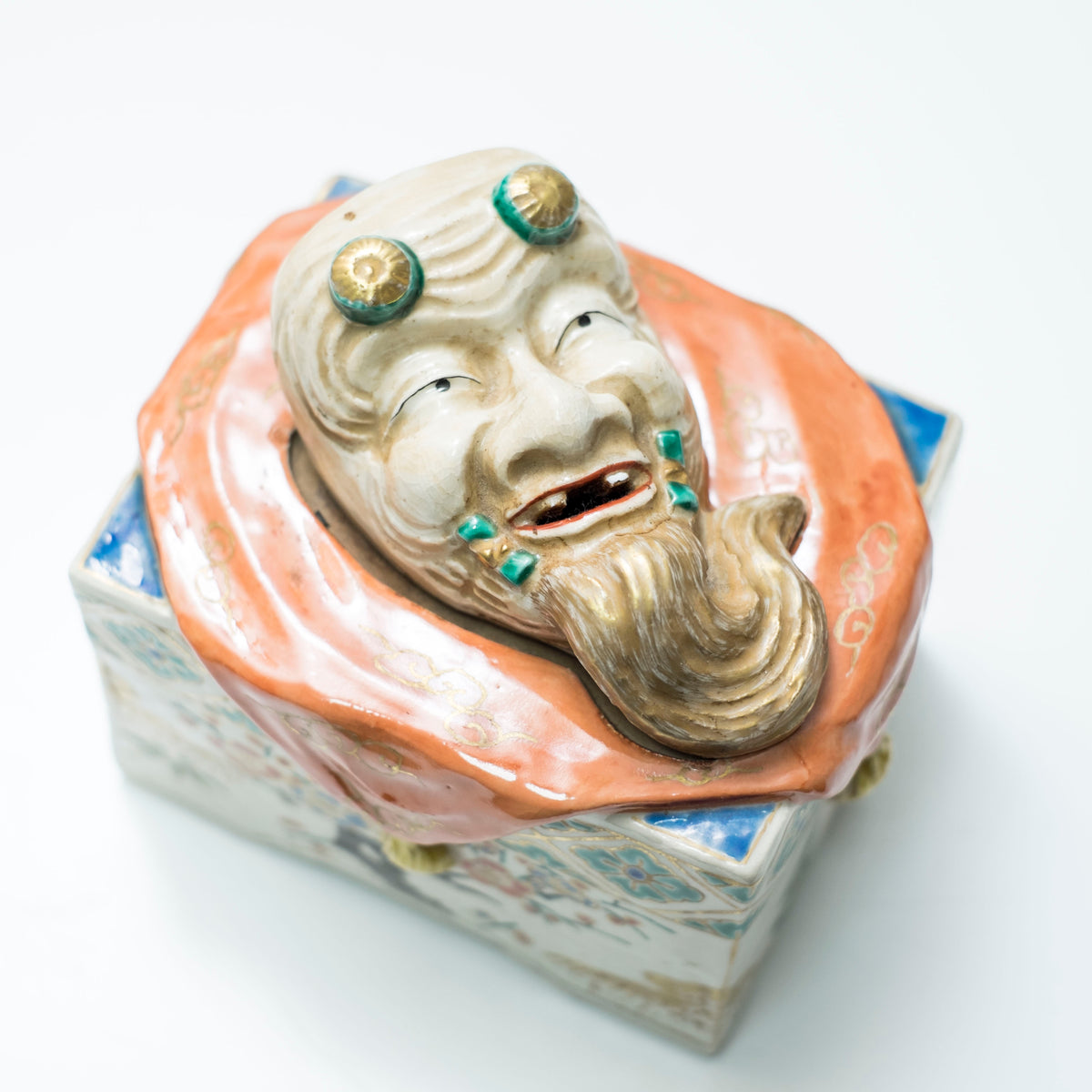
The square architectural body is decorated with blossoms, stylized foliage, landscape elements, geometric borders, and delicate gilded accents. Above it lies a salmon-vermilion textile-like ceramic drape, complete with modeled corner tassels and scrolling gold ornament. Emerging dramatically from the center is the three-dimensional face of an elderly man, his rounded features, long flowing beard, curled hair, small colored ornaments, and slightly parted lips giving the piece an unforgettable personality.
The result is simultaneously theatrical, whimsical, refined, and distinctly Japanese.
Viewed from a distance, the piece reads as a compact decorative sculpture. At closer range, layer after layer appears: the geometric border below the cover, tiny blossoms, bamboo-like leaves, stylized landscape passages, gilded outlines, crackled glaze across the face, jewel-toned green and blue accents, and the sculptural treatment of the old man's beard.
Accompanied by its wooden storage box with traditional woven tie, this is a particularly engaging object for collectors of Japanese ceramics, Noh-related art, incense accessories, Kutani-style decorative ware, theatrical imagery, and unconventional Japanese okimono.
Identification & Artwork Overview
This piece is best described as an antique Japanese Noh-inspired Rojin old-man kogo or covered incense box, executed in richly decorated glazed ceramic or porcelain.
The design combines several traditions that rarely appear together with quite this much personality.
The lower body functions almost as an architectural pedestal. It is square in form, slightly raised on corner feet, and decorated on all visible sides with landscapes, flowering branches, stylized plants, geometric diaper patterns, and gold details.
Above the body is a large orange-vermilion cover resembling a textile cloth laid ceremonially across the top of the box. Its corners descend naturally over the edges and terminate in modeled yellow tassel forms, while delicate scrolling ornament is distributed across its surface.
The extraordinary focal point is the sculptural elderly face resting above the center.
Its long beard sweeps dramatically toward one side. Modeled locks of hair frame the cheeks and temples. Green and gold decorative accents provide bright points of color against the warm ivory glaze. The slightly open mouth and softly closed or lowered eyes create an ambiguous expression that can appear humorous, contemplative, sleepy, or gently smiling depending upon the viewing angle.
That expressive quality is very appropriate to Japanese theatrical imagery, where extraordinarily subtle shifts in angle can alter the emotional character of a mask.
The face-form element is hollow, as visible in the supplied photographs, emphasizing that it was conceived as part of the covered vessel rather than merely being a flat decorative application.
The Rojin and Old-Man Mask Tradition
The figure belongs visually to the broad tradition of old-man imagery associated with Japanese Noh theater.
Noh contains several varieties of elderly male masks rather than one universal “old man” face. Different forms communicate differing combinations of dignity, age, wisdom, supernatural presence, refinement, humor, and ritual significance.
For the present piece, the safest and most useful description is therefore Rojin or old-man Noh-inspired imagery, rather than forcing the sculpture into a highly specific historical mask classification without documentation.
What matters immediately is the visual vocabulary.
The high forehead.
The heavily modeled cheeks.
The aged facial contours.
The exaggerated beard.
The softened eyelids.
The calm but animated mouth.
Together they transform age itself into character.
Rather than portraying old age merely as decline, traditional Japanese theatrical and decorative imagery often presents the elder as someone carrying experience, memory, authority, wisdom, or even supernatural significance.
That quality gives this incense box far more narrative interest than a conventional floral ceramic container.
Theatre Transformed into Decorative Art
One of the most compelling aspects of this piece is the way theatrical imagery has been removed from the stage and transformed into a functional decorative object.
The human face immediately creates emotional engagement.
You do not simply look at the object.
The object seems to look back.
Yet because the expression is restrained rather than caricatured, the mood changes subtly according to angle and light. From one side the figure appears amused. From another, meditative. Seen from below, the long beard becomes dominant and almost monumental. Viewed directly from above, the face becomes part of an elaborate composition of cloth, color, geometry, and ornament.
This changing character is particularly appropriate for an object connected with Noh aesthetics.
It also makes the piece unusually rewarding in a display cabinet because there is no single definitive viewing angle.
Kutani-Style Decorative Language
The coloration and surface treatment strongly evoke the visual language associated with Kutani-style Japanese overglaze decoration.
Rich green, turquoise, blue, coral-orange, red, ivory, brown, yellow, and gold are distributed throughout the vessel in carefully separated decorative zones.
The body does not rely upon one dominant picture. Instead, it behaves almost like a miniature textile composed of borders, panels, motifs, and color fields.
A geometric band around the upper body contains repeated green floral forms within a diamond lattice.
Below this appear delicate landscape passages with flowering branches, small plants, stylized earth or cloud formations, and generous areas of warm ivory ground.
The orange cover creates a completely different visual register. Its surface resembles folded silk or brocade, while fine gilded scrolls suggest embroidered decoration.
Finally, the face introduces yet another palette: creamy ivory, muted gold-brown beard tones, emerald-green jewelry-like accents, red at the mouth, and fine dark linear details.
Despite this complexity, the colors remain surprisingly harmonious.
The palette is exuberant without becoming visually chaotic.
The Sculptural Face
The face is unquestionably the heart of the composition.
Its form has been modeled with considerable dimensionality.
The nose projects strongly.
The cheeks swell outward.
The brow rises gently.
The mouth is open enough to create shadow.
The beard is deeply carved into rhythmic waves.
Rather than applying color over a flat portrait, the maker has allowed the ceramic form itself to generate expression.
The crackled surface visible across portions of the ivory glaze adds another layer of age and texture.
The beard is especially successful.
Its sweeping form creates movement across what would otherwise be a relatively compact, symmetrical object. One side extends outward dramatically, preventing the composition from becoming static and drawing the eye back toward the face.
The small green-and-gold ornaments are visually unusual and contribute a jewel-like quality.
They also echo the greens used in the decorative border below, tying the human figure into the surrounding architecture.
The Vermilion Textile-Form Cover
The orange upper section deserves attention in its own right.
Rather than simply creating a conventional flat ceramic lid, the maker has modeled the surface to resemble a folded cloth draped across the upper edges of the container.
This creates the illusion of softness in an inherently hard material.
The gently irregular edges, descending corners, modeled tassels, and scattered gold ornament reinforce that textile effect.
There is a delightful contradiction here.
Porcelain becomes fabric.
A container becomes a stage.
A theatrical face becomes the lid of an incense object.
That transformation of one material into the visual language of another is part of what gives the piece its charm.
Floral and Landscape Decoration
The panels around the lower section offer a quieter counterpoint to the dramatic face.
Flowering branches extend laterally across portions of the body, using delicate reds and blues against the ivory ground.
Small evergreen or bamboo-like plants punctuate other surfaces.
Gold creates ground lines, clouds, and landscape accents.
The visual balance is carefully handled.
Large motifs occupy the upper structure while smaller, more finely distributed motifs articulate the base.
The viewer therefore encounters the piece hierarchically:
First the face.
Then the orange drape.
Then the geometric border.
Then the landscape.
Then the tiny botanical details.
That progression rewards close inspection.
Kogo and Japanese Incense Culture
A kogo is a small covered container associated with incense.
Within Japanese decorative arts, such containers became opportunities for extraordinary experimentation in form.
They might imitate fruit, animals, flowers, shells, masks, books, auspicious objects, architectural forms, or playful seasonal subjects.
Function was therefore only one part of their appeal.
A beautifully designed incense container could become a miniature sculpture in its own right.
This piece takes that decorative impulse considerably further than most simple kogo because the entire object has been conceived as a multi-level narrative composition.
Even when no incense is placed inside, it remains highly successful as okimono and decorative art.
Brand Heritage
No securely documented individual artist, kiln, workshop, or factory attribution is established from the photographs supplied, so the listing intentionally avoids assigning a famous maker without evidence.
The ceramic decoration, polychrome enamels, gilding, patterned borders, and overall ornamental vocabulary are visually consistent with Japanese Kutani-style decorative ceramic traditions.
The accompanying wooden box strengthens the traditional presentation of the object, but the box shown does not provide enough visible inscription evidence in the supplied photographs to responsibly identify a specific artist or kiln.
For that reason, the piece is presented for what can genuinely be appreciated directly:
An unusually sculptural Japanese decorative ceramic incense box with old-man theatrical imagery, sophisticated overglaze decoration, gilded detail, and an accompanying wooden storage box.
This preserves the character and collector appeal of the object without turning uncertainty into invented provenance.
Historical Character
The original description proposed a late Meiji to Taisho attribution.
Stylistically, an older Japanese date is plausible, particularly considering the elaborate enamel work, theatrical subject, gilding, and presentation.
However, without a diagnostic maker's mark, readable inscription, documented provenance, or stronger physical dating evidence, the exact period should remain conservative.
For public presentation, antique Japanese or early vintage Japanese is preferable to an unsupported exact year range.
Collectors familiar with Meiji, Taisho, and early Showa decorative ceramics will recognize visual elements associated with those traditions, but the object deserves to be appreciated without an artificially precise date attached to it.
Cultural Appeal
This piece combines several collecting worlds.
It speaks to the collector of Japanese ceramics through color and glaze.
It speaks to the collector of theatrical art through its elderly mask-like face.
It speaks to the collector of incense culture through the kogo form.
It speaks to the collector of okimono through its sculptural presence.
It speaks to the interior collector through its unusually decorative silhouette.
And it speaks to anyone with a fondness for Japanese objects that possess personality.
There is something almost cinematic about the piece.
The old man appears to emerge from ceremonial fabric, surrounded by painted blossoms and landscape ornament, his long beard spilling across the upper surface.
It feels less manufactured than staged.
That distinction gives the object considerable decorative charisma.
Craftsmanship & Visual Qualities
The quality of the piece lies not simply in the amount of decoration but in the layering of different forms of craftsmanship.
The body requires controlled ceramic construction.
The human face requires sculptural modeling.
The beard demands textured carving.
The textile illusion relies upon three-dimensional drapery.
The lower panels require fine brushwork.
The repeated borders demand consistency.
The floral passages require delicacy.
The gilded ornament provides highlights.
The glaze unifies all these components into a coherent surface.
Especially attractive details include the crackled ivory face, shaded beard, emerald-green accents, blue corner fields, repeated green floral lattice, flowering branches, gold landscape passages, modeled yellow tassels, and subtle irregularity of the draped upper cover.
Together they make the piece much richer than the phrase “ceramic incense box” might initially suggest.
Collector Appeal
This object should appeal particularly to collectors of Japanese material culture who prefer pieces with a strong visual identity rather than generic ornament.
Its advantages include the unusual Noh-inspired old-man subject, sculptural lid treatment, richly colored Japanese enamel decoration, relatively substantial scale for an incense container, dimensional beard and face modeling, gilded accents, architectural square body, botanical and landscape imagery, decorative textile illusion, and accompanying wooden storage box.
It also crosses collecting categories unusually well.
A ceramic collector can appreciate it.
A Noh enthusiast can appreciate it.
An incense collector can appreciate it.
A collector of Japanese figures can appreciate it.
A maximalist interior can embrace its color.
A minimalist Japanese interior can use it as a single eccentric focal object.
That versatility is a significant part of its charm.
Display & Interior Styling
This is an object that deserves breathing room.
Because the face is visually powerful and the lower body contains considerable fine detail, the piece is especially effective against a quiet background where the ornament can be read without competition.
It would display beautifully in a tokonoma-inspired arrangement, antique cabinet, tea-room setting, Japanese ceramics collection, study, library, collector vitrine, entry console, low display shelf, or curated maximalist interior.
Natural woods are especially complementary.
Walnut, oak, paulownia, dark lacquer, raw linen, plaster, stone, and muted wall colors allow the ivory, coral-orange, green, blue, and gold decoration to stand forward.
The wooden storage box can also be displayed behind the piece, as shown in the photographs, creating an immediate visual context of Japanese collecting and preservation.
Soft directional light brings out the sculptural features dramatically.
The beard produces shadow.
The recess beneath the face becomes deeper.
The gilding flickers.
The colored enamels become more luminous.
From only a slight change in lighting, the personality of the old man seems to change as well.
Condition
This is an older Japanese ceramic object and should be expected to display characteristics consistent with age, manufacture, storage, handling, and previous display.
The supplied photographs show natural surface variation throughout the glaze, including visible crazing or fine crackle particularly around the ivory face and other glazed areas.
There is age-related toning and variation to portions of the beard and lighter surfaces.
The gilded decoration shows the softened character typical of an older handled object rather than the uniform brilliance of newly applied gold.
Minor marks, glaze irregularities, firing characteristics, small surface imperfections, and localized wear may be present.
The wooden storage box also displays natural age, surface variation, edge wear, and wear to the woven fastening ribbon.
The photographs should be considered an essential part of the condition description.
No restoration, exact age, artist attribution, kiln attribution, or undocumented provenance is claimed beyond what can be established from the object itself and the supplied information.
Dimensions
Ceramic piece height: approximately 14 cm
Wooden storage box: approximately 16 cm H × 17 cm W × 14 cm D
Please allow for minor measuring variation.
Because the mask-form cover and beard project beyond the central body, maximum width and depth may differ depending on precisely where the object is measured.
Purchase, Shipping & Vintage Policy
This is a vintage or antique collectible and is offered in its existing condition as shown.
Please review all photographs, measurements, and descriptive information carefully before purchase. Natural age-related wear, patination, glaze variation, crazing, minor surface marks, firing irregularities, gilding wear, and other characteristics associated with older handmade or decorated objects should be understood as part of the piece's individual history rather than expected to resemble a newly manufactured item.
We make every reasonable effort to photograph and describe our pieces accurately. If a particular detail is important to your purchase decision, please feel welcome to contact us before ordering.
Some items in our collection have modest room for negotiation, while others are more firmly priced according to rarity, condition, acquisition cost, and replacement difficulty. Respectful offers are welcome and will always be considered seriously.
Preparation, shipping and handling normally takes 5–10 business days or earlier whenever possible. International orders are carefully packed for transit and shipped with tracking whenever available.
Customs duties, import taxes, brokerage fees, or other destination-country charges may apply according to local regulations and remain the responsibility of the recipient unless otherwise specified.
All vintage and antique items are sold as shown and described. Please inspect the complete listing carefully before purchase.
If you are looking for this design or model in another size, please feel free to message us. Although availability cannot be guaranteed, we may be able to locate the same or a closely matching piece in a different size through our sourcing network.
Closing
Some Japanese antiques impress through scale.
Others through famous signatures.
This piece succeeds through imagination.
A theatrical old man reclines above a miniature world of flowering trees, geometric borders, gilded landscapes, colored enamels, tassels, and ceramic “textile,” turning a small incense object into something closer to a private stage.
The longer it is viewed, the stranger and more charming it becomes.
For a collector who values objects with character, cultural layering, and a little theatrical drama, this is the sort of piece that can become a favorite rather than simply another object on the shelf.
#JapaneseAntique #JapaneseKogo #Kogo #IncenseBox #JapaneseIncenseBox #Rojin #NohMask #NohTheater #JapaneseTheater #OldManMask #JapanesePorcelain #JapaneseCeramics #KutaniStyle #KutaniArt #KutaniCeramics #JapaneseOkimono #CeramicOkimono #JapaneseArt #JapaneseCollectible #AsianAntique #AsianCeramics #JapaneseDecor #TraditionalJapanese #JapaneseCulture #JapaneseCraftsmanship #PolychromePorcelain #HandPaintedCeramic #GildedPorcelain #JapaneseEnamel #OverglazeEnamel #JapaneseFloralArt #PlumBlossom #JapaneseLandscape #Tomobako #WoodenStorageBox #TokonomaDecor #TeaRoomDecor #IncenseCulture #Kodo #JapaneseInterior #WabiSabiDecor #JapaneseVintage #AntiquePorcelain #CollectorCeramics #TheaterCollectible #JapaneseMaskArt #DecorativeCeramics #FineJapaneseArt #AsianDecorativeArt #JapaneseHeritage
japanese kogo, noh mask decor, rojin mask, kutani style, incense box, japanese antique, japanese ceramic, noh theater art, ceramic okimono, japanese porcelain, tomobako box, kutani porcelain, asian collectible
Material Tags
porcelain, glazed ceramic, Japanese ceramic, polychrome enamel, overglaze enamel, colored glaze, gilding, gold decoration, hand painted ceramic, crackle glaze, sculpted porcelain, wood storage box, woven textile tie