Rare Vintage, Antiques and Art Collector / Curator / Personal Shopper From Japan
Antique Japanese Jizo Bosatsu Scroll | Ksitigarbha Buddhist Kakejiku | Edo–Meiji Silk Painting | Sacred Temple Art
Antique Japanese Jizo Bosatsu Scroll | Ksitigarbha Buddhist Kakejiku | Edo–Meiji Silk Painting | Sacred Temple Art
Couldn't load pickup availability
A richly painted Japanese devotional scroll of Jizō Bosatsu seated upon a lotus within a sacred mountain landscape of waterfalls, rocks, mist, and contemplative stillness.
Description
A serene guardian rests at the heart of a mysterious sacred landscape.
This impressive antique Japanese hanging scroll portrays Jizō Bosatsu, known in Sanskrit as Kṣitigarbha, seated upon a blossoming lotus and surrounded by a monumental circular aureole. Behind him rises a secluded world of mountains, ancient trees, waterfalls, mist, rocks, and shadowed valleys, creating the atmosphere of a hidden Buddhist paradise beyond ordinary time.
Jizō appears in the form of a compassionate monk, his head shaven and his expression quiet, youthful, and deeply composed. One hand cradles the radiant wish-fulfilling jewel, while the ringed monk’s staff traditionally associated with him rises beside his halo.
The figure’s elaborately patterned robes contrast beautifully with the subdued landscape. Deep green, blue, muted gold, coral red, ivory, and earthy brown pigments emerge softly from the aged silk, giving the painting a meditative luminosity rather than theatrical brilliance.
Mounted within blue-and-white floral textile borders, warm vermilion brocade bands, and pale green silk, the scroll possesses the dignified stillness of a treasured temple image.
This is not merely a decorative picture of Buddhist serenity. It is a complete devotional world, one that brings together compassion, spiritual guidance, natural beauty, and the accumulated atmosphere of age.
Artwork Identification
The central figure is Jizō Bosatsu, one of the most beloved bodhisattvas in Japanese Buddhism.
Jizō is traditionally portrayed as a Buddhist monk rather than as a richly crowned celestial deity. His simplified human appearance expresses his willingness to walk among ordinary beings and enter even the darkest realms in order to offer guidance.
The principal identifying attributes visible in this painting include:
- A shaven monastic head
- A ringed monk’s staff, or shakujō
- A wish-fulfilling jewel, or hōju
- A lotus throne
- A large circular halo or aureole
- A compassionate, meditative expression
- Elaborately patterned Buddhist robes
These elements distinguish the figure from Amida Buddha, Kannon, Shakyamuni, and other Buddhist subjects frequently encountered in Japanese scroll painting.
Jizō Bosatsu and His Spiritual Meaning
Jizō represents steadfast compassion.
According to Buddhist tradition, he vowed to continue helping sentient beings throughout the difficult age between the passing of Shakyamuni Buddha and the future arrival of Maitreya Buddha.
In Japan, Jizō became especially cherished as a protector and spiritual guide for:
- Children
- Travelers and pilgrims
- The deceased
- Souls undergoing suffering
- Families remembering lost children
- Those facing dangerous journeys or periods of uncertainty
- Anyone seeking mercy, protection, or reassurance
His appeal lies in his closeness to ordinary life. Rather than remaining distant within a celestial paradise, Jizō is imagined walking the roads, mountain paths, villages, cemeteries, and unseen realms where help is most needed.
The scroll therefore carries several intertwined meanings: compassion without limit, guidance through uncertainty, protection during transition, and the promise that no being is beyond the reach of mercy.
The Wish-Fulfilling Jewel
Jizō holds a rounded jewel in his open hand.
Known as the hōju, or wish-fulfilling jewel, it represents the spiritual treasure of Buddhist wisdom and the blessings offered to beings in need.
In this painting, the jewel is especially striking. Its deep green body and red center create a small but intense point of color against the subdued robes and landscape.
The jewel may be understood symbolically as:
- A light within darkness
- Wisdom that dispels ignorance
- Compassion made visible
- The fulfillment of spiritual rather than material needs
- Hope carried through suffering
- The indestructible nature of awakened truth
Its placement near the center of the composition draws the eye gently toward Jizō’s hands, transforming the object into the quiet heart of the painting.
The Ringed Monk’s Staff
Beside Jizō rises the elegant finial of a Buddhist monk’s staff known as a shakujō.
Such staffs traditionally carried metal rings that produced a sound as the monk walked. Within Jizō iconography, the staff signifies spiritual travel, awakening, protection, and his passage through the various realms of existence.
It is often interpreted as an instrument that announces his compassionate presence and awakens beings from spiritual confusion.
Here, the staff rises vertically beside the figure and intersects the broad halo, subtly linking the seated bodhisattva with the landscape and unseen heavens above.
The Sacred Landscape
The environment surrounding Jizō is one of this scroll’s most compelling features.
Rather than presenting the bodhisattva against a plain devotional background, the artist has placed him inside an expansive mountain realm. Waterfalls descend from high cliffs. Mist moves through distant peaks. Gnarled trees cling to rock formations, while pools, plants, and stones surround the lotus throne.
The landscape creates several layers of meaning.
Mountains
Mountains have long been associated in Japanese religious culture with spiritual practice, pilgrimage, seclusion, and contact with sacred realms.
Waterfalls
The descending water suggests purification, continuity, spiritual power, and the movement of compassion from the celestial world into human experience.
Mist and Distance
The veiled mountains create mystery and suggest a realm that is visible yet not fully accessible, positioned between the earthly and the transcendent.
Rocks and Plants
The carefully painted stones, roots, leaves, and small flowers ground the sacred figure in the natural world. Jizō is not isolated from nature. He appears woven into its rhythms.
The Lotus Throne
The lotus rises from dark and uncertain conditions yet opens in purity. It is therefore one of Buddhism’s most powerful symbols of awakening.
The landscape does more than frame the central figure. It turns the entire painting into a visual pilgrimage.
Artistic Character and Composition
The composition is both formal and atmospheric.
Jizō occupies the visual center, framed by an immense circular aureole that establishes spiritual authority and balance. The lotus petals create a warm coral-red foundation beneath the darker robes, while the surrounding landscape expands upward and downward around him.
The artist has used several contrasting visual languages:
- Fine controlled linework in the face, jewelry, robes, and staff
- Repeated textile patterns across the garments
- Soft atmospheric washes in the mountains and sky
- Darker masses of rock and vegetation
- Delicate accents of red, green, blue, ivory, and gold
- Broad negative spaces that allow the image to breathe
The result combines devotional precision with the dreamlike depth of Japanese landscape painting.
The figure is calm, symmetrical, and composed. The landscape is irregular, mysterious, and alive. Together they create a productive tension between spiritual permanence and the changing natural world.
Textile Mounting
The painting is mounted as a traditional Japanese kakejiku, or hanging scroll.
Its mounting includes:
- A pale green silk field
- Blue-and-white botanical patterned borders
- Vermilion brocade bands above and below the painting
- Narrow hanging strips at the upper section
- A traditional lower roller with red lacquered ends
- A suspension cord for display
The cool blue borders harmonize with the green and blue tones of the painting, while the vermilion bands echo the red jewel, lotus petals, and lips of the bodhisattva.
The mounting is restrained enough to preserve the solemnity of the religious image while still giving the scroll a distinct decorative presence.
Estimated Period
Based on the painting style, pigments, textile mounting, aged surface, and devotional format, this work appears consistent with a late Edo to early Meiji-period Japanese Buddhist scroll, broadly within the nineteenth century.
However, the precise date has not been independently authenticated, and no securely readable artist signature, workshop inscription, or dated colophon is visible in the supplied photographs.
The listing therefore presents the Edo–Meiji attribution as a carefully considered visual assessment rather than documented provenance.
Why This Scroll Matters
This is a particularly evocative representation of Jizō because it combines formal Buddhist iconography with a fully developed sacred landscape.
Many Jizō paintings isolate the figure against a plain silk ground or show him descending upon clouds. Here, the viewer encounters a larger spiritual environment, complete with mountain ridges, waterfalls, trees, rocks, plants, mist, and water.
That richness gives the work several layers of appeal.
As Buddhist Art
It presents one of Japan’s most compassionate and culturally resonant bodhisattvas with his principal sacred attributes.
As Japanese Landscape Painting
It creates a mysterious world of mountains and waterfalls that rewards slow observation.
As Interior Art
Its tall vertical form, subdued palette, and elegant mounting make it powerful in traditional, minimalist, wabi-sabi, and Japandi environments.
As a Collectible
It brings together religious subject matter, hand-painted detail, period textile mounting, age, symbolism, and substantial visual presence.
As a Contemplative Object
The painting offers something that mass-produced Buddhist prints rarely provide: atmosphere accumulated through material, age, craftsmanship, and use.
Why You Will Love It
- Authentic Japanese Buddhist subject
- Hand-painted devotional imagery
- Recognizable Jizō iconography
- Beautiful wish-fulfilling jewel and shakujō staff
- Elaborately patterned monastic robes
- Monumental circular halo
- Lotus throne with warm coral-red petals
- Atmospheric mountains and cascading waterfalls
- Elegant blue floral and pale green textile mounting
- Strong spiritual and decorative presence
- Suitable for both traditional and contemporary interiors
- A meaningful object for reflection, remembrance, and protection
- One unique vintage or antique scroll available
Ideal Display Spaces
This scroll would be especially effective in:
- A meditation room
- A Buddhist altar space
- A memorial or remembrance area
- A Japanese-style room or tokonoma
- A tea room
- A quiet study or private library
- A yoga or wellness studio
- A wabi-sabi interior
- A Japandi living space
- A gallery wall devoted to Asian art
- A retreat, cultural venue, or contemplative hospitality interior
- A collector’s private viewing room
Because of its elongated proportions and detailed landscape, it should ideally be displayed where the entire scroll can be seen from a distance while still allowing close examination of the figure and scenery.
Ideal For
- Collectors of Japanese Buddhist art
- Collectors of antique kakejiku
- Admirers of Jizō Bosatsu and Kṣitigarbha
- Buddhist practitioners
- Meditation and mindfulness teachers
- Japanese art enthusiasts
- Interior designers creating contemplative spaces
- Collectors of religious silk paintings
- Lovers of mountain and waterfall imagery
- Buyers seeking meaningful spiritual wall art
- Families creating a remembrance space
- Anyone drawn to the symbolism of compassion, guidance, and protection
Item Details
Origin: Japan
Subject: Jizō Bosatsu, also known as Kṣitigarbha Bodhisattva
Japanese Name: 地蔵菩薩
Artwork Type: Japanese Buddhist devotional painting
Format: Kakejiku or kakemono hanging scroll
Medium: Appears to be ink, mineral color, and decorative pigment on silk
Mounting: Traditional textile and brocade mounting with wooden roller
Estimated Period: Late Edo to early Meiji period, subject to further authentication
Artist: Unidentified; no clearly readable signature is visible in the supplied photographs
Primary Colors: Muted gold, olive green, blue, coral red, ivory, brown, grey, and black
Principal Symbols: Shakujō staff, wish-fulfilling jewel, lotus throne, halo, mountains, waterfalls, rocks, trees, and sacred landscape
Quantity: One unique vintage or antique hanging scroll
Condition
This is an antique or vintage hanging scroll with visible age-related character.
The photographs show general toning, surface wear, horizontal creases, textile waviness, light discoloration, small marks, and areas of rubbing consistent with age, storage, rolling, and traditional use.
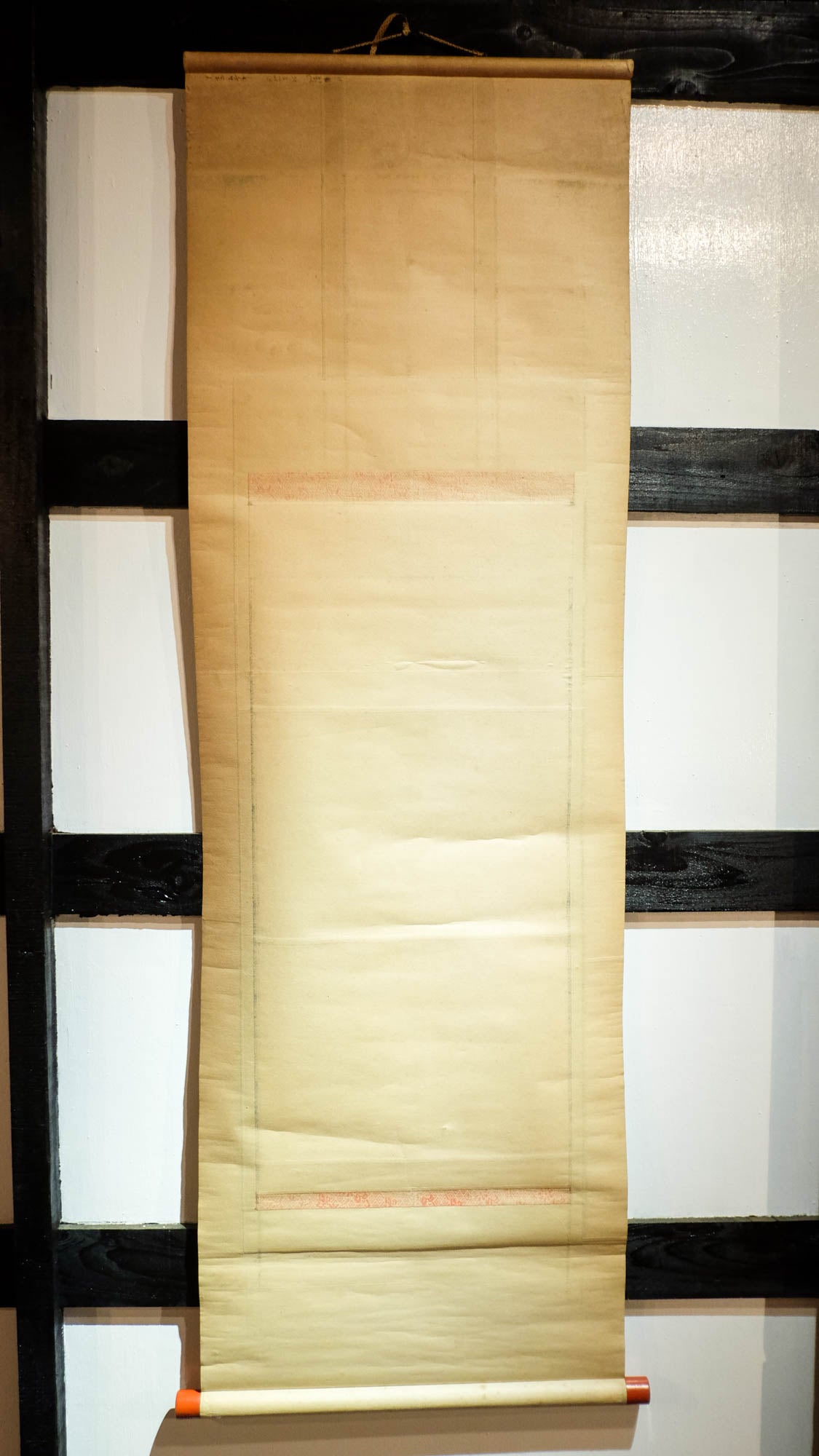
The pale exterior mounting displays visible handling wear, scuffs, faint scratches, creasing, and tonal variation. The painted silk also shows age-softening and horizontal lines created through repeated rolling.
Despite these signs of age, the central figure, halo, jewel, staff, robes, lotus, waterfalls, rocks, trees, and landscape remain clearly visible and visually compelling.
The roller ends, suspension cord, and mounting appear present in the supplied photographs.
No claim is made that the scroll has undergone professional conservation. Buyers seeking a conservation-grade assessment should consult a qualified specialist.
Please examine all photographs carefully, as they form an essential part of the condition description. Additional close-up photographs may be requested before purchase.
Final Words to the Collector
This scroll portrays compassion not as an abstract idea, but as a living presence seated quietly within the landscape.
Jizō does not dominate the mountains around him. He belongs among them.
The waterfalls continue their descent. Mist moves between distant cliffs. Small plants emerge among the rocks. At the center of this changing world, the bodhisattva remains still, holding the jewel of awakened wisdom.
That stillness is the painting’s deepest power.
For a Buddhist practitioner, the scroll may serve as an image of protection, remembrance, and spiritual guidance. For a collector, it offers a sophisticated meeting of devotional iconography, landscape painting, silk mounting, and material history. For an interior, it creates a calm but unmistakable center of gravity.
This is more than an image to fill a wall. It is a place for the eye to rest and the mind to become quiet.
Bring the compassionate presence of Jizō into your space and allow this sacred landscape to unfold slowly, one detail at a time.
Offers
Some objects in our collection allow limited room for negotiation, while others are offered at a firm price.
Respectful and reasonable offers are welcome. Should you have a particular figure in mind, please send us a message. Every proposal will be considered carefully, although acceptance cannot be guaranteed.
We are also happy to assist with questions regarding measurements, condition, display, packing, combined purchases, or international shipping.
Product Representation and Questions
We make every reasonable effort to photograph and describe our items accurately.
Colors, textures, and tonal variations may appear slightly different depending on lighting, photography, display settings, and viewing conditions. Antique silk, pigments, brocade, paper, and lacquer may also reveal subtle irregularities that are difficult to capture completely in photographs.
Please contact us before purchasing should you have questions regarding condition, measurements, materials, mounting, age, storage, display, provenance, or shipping.
We would much rather clarify any uncertainty before payment than leave a concern unresolved afterward.
Condition and Sales Policy
This item is vintage or antique and is sold in its present condition, as photographed and described.
Please do not expect factory-new condition. Age-related wear, patina, fading, creasing, marks, rubbing, repairs, textile deterioration, discoloration, and other historical characteristics may be present.
All sales are considered final except where otherwise required by applicable law or Etsy policy.
By purchasing, the buyer confirms that they have reviewed the description, photographs, dimensions, estimated attribution, condition information, shipping terms, and shop policies.
Shipping
We ship worldwide from Japan using Japan Post EMS wherever service is available.
Shipping and handling charges are calculated through the listing’s shipping settings. Should your destination not appear among the available options, please contact us for assistance or a manual quotation.
The scroll will be carefully rolled, protected, and packed for international transportation.
Import duties, customs taxes, brokerage fees, and destination-country charges are the responsibility of the buyer unless otherwise required by law.
Tracking
Tracking information will be provided after dispatch.
Please allow approximately three to five business days after shipment for tracking activity to become visible, depending on postal processing and the destination country.
International delivery times may vary because of customs inspections, local postal conditions, holidays, weather, transportation disruptions, or other circumstances beyond our control.
Store Policies
Please review our complete shop policies before completing your purchase.
Payment confirms that the buyer understands and accepts the photographed condition, listing description, estimated dating, shipping terms, and the natural limitations involved in purchasing vintage and antique objects online.
#JizoBosatsu #Ksitigarbha #JapaneseScroll #Kakejiku #JapaneseBuddhistArt #BuddhistScroll #AntiqueJapaneseArt #EdoPeriodArt #MeijiPeriodArt #SilkPainting #HandPaintedScroll #BuddhistWallArt #SacredArt #TempleArt #LotusThrone #WishFulfillingJewel #ShakujoStaff #GuardianBodhisattva #JapaneseTempleArt #MeditationRoomDecor #SpiritualWallArt #WabiSabiDecor #JapandiInterior #AsianAntiqueArt #VintageJapaneseArt #BuddhistIconography #MindfulHome #CollectorArt #JapaneseAntiques #SacredSpaceDecor