Rare Vintage, Antiques and Art Collector / Curator / Personal Shopper From Japan
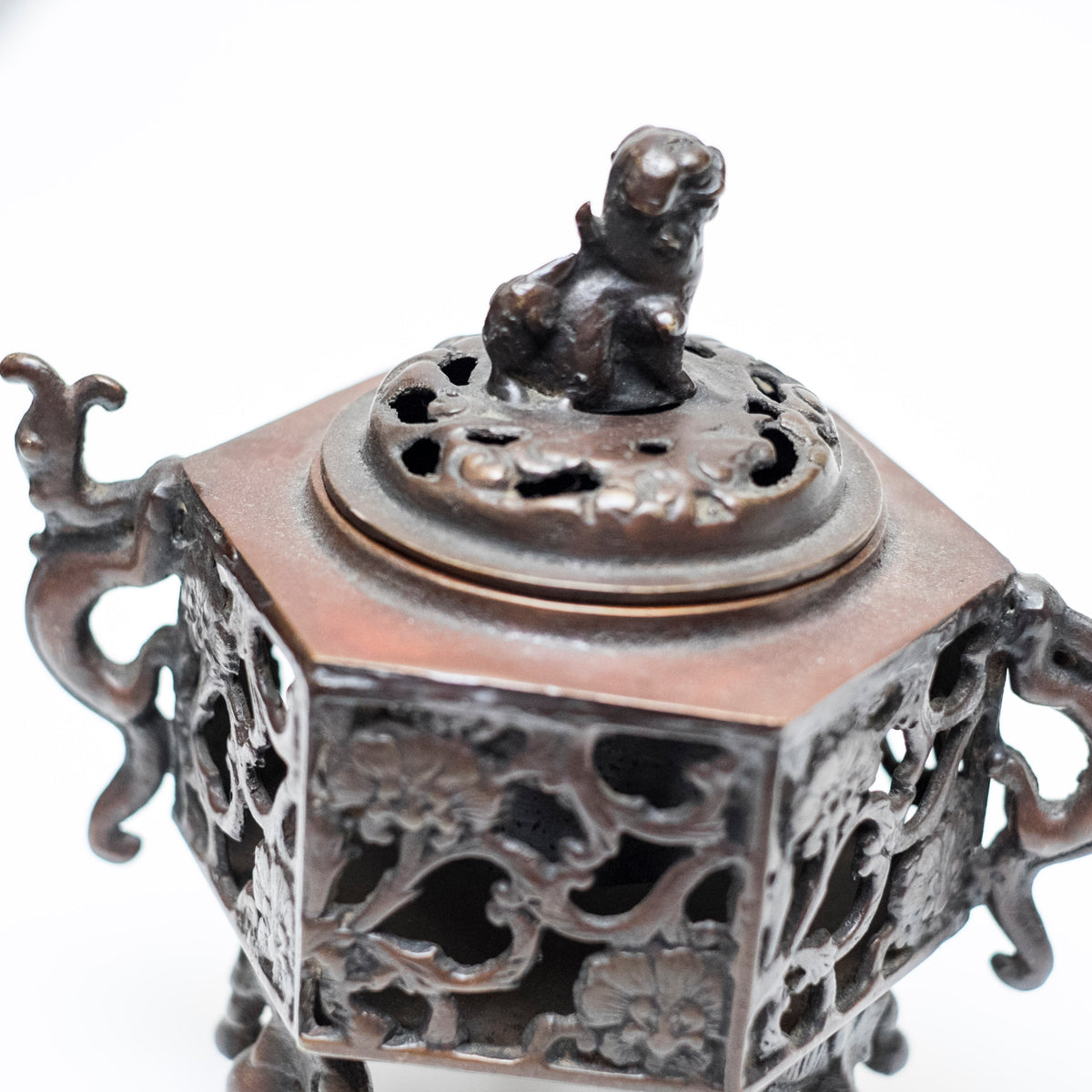
Antique Japanese Bronze Koro Incense Burner Shishi Guardian Lion Floral Openwork Tripod Censer Asian Art
Antique Japanese Bronze Koro Incense Burner Shishi Guardian Lion Floral Openwork Tripod Censer Asian Art
Couldn't load pickup availability
Have a reasonable price in mind? Submit your best offer and our concierge will review it personally.
Sculptural Japanese Bronze Censer with Pierced Botanical Panels, Guardian Shishi Finial, Ornate Handles & Deep Aged Patina
Introduction
A richly atmospheric piece of traditional Japanese decorative metalwork, this antique-style bronze koro incense burner combines architectural form, auspicious symbolism, pierced botanical ornament, and sculptural animal imagery into a compact object with remarkable visual presence.
The vessel is constructed around a multi-sided openwork body raised upon three elaborately shaped legs. Each pierced panel is populated with curling botanical forms and blossoms, allowing light to pass directly through the structure and creating an intricate silhouette from nearly every viewing angle. Above the body sits a removable pierced lid crowned by a small shishi guardian lion, while the sides are framed by dramatic opposing handles whose curling profiles contribute further movement to the composition.
Unlike a simple utilitarian incense vessel, this koro has been conceived as a complete decorative sculpture. The eye moves from the grounded tripod feet upward through the perforated floral body, outward toward the vigorous side handles, and finally to the guardian figure seated at the summit. Even when no incense is being burned, the object possesses the visual authority expected of a traditional display piece.
The dark brown bronze surface has developed layers of patina and tonal variation. Warm bronze highlights emerge along exposed edges, raised floral details, feet, handles, and sculptural contours, while recessed portions retain deeper shades. These variations give the piece the dimensional character that collectors often value in older bronze work.
For admirers of Japanese antiques, traditional interiors, incense culture, Asian metalwork, Buddhist decorative arts, or simply beautifully aged sculptural objects, this koro offers considerable decorative and cultural appeal.
Identification & Object Overview
This piece is best understood as a bronze koro, or incense burner, designed in a highly ornamental traditional East Asian vocabulary.
Its principal visual elements include:
- Multi-sided architectural incense chamber
- Extensive floral and scrolling openwork
- Removable ventilated lid
- Sculptural shishi guardian finial
- Opposing ornamental handles
- Tripod construction
- Decorative pendant-like forms around the lower body
- Rounded terminal feet
- Dark aged bronze patina
- Warm exposed bronze highlights on raised details
The object possesses characteristics associated with Japanese decorative bronze traditions, although the photographs alone do not establish a precise maker, workshop, or date. It is therefore presented for appreciation as a traditional Japanese-style bronze koro rather than burdened with unsupported attribution.
Its strongest quality is not a speculative name or period. It is the craftsmanship visible directly in the object.
Historical & Cultural Context
Incense occupies an extraordinary place within Japanese cultural history.
Introduced to Japan through Buddhist practice, aromatic incense eventually moved far beyond temple ritual. It became associated with aristocratic life, refined domestic culture, literary appreciation, tea practice, contemplative spaces, and the sophisticated aesthetic tradition known as kodo, the Japanese “way of incense.”
Objects created to hold and burn incense therefore developed along several parallel paths.
Some were restrained and functional.
Others became extraordinary works of decorative art.
Bronze proved especially suitable because it could withstand heat while also permitting highly ambitious casting, carving, piercing, sculptural modeling, and patination. Japanese metalworkers transformed practical censers into miniature architectural monuments populated by dragons, birds, mythical animals, flowers, clouds, waves, Buddhist symbols, and guardian figures.
During periods of particularly ambitious decorative production, incense burners could become showcases for almost every skill available to the metal artisan. A single vessel might combine cast bodies, separately modeled animals, pierced panels, movable lids, multiple patinas, relief decoration, and complex feet.
This koro belongs visually to that world.
Its body is not treated as a plain container. Instead, the walls dissolve into pierced vegetation. The handles become sculptural extensions of the vessel. The lid becomes a stage for the guardian lion. The feet themselves become decorative punctuation.
The resulting object exists somewhere between ritual implement, interior furnishing, sculpture, and metalwork display piece.
The Shishi Guardian
At the summit of the lid sits a small sculptural shishi, the lion-like guardian familiar throughout Japanese religious and decorative culture.
Shishi imagery entered Japan through broader East Asian visual traditions and became deeply embedded in temple architecture, shrine approaches, decorative arts, textiles, ceramics, lacquerware, metalwork, and household objects.
Rather than functioning simply as a literal animal representation, the shishi is traditionally associated with ideas of:
Protection
Strength
Vigilance
Sacred guardianship
Repelling harmful influence
Protection of important spaces
Its elevated position on this vessel is especially effective.
The figure occupies the highest point of the composition, almost acting as a sentinel above the incense chamber. Because incense itself historically carried associations with purification, contemplation, offering, and sacred atmosphere, the guardian imagery feels particularly appropriate.
The shishi therefore contributes both visual drama and symbolic coherence.
Botanical Openwork
One of the most attractive features of this koro is its extensive floral openwork.
Rather than simply engraving flowers into a solid wall, the maker has opened the composition entirely, creating a lattice of branches, stems, leaves, and blossoms.
This has several important effects.
First, it visually lightens the bronze. The object appears more delicate and architectural than its material might suggest.
Second, the openwork gives the piece a constantly changing appearance according to viewing angle. Light passing through the openings reveals overlapping layers of handles, feet, internal chamber, and opposite panels.
Third, the botanical imagery introduces a softer natural vocabulary that balances the stronger guardian imagery of the shishi.
The result is a particularly Japanese decorative tension between structure and nature: rigid geometry provides the framework, while organic forms appear to grow freely through it.
When displayed against a pale wall or illuminated from the side, the pierced panels become especially beautiful because their negative spaces become part of the design.
Sculptural Handles
The two large opposing handles contribute substantial character.
Their strongly curling outlines create visual movement beyond the main body of the censer, widening the silhouette and giving the vessel a ceremonial character disproportionate to its physical scale.
Although the exact creature or symbolic interpretation of the handles should not be overstated without closer documentation, their stylized zoomorphic and scrolling appearance belongs comfortably within the broader vocabulary of Japanese bronze ornament.
From a design standpoint, they perform an important role.
Without them, the body would read as a relatively compact pierced container.
With them, the composition expands horizontally and becomes considerably more theatrical.
They act almost like brackets framing the central floral architecture.
Lid & Ventilation
The removable lid is pierced to allow smoke and fragrance to escape while incense is burning within the vessel.
The ventilation openings are therefore practical, but they also contribute decoration and visual rhythm.
Historically, the movement of incense smoke through pierced bronze lids was itself part of the beauty of a koro. Smoke would emerge gradually through small openings rather than rising in a single uninterrupted stream.
On an elaborate vessel such as this, that effect could transform the sculpture temporarily.
The shishi might appear above drifting aromatic smoke while shadows formed across the pierced body below.
Even when used today purely as a decorative antique, understanding this original relationship between vessel and smoke adds another dimension to the piece.
Tripod Construction
The body rests upon three ornamental legs terminating in rounded feet.
Tripod forms possess both practical and visual advantages.
Three support points naturally stabilize a vessel even when placed on surfaces that are not perfectly level, while the raised construction separates the main chamber from the tabletop below.
Visually, the legs allow air and negative space beneath the censer, reinforcing the open architectural quality established by the pierced body.
The decorative extensions around the lower section also create a rhythm of suspended forms between the body and feet.
Rather than appearing heavy and block-like, the vessel seems almost elevated above the surface.
Bronze, Patina & Surface Character
The bronze surface is one of the object's strongest features.
The overall coloration ranges through dark chocolate brown, blackened recesses, muted reddish-brown, and warmer bronze highlights.
These tonal differences should not automatically be interpreted as damage.
On older bronze objects, surface variation develops through a combination of original finishing techniques, oxidation, handling, environmental exposure, cleaning history, and natural aging.
Raised points naturally reveal themselves first.
Edges, floral projections, handles, feet, the lion finial, and other frequently touched or exposed areas may display warmer metallic tones, while recessed portions preserve darker oxidation.
This contrast increases readability and gives the carving greater dimension.
Collectors of historic metalwork often prefer precisely this kind of mature surface because it records the object's passage through time.
Aggressive polishing would erase much of that history.
For that reason, the piece should generally be appreciated with its existing patina rather than treated like contemporary polished metal.
Craftsmanship & Visual Qualities
Several aspects make this koro particularly engaging as decorative metalwork.
The first is complexity of silhouette.
The piece offers no single flat façade. Almost every angle creates a new arrangement of openings, handles, flowers, legs, finial, and shadow.
The second is contrast between mass and transparency.
Bronze is visually substantial, yet much of the main body has been intentionally removed through openwork.
The third is vertical hierarchy.
The eye begins at the feet, travels upward through the pierced floral walls, meets the architectural rim and lid, and finally arrives at the shishi.
The fourth is controlled asymmetry inside symmetry.
The overall construction is balanced, but the botanical patterns and sculptural detailing introduce organic irregularity.
The fifth is surface depth.
Dark oxidation settles into recesses while raised details remain more visible, naturally outlining the craftsmanship.
Together these qualities make the censer successful not only as an antique object but also as sculpture.
Why Collectors May Appreciate This Piece
This koro brings together several categories of collectible Japanese decorative art within one object.
It appeals to collectors of:
Japanese bronze
Koro and incense vessels
Shishi imagery
Japanese metalwork
Traditional incense culture
Pierced bronze
Asian decorative arts
Botanical ornament
Buddhist-associated interior objects
Meiji-style decorative craftsmanship
Wabi-sabi interiors
Sculptural antique objects
Collectors particularly drawn to objects that reward close inspection may find this piece appealing because the openwork reveals new layers depending upon viewing angle.
From one side, the floral lattice dominates.
From another, the silhouette of the handles becomes stronger.
Viewed slightly downward, the lion finial becomes the central visual element.
Seen at tabletop level, the feet and hanging decorative forms create an almost architectural understructure.
This is the type of object that can continue revealing details long after the initial impression.
Display & Interior Suggestions
The dark bronze and intricate silhouette make this piece exceptionally adaptable.
It could be displayed beautifully in a traditional Japanese-inspired interior, but it also works strikingly within modern minimalist spaces.
Possible settings include:
Tokonoma-inspired alcove
Antique cabinet
Collector vitrine
Meditation room
Tea room
Library
Study
Entry console
Mantel
Display pedestal
Japanese art collection
Asian decorative arts collection
Wabi-sabi interior
Contemporary neutral interior
The strongest presentation would likely place the censer against a relatively simple background where its openwork can be read clearly.
Light plaster, natural oak, walnut, stone, linen, black lacquer, or subdued neutral surfaces would all complement the bronze.
A small directional light can also emphasize the openings and throw botanical shadows onto the surface behind it.
Displayed alongside Japanese ceramics, lacquerware, scrolls, Buddhist sculpture, tea objects, or other bronze works, it can serve as a visual anchor without overwhelming the surrounding collection.
Incense Use
The piece appears structurally conceived as an incense burner, and the pierced lid provides ventilation appropriate to that function.
Because this is an older decorative object, however, buyers wishing to actively burn incense should exercise appropriate care.
A removable modern heat-resistant insert may be preferable rather than placing hot charcoal or burning material directly against antique metal surfaces.
Its value today lies just as strongly in its sculptural and cultural presence as in its original practical purpose.
Condition
This is an older bronze object and shows natural signs of age and previous ownership.
Visible characteristics include aged surface patination, oxidation, darkening, color variation, rubbing to raised areas, minor marks, irregularities associated with casting and finishing, and general surface wear consistent with an older decorative bronze.
The pierced construction contains numerous narrow and projecting elements, and buyers should examine the photographs carefully to evaluate the current condition of the openwork, handles, feet, lid, finial, and decorative projections.
The existing patina has considerable visual character and forms an important part of the object's antique appearance.
No aggressive polishing is recommended.
Please review every photograph carefully, as the images form an essential part of the condition description and should be considered together with the written listing.
Precise age, foundry, workshop, and artist attribution are not stated unless independently supported.
Dimensions
Exact measurements were not supplied with the current item information.
Please add the measured:
Height
Maximum width including handles
Body width
Body depth
Approximate lid diameter
Weight
before final publication if available.
The photographs provide useful proportional context, but measurements should always take precedence over visual estimation.
Offers & Store Policies
Some pieces in our collection have modest room for negotiation, while others are priced more firmly according to rarity, condition, acquisition cost, and replacement difficulty.
Respectful offers are always welcome and will be considered seriously.
If you have a particular figure in mind, please feel free to contact us. We are happy to discuss the piece and will accommodate reasonable requests whenever possible.
Product Representation & Questions
We make every effort to represent our pieces accurately through detailed photography and careful written descriptions.
Vintage and antique objects naturally carry individual characteristics that cannot always be fully conveyed through photographs alone, including patination, oxidation, minor marks, production irregularities, and evidence of age.
Please contact us before purchasing if you would like clarification regarding a particular area, detail, surface, or condition concern.
We would always prefer to answer questions thoroughly before purchase.
Vintage & Antique Condition Policy
This item is offered in its present vintage or antique condition as shown.
Older objects should not be expected to possess the uniformity or surface finish of newly manufactured goods. Natural aging, surface variation, oxidation, wear, casting irregularities, minor marks, and other age-related characteristics are inherent to collecting historical decorative art.
Please review all supplied photographs carefully before completing your purchase.
Purchase, Shipping & Handling
Preparation, shipping and handling normally takes approximately 5–10 business days or earlier whenever possible.
Items are carefully prepared for international transit with packaging appropriate to their materials, weight, shape, age, and fragility.
Shipping methods may vary according to destination and parcel requirements, with tracking provided wherever available.
For international orders, customs duties, import taxes, brokerage charges, or other destination-country fees may apply according to local regulations and remain the responsibility of the recipient unless otherwise specified.
Tracking information will be supplied once dispatch preparations have been completed.
If you are looking for this design or model in another size, please feel free to message us. Although availability cannot be guaranteed, we may be able to locate the same or a closely matching piece in a different size through our sourcing network.
A Piece Made for Slow Looking
The charm of this koro lies in the fact that it refuses to reveal itself all at once.
At first glance, it is a handsome dark bronze incense burner.
Then the small guardian appears.
Then the blossoms hidden within the openwork.
Then the depth behind the pierced panels.
Then the architectural relationship between body, feet, handles, lid, and finial.
That gradual discovery is part of what makes older Japanese decorative metalwork so rewarding.
It is an object built not simply to occupy space, but to animate it.
#JapaneseKoro #BronzeKoro #JapaneseBronze #IncenseBurner #BronzeCenser #Shishi #ShishiLion #GuardianLion #JapaneseAntique #JapaneseMetalwork #OpenworkBronze #JapaneseArt #JapaneseDecor #AsianAntiques #AntiqueBronze #IncenseCenser #BronzeArt #JapaneseCollectible #JapaneseInterior #TokonomaDecor #JapaneseCraftsmanship #VintageJapanese #AsianArt #FloralOpenwork #TripodCenser #JapaneseHeritage #JapaneseCulture #TraditionalJapan #WabiSabiDecor #JapaneseDesign #BronzeSculpture #IncenseCulture #AsianDecorativeArt #AntiqueMetalwork #JapaneseHomeDecor #CollectorDecor #SacredArt #KoroIncenseBurner #PatinatedBronze #JapaneseCurio #BotanicalBronze #FineJapaneseArt #MeijiStyle #JapaneseTraditionalArt #AsianCollectible #GuardianFigure #IncenseArt #DecorativeBronze #HistoricDecor #SculpturalObject
japanese koro, bronze koro, incense burner, shishi lion, japanese bronze, bronze censer, japanese antique, asian antique, openwork bronze, shishi guardian, japanese decor, incense censer, bronze sculpture
Material Tags
bronze, cast bronze, patinated bronze, aged bronze, bronze metal, metal, cast metal, oxidized bronze, traditional bronze, decorative bronze, sculptural bronze, pierced bronze, openwork bronze, dark bronze patina, Japanese metalwork