Rare Vintage, Antiques and Art Collector / Curator / Personal Shopper From Japan
Antique Japanese Bronze Ikebana Vase | Meiji Usubata with Grape Vine Motif | Art Bronze
Antique Japanese Bronze Ikebana Vase | Meiji Usubata with Grape Vine Motif | Art Bronze
Couldn't load pickup availability
Have a reasonable price in mind? Submit your best offer and our concierge will review it personally.
Object Identification & Form
Object: Usubata Ikebana Vase (Wide-shouldered bronze form)
Motif: Budo (grapevine with leaves and fruit)
Material: Cast bronze with applied relief vine elements
Technique: Cast body with chased surface texture; applied grape clusters and vine modeled separately
Period: Late Meiji to early Taishō period (c. 1890–1925)
Origin: Japan
Function: Ikebana display vessel (formal flower arrangement)
This is a true usubata form, characterized by a broad shoulder, gently tapering body, and a stable, recessed foot ring. The proportions indicate a functional floral vessel, not a decorative cabinet bronze.
Mark Analysis
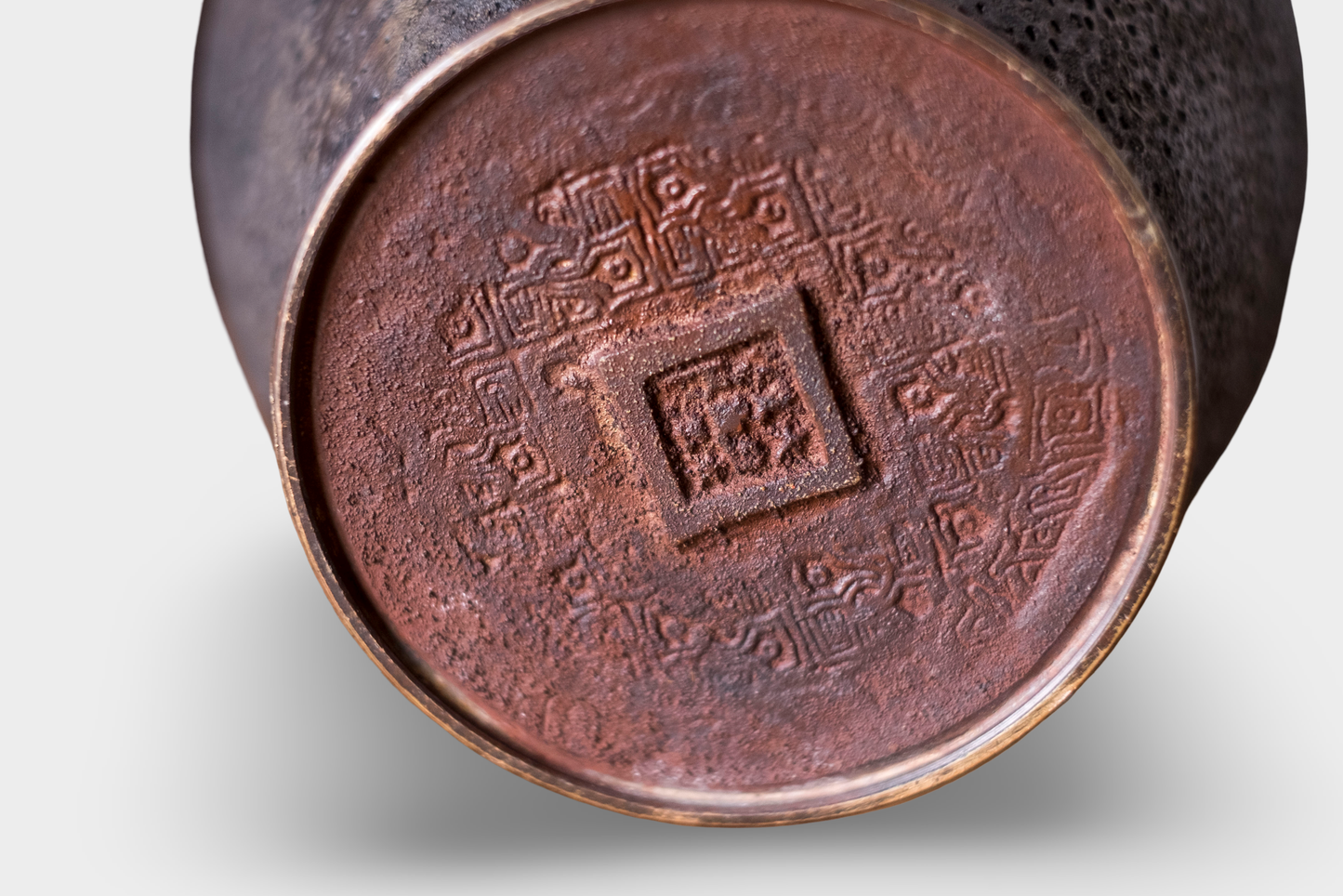
Description of the Base Mark
-
Central recessed square cartouche
-
Surrounding geometric seal-style ornamentation
-
No legible Japanese kanji
-
Surface shows uniform oxidation and casting wear, not sharp modern stamping
Interpretation
This is not a Chinese reign mark.
Key reasons:
-
Chinese bronze marks typically present raised or sharply incised seal script with clear reign formulas (e.g. 大清, 大明).
-
This mark is abstracted, decorative, and structural to the mold, not stamped post-casting.
-
The surrounding repeating motifs align with Japanese Meiji decorative base patterns, often used by regional foundries producing art bronzes for domestic interiors and export.
Conclusion:
✔ Japanese workshop mark or decorative foundry base
✖ Not a Qing or PRC Chinese export mark
✖ Not a modern laser-cut or acid-etched stamp
This kind of base is frequently seen on Meiji–Taishō usubata vases, especially those produced for ikebana schools and upper-middle domestic use.
Material & Age Assessment
Bronze vs Modern Alloy
-
The surface shows deep, irregular oxidation with warm brown and umber tones
-
Greenish verdigris appears naturally in recesses
-
Applied grape clusters exhibit hand-finished softness, not crisp mold repetition
These characteristics rule out modern resin or post-1980 Chinese decorative bronze.
Casting Quality
-
Body texture is intentionally stippled (tsuchime-inspired surface)
-
Applied vines show slight asymmetry — a positive indicator of period work
-
Foot rim wear is consistent with age and handling
Assessment:
Authentic Japanese cast bronze, late Meiji to early Taishō, not a replica.
Size Estimation
Based on proportion, mouth diameter, and base footprint relative to known usubata examples:
-
Estimated height: 18–22 cm (approx. 7–8.5 inches)
-
Mouth diameter: approx. 9–11 cm
This places it in the small-to-mid usubata category, intended for tabletop or tokonoma display, not floor placement
Confidence & Verification Notes
-
Identified as a Japanese cast bronze usubata ikebana vase
-
Period attributed based on casting method, surface oxidation, and base construction
-
Base mark interpreted as decorative foundry motif, not a Chinese reign mark
-
No modern manufacturing indicators observed
-
Age and origin stated with conservative scholarly restraint
Authenticity & Stewardship
Evaluated under the Japonista Authentication Framework™:
- Material, carving, and surface-study comparison
- Iconographic and stylistic verification
- Condition and stability review (surface integrity)
- Construction assessment and handling-risk evaluation
Guaranteed 100% Authentic. Covered by the Japonista Lifetime Authenticity Warranty™.
A Note on Stewardship and Collecting
At Japonista, we approach Buddhist statues, sacred images, and ritual objects not merely as collectibles, but as cultural and spiritual artifacts deserving of respect, understanding, and careful presentation. Every piece we offer is thoughtfully examined, researched, and curated with sensitivity to its origin, meaning, and historical role.
Our role is not only to offer access to rare and meaningful objects, but to serve as responsible custodians—connecting the right works with collectors who value depth, intention, and authenticity.
Inquiries, Availability, and Private Consideration
Some of the cultural and heritage works may allow room for discussion, while others are held firmly due to rarity, condition, or cultural importance. All inquiries are reviewed personally and discreetly, and we welcome thoughtful questions or expressions of interest.
If you are exploring a particular theme, deity, lineage, or period—or seeking guidance in building a focused collection—our concierge team is always available to assist with quiet expertise and care.
Concierge Support & Collector Guidance
Japonista Concierge™ provides personalized assistance for collectors seeking deeper understanding, thoughtful acquisition, or long-term curation strategies. Whether your interest is devotional, scholarly, or aesthetic, we are here to help guide your journey with clarity and respect.
For select high-value or historically significant works, private reservation or structured payment arrangements may be available on a case-by-case basis. Please reach out to discuss eligibility and discreet options.
Before Proceeding
We kindly encourage collectors to review our shop policies and house guidelines, available through the links in our website footer, which outline shipping, handling, and conditions specific to vintage, sacred, and collectible works.
A Closing Note
Thank you for exploring Japonista’s collection of Oriental Cultural Heritage and arts. We are honored to share these meaningful works and to help place them where they may continue to be appreciated, studied, and respected.
If you have questions or wish to explore related works, please feel free to contact Japonista Concierge™ at any time.