Rare Vintage, Antiques and Art Collector / Curator / Personal Shopper From Japan
Antique Japanese Brass Diving Helmet TOA Tokyo Vintage Maritime Diver Helmet Industrial Nautical Artifact
Antique Japanese Brass Diving Helmet TOA Tokyo Vintage Maritime Diver Helmet Industrial Nautical Artifact
Couldn't load pickup availability
Have a reasonable price in mind? Submit your best offer and our concierge will review it personally.
ANTIQUE JAPANESE BRASS DIVING HELMET, PROBABLY TOA WORKSHOP, MID-20TH CENTURY
Industrial maritime example with authentic patina; complete multi-port structure; collector-grade decorative conversion potential
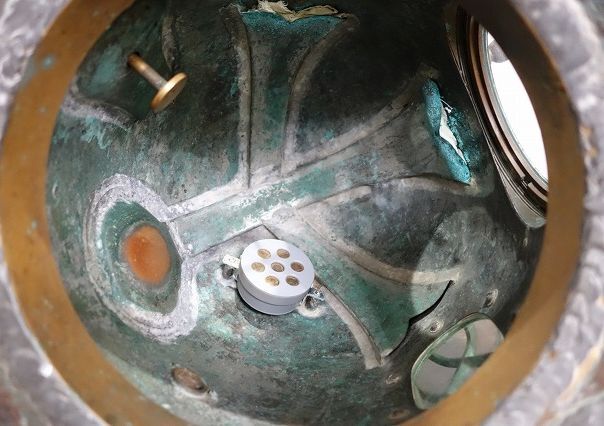
A substantial and visually compelling brass diving helmet of probable Japanese origin, likely produced within the Minami-Senju industrial district during the mid-20th century. Constructed in heavy gauge brass with multiple reinforced viewing ports and a bolted neck flange system, the piece exhibits extensive natural oxidation and surface patination consistent with prolonged exposure to marine or humid conditions. Retaining its original structural integrity and fittings, this helmet stands as both a functional relic of industrial diving history and a powerful sculptural object suited for high-impact interior display. Offered in as-found condition, presenting strong aesthetic character and historical authenticity.
Category: Maritime & Diving Antiques
Object Type: Surface-supplied diver’s helmet / display-grade artifact
Material Composition:
• Solid brass dome construction
• Copper/brass alloy fittings
• Glass viewports (front + side lattice guards)
• Multi-bolt neck ring system
Dimensions (approx):
H 42 cm × W 36 cm × D 42 cm
Origin (Attributed):
Japan — Tokyo (Minami-Senju industrial zone, TOA-type production era suspected)
Era:
Mid 20th century (Showa industrial maritime period, likely 1940s–1960s)
Condition:
Vintage / used
• Heavy patina development (verdigris oxidation)
• Surface abrasions, corrosion spots
• Structurally intact
• Interior present, untested for diving functionality
Overview
This is not a prop.
This is not decorative fiction.
This is a machine built to keep a human alive where humans do not belong.
The ocean doesn’t negotiate.
It crushes, floods, erases.
And this helmet—
this heavy, riveted, oxidized dome—
was once the only thing standing between a man and that silence.
Material & Surface Language
Brass, over time, becomes a storyteller.
Not polished. Not pristine.
But layered in green oxidation, salt memory, and chemical scars.
Each patch of verdigris is a timestamp:
• Exposure to moisture
• Contact with air and minerals
• Years without intervention
The result?
A surface that looks less manufactured…
and more grown.
Almost like coral tried to claim it.
Engineering Anatomy
Look closely and it reveals its logic:
• Thick circular viewport — pressure resistance
• Side lattice windows — reinforced visibility
• Air intake valve — lifeline connection
• Multi-bolt neck flange — sealed interface with suit
This is early human vs pressure engineering.
No electronics. No sensors.
Just:
🔩 Metal
🔧 Physics
🫁 Trust
Historical Context
Japan’s post-war and mid-Showa industrial zones—particularly areas like Minami-Senju—were dense with:
• Metalworking facilities
• Marine equipment fabrication
• Salvage and port infrastructure
Helmets like this were used for:
• Harbor construction
• Ship repair
• Salvage diving
• Underwater welding
Not glamorous work.
Hard, dangerous, unseen labor.
Functional vs Object Evolution
Originally:
→ Life-support equipment
Now:
→ Artifact
→ Sculpture
→ Interior anchor
It has crossed the boundary from:
tool → relic → symbol
And that transformation is where value multiplies.
Collector Relevance
This sits inside a powerful cross-category zone:
• Maritime collectors
• Industrial design collectors
• Steampunk / cinematic collectors
• High-end interior designers
Unlike fashion or watches—
This category has:
📉 Lower saturation
📈 Higher uniqueness per piece
No two helmets age the same.
Collector’s Resonance
This piece is for someone who wants:
• Weight in their space
• History without explanation
• Objects that feel like they’ve lived a life
You don’t “style” this.
You place it… and everything else adjusts around it.
Summary
A silent dome that once faced crushing depth.
Now surfaced—
not cleaned, not restored—
but honestly aged.
Authenticity & Stewardship
Evaluated under the Japonista Maritime & Diving Heritage Authentication & Provenance Framework™
Each object is assessed through a structured, cross-disciplinary review:
• Object typology and period attribution (nautical instruments, ship fittings, diving apparatus, naval equipment)
• Material analysis across brass, copper, bronze, steel, glass, rubber, and composite components
• Manufacturing and maker identification, including foundry marks, engraved plates, and workshop signatures
• Functional and mechanical assessment where applicable (valves, gauges, seals, joints)
• Surface condition and patina evaluation, distinguishing age-consistent oxidation from later alteration
• Provenance indicators, including maritime usage context or collection history where available
Guaranteed 100% Authentic.
All works are curated and backed by the Japonista Lifetime Authenticity Warranty™, with emphasis on material integrity, historical accuracy, and responsible documentation.
A Note on Navigation, Depth & Human Ingenuity
Maritime and diving objects were created at the edge of human capability—where navigation depended on precision, and survival relied on engineering.
From shipboard instruments to early diving helmets, these objects reflect a convergence of craft, science, and risk. Each component—glass port, weighted fitting, pressure mechanism—was designed with purpose under demanding conditions.
At Japonista, these works are approached as functional artifacts of exploration. Wear, salt exposure, oxidation, and structural aging are read as part of their operational history rather than imperfection.
They are records of movement across oceans and descent into depth—material traces of environments few objects endure.
Inquiries, Availability, and Private Consideration
Maritime and diving antiques are often singular due to survival rates, condition, and construction variation. Larger or mechanically complex pieces may be especially limited.
All inquiries are handled with discretion. We welcome thoughtful discussion regarding maker attribution, functional components, restoration history, and display considerations.
Collectors, institutions, and designers building maritime-focused collections may consult with us for deeper guidance.
Concierge Support & Collector Guidance
Japonista Concierge™ provides tailored support for maritime collectors:
• Object identification and dating across nautical and diving categories
• Material preservation guidance, particularly for metals exposed to marine environments
• Display strategies for both decorative and large-format industrial objects
• Mechanical stabilization considerations for legacy equipment
• Acquisition planning for building cohesive maritime collections
For rare or large-scale works, private reservation or structured acquisition arrangements may be available.
Before Proceeding
We encourage collectors to review our shop policies and handling guidelines available through the links in our website footer. These outline shipping logistics, condition disclosure, and care considerations specific to heavy, fragile, or mechanically complex objects.
Understanding these guidelines ensures safe handling and long-term preservation.
A Closing Note
Maritime and diving artifacts are shaped by environments defined by pressure, motion, and uncertainty. They carry the marks of salt, depth, and time.
What remains is not only the object, but the evidence of its endurance.
At Japonista, we steward these works as records of exploration and engineering, ensuring they continue forward with context, integrity, and respect for the conditions that formed them.
If you have questions or wish to explore related items, please feel free to contact Japonista Concierge™ at any time.