Rare Vintage, Antiques and Art Collector / Curator / Personal Shopper From Japan
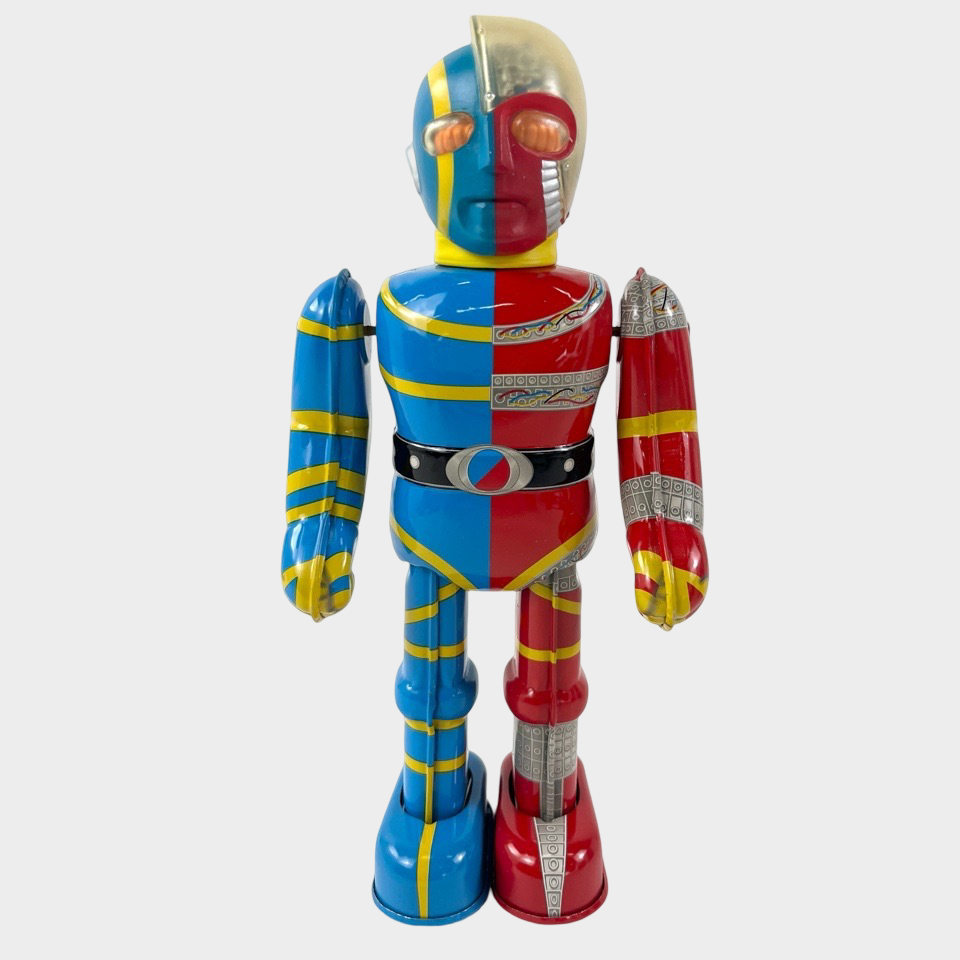
Biliken Shokai Android Kikaider Tin Wind-Up Figure — Showa Japanese Buriki Hero, Boxed Mechanical Toy
Biliken Shokai Android Kikaider Tin Wind-Up Figure — Showa Japanese Buriki Hero, Boxed Mechanical Toy
Couldn't load pickup availability
Have a reasonable price in mind? Submit your best offer and our concierge will review it personally.
🧠 CURATORIAL ANALYSIS
Overview
Kikaider is not a hero of strength — he is a hero of conscience.
That distinction matters enormously when rendered in tin.
Where other tokusatsu figures emphasize power, monsters, or speed, Kikaider’s entire identity is built around internal conflict: a mechanical being programmed to obey, yet struggling toward ethical autonomy. Tinplate is the perfect medium for this idea. It is rigid, segmented, reflective — visibly mechanical — yet capable of movement that feels strangely human.
This is not accidental symbolism. This is Showa philosophy made physical.
Character / Title: (Android Kikaider)
Original Creator: (Shotaro Ishinomori)
Maker / Program: (Biriken Shokai) — The Golden Age of Tin Toys
Category: Tinplate humanoid figure
Material: Lithographed tinplate + clear head element
Mechanism: Zenmai (spring wind-up) — walking action confirmed
Action: Forward walk (mechanical gait)
Packaging: Original illustrated box + paper materials included
Condition Tier: B (visible wear, age-consistent; movement present)
Cultural Axis: Tokusatsu × mechanical morality × Showa design language
Iconography (Why Kikaider Looks the Way He Does)
Collectors immediately recognize Kikaider through several visual codes:
-
Asymmetrical color blocking → inner division, incomplete self
-
Visible mechanical motifs → identity as machine, not disguise
-
Clear head element → transparency, vulnerability, consciousness
-
Upright stance → dignity through restraint, not dominance
In tin, these elements flatten into graphic absolutes. The toy does not hide its construction — it declares it.
Materials & Mechanism (Why Zenmai Matters Here)
Zenmai motion is not just nostalgic — it is thematic.
-
Wind → external force (command, programming)
-
Release → limited autonomy
-
Walk → effortful progress
-
Stop → imposed limitation
Kikaider’s walk is never smooth. That hesitation is correct.
A battery-powered glide would betray the character.
Philoshophical Context
Kikaider emerged during a critical shift in Japanese pop culture:
-
Post-industrial anxiety
-
Ethical questions about automation
-
Fear of control systems and loss of agency
Unlike Western robots, Kikaider is not a servant or conqueror — he is a moral experiment. Tin toys allowed children to rehearse these questions through play, long before AI became real.
Biriken’s revival matters because it preserves not just the shape, but the ideological friction of the original.
HISTORICAL & CULTURAL BACKGROUND
Android Kikaider ー debuted in 1972. This Japanese tokusatsu superhero television series created by manga artist Shotaro Ishinomori. Produced by Toei Company and aired on NET (now TV Asahi), it follows a humanoid android hero battling an evil organization. The show became a foundational entry in Japan’s 1970s superhero boom and remains a classic of the genre.
Key facts
-
Original broadcast: 1972–1973 (NET/TV Asahi)
-
Episodes: 43
-
Creator: Shotaro Ishinomori
-
Production company: Toei Company
-
Genre: Tokusatsu, science fiction, action
Story and Characters
The story centers on Jiro, an android created by Dr. Komyoji, who transforms into Kikaider, a red-and-blue android powered by a conscience circuit. After Dr. Komyoji is captured by the evil organization DARK and its leader Professor Gill, Jiro rebels against his programming to protect humans and resist Gill’s control. The show explores themes of free will, morality, and the tension between humanity and machinery.
Production and Style
The series combined Ishinomori’s philosophical storytelling with Toei’s pioneering special effects. Filmed primarily in outdoor locations around Japan, it featured colorful suits, practical explosions, and stylized fight choreography. Kikaider’s design, split symmetrically into red and blue halves, symbolized his dual nature—half machine, half human conscience.
Cultural Impact and Legacy
Android Kikaider gained a large following for its darker tone and existential themes, influencing later tokusatsu and anime works. It spawned sequels and spin-offs such as Kikaider 01, animated adaptations, and a 2001 live-action reboot. The franchise remains an iconic representation of Japan’s early 1970s hero television era.
Unlike simple good-vs-evil heroes:
-
Kikaider was programmed, not born
-
His struggle was ethical, not physical
-
Children were introduced to ideas of autonomy, conscience, and choice
Biliken Shokai later became famous for preserving this emotional weight through faithful tin reproductions — not modernized, not “cute-ified.”
BILIKEN SHOKAI CONTEXT
Biliken is not a mass toy brand.
They specialize in:
-
Short-run heritage models
-
Faithful Showa proportions
-
Traditional tin lithography techniques
-
Mechanical authenticity over articulation gimmicks
Their works sit between toy and folk sculpture — often collected alongside sofubi, not action figures.
MECHANICAL BEHAVIOR & MATERIAL TRUTH
-
Walking gait: Side-to-side advance typical of buriki balance systems
-
Wind-up torque: Adequate; not overwound
-
Tin resonance: Audible internal vibration when in motion
-
Paint aging: Expected micro-wear at edges and raised lithography
⚠️ As with all tin wind-ups:
Functionality today does not imply permanence. These are mechanical survivors, not modern appliances.
COLLECTOR RELEVANCE
This piece resonates with collectors who value:
-
Showa-era hero philosophy
-
Mechanical honesty over poseability
-
Tin as an expressive medium
-
Ishinomori’s darker moral universe
-
Display objects that teach as much as they decorate
It is especially relevant to collectors of:
-
Buriki / tin heritage
-
Tokusatsu lineage objects
-
Japanese post-war design history
POSITIONING & VALUE INTELLIGENCE
This example is not “mint perfection.”
Its value lies in:
-
Authentic materials
-
Correct proportions
-
Boxed survival
-
Functioning mechanism
-
Cultural clarity
Comparable Biliken Kikaider examples routinely disappear into private collections rather than circulate continuously.
Packaging as Cultural Interface
The illustrated box is not secondary. It functions as:
-
Narrative primer
-
Visual grammar guide
-
Emotional framing device
In Showa toy culture, the box taught you how to see the toy.
A boxed Kikaider is a complete educational unit, not just an object.
Collector Relevance
This piece belongs with:
-
Godzilla tins (external threat)
-
Super Jetter (technological optimism)
-
Yusei Kamen (moral authority)
Kikaider sits at the ethical center of that constellation.
Collectors who understand this do not treat him as “another hero toy” — they treat him as mechanical literature.
Authenticity & Collectible Stewardship
Evaluated under the Japonista Collectibles Authentication Framework™:
-
Period, manufacturer, and production-era assessment
-
Material, paint, lithography, and surface-wear analysis
-
Mechanical, structural, and component integrity review (where applicable)
-
Design, iconography, and cultural-context verification
Guaranteed 100% Authentic.
Every piece is backed by the Japonista Lifetime Authenticity Warranty™ and curated with collector-grade scrutiny.
A Note on Collecting & Preservation
At Japonista, we approach vintage and modern toys not merely as nostalgic objects, but as design artifacts, cultural touchstones, and expressions of their era—from postwar ingenuity and Showa imagination to contemporary pop and designer movements.
Each work is carefully examined, researched, and presented with respect for its original intent, historical context, and collector relevance, balancing preservation with the honest character earned through time and play.
Our role is not only to offer access to meaningful collectibles, but to act as thoughtful custodians—connecting the right pieces with collectors who value history, originality, and lasting significance.
Inquiries, Availability, and Private Consideration
Some collectible works may allow room for discussion, while others are held firmly due to rarity, condition, provenance, or cultural importance. All inquiries are reviewed personally and discreetly, and we welcome thoughtful questions or expressions of interest.
If you are exploring a specific theme, franchise, maker, era, or mechanical category—or seeking guidance in building a focused collection—our team is always available to assist with informed, quiet expertise.
Concierge Support & Collector Guidance
Japonista Concierge™ offers personalized assistance for collectors seeking deeper understanding, strategic acquisitions, or long-term curation across vintage and modern collectibles.
Whether your interest lies in nostalgia, design history, mechanical fascination, or pop-culture legacy, we are here to support your collecting journey with clarity, care, and discretion.
For select high-value or historically significant pieces, private reservation or structured payment arrangements may be available on a case-by-case basis. Please contact us to discuss eligibility and options.
Before Proceeding
We kindly encourage collectors to review our shop policies and house guidelines, available through the links in our website footer, which outline shipping, handling, and condition standards specific to vintage, mechanical, and collectible works.
A Closing Note
Thank you for exploring Japonista’s collection of vintage and modern toys, robots, and cultural collectibles. We are honored to share these enduring objects of imagination and design—and to help place them where they may continue to be appreciated, studied, and enjoyed.
If you have questions or wish to explore related works, please feel free to contact Japonista Concierge™ at any time.