Rare Vintage, Antiques and Art Collector / Curator / Personal Shopper From Japan
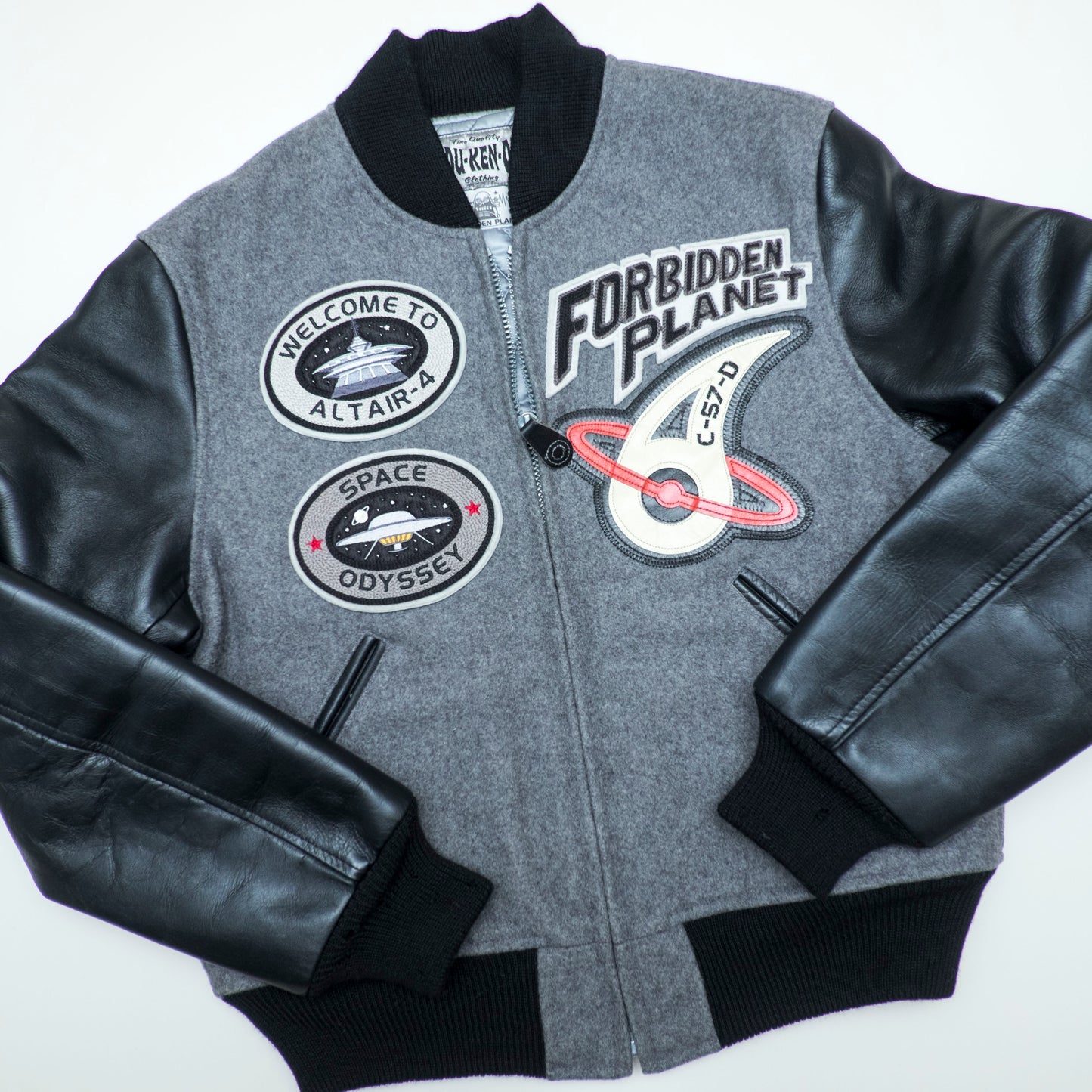
Amekaji Holy Grail BOUKEN-OH Adventure King “Forbidden Planet” Robby The Robot Stadium Sutajan Jacket
Amekaji Holy Grail BOUKEN-OH Adventure King “Forbidden Planet” Robby The Robot Stadium Sutajan Jacket
Couldn't load pickup availability
Have a reasonable price in mind? Submit your best offer and our concierge will review it personally.
Quick Details:
This is a black-bodied stadium jacket featuring a dramatic, science-fiction-inspired back embroidery centered around the iconic “Bouken-Oh / Adventure King” identity.
The back panel showcases a bold, highly graphic motif referencing classic “Forbidden Planet” / retro sci-fi aesthetics — a genre deeply rooted in post-war Japanese pop culture, manga, and tokusatsu influence.
The embroidery is executed in a heavy, high-contrast thread palette, giving the artwork a raised, tactile presence rather than flat decorative stitching. The design reads clearly from distance, a hallmark of premium stadium jackets intended for visual impact in public spaces.
Sleeves are constructed from contrasting leather, giving the jacket authentic varsity proportions and weight balance. Ribbing at collar, cuffs, and hem retains structure while framing the body cleanly.
Overall silhouette is boxy and traditional, aligned with classic American varsity cuts adopted and reinterpreted by Japanese brands.
CURATORIAL NARRATIVE:
This jacket reads like an artifact from the overlap between two devotions: Japan’s postwar obsession with American pop mythology, and the enduring collector cult around mid‑century science fiction. “Stadium jacket” is an American form—born from varsity ritual, athletic ceremony, and the swagger of the award jacket—yet in Japan it became an archivist’s silhouette, refined by reproduction culture and elevated into fashion object. Here, that silhouette is used as a display case: the back panel becomes the wall of a private gallery, carrying a single “exhibition image” meant to be seen from across a room.
The motif—Forbidden Planet and Robby the Robot—matters because it is not merely “retro.” It is foundational. Forbidden Planet (1956) is widely regarded as a landmark in science‑fiction cinema, a film where the future is staged with theatrical seriousness, and where technology is treated as character rather than prop. Robby the Robot, introduced through that film, became one of the most recognizable robots in screen history: a figure that crystallized the “Space Age” imagination for a generation. When a jacket chooses Robby, it is choosing an icon with a deep visual memory—more like selecting a museum poster than selecting a graphic.
Robby’s significance is also symbolic: he represents the optimism and dread of the Atomic Age in one body. His design is friendly and industrial, advanced and heavy, almost like a walking machine-room—an embodiment of “the future” as it was pictured in the 1950s. That tension is precisely why the motif still feels modern. In contemporary style language, Robby is the ancestor of retro-futurism: the clean geometry, the mechanical confidence, the promise that a machine can be both assistant and myth.
The back artwork on this piece functions like a badge of connoisseurship. It’s not the obvious franchise of the present; it’s a reference that signals long memory and taste—film history, robot history, and the collector’s habit of recognizing the “firsts” (first icons, first archetypes). In the way a jazz collector looks for first pressings, the sci‑fi collector looks for early archetypes; Robby is that kind of archetype.
From a garment-architecture perspective, the stadium jacket is ideal for this subject. Leather sleeves (or leather-like contrast sleeves) create the “armor” effect; wool or heavy body fabric creates the “uniform” effect; rib knit hems and cuffs frame the image like a border. This is why varsity jackets carry graphics so well—they are already built like a framed object. The result is a wearable poster with structure.
In the collector economy, this is a “cross‑category” piece, which is where maximum upside lives: (1) heritage reproduction / Japanese archive outerwear, (2) film memorabilia / sci‑fi history, (3) robot iconography, and (4) statement black outerwear as everyday uniform. Cross‑category items sell higher because they recruit multiple buyer tribes, and the buyer feels they are acquiring more than one story at once.
ICONOGRAPHY & CULTURAL CONTEXT
“Bouken-Oh / Adventure King” as a naming concept taps directly into Japan’s long-standing fascination with exploration, outer space, and heroic futurism — themes that dominated mid-century manga, pulp magazines, and early sci-fi cinema.
The “Forbidden Planet” reference is especially important:
- It signals a retro-futurist worldview
- It aligns with late-Showa and early-Heisei nostalgia
- It places the jacket within a lineage of sci-fi collectibles rather than simple fashion
This is not casual embroidery — it is narrative embroidery. The jacket tells a story of danger, discovery, and heroic confrontation with the unknown.
Such pieces were often produced in limited runs or short production cycles, making survival rates in wearable condition extremely low today.
CONDITION ASSESSMENT
- Leather sleeves appear supple with no visible cracking
- Ribbing maintains elasticity
- Embroidery threads show no fraying or discoloration
- Interior lining appears clean and intact
Condition is listed as “near unused.” As with all archive outerwear, micro storage marks can exist (minor rubs, faint creases at leather, small knit fuzz). Excellent pre-owned condition; please review photos for any minor storage marks typical of preserved outerwear. No promises beyond visible evidence.
SIZE & FIT DATA
Tagged Size: M
Measured (approximate):
- Body Width: ~55 cm
- Length: ~59 cm
- Shoulder Width: ~45 cm
- Sleeve Length: ~63 cm
Fit Interpretation:
Classic Japanese M — best suited for:
- Slim to average builds
- Layering over light knits or sweatshirts
- Collectors who prioritize proportional authenticity over oversized trends
RARITY & COLLECTOR VALUE
This jacket sits at the intersection of:
- Japanese sci-fi nostalgia
- Stadium jacket collecting
- Embroidered outerwear appreciation
Adventure King is not a mass-export brand, and pieces like this were never intended for international markets.
Comparable jackets from larger heritage brands (Real McCoy’s, Buzz Rickson’s) with similar embroidery density now command significantly higher prices.
This piece remains undervalued relative to:
- Craft complexity
- Narrative strength
- Condition
- Cultural specificity


Inquiries, Size Availability & Private Consideration
Some items in our shop allow limited flexibility, while others are firmly priced due to rarity, condition, or archival significance. On a case-by-case basis, we do consider reasonable best offers. All inquiries are reviewed personally and handled discreetly.
Whether you’re searching for a specific sizes (other than advertised), label, era, motif, or aesthetic — or building a focused Amekaji wardrobe or archive — our concierge team is available to assist with quiet expertise and care.
If you have a specific figure in mind or would like to discuss options, please feel free to reach out directly. We review all inquiries seriously and do our best to accommodate budgets and collecting goals whenever possible.
We’re always happy to help — just a message away.
Authenticity & Archive Standards
Each piece is evaluated under the Japonista Authentication Framework™, with close attention to:
-
Fabric, material, and construction analysis
-
Stitching, embroidery, print, and hardware verification
-
Brand, era, and stylistic consistency
-
Condition grading and wear-pattern assessment
-
Handling, storage, and long-term preservation considerations
All items are 100% authentic, backed by the Japonista Lifetime Authenticity Warranty™.
A Note on Stewardship & Archive Curation
At Japonista, we approach Amekaji fashion archives not merely as clothing, but as cultural garments shaped by craft, subculture, and time. Every piece is carefully examined, researched, and curated with respect for its origin, design language, and place within the evolution of Japanese street and heritage fashion.
Our role extends beyond offering rare pieces — we act as responsible stewards of archive-grade fashion, connecting garments with collectors who value authenticity, depth, and intention.
Before Proceeding
We kindly encourage customers to review our shop policies and house guidelines, available via the website footer. These outline shipping, handling, and condition considerations specific to vintage, archive, and collectible fashion pieces.
A Closing Note
Thank you for exploring Japonista’s Amekaji fashion archives and rare street-heritage pieces. We are honored to share garments that carry history, craftsmanship, and character — and to help place them where they will continue to be worn, preserved, and appreciated.
If you have questions or wish to explore related pieces, please feel free to contact Japonista Concierge™ at any time.