Rare Vintage, Antiques and Art Collector / Curator / Personal Shopper From Japan
1950s U.S. Navy G-1 Flight Jacket “Hirohito’s Headache” Hand Painted Bugs Bunny Aviation Artifact
1950s U.S. Navy G-1 Flight Jacket “Hirohito’s Headache” Hand Painted Bugs Bunny Aviation Artifact
Couldn't load pickup availability
Have a reasonable price in mind? Submit your best offer and our concierge will review it personally.
A U.S. NAVY G-1 FLIGHT JACKET, CIRCA 1950s, PAINTED “HIROHITO’S HEADACHE” WITH CARTOON FIGURE
Rare occupation-era cultural artifact combining military leather, animation iconography, and postwar symbolic language
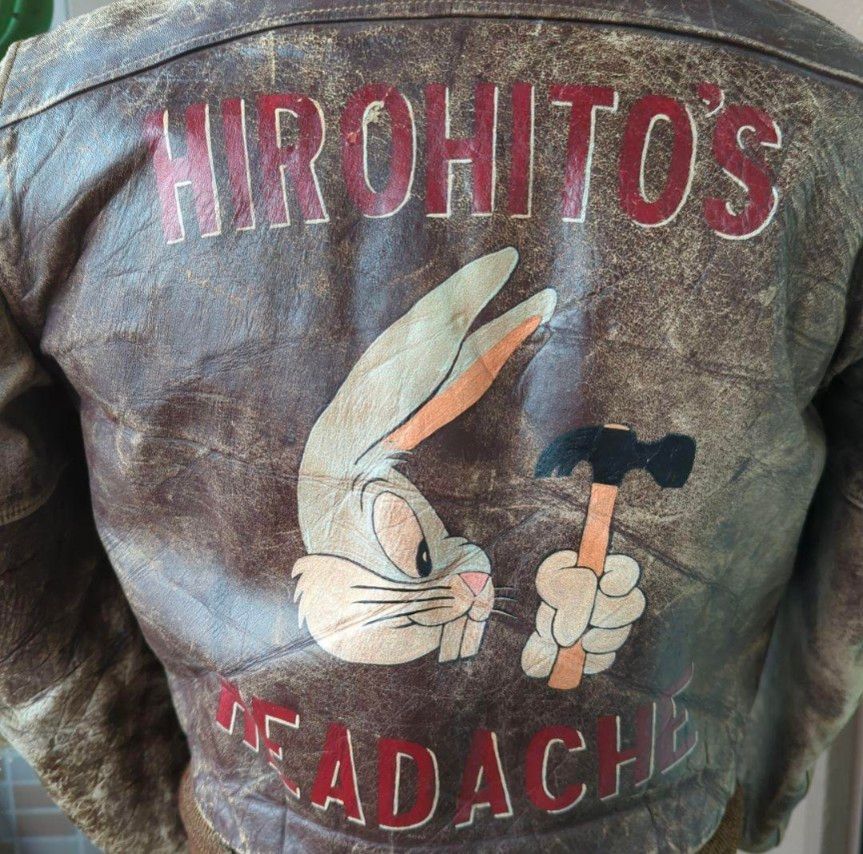
A goatskin G-1 flight jacket retaining its mouton collar and original military construction, the reverse boldly painted with the phrase “Hirohito’s Headache” and a depiction of the Warner Bros. character Bugs Bunny wielding a hammer. The imagery reflects a convergence of wartime cultural language and postwar occupation-era sentiment, in which humor, caricature, and symbolic aggression intersect. The leather surface displays significant oxidation and patination consistent with long-term wear, while the painted layer remains stable and integrated. The present example occupies a rare category of aviation garments in which personal expression extends beyond unit identification into broader cultural commentary, offering a complex and historically charged visual document.
Object
G-1 U.S. Navy Flight Jacket (Hand-Painted Reverse)
Production Era
Early–mid 1950s (Korean War / immediate post-WWII occupation period)
Category
Original military flight leather with period-style personalized painted back
Material
Goatskin-class flight leather (typical of G-1 specification; surface confirms pebble grain under oxidation)
Hardware
SERVEL zipper (period-correct hardware class; functional)
Construction Features
- Bi-swing back construction
- mouton shearling collar (significant wear / loss at edge)
- rib knit waistband and cuffs (aged, compressed)
- USAAF/USN-style chest pocket configuration
- shoulder patch (aviation insignia with eagle/star motif)
Decoration Context (Critical)
Reverse panel hand-painted:
- Text: “HIROHITO’S HEADACHE”
- Central figure: Bugs Bunny holding hammer
- Composition: cartoon aggression motif directed symbolically toward Imperial Japan reference
Condition Summary
- Leather heavily oxidized with high-contrast patina
- Collar degradation (mouton loss and thinning)
- Paint layer stable with age-consistent wear
- Structurally intact → controlled wearable / high-tier display piece
COLLECTOR RELEVANCE
Tier: High Narrative / Cultural Edge Aviation Artifact
Primary buyers:
- advanced militaria collectors
- WWII / Korean War cultural historians
- aviation art collectors
- controversial / narrative-driven artifact buyers
This piece carries edge value—not for everyone, but extremely strong for the right collector.
CONFIDENCE & VERIFICATION NOTES
Strong:
- G-1 structural authenticity
- period-correct hardware
- integrated paint aging
Measured:
- exact timing of paint application
- direct wearer attribution
A Jacket That Sits at the Edge of War and Memory
This is not neutral military customization.
This is not decorative nostalgia.
This is language formed in the immediate aftermath of conflict.
The phrase “Hirohito’s Headache” directly references Emperor Hirohito, placing the object inside a psychological landscape shaped by WWII memory and its unresolved aftermath during the early Cold War years.
This jacket does not simply represent military identity.
It reflects how conflict lingers in humor, caricature, and symbolic aggression.
Why Bugs Bunny Appears Here
The presence of Bugs Bunny is not random.
During WWII and after, American animation—especially Warner Bros.—became embedded in military culture:
- cartoons used for morale
- characters used as informal mascots
- humor deployed as emotional release
Bugs Bunny specifically appears frequently in military art because:
- irreverent personality
- anti-authority tone
- adaptable symbolic role
Here, Bugs is not playful.
He is weaponized humor.
The hammer in hand transforms the character from comic figure → symbolic aggressor.
The Phrase: “Hirohito’s Headache”
This is where the jacket becomes serious.
The phrase operates on multiple levels:
- direct reference to wartime enemy leadership
- continuation of wartime language into postwar period
- expression of unresolved hostility reframed as humor
This is not uncommon in occupation-era objects, but examples that survive in wearable leather form are rare.
Historical Positioning
This piece sits precisely in a narrow and important window:
Late 1940s → Early 1950s
Where:
- WWII had ended
- U.S. presence in Japan remained strong
- Korean War tensions were active
- cultural perception of former enemies was still evolving
Objects from this period often contain:
- contradiction
- humor masking hostility
- symbolic language that would not be produced in later decades
This jacket is a direct product of that environment.
Material and Surface Authority
The leather shows advanced oxidation:
- mottled surface pattern
- high contrast tonal variation
- grain expansion and dryness zones
This is not artificial distress.
This is decades of environmental exposure interacting with military-grade goatskin.
Unlike the previous A-2 artifact (collapsed leather), this jacket retains:
- structure
- silhouette
- wearable capacity
This places it in a higher liquidity bracket.
Paint Layer Analysis
The paint is:
- embedded into the leather grain
- worn consistently across surface stress points
- aged in harmony with leather, not sitting artificially above it
This supports classification as:
period-integrated painted layer, not modern addition
Collar and Wear Reality
The mouton collar shows:
- edge loss
- compression
- uneven wear
Important point:
The collar damage does not reduce value significantly here, because:
- the back panel is the primary value driver
- the piece is already narrative-dominant, not condition-dominant
MATERIAL FORENSICS
Leather Behavior
- Pebble grain consistent with G-1 goatskin
- Surface bloom and oxidation visible
- Structural integrity still present
Conclusion:
Matured, not collapsed
Paint Integration
- no peeling layers inconsistent with age
- wear aligns with flex zones
- color fading natural, not uniform
Conclusion:
Authentic aging trajectory
Patch Element
Shoulder insignia:
- embroidered aviation motif
- consistent with period military patch styling
Acts as a secondary authenticity anchor.
Authenticity & Stewardship
Evaluated under the Japonista Aviation & Military Garment Authentication Framework™
Each work is examined through a structured, multi-layered assessment:
• Model classification and military typology verification (A-2, B-3, MA-1, G-1, L-2, etc.)
• Material evaluation across leather, shearling, nylon, wool, and mixed components
• Hardware inspection including zippers, snaps, and period-correct fastenings
• Graphic and nose art analysis, including paint method, iconography, and historical alignment
• Condition and structural integrity review, including wear patterns consistent with age and use
Where applicable, contract labels, manufacturer markings, and period construction details are reviewed to confirm authenticity and era alignment.
Guaranteed 100% Authentic.
All garments are curated and backed by the Japonista Lifetime Authenticity Warranty™, with emphasis on both material truth and historical accuracy.
A Note on Flight Jackets, Service & Visual Identity
Military flight jackets were engineered as functional equipment—designed for temperature regulation, durability, and survival in demanding conditions. Over time, they evolved into carriers of identity, memory, and personal expression.
Nose art and painted jackets—originally applied to aircraft and later to garments—represent a distinct form of visual folklore. Pin-up figures, squadron insignia, mascots, and symbolic imagery transformed standard-issue equipment into individualized statements of presence and morale.
At Japonista, these jackets are approached as wearable military artifacts. Surface wear, leather creasing, paint aging, and textile fatigue are evaluated as evidence of lived history rather than imperfection.
We preserve these works with restraint—allowing their material narrative to remain visible and intact.
Our role is to connect these garments with collectors who recognize their dual nature as both functional objects and historical documents.
Inquiries, Availability, and Private Consideration
Many flight jackets are singular in character due to condition, paintwork, contract variation, or production era. Certain pieces are held firmly due to rarity, historical resonance, or preservation status.
All inquiries are handled discreetly, and we welcome thoughtful discussion regarding provenance, contract details, nose art interpretation, and long-term wear or display considerations.
Collectors building focused archives—by model type, era, or graphic style—may consult with us for deeper guidance.
Concierge Support & Collector Guidance
Japonista Concierge™ provides tailored assistance for collectors seeking deeper engagement with aviation garments:
• Model and contract identification (A-2 variants, G-1 lineage, MA-1 evolution)
• Leather and textile preservation guidance
• Paint conservation and display considerations
• Wearability versus archival preservation assessment
• Strategic acquisition planning for aviation-focused collections
For select rare or historically significant works, private reservation or structured acquisition arrangements may be available on a case-by-case basis.
Before Proceeding
We encourage collectors to review our shop policies and house guidelines, available through the links in our website footer. These outline shipping protocols, handling considerations, and condition standards specific to vintage leather, painted garments, and military-issued clothing.
Understanding these guidelines supports responsible stewardship of each piece.
A Closing Note
Flight jackets occupy a distinct place within material history. They are objects of function shaped by environment, and over time, transformed into records of identity, service, and expression.
Nose art—whether applied to aircraft or garments—extends this narrative, capturing moments of humor, defiance, and individuality within structured military life.
At Japonista, we steward these works as aviation artifacts in wearable form—ensuring they continue their journey with collectors who understand both their construction and their story.
If you have questions or wish to explore related items, please feel free to contact Japonista Concierge™ at any time.