
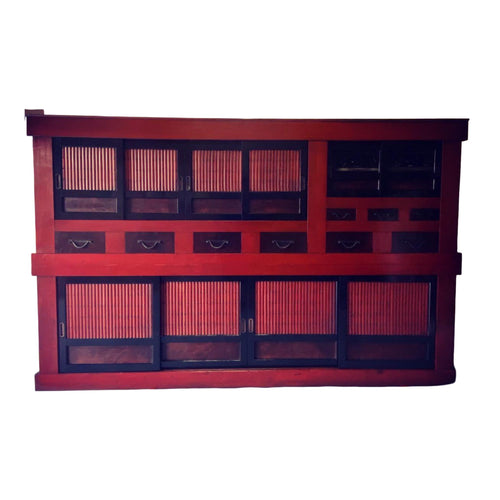


Omi Mizuya Tansu, Japanese Kitchen Cabinet in Red and Black, Studded Lattice Sliding Doors, Nine Drawers, Renewed Cedar Shelves, Two Sections
Omi Mizuya Tansu, Japanese Kitchen Cabinet in Red and Black, Studded Lattice Sliding Doors, Nine Drawers, Renewed Cedar Shelves, Two Sections
- Dispatch
- Packed, crated and cleared for export in about five weeks, often sooner, or as arranged
- Arrival
- États-Unis · by air about six weeks from order, by sea nine to fifteen weeks Check the Shipping Flowchart here
- Shipping
- Freight, by air or by sea ·
- Import
Duties and customs · View the estimate
A guide for this piece: about $4,227, based on the 10% US charge on the declared value of goods made in Japan.
The final figure is set by US Customs and depends on where the piece was made and the kind of object it is. Many antiques over a century old carry no ordinary duty; most jewellery and leather goods add a single-digit rate.
With freight, duties and taxes are settled at the arrival airport or seaport, by you, by your broker, or by us where we arrange delivery to your door.
Your customs authority: U.S. Customs and Border Protection (CBP), CBP Information Center · +1 877 227 5511 within the United States; +1 202 325 8000 from abroad (Monday to Friday, 8:30 to 17:00 Eastern)
These figures are estimates for your guidance; the charge set by customs may come in over or under them.
How the estimate is reached · Ask for a figure on this piece
- Character
- Balanced 4.5 of 10 ·
- Replies
- Within one Tokyo business day · Ask the curator team
- Guarantee
- Authenticity guaranteed · How we grade
Every piece is measured by hand, in centimetres as Japan measures. Please allow 1–2 cm (about ½ inch) for the give of the material and the hand that held the tape.
Where each figure is taken · View the plate

Furniture and tansu
Condition report
Very Good
- Giftable
- Mint
- Excellent
- Very Good
- Good
- Honest Wear
- As Found
Condition notes
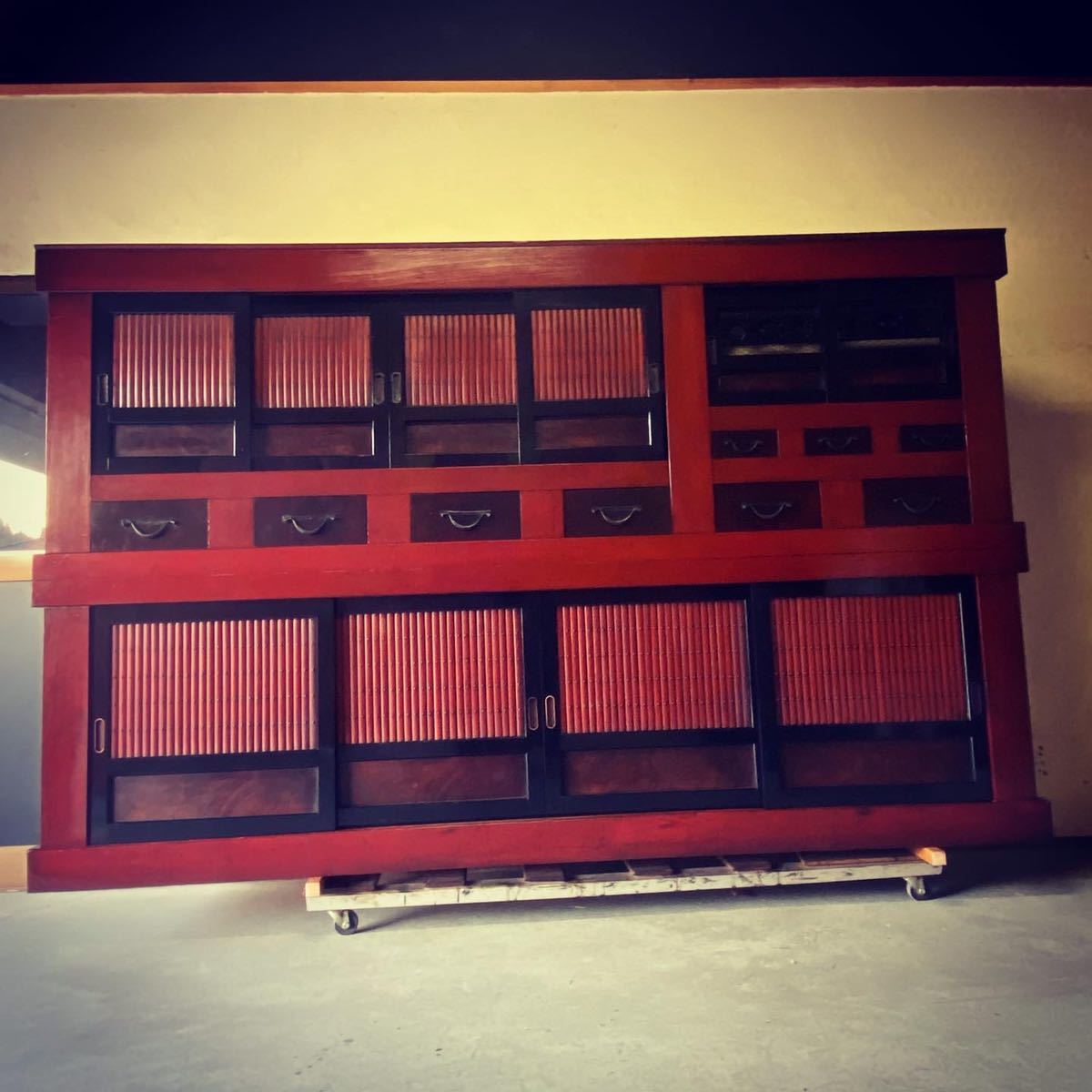
Recorded with signs of wear and soiling, and as restored: top boards replaced, shelves newly made as frames with vertical cedar boarding, glass and drawer interiors cleaned, surfaces polished. Photographs show the red finish rubbed back to the grain on posts and rails, small pale chips and scuffs along the front edge of the plinth and a few dark specks on the cornice. Black door frames glossy and even; lattice bars, studs, ten sliding doors and nine drawers with iron handles all in place; interior boards pale and clean. The photographs are strongly filtered, so the depth of the red is uncertain.
Grades, ratings and commentary are given to the best of our ability, knowledge and experience, and condition remains partly a matter of personal perception. What we stand behind without qualification is authenticity, truthful description and provenance, to the best of our knowledge. How we grade
Acquired by private invoice
Pieces of this calibre are reserved personally rather than through online checkout. Request the piece and the curator desk confirms availability, delivery and your invoice, payable by bank transfer or Wise. The piece is held for you while your transfer arrives.
Reserve this pieceAll sales are final. Please read our refund policy before purchase.
Considered offers only. The Desk replies personally to figures made in good faith; those set far below the asking price receive no reply.
Examined in Tokyo, one price, insured to your door. How buying from Japonista works · Join the Circle, free
Red posts, black door frames and row upon row of studded lattice: a two-section Omi mizuya, the kitchen cabinet of the Japanese house, one and a half ken wide and fitted with newly made cedar shelves.
The Piece
A mizuya, or mizuya-dansu, is the cupboard that stood in or beside the kitchen of a Japanese house and held its bowls, trays, lacquer and dry food. Omi is the old province around Lake Biwa, the present Shiga Prefecture, and this example is recorded as a one-and-a-half-ken Omi mizuya. The ken is the bay of traditional Japanese carpentry, about 182 cm, so the cabinet answers to a wall of roughly 273 cm (107 in).
It is built in two sections that stack at a broad red rail. In the upper section four sliding doors fill the left bay, each a black frame holding a panel of round red bars set edge to edge and pinned with rows of dome-headed studs, above a lower panel of dark figured wood. The narrower right bay is different: two black doors pierced with flower-shaped openwork over a honeycomb mesh, a ventilated cupboard of the kind kept for food. Nine drawers run beneath, four across the left, three small and two wide on the right, each with a dark figured front and an iron bail handle. The lower section repeats the studded lattice on four wide sliding doors above a plain red plinth. The ends are dark boarded panels crossed by battens, as on a cabinet meant to stand against a wall.
The interior has been renewed for use. The shelves are not sanded old planks: they were made new as frames with vertical cedar boarding, and the photographs show pale, clean boards inside both cupboards and clean drawer interiors behind the dark fronts. The top boards, which had split and shrunk until the gaps were substantial, were replaced. The cabinet keeps its old face and its working doors, while the surfaces that meet plates, linen or books are fresh.
A mizuya of this width is architecture as much as furniture. It suits a dining room, a kitchen wall, a studio or a gallery, where the red and black front reads from across the room and the ten sliding doors need no space to swing.
Details
- Type: Omi mizuya (mizuya-dansu), a Japanese kitchen cabinet
- Construction: two stacking sections on a post and rail frame
- Width: one and a half ken as recorded, a module of about 273 cm (107 in)
- Height and depth: being confirmed against our archive records; ask the Concierge before planning a wall
- Doors: ten sliding doors, eight with studded round-bar lattice and two with pierced openwork over mesh
- Drawers: nine, with iron bail handles
- Finish: red frame, black door frames, dark figured panels and drawer fronts, polished to a natural sheen
- Shelves: newly made frames with vertical cedar boarding
- Top: boards replaced
- Ends: dark boarded panels with battens
- Origin: Japan; Omi, the present Shiga Prefecture, as recorded
- Included: the cabinet only; the trolley seen in the photographs is not included
Condition
Japonista grade: Very Good, restored. The cabinet is recorded with signs of wear and soiling, and it has been through the workshop: the top boards replaced, the shelves made new, the glass and the drawer interiors cleaned, and the surfaces polished to a natural sheen. In the photographs the red finish is rubbed back to the grain on the posts and rails, the front edge of the plinth carries small pale chips and scuffs, and a few dark specks sit on the cornice. The black door frames are glossy and even. The lattice bars and studs are complete as far as the photographs show, and all ten doors and nine drawers are in place. The photographs were taken indoors with strong contrast, so the red may read deeper on screen than in daylight. The grades are set out in Japanese condition ranks explained.
Authenticity and Care
The build matches the type as recorded: two sections on a post and rail frame, rail ends that project at the sides, sliding lattice doors and iron bail handles. No maker's mark and no date are recorded, and none is claimed here. The renewed parts are named above so that old and new can be told apart.
Keep the cabinet from direct sun, heaters and damp, and dust it with a soft dry cloth. Do not wet the timber or use solvents. Slide the doors by their finger pulls, not by the lattice. To move it, empty it, separate the two sections and lift each from the base.
Delivery from Japan
This piece travels from Japan as cargo, by air or by sea, and is crated before it leaves. The price is for the cabinet itself; freight and crating are quoted in writing before any commitment, once the destination, access, doorways, stairs and final placement are known. Preparation takes one to three weeks after the quote is agreed; that is workshop time, not transit. Duties and taxes are collected from the importer at the destination. Every sale is final.
More cabinets and chests are on the tansu, furniture and folk art shelf, and our guide to importing large pieces from Japan sets out the stages. For a written freight quote, open a freight consultation.
A private request or offer may be sent through the house. Structured payment may be considered from one thousand dollars.
Collectors also search: Japanese mizuya cabinet, Omi mizuya, kitchen tansu, red and black tansu.


Chosen for you