
The Flower-Town Year: Dances and Festivals | Japonista
Heritage Wing · Lantern Season
The Flower-Town Year: Dances and Festivals
花街の一年
The flower towns keep time by dance. Each district puts on a public performance, the hair ornaments change with the month, and a great festival fills July. This chapter assembles the calendar from the sources and says where they disagree.
Fact sheet
At a glance
- Four times a day. The Miyako Odori is performed four times a day from 1 to 30 April at the Gion Kōbu theatre, Wikipedia says.
- Five districts, five dances. Wikipedia lists a public dance for each of the Kyoto districts, one of them held in autumn.
- A year of ornaments. A maiko’s hair ornaments change month by month, from New Year rice to December rice-cake flowers.
- A festival of floats. The Gion Festival runs through July, with processions on 17 and 24 July.
The Cherry Season Dances
In April the district of Gion Kōbu opens its theatre. Wikipedia’s article on the Miyako Odori says the dance is held four times a day from 1 to 30 April at the Gion Kōbu Kaburen-jo, near Yasaka Shrine, performed by the maiko and geisha of the quarter. A dance may involve 32 maiko and geisha and twenty musicians, in identical costumes, often moving in unison. Its themes include classical Japanese culture, everyday life and folklore, with the Tale of Genji as an example.

Cherry dance in Kyoto, Miyako Odori(都をどり)
Look closer: The lanterns are the district’s signature; the painted backdrop on the left belongs to the stage.
Conveyor belt sushi, CC BY 2.0, via Wikimedia Commons.

On the founding year, the two articles differ. The article on the dance says it was first celebrated in 1875 as part of a drive by Kyoto’s mayor to attract tourists and revive the city’s reputation after the Imperial court moved to Tokyo; the article on the hanamachi gives 1872. We report both and choose neither. The dance article adds that it is held alongside the Kamogawa Odori of Pontochō and the Kitano Odori of Kamishichiken, and that, unlike the Kamogawa Odori, which presents a new programme every year, the Miyako Odori is much the same year after year.

A maiko (on the left) and a geiko at a tea service at Miyako odori. The geiko is dressed specifically for the purpose and instead of more typical geiko dress fe
Look closer: The photograph’s Commons description records a tea service at the Miyako Odori.
Joi Ito from Inbamura, Japan, CC BY 2.0, via Wikimedia Commons.

The other districts have their own. The hanamachi article gives Kamogawa Odori, of Pontochō, since 1872; Kitano Odori, of Kamishichiken, since 1953; Kyō Odori, of Miyagawa-chō, since the 1950s; and Gion Odori, of Gion Higashi, held in autumn. It also records the Aoyagi Odori of the former Shimabara district, produced from 1873 to 1880.
July and the Gion Festival
In July the whole of Kyoto turns to the Gion Festival. Wikipedia describes it as running through the month, from 1 to 31 July, and as having begun as a purification ritual during an epidemic: in 869, during a plague attributed to vengeful spirits, Emperor Seiwa ordered prayers to Susanoo-no-Mikoto, the god of Yasaka Shrine, and the festival became annual by 1000.
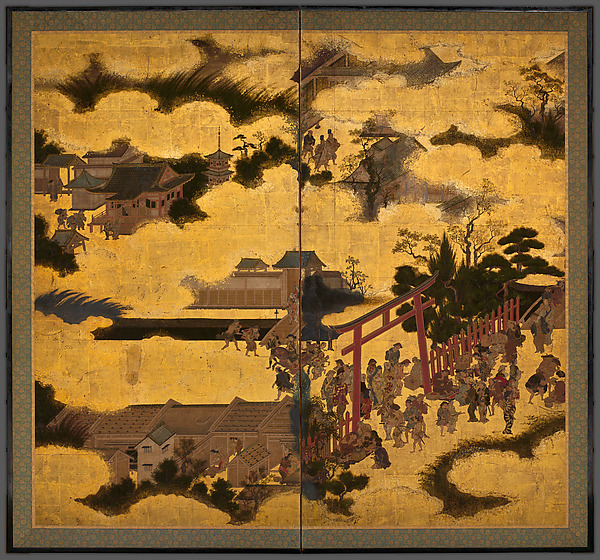
The Torii Gate of Gion Shrine · early 17th century · Sliding doors (fusama) remounted as a two-panel folding screen; ink, color, and gold on paper
Look closer: The shrine whose festival fills July.
The Metropolitan Museum of Art, Gift of A. I. Sherr, 1960, accession 60.164. Public domain (Open Access).
Its great events are the two float processions, the Yamaboko Junkō, on 17 and 24 July, preceded by three evenings of yoiyama when the downtown is reserved for pedestrians and stalls line the streets. The floats are of two kinds: ten larger hoko, “halberd” floats, which recall the 66 halberds of the original ritual, and twenty-four smaller yama, “mountain” floats, which carry life-sized figures of deities, bodhisattvas and other historic and cultural figures. The article adds that the festival’s floats were listed as Intangible Cultural Heritage of Humanity in 2009.

Utagawa Hiroshige · Gion Shrine in Snow · 1797–1858 · Woodblock print; ink and color on paper
Look closer: The same shrine in winter.
The Metropolitan Museum of Art, Henry L. Phillips Collection, Bequest of Henry L. Phillips, 1939, accession JP2883. Public domain (Open Access).
The article we consulted does not discuss the maiko’s role in the festival, and so we do not either. What the kanzashi article adds is that the July ornaments of a maiko are fans tied to the Gion Festival, with fireworks and dewdrops. The festival, in other words, appears in the town’s hair as well as in its streets.
Autumn, Winter and New Year
The Gion Odori of Gion Higashi is the only autumn dance in Wikipedia’s list, and the article gives no further detail. The monthly ornament list fills the rest of the season: in October a maiko wears chrysanthemum, one large flower if senior and a cluster of small ones if junior; in November, Japanese maple, ginkgo and liquidambar leaves; and in December, mochibana, rice-cake flowers, with two blank maneki name plates.
Dances and festival dates as recorded by Wikipedia, and ornaments as listed in its kanzashi article. Calendar order, not to scale.
Look closer: Read the chart from left to right; April and July carry the dated events.
Diagram by Japonista. Original drawing, no source image.
At New Year the ornaments change again: unhusked rice, worn on the right by maiko and on the left by geisha, and eyeless white doves. In January the list names pine, bamboo and plum, with sparrows, spinning tops and hagoita paddles; in February, plum blossoms with pinwheels and kusudama for Setsubun.
The calendar chart on this page lays the year out in order. It is built only from what the sources say, and it leaves gaps where they are silent.
Older Pictures of the Season
The Met’s Edo prints show seasons of a different quarter. The Yoshiwara parade in autumn is a triptych of about 1793 by Eishi, in which courtesans and attendants walk beneath lanterns and blossoming branches. The Niwaka festival print of about 1796 by Chōki shows a lively crowd at a seasonal festival in the same district. A surimono of 1814 by Kubo Shunman shows a courtesan dreaming of a New Year procession.

Chōbunsai Eishi · The Yoshiwara Parade in Autumn · ca. 1793 · Triptych of woodblock prints; ink and color on paper
Look closer: Lanterns and branches frame a procession.
The Metropolitan Museum of Art, Rogers Fund, 1914, accession JP183. Public domain (Open Access).
The comparison is the point. The licensed quarters of Edo kept their own calendar, and the Met’s prints record it. The Kyoto flower towns kept another, and their dances and festival are the subjects of this chapter. Both are part of the larger world that the Heritage wing describes.
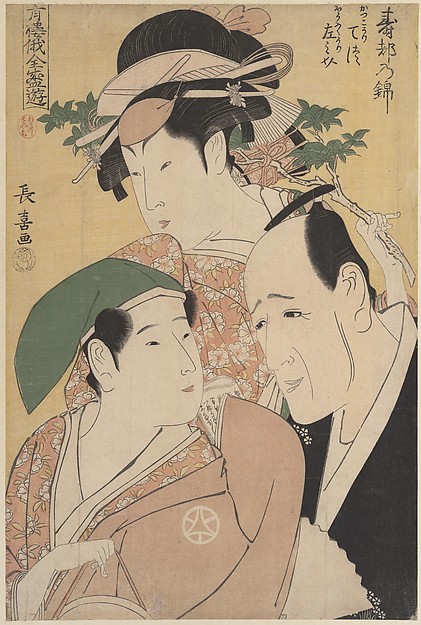
Eishōsai Chōki · Amusements at the Height of Yoshiwara’s Niwaka Festival (Seirō niwaka zensei asobi) · ca. 1796 · Woodblock print (nishiki-e); ink and color on paper
Look closer: A crowd scene from a seasonal festival.
The Metropolitan Museum of Art, The Howard Mansfield Collection, Purchase, Rogers Fund, 1936, accession JP2418. Public domain (Open Access).
A reader who wants to follow the older world will find its principal figures in the oiran chapter, and its hair and dress in the chapters on kimono and kanzashi.

Kubo Shunman · Courtesan Dreaming of the New Year Procession · 1814 · Woodblock print (surimono); ink and color on paper
Look closer: The procession is in a dream cloud above the sleeper.
The Metropolitan Museum of Art, H. O. Havemeyer Collection, Bequest of Mrs. H. O. Havemeyer, 1929, accession JP1971. Public domain (Open Access).
Seasons in the sources

Utagawa Hiroshige · The Gion Shrine in Snow, from the series Famous Views of Kyoto (Kyōto meisho no uchi) · ca. 1834 · Woodblock print; ink and color on paper
Look closer: A winter view of the shrine.
The Metropolitan Museum of Art, The Howard Mansfield Collection, Purchase, Rogers Fund, 1936, accession JP2465. Public domain (Open Access).

Shōsai Ikkei · Shin Yoshiwara: The New Yoshiwara · ca. 1875 · Woodblock print; ink and color on paper
Look closer: A Meiji view of the new Yoshiwara.
The Metropolitan Museum of Art, Gift of Lincoln Kirstein, 1959, accession JP3208. Public domain (Open Access).

Kubo Shunman · Procession of a Courtesan with Her Four Attendants · 1789 · Woodblock print (surimono); ink and color on paper
Look closer: A procession in miniature.
The Metropolitan Museum of Art, Purchase, Marjorie H. Holden Gift, 2012, accession 2012.248.1. Public domain (Open Access).
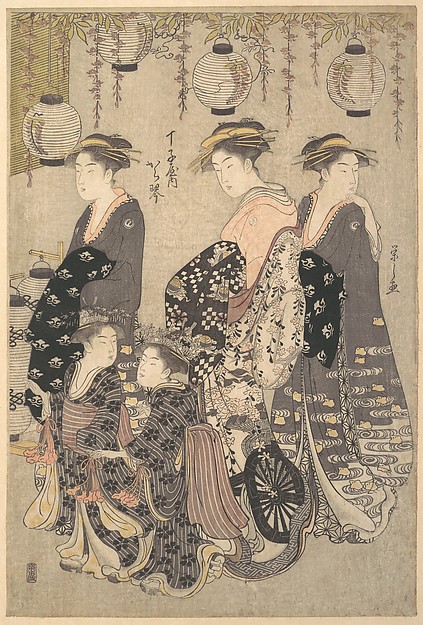
Chōbunsai Eishi · Karakoto of Chojiya on Parade · ca. 1790 · One sheet of a triptych of woodblock prints; ink and color on paper
Look closer: The standing women are in dark patterned robes.
The Metropolitan Museum of Art, The Howard Mansfield Collection, Purchase, Rogers Fund, 1936, accession JP2423. Public domain (Open Access).
Prints and Heritage Pieces
The house’s print shelf holds Edo and Meiji pieces from the world of the quarters. The concierge desk can advise on dates and condition.
Answered plainly
When is the Miyako Odori held?
From 1 to 30 April, four times a day, at the Gion Kōbu Kaburen-jo, according to Wikipedia.
When did the Miyako Odori begin?
Wikipedia gives 1875 in the article on the dance and 1872 in the hanamachi article; this chapter reports both.
What are the other districts’ dances?
Kamogawa Odori of Pontochō, Kitano Odori of Kamishichiken, Kyō Odori of Miyagawa-chō and the autumn Gion Odori of Gion Higashi.
When are the Gion Festival processions?
On 17 and 24 July, according to Wikipedia, within a festival that runs through the month.
How many floats are there?
Ten hoko and twenty-four yama, so thirty-four, according to Wikipedia’s article.
What do maiko wear in July?
Hair ornaments of fans tied to the Gion Festival, with fireworks and dewdrops, according to Wikipedia’s kanzashi article.
Where next
Sources and image credits
- Miyako Odori, Wikipedia
- Gion Matsuri, Wikipedia
- Hanamachi, Wikipedia
- Kanzashi, Wikipedia
- Metropolitan Museum of Art Open Access
- Image: Interior of the Gion Kōbu theatre during the Miyako Odori, Conveyor belt sushi (CC BY 2.0)
- Image: A tea service at the Miyako Odori, Joi Ito from Inbamura, Japan (CC BY 2.0)
- Image: The Torii Gate of Gion Shrine, Unknown maker (Public domain (Met Open Access))
- Image: Gion Shrine in Snow, Utagawa Hiroshige (Public domain (Met Open Access))
- Image: The Yoshiwara Parade in Autumn, Chōbunsai Eishi (Public domain (Met Open Access))
- Image: Amusements at the Height of Yoshiwara’s Niwaka Festival (Seirō niwaka zensei asobi), Eishōsai Chōki (Public domain (Met Open Access))
- Image: Courtesan Dreaming of the New Year Procession, Kubo Shunman (Public domain (Met Open Access))
- Image: The Gion Shrine in Snow, from the series Famous Views of Kyoto (Kyōto meisho no uchi), Utagawa Hiroshige (Public domain (Met Open Access))
- Image: Shin Yoshiwara: The New Yoshiwara, Shōsai Ikkei (Public domain (Met Open Access))
- Image: Procession of a Courtesan with Her Four Attendants, Kubo Shunman (Public domain (Met Open Access))
- Image: Karakoto of Chojiya on Parade, Chōbunsai Eishi (Public domain (Met Open Access))
Last reviewed 28 October 2026. Pictures are public-domain or openly licensed and credited beneath each one; diagrams are drawn by Japonista.
Interested in prints or objects from the seasons of the quarters? The concierge desk replies within one to three business days.
Private concierge
Looking for something in particular?
Describe the piece or the project you have in mind. A senior advisor in Tokyo reads every case file personally and replies within two business days, with fees set out in writing before any work begins.