
Hanamachi: The Flower Towns | Japonista
Heritage Wing · Lanterns and Teahouses
Hanamachi: The Flower Towns
花街
A hanamachi is a district with a name, a crest, a theatre and a register of its artists. It is also a community of houses whose women train for years to entertain with music, dance and conversation. This chapter describes how such a town is built and what it is not.
Fact sheet
At a glance
- A town in two kinds of house. Okiya are the lodgings of the artists; ochaya are the teahouses where they entertain.
- Five in Kyoto. The five active Kyoto districts are sometimes called the gokagai; a sixth, Shimabara, is now a living museum.
- From the yūkaku. Wikipedia dates Yoshiwara to 1617, Shimabara to 1640 and records that geisha developed within the quarters in the mid-1700s.
- A different profession. Geisha are artists. Oiran, who belonged to the older licensed quarters, are the subject of a separate chapter.
What a Flower Town Contains
Wikipedia defines a hanamachi as a district where geisha live and work in Japan, and adds that each one typically has its own name, crest and geisha population. The word means “flower town”. Inside it stand two kinds of house. The okiya, the article says, are the geisha houses, where the women are lodged and trained; the ochaya are the teahouses where they entertain guests.

Unknown · [Geisha Girls] · ca. 1880 · albumen silver print
Look closer: Photographers of the 1880s made portraits like this for visitors; the museum catalogues the sitters as geisha girls.
The Metropolitan Museum of Art, Museum Accession, transferred from the Costume Institute Library, accession 2011.533. Public domain (Open Access).
Historically the larger districts also had a kaburenjō, a communal building with a theatre, classrooms for the arts and a registry office, the kenban. The dances described in the calendar chapter of this wing are the public face of that teaching.

Unknown · [Tokyo Geisha with Shamisen] · 1870s · Albumen silver print from glass negative with applied color
Look closer: The shamisen is the instrument most associated with the profession; the setting is a studio.
The Metropolitan Museum of Art, Gilman Collection, Museum Purchase, 2005, accession 2005.100.505.1 (7b). Public domain (Open Access).
The structure explains a good deal that visitors find puzzling. A geisha must be registered to an okiya, though she need not live there throughout her career. Her engagements, the article says, usually take place at an ochaya, and are called ozashiki: a party that may last part or all of an evening.
The Kagai of Kyoto
Kyoto’s districts are called kagai locally. Wikipedia names the five active ones as Gion, which is separated into Gion Kōbu and Gion Higashi; Miyagawa-chō; Kamishichiken; and Pontochō. Together they are sometimes called the gokagai, the five flower towns. The former Shimabara district was one of the rokkagai, the six, and its last geisha left in the late twentieth century; the article describes the district today as largely a living museum, with tayū reenactors.
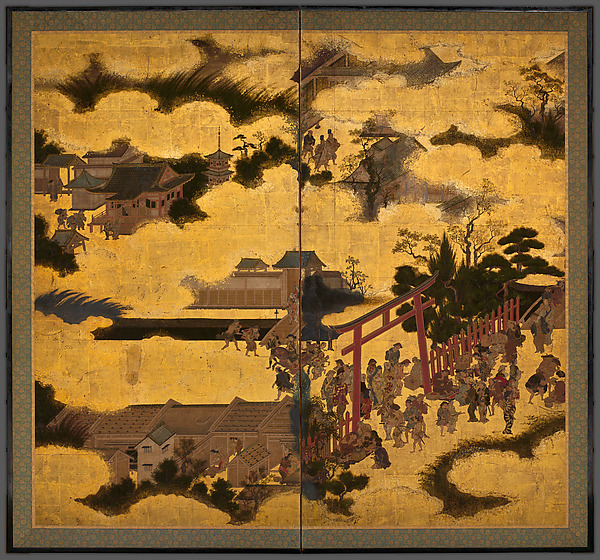
The Torii Gate of Gion Shrine · early 17th century · Sliding doors (fusama) remounted as a two-panel folding screen; ink, color, and gold on paper
Look closer: The gate and shrine appear on gold; the district’s name comes from the shrine.
The Metropolitan Museum of Art, Gift of A. I. Sherr, 1960, accession 60.164. Public domain (Open Access).
Each district gives a spring or autumn dance, and the article records when. Miyako Odori of Gion Kōbu has been given since 1872, as has Kamogawa Odori of Pontochō; Kitano Odori of Kamishichiken began in 1953; Kyō Odori of Miyagawa-chō in the 1950s; and Gion Odori of Gion Higashi is held in autumn. They are described in more detail in this wing’s chapter on the flower-town calendar.

Utagawa Hiroshige · The Gion Shrine in Snow, from the series Famous Views of Kyoto (Kyōto meisho no uchi) · ca. 1834 · Woodblock print; ink and color on paper
Look closer: Hiroshige’s Gion is a shrine in snow, with two small walkers; the district’s later lanterns are not yet in the picture.
The Metropolitan Museum of Art, The Howard Mansfield Collection, Purchase, Rogers Fund, 1936, accession JP2465. Public domain (Open Access).
The Gion name is shared with the Gion Shrine, which the Met’s screens and prints show, as on this page, in an early seventeenth-century screen and a snowy print of the 1830s.
From Licensed Quarter to Arts District
Hanamachi were preceded, Wikipedia says, by the yūkaku, the registered pleasure quarters. The article dates Yoshiwara in Edo, today’s Tokyo, to 1617, Shimabara in Kyoto to 1640 and Shinmachi in Osaka to between 1624 and 1644. Geisha, the article continues, developed within the yūkaku in the mid-1700s.

Chōbunsai Eishi · The Yoshiwara Parade in Autumn · ca. 1793 · Triptych of woodblock prints; ink and color on paper
Look closer: Courtesans and attendants of the licensed quarter, in a parade: a different world from the teahouse.
The Metropolitan Museum of Art, Rogers Fund, 1914, accession JP183. Public domain (Open Access).
The word geisha itself, in the article on the profession, combines gei, art, and sha, person: a performing artist. Early geisha were men, the taikomochi or hōkan; the first woman to call herself a geisha was Kikuya, a dancing girl from Fukagawa, around 1750. The same article warns that sources differ, and one of them suggests the women geisha did not appear until the 1800s. We follow it in reporting both, and no more.
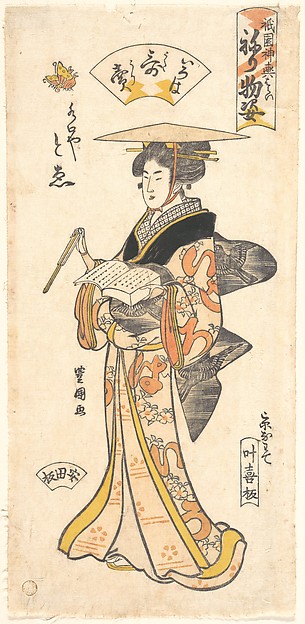
Utagawa Toyokuni I · “The Geisha To’e as a Vendor of Poems,” from the series Gion Festival Costume Parade (Gion mikoshi arai nerimono sugata) · ca. 1795 · Woodblock print; ink and color on paper
Look closer: The Met’s title names a geisha at work as a vendor of poems, a performance rather than a trade.
The Metropolitan Museum of Art, Rogers Fund, 1922, accession JP1390. Public domain (Open Access).
What is clear is the contrast with the courtesans of the quarters. Oiran were the highest-ranking courtesans, and their entertainment included sex as well as the arts; geisha were a separate profession, though both belonged to the same larger world. The shogunate banned prostitution outside the licensed quarters in 1617, and geisha were officially forbidden from selling sex, though the article says some did. The long-standing confusion between the two, particularly in the West, is one of the principal misconceptions it records.
Kanazawa, Tokyo and the Rest
Kyoto is the best known, not the only one. Wikipedia’s article lists Kanazawa, where the geisha districts, now called chayagai, were most active in 1820 to 1830 and again from 1867 to 1954, and names the Higashi and Nishi chaya districts. In Tokyo it lists Shinbashi, Akasaka, Asakusa, Yoshichō, Kagurazaka, Mukōjima and Ōmori Kaigan without further explanation, so this chapter reports only the names.
A Tokyo geisha is the same kind of artist. The article on geisha records the regional term geiko, “woman of art”, used in Kyoto and Kanazawa. A photograph of the 1870s at the Met shows a Tokyo geisha with a shamisen, and a picture of about 1880 shows two with an umbrella.

Torii Kiyonaga · Two Geisha · Woodblock print; ink and color on paper
Look closer: A pillar print of two geisha, made to hang on a post.
The Metropolitan Museum of Art, Rogers Fund, 1922, accession JP1437. Public domain (Open Access).
The numbers have fallen. The same article cites an estimate of about 80,000 geisha before the Second World War, though it does not clearly date it; it records that Kyoto’s geisha fell from 548 in 1965 to 202 in 2006, and its maiko from 76 to 71; and it gives an estimate of 600 to 700 nationwide in 1989. Its figures are old, and we do not offer newer ones.
Geisha in Edo and Meiji images

Katsukawa Shuntei · Geisha Seated · dated 1795 · Hanging scroll; ink and color on silk
Look closer: A seated geisha, painted rather than printed, with a poem above.
The Metropolitan Museum of Art, The Howard Mansfield Collection, Purchase, Rogers Fund, 1936, accession 36.100.71. Public domain (Open Access).

Chōbunsai Eishi · Two Geisha · ca. 1792 · One sheet of a triptych of woodblock prints; ink and color on paper
Look closer: Look at the shamisen and the lantern; the sheet belongs to a triptych.
The Metropolitan Museum of Art, The Howard Mansfield Collection, Purchase, Rogers Fund, 1936, accession JP2421. Public domain (Open Access).

Utagawa Hiroshige · Gion Shrine in Snow · 1797–1858 · Woodblock print; ink and color on paper
Look closer: The shrine in winter, from the Met’s Hiroshige holdings.
The Metropolitan Museum of Art, Henry L. Phillips Collection, Bequest of Henry L. Phillips, 1939, accession JP2883. Public domain (Open Access).

Shōsai Ikkei · Shin Yoshiwara: The New Yoshiwara · ca. 1875 · Woodblock print; ink and color on paper
Look closer: A Meiji view of the district that the Edo quarter became.
The Metropolitan Museum of Art, Gift of Lincoln Kirstein, 1959, accession JP3208. Public domain (Open Access).
Related Pieces
The house’s lacquer, textile and print shelves hold Edo-period and Meiji objects from the world described here. The concierge desk can advise on a piece’s date and condition.
Answered plainly
What does hanamachi mean?
“Flower town”. Wikipedia defines it as a district where geisha live and work, typically with its own name, crest and geisha population.
What is an okiya?
A geisha house, where a trainee is lodged. Every geisha is registered to one, though not all live there full-time.
Which are the five Kyoto districts?
Gion Kōbu, Gion Higashi, Miyagawa-chō, Kamishichiken and Pontochō, according to Wikipedia.
What came before the hanamachi?
The licensed yūkaku: Wikipedia dates Yoshiwara to 1617, Shimabara to 1640 and Shinmachi to between 1624 and 1644.
What does geisha mean?
Performing artist: gei is art and sha is person. Kyoto and Kanazawa use geiko, woman of art.
Are geisha and oiran the same?
No. Oiran were high-ranking courtesans of the licensed quarters; geisha are a separate profession of performing artists.
Where next
Sources and image credits
- Hanamachi, Wikipedia
- Geisha, Wikipedia
- Metropolitan Museum of Art Open Access
- Image: [Geisha Girls], Unknown (Public domain (Met Open Access))
- Image: [Tokyo Geisha with Shamisen], Unknown (Public domain (Met Open Access))
- Image: The Torii Gate of Gion Shrine, Unknown maker (Public domain (Met Open Access))
- Image: The Gion Shrine in Snow, from the series Famous Views of Kyoto (Kyōto meisho no uchi), Utagawa Hiroshige (Public domain (Met Open Access))
- Image: The Yoshiwara Parade in Autumn, Chōbunsai Eishi (Public domain (Met Open Access))
- Image: “The Geisha To’e as a Vendor of Poems,” from the series Gion Festival Costume Parade (Gion mikoshi arai nerimono sugata), Utagawa Toyokuni I (Public domain (Met Open Access))
- Image: Two Geisha, Torii Kiyonaga (Public domain (Met Open Access))
- Image: Geisha Seated, Katsukawa Shuntei (Public domain (Met Open Access))
- Image: Two Geisha, Chōbunsai Eishi (Public domain (Met Open Access))
- Image: Gion Shrine in Snow, Utagawa Hiroshige (Public domain (Met Open Access))
- Image: Shin Yoshiwara: The New Yoshiwara, Shōsai Ikkei (Public domain (Met Open Access))
Last reviewed 28 October 2026. Pictures are public-domain or openly licensed and credited beneath each one; diagrams are drawn by Japonista.
Interested in Edo or Meiji prints and objects from the flower towns? The concierge desk replies within one to three business days.
Private concierge
Looking for something in particular?
Describe the piece or the project you have in mind. A senior advisor in Tokyo reads every case file personally and replies within two business days, with fees set out in writing before any work begins.