
Samurai Myths and Fakes | Japonista
Heritage Wing · Truth and Legend
Samurai Myths and Fakes
武士の俗説
Every collecting field has its legends, and the samurai have more than most. This chapter takes five of them in turn, shows what the reference sources actually say, and leaves the rest to the reader’s own judgement.
Fact sheet
At a glance
- A code with a late name. The word bushido is first written down about 1616 and was made famous worldwide by a book at the turn of the twentieth century.
- Folding. Folding evens out a blade’s steel. Wikipedia’s sword article gives no count, so neither does this page.
- Black clothes. The ninja’s black suit comes from the Edo stage, where stagehands called kuroko wore it to be ignored.
- Women with blades. Tomoe Gozen and Nakano Takeko appear in the sources; the first’s place in history is uncertain.
A Code Written Down Late
The first myth is the grandest: that the samurai lived by a single written code called bushido, handed down from the earliest warriors. Wikipedia’s article on bushido says otherwise, politely. The word is first recorded in the Kōyō Gunkan, a chronicle of the Takeda clan dated to about 1616, and before the Edo period it was rarely attested in pre-modern literature. Earlier expressions, such as the “way of the bow and the horse”, belong to the language of the twelfth century and the Genpei War.
The Edo period gave warrior ethics a legal and literary shape. The article records the first Buke shohatto, the laws for the military houses, in 1615, and describes the Kashoki of 1642 as the earliest known description of bushido morality. It also says that clans and individuals interpreted the ideas differently: there was no single fixed code, a point this wing’s chapter on bushido takes further.

Utagawa Kunisada · Battle of Awazugahara · mid-19th century · Triptych of woodblock prints; ink and color on paper
Look closer: A nineteenth-century print of a twelfth-century battle: the picture is later than the story.
The Metropolitan Museum of Art, Gift of Harold de Raasloff, 1918, accession JP1115.5a–c. Public domain (Open Access).
The best-known version is later still. Nitobe Inazō’s book Bushido: The Soul of Japan, published around the turn of the twentieth century, spread the word internationally. The article calls his version romanticised and says it does not represent all of bushido. It adds that some researchers hold the chivalric bushido of Nitobe to be a nineteenth-century invention, and that in the 1930s and 1940s the military and government reshaped the idea as propaganda. A careful collector keeps all four layers in mind: the medieval habit, the Edo codification, the Meiji romance and the wartime use.
A Thousand Folds and What They Do
The second legend concerns the sword itself, and the number that goes with it: a blade is folded a thousand times, or a million, or a number that rises every time it is told. Wikipedia’s article on the katana does not give a figure, and neither will we. What it says is more useful. The smith works with tamahagane, a specialised steel from a traditional smelting process that yields layers of different carbon content, and he folds and welds it several times to even out differences in composition before drawing it into a billet.

Gassan Mitsu[...] · Blade for a Sword (Katana) · late 15th–early 16th century · Steel
Look closer: The curve is made in the quench; the blade is photographed without its mount so the line can be read.
The Metropolitan Museum of Art, Gift of Etsuko O. Morris and John H. Morris Jr., 2018, accession 2018.833.21a–e. Public domain (Open Access).
Folding, in other words, is a way of making steel behave; it is not a ritual of repetition. The feature that gives a Japanese blade its look is a different step altogether: differential hardening. The article describes a clay slurry, tsuchioki, applied thinly at the edge and more thickly elsewhere. When the blade is heated and quenched in water the edge hardens, and, the article adds, the blade also takes its curve.
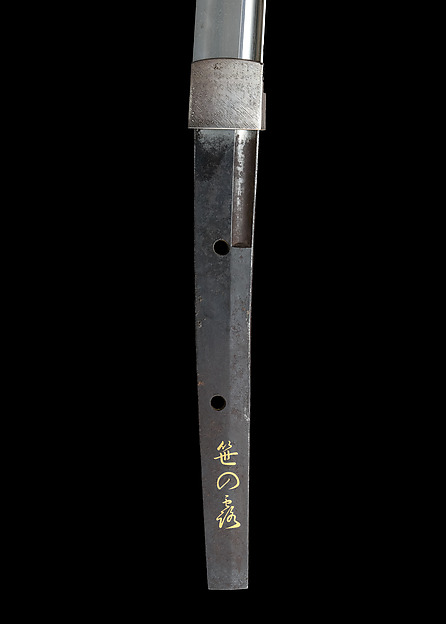
Blade for a Sword (Katana) · late 16th century · Steel, gold
Look closer: The tang is the part that carries a smith’s signature, and the part a collector reads first.
The Metropolitan Museum of Art, Purchase, Bashford Dean Bequest, 1970, accession 1970.273. Public domain (Open Access).
The visible line of that hardening is the hamon. A good deal of confusion attaches to the word, and the article is careful about it: the hamon is the line along the blade made distinct by polishing, and it does not refer to the white area on the side of the blade. Polishing, the same article says, takes between one and three weeks. The blades in the pictures here are catalogued by the Met as steel, which is the safest statement a museum label can make.
Which Swords Are Old
The third legend is subtler: that anything called a samurai sword is old. Wikipedia’s sword article divides Japanese blades into periods: kotō, old swords, from about 900 to 1596; shintō, new swords, from 1596 to 1780; shinshintō, new new swords, from 1781 to 1876; and gendaitō, modern swords, from 1876 to the present. It also lists the guntō, the military swords of 1875 to 1945, and the shinsakutō, the swords made since 1953 under the postwar licensing system.
The wartime blades deserve a particular word. The shōwatō, the article says, were made with power hammers and oil quenching and with limited tamahagane, and from 1937 a special stamp was required on the tang. It adds that in Japan such swords can be confiscated, while elsewhere they are collected as artefacts. They are real objects with a real history; they are not what the word “antique” implies.

Sukemitsu of Bizen · Blade and Mounting for a Sword (Katana) · blade, dated 1440; mounting, late 18th century · Steel, wood, lacquer, ray skin (samé), thread, copper-gold alloy (shakudō), copper-silver alloy (shibuichi)
Look closer: A very common situation: a medieval blade in a much later mount. The museum labels each part separately.
The Metropolitan Museum of Art, The Howard Mansfield Collection, Gift of Howard Mansfield, 1936, accession 36.120.417a, b. Public domain (Open Access).
The legal frame today is equally specific. The article reports that sword manufacture was banned from 1945 to 1953; that smiths have been licensed since 1953 and must complete a five-year apprenticeship; that only licensed smiths may produce nihontō; and that all swords must be registered with the Japanese government. It also notes that many katana sold worldwide are fakes made in China, and that mass-produced practice swords are mostly Chinese-made as well. The practical lesson is a short one: ask for the registration and the signature, and do not accept a period or a smith’s name on trust.

Blade and Mounting for a Sword (Katana) · blade, 16th century; mounting, mid–late 19th century · Steel, wood, laquer, gold, enamel
Look closer: Hilt and blade are of different centuries; the Met’s catalogue gives both dates.
The Metropolitan Museum of Art, Gift of the family of Dr. Francis E. Doughty, 1907, accession 07.109.4. Public domain (Open Access).
The Ninja in Black
The fourth legend is a costume. Wikipedia’s article on the ninja says that fiction usually shows them in black, but that in peacetime they wore farm-style work clothes dyed dark indigo and that combat garments were likely dark brown, which blended better at night. The black suit comes from the Edo theatre, where it was supposed to imitate the outfits of kuroko, the stagehands who were meant to be ignored.
The word is its own story. The article notes that ninja is the Sino-Japanese reading of the characters and that it was uncommon; in historical documents shinobi is almost always used. It places the first stealthy soldiers named in this way in the Sengoku period, and says that the popular image emerged in the Edo period through folktales and plays. It also says there is little evidence that ninja were assassins, and that the famous army of Hattori Hanzō first appears in an Edo-period record, which at least one scholar believes was propaganda.

Tsukioka Yoshitoshi · Fifty-three Stations of Suehiro: Warrior Looks at Passing Steamship · ca. 1865 · Woodblock print; ink and color on paper
Look closer: Yoshitoshi’s warriors wear bright cloth, not black; the print is a reminder of what the Edo public looked at.
The Metropolitan Museum of Art, Gift of Lincoln Kirstein, 1959, accession JP3178. Public domain (Open Access).
This wing’s fuller chapter on the ninja, history and myth, goes through the same ground with more of the sources; here the aim is only to note how much of the picture is theatre.
Women with Blades
The last legend runs the other way: that the samurai world was entirely male. Wikipedia’s article on women warriors, which uses the term onna-musha, names two figures. Tomoe Gozen, of the twelfth century, served Minamoto no Yoshinaka and helped him at the Battle of Awazu in 1184; she appears in the Heike Monogatari, and the article notes that she was not always accredited as a historical figure, so her historicity is uncertain. Nakano Takeko, who lived from 1847 to 1868, led the Jōshitai, the Girls’ Army of the Aizu clan, in the Boshin War and is described as highly skilled with the naginata.

Ishikawa Toyonobu · Tomoe Gozen Killing Uchida Saburo Ieyoshi at the Battle of Awazu no Hara · ca. 1750 · Woodblock print; ink and color on paper
Look closer: The woman and the horse fill the sheet; the print is a single dramatic moment from a battle story.
The Metropolitan Museum of Art, Gift of Estate of Samuel Isham, 1914, accession JP846. Public domain (Open Access).
The naginata, a polearm with a curved blade at the tip, became the emblem of the woman warrior, and many Edo-period schools of the weapon were organised around it. The article ties its length to the reach of male opponents. We can say with confidence that both women are in the sources, and with equal confidence that their records differ in strength.

Katsukawa Shunshō 勝川春章 · Yoshizawa Iroha as a Woman (Tomoe Gozen?) Standing on the Bank · 1774 or 1775 · Woodblock print (nishiki-e); ink and color on paper
Look closer: The museum’s own title has a question mark after the name: even the sitter’s role is not certain.
The Metropolitan Museum of Art, Purchase, Joseph Pulitzer Bequest, 1918, accession JP411. Public domain (Open Access).
The images are older than the research. The Met’s print of about 1750 shows Tomoe Gozen on horseback in armour, and a print of 1774 or 1775 by Katsukawa Shunshō shows an actor as a woman in a robe standing before a battlefield, catalogued with a question mark after her name. The pictures are later than the legends they show.
Evidence on the table

Sword with Scabbard Mounts · ca. 600 · Iron, bronze, gold, silver, wood
Look closer: Swords of around the year 600 are straight in the photograph, unlike the curved blades above.
The Metropolitan Museum of Art, Gift of Clarence H. Mackay, 1930, accession 30.65.2. Public domain (Open Access).

Blade and Mounting for a Sword (Katana) · blade, probably 19th century; mounting, 19th century · Steel, wood, lacquer, iron, gold, copper-gold alloy (shakudō), rayskin (samé), leather, windmill palm leaves
Look closer: A blade of probably the nineteenth century with a nineteenth-century mount; the label separates the two.
The Metropolitan Museum of Art, Museum Accession, accession X.11. Public domain (Open Access).
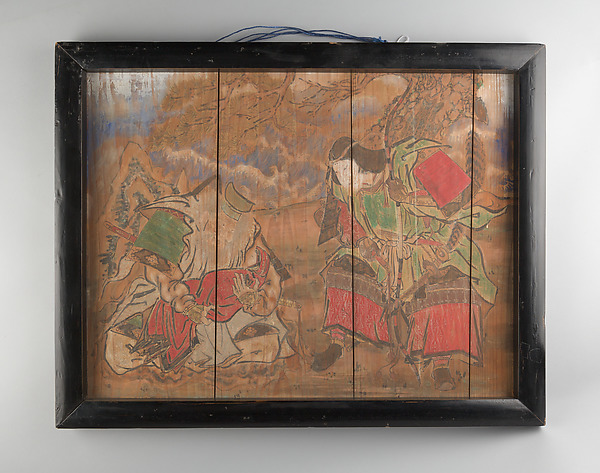
Nagano Yasunosuke · Ema (Votive Painting) of Empress Jingū, Her Minister Takenochi no Sukune, and an Infant (the Future Emperor Ōjin) · 1898 · Ink and color on cryptomeria (sugi) wood
Look closer: Empress Jingū is described by Wikipedia as semi-legendary; the Met’s votive painting is a record of devotion, not of fact.
The Metropolitan Museum of Art, Gift of Stanley J. Love, 1985, accession 1985.396.2. Public domain (Open Access).
Utagawa Kunisada · Battle of Awazugahara · mid-19th century · Triptych of woodblock prints; ink and color on paper
Look closer: The battle that Tomoe Gozen was said to have joined; the print is an act of later memory.
The Metropolitan Museum of Art, Gift of Harold de Raasloff, 1918, accession JP1115.5a–c. Public domain (Open Access).
Pieces with Documentation
The house’s samurai shelf keeps armour, helmets and fittings described with their parts, dates and condition set out. The concierge desk can advise on signatures, registration and the marks that separate old from new.
Answered plainly
When was the word bushido first written?
About 1616, in the Kōyō Gunkan, a chronicle of the Takeda clan, according to Wikipedia’s bushido article. It describes the word as rarely attested before the Edo period.
How many times is a katana folded?
Wikipedia’s katana article gives no figure. It says the smith folds and welds the steel several times to even out its composition.
What makes the wavy line on a blade?
Differential hardening: a clay slurry thinner at the edge, then heating and quenching. The visible line is the hamon, according to the same article.
Are wartime swords antiques?
They are shōwatō, made with power hammers and oil quenching and often stamped on the tang from 1937. Wikipedia says they can be confiscated in Japan and are collected as artefacts elsewhere.
Why were ninja shown in black?
Because the Edo stage dressed stagehands, kuroko, in black. Wikipedia says peacetime ninja dress was dark indigo work clothing, and combat garments were likely dark brown.
Were there women warriors?
Wikipedia’s article names Tomoe Gozen, whose historicity is uncertain, and Nakano Takeko (1847 to 1868), who led the Jōshitai in the Boshin War.
Where next
Sources and image credits
- Bushido, Wikipedia
- Katana, Wikipedia
- Ninja, Wikipedia
- Onna-musha, Wikipedia
- Metropolitan Museum of Art Open Access
- Image: Battle of Awazugahara, Utagawa Kunisada (Public domain (Met Open Access))
- Image: Blade for a Sword (Katana), Gassan Mitsu[...] (Public domain (Met Open Access))
- Image: Blade for a Sword (Katana), Unknown maker (Public domain (Met Open Access))
- Image: Blade and Mounting for a Sword (Katana), Sukemitsu of Bizen (Public domain (Met Open Access))
- Image: Blade and Mounting for a Sword (Katana), Unknown maker (Public domain (Met Open Access))
- Image: Fifty-three Stations of Suehiro: Warrior Looks at Passing Steamship, Tsukioka Yoshitoshi (Public domain (Met Open Access))
- Image: Tomoe Gozen Killing Uchida Saburo Ieyoshi at the Battle of Awazu no Hara, Ishikawa Toyonobu (Public domain (Met Open Access))
- Image: Yoshizawa Iroha as a Woman (Tomoe Gozen?) Standing on the Bank, Katsukawa Shunshō 勝川春章 (Public domain (Met Open Access))
- Image: Sword with Scabbard Mounts, Unknown maker (Public domain (Met Open Access))
- Image: Blade and Mounting for a Sword (Katana), Unknown maker (Public domain (Met Open Access))
- Image: Ema (Votive Painting) of Empress Jingū, Her Minister Takenochi no Sukune, and an Infant (the Future Emperor Ōjin), Nagano Yasunosuke (Public domain (Met Open Access))
Last reviewed 28 October 2026. Pictures are public-domain or openly licensed and credited beneath each one; diagrams are drawn by Japonista.
Holding a blade, mount or armour whose age or signature you would like to understand? The concierge desk replies within one to three business days.
Private concierge
Looking for something in particular?
Describe the piece or the project you have in mind. A senior advisor in Tokyo reads every case file personally and replies within two business days, with fees set out in writing before any work begins.