
The Japanese Sword, Forged and Polished | Japonista
Heritage Wing · Steel and Fire
The Japanese Sword, Forged and Polished
A Japanese blade begins as iron sand and ends as a mirror, and between the two lie a smelter, a hammer, a bath of water and a polisher who may work as long as the smith. This chapter follows that road, then asks how to read what comes out of it.
Fact sheet
At a glance
- Made twice. First the steel is made in a smelter, then the blade is made from the steel. Both steps leave marks a trained eye can read.
- Hard and soft. A hard outer skin wraps a softer core, so the edge keeps its keenness and the blade keeps its spring.
- A line of fire. The wavering line along the edge is the trace of a clay coating and a quench, and it differs from school to school.
- Five houses. Collectors sort old blades into five traditions, each tied to a province and a period.
- Paper and law. In Japan a sword is lawfully held only with a registration card, and its attribution is usually judged by society certificates.
Steel Before the Sword
The Metropolitan Museum’s essay on the Japanese blade, written in October 2003 by Edward Hunter of its Department of Arms and Armor, begins with the metal. Smiths traditionally work with tamahagane, a steel made in a clay smelter called a tatara from iron-rich sand. The museum notes that the last operating tatara is in Yokota, in Shimane Prefecture.
The steel that comes out is not uniform. The essay is frank about it: tamahagane carries impurities and uneven carbon, and carbon is a narrow bargain. Too little leaves the metal soft; too much makes it brittle. The whole craft that follows is an answer to that unevenness.
Wikipedia’s article on the Japanese sword takes a harder line on definition, saying that the legitimate Japanese sword uses tamahagane. Collectors will meet the word in just that sense, as a test of tradition. It is a useful rule of thumb, but it is the language of the trade and not a law of nature, and it is worth remembering that the smelting itself is now rare enough to be a living museum piece.
Fourteen Folds
The smith selects pieces of tamahagane, forge-welds them into a block and begins to work it, according to the Metropolitan essay. Hammering and folding drive out impurities and even out the carbon. Each fold doubles the layers, so the essay’s figure follows by arithmetic: fourteen folds produce more than 16,000 layers.
The direction of the folding is what draws the surface. The essay names two grains as examples: masame, a straight grain that runs parallel to the edge, and ayasugihada, a concentric, wave-like grain. A smith can fold in one direction, alternate, or cross the folds, and the resulting pattern, the jihada, is one of the clues by which a specialist recognises a period, a province and sometimes a hand.
Structure matters as much as surface. A hard outer skin, the kawagane, is wrapped around a softer iron core, the shingane. The core gives flexibility; the skin takes and holds the edge. The layers are heated and hammered into a long bar, which is then cut, filed and planed to its profile, with the point, the ridgelines, the tang and the surface all set before the edge is treated. Wikipedia’s article gives the rough, unhardened shape the Japanese name sunobe.
The Night Quench
Then comes the moment the whole blade depends on, called yaki-ire. The smith coats the blade in yakibatsuchi, a paste of clay, water, ash and other ingredients, each smith holding a recipe close. The coating is thick on the spine and thin at the edge.
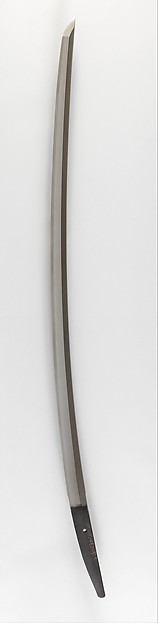
The Metropolitan Museum of Art, accession 2001.574. Steel; overall length 91.8 cm, length of cutting edge 75.1 cm. Purchase, Arthur Ochs Sulzberger Gift, 2001. Open Access.
Look closer: Notice the gentle curve and the long plain tang at the foot. At this size the hamon is faint; the museum’s page has a larger image, and it is the boundary you are looking for between the hardened edge and the body of the blade.
The Metropolitan Museum of Art, public domain (Open Access).
The blade goes into a darkened forge. Wikipedia notes that the temperature was traditionally judged by eye, at night, and the Metropolitan essay says the same of colour: the smith watches the steel glow, and at the critical point, about 750 degrees Celsius according to the essay, plunges it into a trough of water.
What happens next is metallurgy made visible. The thin-coated edge cools fast and becomes martensite, the hardest form of steel. The thickly coated spine cools more slowly and stays softer, as ferrite and pearlite. The boundary between the two is the hamon, the visible line along the blade that is central to its look. The essay gives two simple examples: suguha, a very straight line, and sanbonsugi, a zigzag in clusters of three. Wikipedia adds that the hamon varies by school.
If the smith approves the result, the blade passes to a polisher. Wikipedia says sharpening and polishing take as long as forging, and the Metropolitan essay calls the final finish mirror-like. Separate craftsmen then make the scabbard and the mountings: the tsuba, the menuki, the lacquered wood, the silk cord and the ray-skin grip.
Five Traditions
Collectors do not sort old blades alphabetically. They sort them by tradition, the Gokaden, five lines of work tied to five regions. Wikipedia lists them as Yamato in Nara Prefecture, whose founder Yukinobu belongs to the Heian period; Yamashiro in Kyoto, founded by Sanjō Munechika in the late tenth century; Bizen in Okayama, which began with Ko-Bizen in the mid-Heian; Sōshū in Kanagawa, whose best-known smith is Masamune; and Mino in Gifu, which began in the middle of the Kamakura period.

Original chart drawn from the counts in the Wikipedia article on the Japanese sword. They count recorded names, not quality.
Look closer: The longest bar is Bizen, which alone outnumbers the other four traditions put together by more than 400.
Original diagram, The Japonista Curation and Concierge Team, Tokyo, Japan.
The article also gives the number of smiths recorded for each. Bizen leads by a wide margin with 4,005, followed by Mino with 1,269, Yamato with 1,025, Yamashiro with 847 and Sōshū with 438. The figures are the article’s, and the chart above is drawn directly from them. They record how many names survive, which is not the same as how good each school was; Sōshū’s small number carries Masamune.
One name needs care. Wikipedia reports that Amakuni is credited with first signing a tang, but calls this a legend, and says the earliest recorded founder is Yukinobu. We follow the article in treating Amakuni as a story and not a fact.
A Blade Is Named by Its Length
The vocabulary of the Japanese sword is, to a surprising degree, a vocabulary of length and wear. Wikipedia gives the working definitions. The shaku is the unit: one shaku is about 30.3 centimetres. A tantō is under one shaku and is used like a knife. A wakizashi runs from one to two shaku, 30 to 60.6 centimetres, and is mostly made after 1600. A katana, the best-known type, has a blade of more than two shaku, about 60.6 centimetres, usually curved and single-edged, and was worn by the samurai from the fifteenth century on.
How the sword was worn is part of its name. The tachi, longer and more curved, was worn edge down and was popular before the fifteenth century. The uchigatana, a curved blade over 60 centimetres, was worn edge up; it developed from the sasuga around the fourteenth century and became the mainstream from the fifteenth. Wikipedia reports that the katana developed from the sasuga, and that the oldest surviving katana is a hishizukuri uchigatana from the Nanbokuchō period.
In the Edo period the pair known as the daishō, a long and a short sword together, became the samurai’s symbolic armament, according to the article. A sword on its own is only part of the object: our guides to the tsuba, the sword guard, and the koshirae, the mounting, follow the parts that sit around it.
Two Prohibitions
Peace made the sword a symbol. On the battlefield firearms displaced it in the Sengoku period, and Wikipedia notes that in 1588 Toyotomi Hideyoshi ordered a sword hunt against farmers. The Edo centuries followed: Wikipedia divides them into the Shintō blades, 1596 to 1780, and the Shinshintō, 1781 to 1876, the second beginning with a revival led by Suishinshi Masahide, who criticised decorative blades and urged a return to Kamakura methods.
The first prohibition came in 1876. The Haitōrei edict banned the carrying of swords in public, except by the military and officials. Wikipedia names two smiths, Miyamoto Kanenori and Gassan Sadakazu, later Imperial Household Artists, who kept the craft alive. Before the Second World War the article estimates about 1.5 million swords existed, including 200,000 factory-made in the Meiji era. In the war years the military blades were often oil-tempered or stamped with serial numbers where a signature would have been chiselled.
The second prohibition came with the Occupation, when edged swords were banned except by permit. Wikipedia tells of Junji Honma, who appealed to General MacArthur; the ban was revised so that military blades were destroyed and artistically valued swords preserved. Honma later co-founded the Society for the Preservation of the Japanese Sword. The ban was lifted in 1953. The article reports that around a million swords went abroad in that period and that by 1958 more Japanese swords were in America than in Japan; elsewhere it estimates 250,000 to 350,000 leaving the country, so the figures should be read as rough.
Today the article says swords are classed as art objects and not weapons, that the government limits a smith to 24 swords a year, and that about 100,000 remained in Japan as of 2008. More than 100 swords are National Treasures; Wikipedia says Kamakura-period blades make up 80 per cent of them and tachi 70 per cent.
| Moment | What happened | Source |
|---|---|---|
| 1588 | Hideyoshi orders a sword hunt against farmers | Wikipedia |
| 1876 | Haitōrei bans carrying swords in public, with exceptions | Wikipedia |
| 1945 to 1953 | Occupation ban; military blades destroyed, art swords preserved after Honma’s appeal | Wikipedia |
| 1953 | Ban lifted | Wikipedia |
| 2008 | About 100,000 swords remain in Japan, by the article’s figure | Wikipedia |
Reading the Paper
In Japan a sword is lawfully held only with a registration certificate issued by the board of education of the prefecture where it was registered. According to our guide to buying a sword, registration is granted to swords of artistic value made by traditional methods, and the card records the blade’s length, curvature, number of peg holes and inscription. It belongs to the sword, not to the owner.
Separate from registration are the certificates of the Society for the Preservation of Japanese Art Swords, the NBTHK, in rising grades: Hozon, Tokubetsu Hozon, Jūyō Tōken and Tokubetsu Jūyō Tōken. Collectors also sort blades by period: Kotō before about 1596, Shintō to about 1780, Shinshintō to 1876, Gendaitō from 1876 to 1945 and Shinsakutō from 1953, when traditional smithing resumed under licence.
A registered sword leaves Japan only with an export certificate from the Agency for Cultural Affairs, and many couriers will not carry a blade at all. Our guide to registration, papers and export sets out the steps. Nothing here is advice on a particular purchase; the sword should always match its papers, and the concierge desk will check them before anything is bought.
The Blade and Its Dress
The guides to the tsuba, the koshirae and the paperwork of export sit alongside this chapter, and the concierge desk can advise on a particular piece before it is bought.
Answered plainly
What is tamahagane?
The traditional steel of the Japanese sword, smelted from iron-rich sand in a clay furnace called a tatara. The Metropolitan Museum notes that the last operating tatara is in Yokota, Shimane Prefecture.
Does folding the steel 14 times really give 16,000 layers?
The Metropolitan essay states that fourteen folds produce over 16,000 layers. The arithmetic follows from each fold doubling the layers; 2 to the power of 14 is 16,384.
What is a hamon?
The visible line along the edge left by differential hardening. The thin-coated edge hardens into martensite and the thickly coated spine stays softer. It differs from school to school.
What is the difference between a katana and a wakizashi?
By length. Wikipedia gives a katana as having a blade of more than two shaku, about 60.6 cm, and a wakizashi as one to two shaku, 30 to 60.6 cm.
Why are there so many Japanese swords outside Japan?
Wikipedia reports that after the Occupation ban was lifted in 1953 about a million swords went abroad, and that by 1958 more Japanese swords were in America than in Japan. It also gives a lower estimate of 250,000 to 350,000, so the number is uncertain.
What do NBTHK papers mean?
They are certificates of the Society for the Preservation of Japanese Art Swords, in rising grades from Hozon to Tokubetsu Jūyō. They are a strong guide to attribution, but the sword should still match them exactly.
Where next
Sources and image credits
- Edward Hunter, The Japanese Blade: Technology and Manufacture, The Metropolitan Museum of Art, Heilbrunn Timeline of Art History, October 2003
- Japanese swords, Wikipedia
- Blade for a Sword (Katana), Masazane, dated 1526, accession 2001.574, The Metropolitan Museum of Art
- Japonista, Buying a Japanese Sword: Registration, Papers and Export
Last reviewed 28 October 2026. Pictures, where shown, are public-domain or open-access and credited beneath each one.
Looking for a blade, a guard or a mounting with papers that match? The concierge desk replies within one to three business days.
Private concierge
Looking for something in particular?
Describe the piece or the project you have in mind. A senior advisor in Tokyo reads every case file personally and replies within two business days, with fees set out in writing before any work begins.