
The Anatomy of a Gusoku | Japonista
Heritage Wing · Lacquer and Cord
The Anatomy of a Gusoku
具足
A suit of samurai armour looks like a single object and reads, up close, like a conversation between iron, leather, silk and lacquer. This chapter takes one suit apart, part by part, and shows how the whole changed when the gun arrived.
Fact sheet
At a glance
- Six pieces. Wikipedia lists the six major components of samurai armour as the cuirass, helmet, mask, sleeves, shin guards and thigh guards.
- Two constructions. Older armour was built of small laced scales; later armour of iron plates, hinged for ease of dressing.
- A language of cord. Lacing colour and pattern identified a clan at a distance, and tighter lacing signalled higher rank.
- A long afterlife. When peace came, armour became a statement of status, and medieval patterns were revived.
Six Pieces and a Banner
Begin with the simplest fact, because everything else hangs from it. Wikipedia’s article on the ō-yoroi names six major components of samurai armour, which it calls the rokugu: the dō, or cuirass; the kabuto, or helmet; the menpō, or face mask; the kote, or armoured sleeves; the suneate, or shin guards; and the haidate, or thigh guards. A full suit adds shoulder guards, a neck guard, a skirt of hanging plates and, on many battlefields, a small banner at the back.
The Met’s catalogue uses a word for the complete ensemble that is worth learning early: gusoku, which the museum applies to a whole suit. You will see it in the Met’s records beside the date, the maker where known, and the materials: iron, leather, lacquer, silk and copper alloy recur on almost every line. The diagram below is a schematic of a late-style suit seen from the front, drawn by us from the descriptions in the sources listed at the foot of the page. Each numbered part is explained in the key beneath it.
Eleven numbered parts and a rear banner; the key follows. Not a drawing of any one museum piece.
Look closer: Follow the red bands: on the real objects they are lacing cord, and the way it is tied is as readable as a signature.
Diagram by Japonista. Original drawing, no source image.
Notice what the key leaves out. There is no single piece called “the armour”. The word covers a kit, and the kit was assembled, worn, repaired and handed down in pieces. That habit of assembly explains why museum labels so often carry two dates for one object, a point we return to in the last section.

Yukinoshita Sadaiyé · Armor (Gusoku) · 17th century · Iron, lacquer, silk, gilt copper
Look closer: Find the six principal pieces from the key: the helmet, the face mask, the cuirass, the sleeves, the thigh guards and the shin guards are all present on this one stand.
The Metropolitan Museum of Art, Rogers Fund, 1904, accession 04.4.9a–l. Public domain (Open Access).
Key to the diagram.
| No. | Part | Japanese | What it does |
|---|---|---|---|
| 1 | Helmet bowl and crest | kabuto, maedate | Plates riveted into a dome, from three to well over a hundred; a crest on the front or top marked the wearer. |
| 2 | Wing-like turn-backs | fukigaeshi | Wing-like projections at the sides of the helmet, below the brow. |
| 3 | Face armour | menpō, mengu | Lacquered iron or leather over the face; the helmet’s chin cord is anchored to it. |
| 4 | Shoulder guards | sode | Large rectangular guards of laced plates hanging from the shoulder. |
| 5 | Armoured sleeves | kote | Cloth sleeves carrying mail, small plates or quilting, tied along the inner arm. |
| 6 | Shin guards | suneate | Vertical plates or mail on a cloth backing, tied around the lower leg. |
| 7 | Neck guard | shikoro | Lames hanging from the helmet’s lower edge, three to seven in many examples. |
| 8 | Cuirass | dō | The chest and trunk, of iron or leather plates, or of laced scales. |
| 9 | Skirt plates | kusazuri | Plates hung from the front and back of the dō to guard the hips and upper legs. |
| 10 | Thigh guards | haidate | A cloth apron carrying small plates or mail, tied at the waist. |
| 11 | Back banner | sashimono | A small flag socketed into the back of the dō, so that friend might be told from foe. |
From Scale to Plate
The oldest armour you will meet in a museum is built of kozane, small scales of iron or leather, laced into rows with cord and then lacquered. Wikipedia’s account of the ō-yoroi, the “great armour”, says it combined plate and lamellar construction, was lacquered after lacing, and first appeared in the 10th century, in the Heian period. It became common in the Genpei War of about the twelfth century, when demand for armour peaked. Because iron is heavy, the article says, metal was kept for vital areas and leather used for the rest, alternating the two kinds of scale to save weight while keeping strength and flexibility.
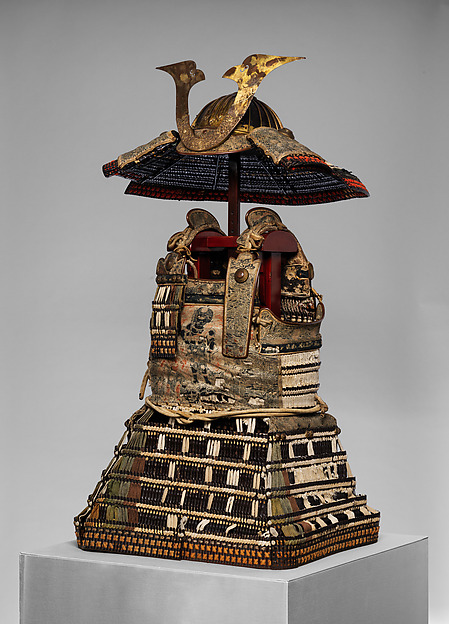
Armor (Yoroi) of Ashikaga Takauji (1305–1358) · early 14th century · Iron, lacquer, leather, silk, gilt copper
Look closer: Count the panels of the skirt below the waist: the great armour has four, where the lighter types usually have seven.
The Metropolitan Museum of Art, Gift of Bashford Dean, 1914, accession 14.100.121b–e. Public domain (Open Access).
It was a heavy, costly thing, and the Met gives exact figures for its own. The museum’s early fourteenth-century yoroi of Ashikaga Takauji weighs 11.77 kilograms in the body, and the helmet long associated with it weighs 5.56 kilograms more. The catalogue calls it a rare example of a medieval yoroi: a cuirass that wraps the body, closed by a separate right-side panel, the waidate, with a deep four-sided skirt. Yoroi, the Met says, were worn mainly by mounted warriors from about the tenth to the fourteenth century. This one was first laced in white silk, with diagonal bands of many colours on the skirt and shoulder guards, a colour scheme the museum reads as a rainbow, a symbol of good fortune and fleeting beauty, and its breastplate is covered in stencilled leather showing the Buddhist deity Fudō Myōō, whom samurai valued for his calm and steadfastness. Tradition says Takauji gave it to a shrine near Kyoto; Bashford Dean bought it in 1905 for 1,200 yen and gave it to the museum in 1914.
Wikipedia adds that the ō-yoroi was cut for a mounted archer, loose and boxy, awkward for free sword-play on foot, which is one reason, the article suggests, that the spear was preferred in close combat. A four-panel skirt distinguished it from the lighter dō-maru and haramaki, which usually had seven.

Armor (Dō-maru) · armor, ca. 1550; helmet, 18th century · Iron, leather, lacquer, silk, gilt copper
Look closer: Here the body wraps the torso instead of boxing it; compare the shape with the great armour above.
The Metropolitan Museum of Art, Gift of Bashford Dean, 1914, accession 14.100.120a–g. Public domain (Open Access).
Those two lighter types come next. The Met’s catalogue explains the shift of the sixteenth century in a single sentence: warlords had to fight on foot as well as on horseback, so they favoured lighter, closer-fitting armour such as the dō-maru. Wikipedia’s dō-maru article dates its first appearance to the 11th century, as armour for lesser samurai and retainers, and says it spread alongside the great armour in the Genpei War. The dō-maru wraps the torso and opens on the right side; the haramaki opens at the back; the ō-yoroi, open all down the right, needs a separate plate to cover the gap. Both lighter types fitted more closely and cost less, and the article says that even higher-ranking samurai eventually adopted the dō-maru for fighting on foot. The Met’s own dō-maru, of about 1550, carries a story: Date Masamune, an armour enthusiast who often rewarded retainers with armour rather than swords, gave it to his retainer Shiraishi Bungo after Shiraishi put down a miners’ uprising in 1594 and persuaded Toyotomi Hideyoshi that Masamune had not caused it. It descended in the Shiraishi family until 1905.

Cuirass of a Haramaki · 15th century · Iron, lacquer, leather, silk, gilt copper
Look closer: The haramaki closes at the back, so from the front you see an unbroken sweep of lacing.
The Metropolitan Museum of Art, Gift of Bashford Dean, 1914, accession 14.100.105. Public domain (Open Access).
The great change came with the gun. Wikipedia’s article on tōsei-gusoku, “modern armour”, dates the arrival of matchlocks to 1543, by way of the Portuguese trade, and says Japanese makers were soon producing them in numbers. Tōsei-gusoku, derived from the dō-maru and prominent from the 1500s, replaced the individual scales with iron plates, hinged the cuirass so that it could be put on and taken off quickly, and cost less to make. Large armies needed armour in quantity. The same article describes the nanban-dō, modelled on late European armour, whose front and back were each one iron plate with a raised centre and a V-shaped lower edge, and records that Tokugawa Ieyasu gave the first such set to Sakakibara Yasumasa before the Battle of Sekigahara, in 1600. A further type, tameshi, or “bullet-tested”, armour, was made so that samurai could keep wearing armour in the age of firearms.
Reading the Cord
Lacing, called odoshi, is the first thing a visitor notices and the last thing they learn to read. Wikipedia’s article on Japanese armour distinguishes dense lacing, kebiki-odoshi, in which cords cover the whole surface of the scales, from sparse lacing, sugake-odoshi, in which two cords connect the scales at intervals. Braided silk cord, kumihimo, was used for the lacing; the article says noble families used particular patterns and colours, that some cords had well over a hundred strands, and that one great armour could need as much as 300 metres of it.

Shoulder Guard (Ō-Sode) · mid–late 14th century · Iron, leather, lacquer, silk, gilt copper
Look closer: Lacing is a technology and a signature at once: find the horizontal bands and the cord that ties them together.
The Metropolitan Museum of Art, Gift of Bashford Dean, 1914, accession 14.100.50. Public domain (Open Access).
The great-armour article adds the social meaning. Colour and design of lacing identified a clan from a distance, it says, and tighter lacing indicated higher rank, though loose lacing was later adopted by every rank for lightness, ventilation and quick drying. It also notes that many surviving examples have been re-laced, with a few retaining original cord that still shows its clan association. That warning matters at a museum label: a splendid blue or purple suit may carry lacing from a later century than the plates beneath it.
The cuirass sits on a padded collar, and around it the other parts are tied. According to Wikipedia’s article on sangu, the leg and arm armour, the sleeves are cloth backed and laced with small cords on the inside of the arm, covered with mail, small plates or quilting; the shin guards are vertical plates or mail on cloth, tied below the knee, with a leather guard on the inside where the leg meets the stirrup; and the thigh guards are a cloth apron carrying small hexagonal or rectangular plates or mail. The article dates the first use of shin guards to the twelfth century.
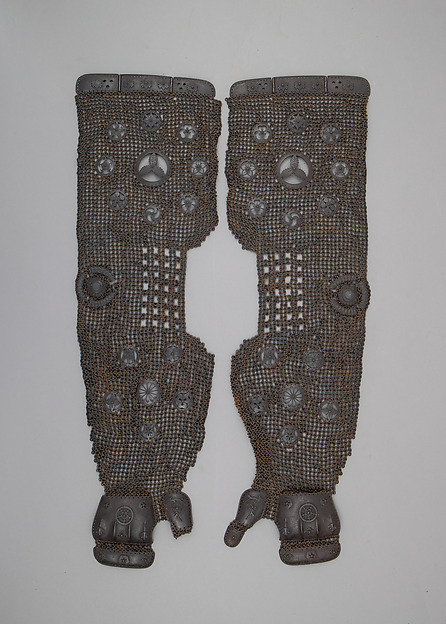
Pair of Sleeves (Kotē) · 18th century · Chainmail
Look closer: Mail and plates are sewn to a cloth ground; the sleeve is a garment first and armour second.
The Metropolitan Museum of Art, Rogers Fund, 1906, accession 06.55a, b. Public domain (Open Access).
Banners, Crests and Horns
In a battle of thousands, a suit had to say whose it was. Wikipedia’s article on sashimono describes small banners worn so that soldiers could be identified, most prominent in the Sengoku period, roughly the mid-fifteenth to early seventeenth century. They were usually square or short rectangles of silk or leather, often bearing a clan emblem, a name or a slogan, and they were held by an L-shaped frame set into a socket at the waist of the cuirass and hinged at shoulder level. Larger, more personal flags, uma-jirushi, belonged to commanders, and very large narrow banners, nobori, needed two or three men to hold them upright and helped direct the fighting in big battles. The article notes that both are still seen at sports events.

Armor (Gusoku) of the Maeda Family · 18th century · Iron, lacquer, gold, copper alloy, copper-gold alloy (shakudō), leather, silk
Look closer: This suit belongs to a named family. Look for how the colour of the lacing and the shape of the crest work together.
The Metropolitan Museum of Art, Rogers Fund, 1904, accession 04.4.64. Public domain (Open Access).
The helmet carried its own signs. Wikipedia’s article on the kabuto lists four positions for a crest, front, side, top and rear, and says that in the middle Muromachi period ordinary samurai began to wear crests in the shape of hoes, suns, moons or flags, to show courage or to tell friend from foe. In the Edo period, after the Siege of Osaka brought peace, medieval styles were revived and fanciful “strange helmets” flourished. The next chapter in this almanac, on the helmet and the face mask, follows that story.
The Armour That Never Fought
When the battles ended, the armour did not. Wikipedia’s account says that in the Edo period, from 1603 to 1868, armour became a status symbol, and that designs from the medieval past, ō-yoroi and dō-maru among them, came back into favour. At the same time lightweight, concealable armour, including mail jackets, was made for internal security and personal protection. The article also says that on 5 May, Children’s Day, Japanese households still display small armour and helmets, an adaptation of an old court ritual.
The Met’s records make the point from another side. Several of its suits are catalogued with two dates, for example an armour dated 1717 with a helmet of the late sixteenth century and restorations of 2015, or the dō-maru of about 1550 mounted with an eighteenth-century helmet. These are not errors; they are what a long-lived suit looks like. Parts were replaced, matched and paired by owners and later by dealers. A good collector learns to ask not “how old is this armour?” but “which parts are which age?”.

Myōchin Muneakira · Armor (Nimaidō Gusoku) · armor, dated 1717; helmet, late 16th century; restorations, 2015 · Iron, copper, copper-gold alloy (shakudō), gold, silver, horn, leather, silk
Look closer: The museum dates the armour 1717 and the helmet to the late sixteenth century: the suit is a partnership across two centuries.
The Metropolitan Museum of Art, Gift of Etsuko O. Morris and John H. Morris Jr., 2018, accession 2018.833.3a–p. Public domain (Open Access).
There is a human note to end on. The museum’s article on Bashford Dean, the Met’s founding curator of arms and armour, says that when he studied Japanese armour in the 1890s he assembled his own collection of about 125 pieces, lent it to the museum in 1903, and by his retirement in 1927 had helped make the Met’s collection the most comprehensive of its kind outside Japan. The article also records that a gusoku Dean wore in Japan around 1900 is now in the museum. We find that detail hard to forget: the great scholar of armour, trying one on.

Myōchin Munesuke · Armor (Gusoku) · early 18th century · Iron, lacquer, silk, copper, gold
Look closer: The Met attributes this suit to Myōchin Munesuke; the helmet and face mask often matter as much as the body.
The Metropolitan Museum of Art, Rogers Fund, 1913, accession 13.112.4. Public domain (Open Access).
Details worth a long look
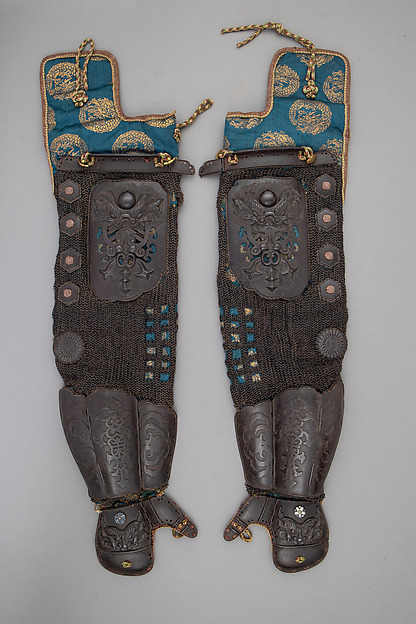
Pair of Sleeves (Kotē) · early 18th century · Iron, chainmail, silk
Look closer: The cloth is a brocade; the plates beneath are lacquered. Silk and iron sit in the same garment.
The Metropolitan Museum of Art, Rogers Fund, 1913, accession 13.112.14a, b. Public domain (Open Access).

Half Mask (Menpō) · 15th–16th century · Iron, lacquer
Look closer: The chin of the mask is built to hold the helmet’s cord.
The Metropolitan Museum of Art, Bequest of George C. Stone, 1935, accession 36.25.321. Public domain (Open Access).

Helmet (Suji-Kabuto) · 18th century · Iron, copper, gold, lacquer, silk, wood
Look closer: The ridges where plates meet are visible: this is a ridged helmet, suji-bachi.
The Metropolitan Museum of Art, Gift of Etsuko O. Morris and John H. Morris Jr., 2018, accession 2018.833.12a–f. Public domain (Open Access).

Armor (Gusoku) · 18th century · Iron, lacquer, silk, gilt copper
Look closer: Seated displays show how the skirt and thigh guards fall when the wearer sits.
The Metropolitan Museum of Art, Rogers Fund, 1906, accession 06.118. Public domain (Open Access).
Helmets, Masks and Armour
The house’s samurai shelf holds armour, helmets and face masks from Japan, each documented with its parts and condition; the concierge desk can advise on a particular piece or on display and care.
Answered plainly
What does gusoku mean?
In the Met’s catalogue the term names a complete suit of armour. Wikipedia’s armour articles use tōsei-gusoku for the later, plate-built suits of the 1500s onward.
What are the six main parts of samurai armour?
Wikipedia’s ō-yoroi article lists the cuirass (dō), helmet (kabuto), face mask (menpō), sleeves (kote), shin guards (suneate) and thigh guards (haidate).
Why did armour change in the sixteenth century?
Wikipedia’s tōsei-gusoku article ties it to firearms, which reached Japan in 1543, and to large armies that needed lighter, cheaper armour made quickly. Iron plates replaced scales and the cuirass was hinged.
How heavy was the great armour?
The Met gives 11.77 kilograms for the body of its early fourteenth-century yoroi of Ashikaga Takauji and 5.56 kilograms for the helmet associated with it; its dō-maru of about 1550 has a cuirass of 10.7 kilograms and a helmet of 3.8 kilograms. Weights vary by piece.
What is lacing for?
It binds scales and plates together; its colour and tightness could also identify a clan and rank, according to Wikipedia’s ō-yoroi article. Many surviving suits have been re-laced, so lacing is not always original.
When was samurai armour last used in war?
Wikipedia’s article says the last recorded use was in the Satsuma Rebellion of 1877.
Where next
Sources and image credits
- Japanese armour, Wikipedia
- Ō-yoroi, Wikipedia
- Dō-maru, Wikipedia
- Tōsei-gusoku, Wikipedia
- Sangu (armour), Wikipedia
- Sashimono, Wikipedia
- Kabuto, Wikipedia
- Bashford Dean and Japanese Arms and Armor, The Metropolitan Museum of Art
- Image: Armor (Gusoku), Yukinoshita Sadaiyé (Public domain (Met Open Access))
- Image: Armor (Yoroi) of Ashikaga Takauji (1305–1358), Unknown maker (Public domain (Met Open Access))
- Image: Armor (Dō-maru), Unknown maker (Public domain (Met Open Access))
- Image: Cuirass of a Haramaki, Unknown maker (Public domain (Met Open Access))
- Image: Shoulder Guard (Ō-Sode), Unknown maker (Public domain (Met Open Access))
- Image: Pair of Sleeves (Kotē), Unknown maker (Public domain (Met Open Access))
- Image: Armor (Gusoku) of the Maeda Family, Unknown maker (Public domain (Met Open Access))
- Image: Armor (Nimaidō Gusoku), Myōchin Muneakira (Public domain (Met Open Access))
- Image: Armor (Gusoku), Myōchin Munesuke (Public domain (Met Open Access))
- Image: Pair of Sleeves (Kotē), Unknown maker (Public domain (Met Open Access))
- Image: Half Mask (Menpō), Unknown maker (Public domain (Met Open Access))
- Image: Helmet (Suji-Kabuto), Unknown maker (Public domain (Met Open Access))
- Image: Armor (Gusoku), Unknown maker (Public domain (Met Open Access))
Last reviewed 28 October 2026. Pictures are public-domain or openly licensed and credited beneath each one; diagrams are drawn by Japonista.
Looking for an armour, a helmet or a face mask with a documented history? The concierge desk replies within one to three business days.
Private concierge
Looking for something in particular?
Describe the piece or the project you have in mind. A senior advisor in Tokyo reads every case file personally and replies within two business days, with fees set out in writing before any work begins.