Japonista
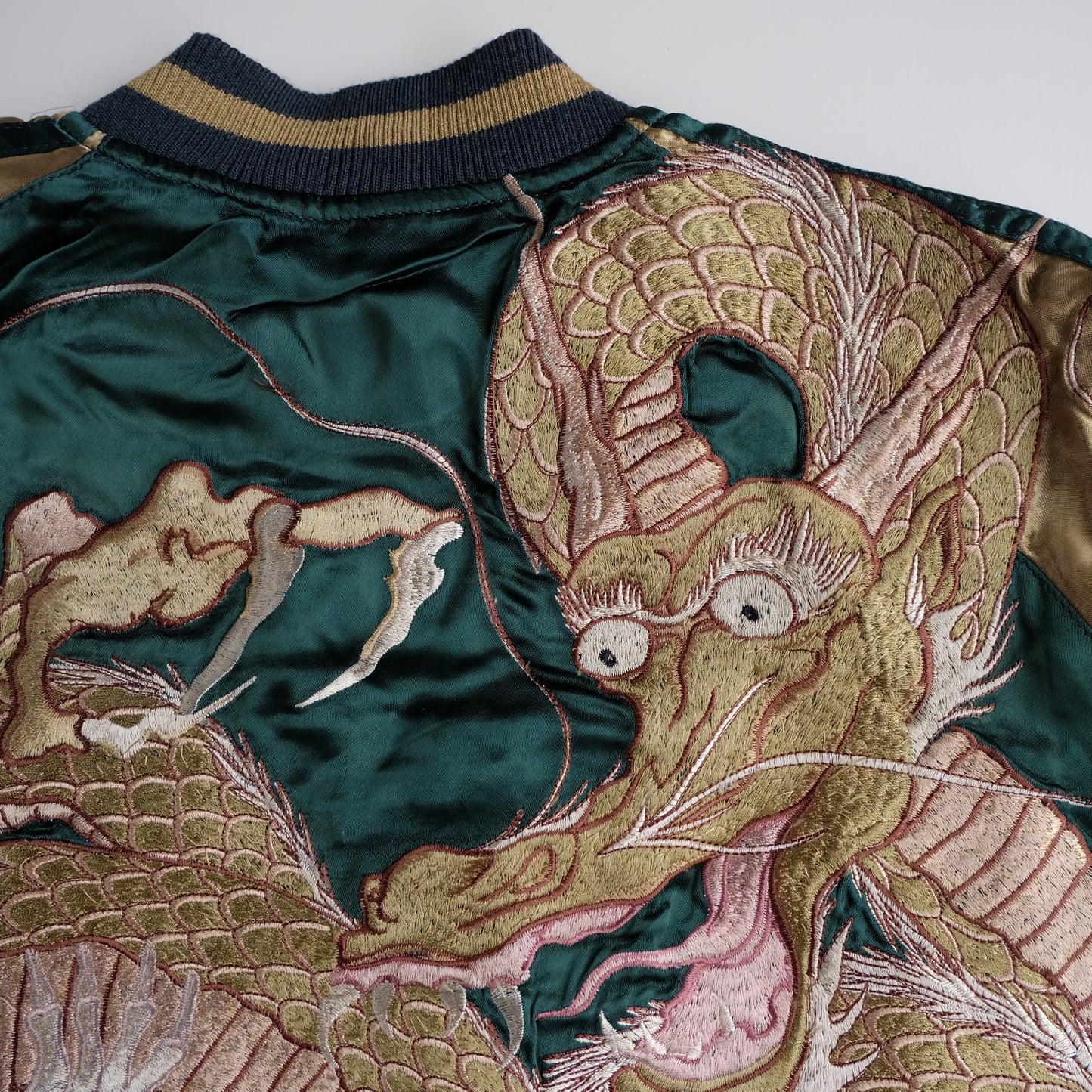
Sukajan reversible, bordado de dragón Ryū y esqueleto Dokuro, verde esmeralda × satén negro, finales del siglo XX
Sukajan reversible, bordado de dragón Ryū y esqueleto Dokuro, verde esmeralda × satén negro, finales del siglo XX
This piece has found its collector.
The Hunting Salon™ can search Japan's private collections for another like it. Ask us to find one or browse similar pieces.
No se pudo cargar la disponibilidad de recogida
All sales are final. Please read our refund policy before purchase.
A celestial dragon coils around a fully articulated human skeleton on both faces of this reversible sukajan, once in emerald and antique gold, once in black and spectral lavender. It is a wearable memento mori, the same embroidered confrontation told twice in two emotional registers.
The Piece
This reversible Japanese souvenir jacket is built around one of the most dramatic symbolic pairings in Japanese streetwear: the celestial dragon and the human skeleton. On the primary face, deep emerald-green satin meets antique-gold sleeves and muted gold ribbing, and a vast olive-gold dragon coils around an ivory embroidered skeleton, filling almost the entire back with scales, claws, whiskers, ribs and bones. Turned inside out, the same composition re-emerges in a darker register: black satin, silver-grey sleeves and pale lavender-grey embroidery transform the scene into a spectral monochrome vision. Neither side is a simplified alternative; both are complete, expressive and independently wearable.
The dragon is built from individually embroidered scales with pale pink and bronze contour stitching, sharply articulated claws, long curling whiskers, raised horns, layered mane details, ribbed belly plates and an open jaw with visible teeth, its sweeping body forming an enclosing circular rhythm. The skeleton is worked in ivory, bone-white, cream and pale grey threads, with dark eye sockets, nasal cavity and mouth set against the lighter skull. Skull, jaw, cervical spine, vertebral column, rib cage, shoulder blades, pelvis, upper arms, forearms, hands, fingers, femur and the lower skeletal elements are each clearly embroidered. The skeleton occupies the center and foreground while the dragon moves behind, around and above it, its head descending from the upper corner, so the composition reads with genuine depth rather than as separate motifs.
The green front is asymmetrical and theatrical. A large dragon head occupies the upper chest on one side, its horn extending toward the collar, its face rendered in olive, tan, dusty pink and ivory with a wide eye, flared nostril, whiskers and visible fangs. Opposite, a skeletal figure emerges from the side of the lower torso, skull and raised hand appearing as if from beyond the edge of the jacket. Worn open, portions of the reverse embroidery show at the center, adding a further layer.
On the black face the body turns deep black, the sleeves pale silver-grey and the ribbing black and ivory, while dragon and skeleton are rendered in dusty lavender, silver-grey, pale violet, ivory and muted taupe. The pale bones seem to emerge from darkness and the dragon becomes ghostlike, its enormous eyes and winding whiskers especially prominent; the effect is closer to ink drawing, ghost-story illustration and monochrome tattoo flash. Across the chest, two opposing dragon heads with long horns, open mouths and pale whiskers form a symmetrical gateway around the zipper.
The back embroidery covers nearly the entire central panel, leaving only narrow areas of satin visible at the edges. Dense satin stitching, layered scale construction, directional bone stitching, contour outlining, filled anatomical forms, fine whisker embroidery, long linear horn stitching, curved belly-plate embroidery, shaded thread transitions, contrasting facial details and dimensional raised threadwork combine across hundreds of individually defined scale shapes, the two subjects overlapping without losing their identity. The sukajan began as a postwar souvenir jacket for foreign servicemen, pairing American bomber silhouettes with Japanese embroidery; this example belongs to the darker, more theatrical branch of that tradition.
Details
- Era: Late 20th to early 21st century (assessed)
- Origin: Japan
- Material: Satin-finish textile; dense machine embroidery
- Color: Face A: emerald-green body, antique-gold sleeves, muted gold ribbing · Face B: black body, silver-grey sleeves, black-and-ivory ribbing
- Palette: Emerald green, antique gold, ivory, dusty pink, bronze, black, silver-grey, muted lavender
- Motifs: Ryū / tatsu dragon, full dokuro skeleton, dragon heads, scales, claws, sweeping whiskers
- Construction: Fully reversible double-faced souvenir jacket; raglan sleeves; reversible metal front zipper
- Trim: Striped rib-knit collar, cuffs and waistband (dark charcoal or black alternating with beige, antique gold or ivory by face)
- Pockets: Angled welt pockets with contrasting trim on both faces
- Gender: Unisex
Condition
- Older pre-owned garment in vintage condition with visible age-related wear, satin creasing, tonal variation and patina; the embroidery retains strong definition and both compositions remain clearly readable.
- Overall satin creasing, storage-related wrinkles and natural puckering around the dense embroidery.
- Age-related tonal variation, areas of fading and muted color, and uneven sheen under changing light.
- Visible patina on the lighter sleeve sections, with discoloration and shading on portions of the silver-grey and antique-gold fabric; the light sleeves show age and handling more readily than the darker body panels.
- Wear and tonal variation around the rib-knit collar, cuffs and waistband.
- Possible minor pulls or thread irregularities, and surface variation consistent with previous wear.
- The emerald side retains a rich presence; the black side offers a more subdued, atmospheric finish. No claim of mint, deadstock or unworn condition is made; the photographs of the sleeves, ribbing, zipper area and larger embroidered sections complete this record.
Dragon and Dokuro Symbolism
The Japanese dragon, ryū or tatsu, is serpentine rather than winged and is traditionally tied to water, clouds, storms, rivers, rain and supernatural authority, standing for transformation, protection, wisdom, resilience and movement between earthly and spiritual realms. The skeleton, or dokuro imagery, recurs across Japanese art, folklore and tattoo culture as a reminder that wealth, appearance and strength are temporary, carrying ideas of impermanence, fearlessness before death and the hidden structure beneath the surface.
Here the dragon does not stand beside the skeleton; it surrounds it completely, at once guardian, adversary, fate or the force through which the mortal body transforms. The ambiguity is the point: body and spirit, mortality and endurance, fear and mastery held in one embroidered field.
Period Assessment
The jacket is unattributed and undated, but appears consistent with an older Japanese sukajan of the late 20th or early 21st century, likely from the broad vintage revival when reversible souvenir jackets were reinterpreted for streetwear, rock and alternative fashion audiences.
- Reversible satin construction
- Large-scale machine embroidery
- Muted vintage color palette
- Striped rib-knit trim
- Traditional raglan silhouette
- Extensive two-sided decoration
- Naturally developed textile patina
- Older zipper and finishing character
Wearing and Display
The emerald face sits well with black, charcoal, brown, cream and muted olive, from faded indigo denim to wide military trousers and boots; the black face suits monochrome dressing, grey denim and engineer boots. Unworn, the back reads clearly across a room as textile art, and because both sides are fully developed the jacket can be reversed periodically to change the mood of a display.
Authenticity & Care
No maker label is visible; the jacket is offered as a Japanese reversible sukajan of the late 20th to early 21st century and is not represented as a 1940s or 1950s occupation-era souvenir jacket. Every piece is examined and documented in Japan before dispatch and is offered with the Japonista authenticity guarantee.
Delivery from Japan
Packed by hand in Japan and shipped insured and tracked by EMS or an equivalent express service. Import duties and taxes, where applicable, are payable on arrival. Returns follow our published policy.
Considered offers are welcome through Send an Offer, and each one is reviewed personally. Pieces over $1,000 may be reserved over several payments with Layaway Privilege™.
Continue browsing: Sukajan Souvenir Jackets · Amekaji & Wagara Fashion
Related pieces: Kingyo, dragon, tiger and oiran embroidered sukajan · Tailor Toyo KOSHO TT11201 bulldog and tiger reversible sukajan · WACKO MARIA × Tim Lehi 23SS velvet Vietnam jacket
Yokosuka Archive
A particular size, motif or decade in mind? Postwar souvenir jackets and heritage amekaji surface in Japan one at a time. Name the maker, the embroidery and the chest measurement, and the Hunting Salon™ watches for it on your behalf. Request a jacket search →
Collectors also search: dragon skeleton sukajan · reversible dragon sukajan · dokuro skeleton jacket · emerald green sukajan · japanese dragon souvenir jacket · skull embroidered bomber japan · vintage reversible sukajan · memento mori jacket