
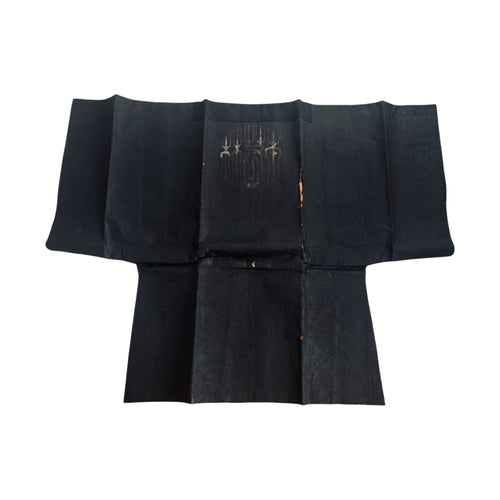


Meiji to Taisho Kamiko Dochugi, Washi Paper Travel Coat, Kakishibu-zome Lining and Back Crest
Meiji to Taisho Kamiko Dochugi, Washi Paper Travel Coat, Kakishibu-zome Lining and Back Crest
- Dispatch
- Prepared and sent from Tokyo within 7–14 days, often sooner, or as arranged
- Arrival
- Estados Unidos · usually 4–7 days after dispatch, insured and tracked Check the Shipping Flowchart here
- Shipping
- EMS recommended, with FedEx, DHL and UPS compared ·
- Import
Duties and customs · View the estimate
A guide for this piece: about $118, based on the 10% US charge on the declared value of goods made in Japan.
The final figure is set by US Customs and depends on where the piece was made and the kind of object it is. Many antiques over a century old carry no ordinary duty; most jewellery and leather goods add a single-digit rate.
With EMS, any charge is collected by your postal service on delivery. For pieces of significant value we can often arrange duties prepaid before dispatch.
Your customs authority: U.S. Customs and Border Protection (CBP), CBP Information Center · +1 877 227 5511 within the United States; +1 202 325 8000 from abroad (Monday to Friday, 8:30 to 17:00 Eastern)
These figures are estimates for your guidance; the charge set by customs may come in over or under them.
How the estimate is reached · Ask for a figure on this piece
- Sizing
- Measured by hand, in centimetres · Find your size · Ask before you buy
- Character
- Scoring underway ·
- Replies
- Within one Tokyo business day · Ask the curator team
- Guarantee
- Authenticity guaranteed · How we grade
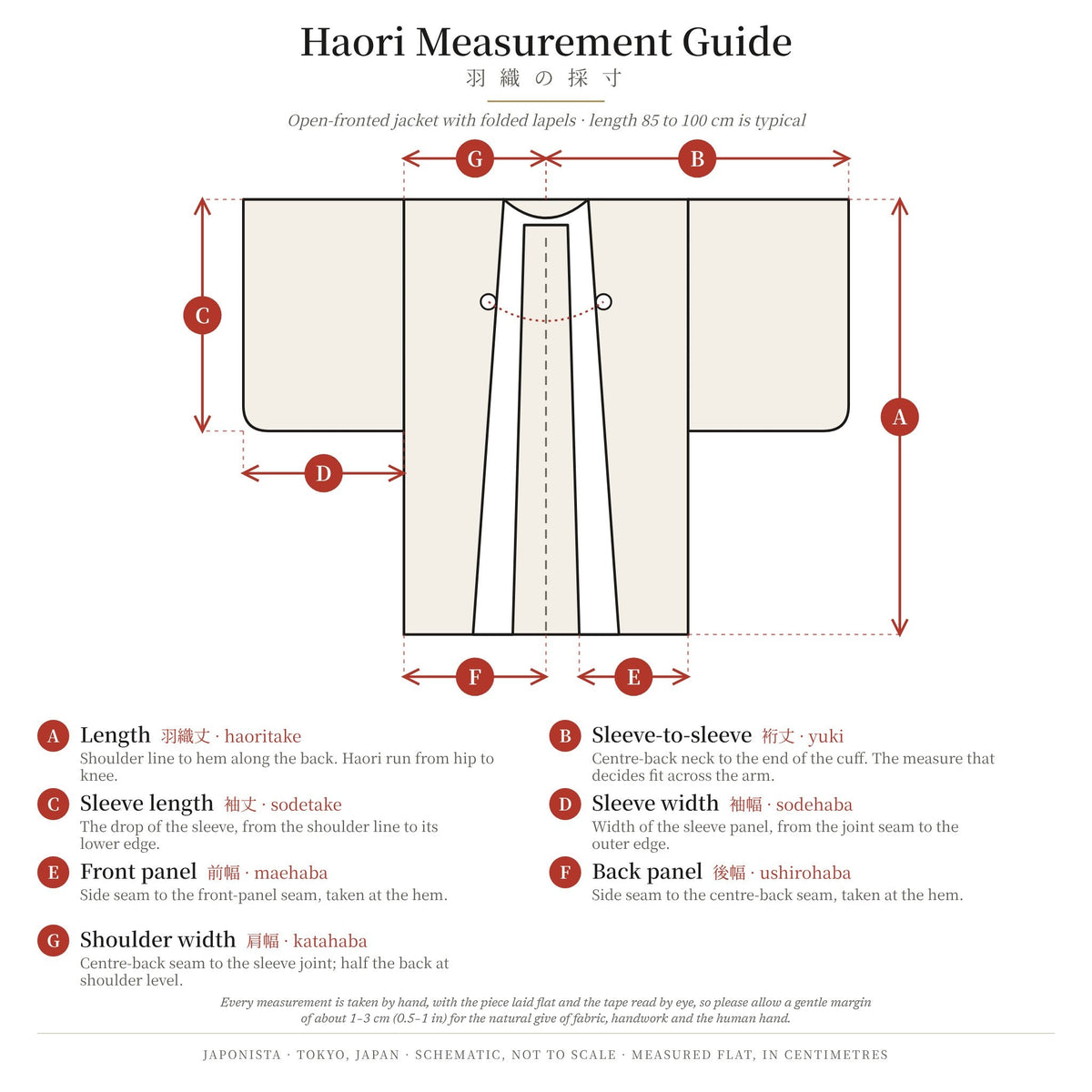
Every piece is measured by hand, in centimetres as Japan measures. Please allow 1–2 cm (about ½ inch) for the give of the material and the hand that held the tape.
Where each figure is taken · View the plate

Kimono
No se pudo cargar la disponibilidad de recogida
All sales are final. Please read our refund policy before purchase.
Considered offers only. The Desk replies personally to figures made in good faith; those set far below the asking price receive no reply.
Examined in Tokyo, one price, insured to your door. How buying from Japonista works · Join the Circle, free
A dochugi, the travelling coat of old Japan, made not of cloth but of washi paper in the kamiko tradition, its lining apparently dyed in Kakishibu-zome, the persimmon-tannin dyeing.
The Piece
The collar is faced in warm cotton and the original fastener remains near it. A crest stands on the back, and the lining glows with what appears to be kakishibu persimmon dye. Ink writing survives inside. The paper is fragile and torn along its folds, so this is a piece to hang, not to wear.
Measured flat: yuki 68 cm (26.8 in), body width 73 cm (28.7 in), length 100 cm (39.4 in), cuff 29 cm (11.4 in).
Every measurement is taken by hand, with the piece laid flat and the tape read by eye, so please allow a gentle margin of about 1–3 cm (0.5–1 in) for the natural give of fabric, handwork and the human hand.
The Craft of Persimmon Dyeing, Kakishibu-zome
Kakishibu is the fermented, tannin-rich juice pressed from unripe astringent persimmons, called shibugaki in Japanese. The suffix -zome means dyeing, so Kakishibu-zome is the traditional practice of colouring and finishing cloth with that juice. Pale tan at first, the colour warms toward russet and deep brown with wear, light and years.
The green fruit is gathered in early summer, crushed and pressed, and the juice is left to ferment and age for months or even years, which mellows its sharp smell. It is then brushed on, dipped or applied through a stencil, and the cloth is dried in the sun; the cycle may be repeated. As the tannins oxidise and bond with the fibre, the colour deepens in daylight, and no dye vat is required.
Aozome, Japan's indigo dyeing, begins with indigo leaves fermented into sukumo and kept alive in a vat. Cloth is dipped again and again, emerging yellow-green and turning blue as it meets the air, with deeper shades coming from repeated dips. Kakishibu has no vat: it is a plant tannin, used raw or aged, that deepens through oxidation and sunlight and keeps changing as the garment ages. It also tends to stiffen and strengthen fibre, and has long been valued for water resistance and for deodorising. Indigo is a cool blue; kakishibu is warm earth, red-brown.
Few dyes ask for so much patience. The fruit is harvested only in one season, the juice needs time to ferment, the application is by hand, and no two results are alike, because sun, humidity and the number of coats all leave their mark. Few workshops still keep the practice, and what it gives is a quiet, living patina rather than a fixed colour, a finish for those who value cloth that changes with them.
Details
- Form: Dochugi, travel coat
- Material: Washi paper, kamiko
- Collar: Cotton
- Lining: Kakishibu-zome (persimmon-tannin dyeing), apparently
- Era: Meiji to Taisho
- Made in: Japan
- Colour: Black tones
- Length: 100 cm (39.4 in)
- Grade: D, fragile
Condition
- Many tears, mostly along the folds, and the paper sheds flakes when handled; not suited to wearing, all photographed. Ships from Japan.
- See every photograph before deciding; they are part of the description.
Condition grade B (visible wear) on the Japanese scale; see Japanese condition ranks, explained.
Authenticity & Care
Checked and photographed in Japan before dispatch. Very fragile paper; keep it dry and out of the sun, handle as little as possible, and store it flat in breathable cotton.
Delivery from Japan
Packed by hand in Japan and shipped insured and tracked by EMS or an equivalent express service. Import duties and taxes, where applicable, are payable on arrival. Every sale is final; please ask anything before you buy, and see our published policy.
Every figure above is taken by hand, in centimetres, and Japanese labels often run a size smaller than Western ones. Compare with a piece you already own and allow a little margin, the quiet safeguard on a final sale. Our size conversion guide sets Japanese sizes beside US, UK, EU and Asian ones, and for anything it leaves open the curator team replies within one Tokyo business day.
Considered offers are welcome through Send an Offer, and each one is reviewed personally. Pieces over $1,000 may be reserved over several payments with Layaway Privilege™.
Continue with the boro and Japanese patchwork textiles, the kimono and textile heritage archive, or read the kimono types and formality guide.
Kimono and Textile Heritage
Looking for a similar piece, a different size or a particular reference? Our Hunting Salon™ locates it across Japan’s private collector circles, then inspects, documents and delivers it to you. Begin a Hunting Salon™ request.
Collectors also search: Kakishibu-zome · kakishibu · kamiko paper kimono · washi paper coat · antique dochugi · kakishibu textile


Chosen for you