
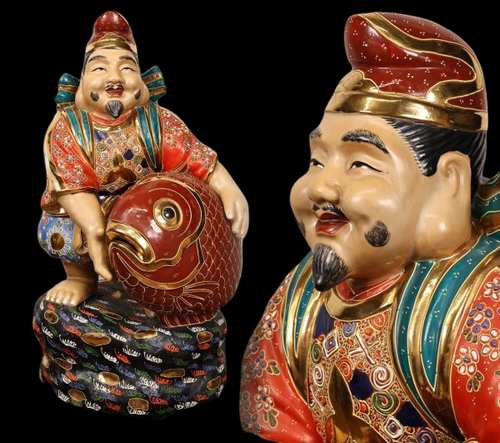


Ebisu de cerámica Kutani firmado Minekō, deidad de la fortuna Shichifukujin en cerámica policroma y dorada, 62 cm
Ebisu de cerámica Kutani firmado Minekō, deidad de la fortuna Shichifukujin en cerámica policroma y dorada, 62 cm
- Dispatch
- Prepared and sent from Tokyo within 7–14 days, often sooner, or as arranged
- Arrival
- Estados Unidos · usually 4–7 days after dispatch, insured and tracked Check the Shipping Flowchart here
- Shipping
- Quoted for this piece before purchase ·
- Import
Duties and customs · View the estimate
A guide for this piece: about $398, based on the 10% US charge on the declared value of goods made in Japan.
The final figure is set by US Customs and depends on where the piece was made and the kind of object it is. Many antiques over a century old carry no ordinary duty; most jewellery and leather goods add a single-digit rate.
With EMS, any charge is collected by your postal service on delivery. For pieces of significant value we can often arrange duties prepaid before dispatch.
Your customs authority: U.S. Customs and Border Protection (CBP), CBP Information Center · +1 877 227 5511 within the United States; +1 202 325 8000 from abroad (Monday to Friday, 8:30 to 17:00 Eastern)
These figures are estimates for your guidance; the charge set by customs may come in over or under them.
How the estimate is reached · Ask for a figure on this piece
- Character
- QuietResplendent Resplendent 9.5 of 10 ·
- Replies
- Within one Tokyo business day · Ask the curator team
- Guarantee
- Authenticity guaranteed · How we grade
Freight piece: please confirm delivery before purchase
This piece travels in a crate or by freight rather than standard mail, and may need careful dismantling before it can be packed. The shipping shown at checkout is an estimate. Japonista reserves the right to determine the final handling, crating and freight cost when your order is received, according to the piece, the destination and carrier conditions at that time.
We advise requesting a delivery quote before checkout. If the final cost is higher than the amount paid, we send the difference for your approval before dispatch. Your piece is held for you until it is settled.
Questions about delivery? Write to the curator deskNo se pudo cargar la disponibilidad de recogida
All sales are final. Please read our refund policy before purchase.
Considered offers only. The Desk replies personally to figures made in good faith; those set far below the asking price receive no reply.
Examined in Tokyo, one price, insured to your door. How buying from Japonista works · Join the Circle, free
Ebisu, the only one of the Seven Lucky Gods born in Japan and patron of honest labor, commerce and the sea, rises here to approximately 62 cm in iro-e enamels and kinrande-style gold. Signed Minekō beneath, it is a display-grade Kutani figure of uncommon scale and saturation.
The Piece
Ebisu is among the most distinctive figures of the Shichifukujin (Seven Lucky Gods), revered not only as a deity of wealth and prosperity but as the patron of honest labor, commerce, fisheries and fortune earned through diligence rather than chance. Unlike the members of the group whose origins trace to China or India, Ebisu is uniquely Japanese, and his iconography is woven into local belief, merchant culture and seasonal ritual life.
Ebisu figures were never merely decorative. They served as talismanic presences in shops, homes, storehouses and entrances, inviting continuity of business, safe harvests and a harmonious balance between effort and reward. Larger sculptural examples such as this were often commissioned as focal icons rather than casual ornaments, signaling both aspiration and reverence.
Executed in Kutani ware with rich iro-e polychrome enamels and kinrande-style gilding, the figure reflects the late development of Kutani as a medium for bold figural expression. Its dense surface, saturated reds and greens and generous gold articulate prosperity visually, and at approximately 62 cm it stands well above common domestic figures. The joyful expression, relaxed posture and the sea bream (tai) at his side reference Ebisu's role as a god of abundance; tai is also a visual pun on medetai, auspicious. The modeling favors warmth and approachability over severity, in keeping with the most benevolent of the Seven Lucky Gods.
In figural Kutani, enamel thickness must be balanced to avoid pooling and gilding must follow contour rather than sit on the surface. Here the volumes are handled with confidence: the face is modeled with expressive clarity, the robe patterns are carefully segmented into color fields that avoid visual overload, and gold is used strategically on garments, accessories and auspicious motifs. Signed Kutani figures of this scale that keep strong enamel saturation and structural integrity are comparatively uncommon.
Ebisu's place in the pantheon centers on ethical prosperity, wealth achieved through perseverance, craftsmanship and honest trade, which explains his prominence in merchant households and coastal communities. Large figures were placed with intent: near shop entrances to invite steady customers, in interior alcoves as guardians of livelihood, and in communal spaces to affirm shared fortune. Today such a figure suits a retail or hospitality interior, a collection of Japanese folk deities, or an entrance where his symbolism resonates naturally.
Details
- Maker: Kutani ware; kiln mark and signature Minekō on the underside
- Era: 20th century Kutani production
- Origin: Japan
- Material: Kutani ware ceramic with iro-e polychrome enamels and kinrande-style gilt accents
- Color: Saturated reds and greens with generous gold
- Measurements: Height approx. 62 cm · Width approx. 31 cm · Depth approx. 30 cm (a 77 cm figure cited in earlier notes is a different piece)
- Weight: Object approx. 19.4 kg
- Subject: Ebisu (Shichifukujin) with sea bream (tai)
- Shipping: Cargo or freight only; EMS and courier services are not applicable at this packed weight and size. Custom crating and reinforced packing; typical delivery 6 to 10 weeks. A destination-specific shipping quotation is recommended before purchase.
Condition
- Well preserved overall, with minor surface wear consistent with age and long-term display.
- No major losses or structural damage observed; enamel colors remain vibrant and the gilding retains strong visual impact.
Authenticity & Care
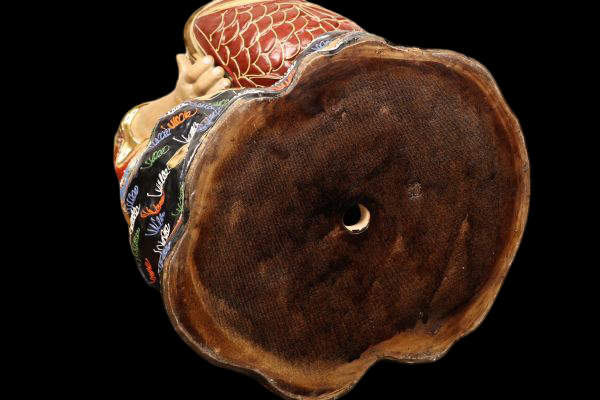
The underside bears a kiln mark consistent with Kutani attribution and the signed name Minekō, indicating workshop authorship; biographical data on Minekō is limited. Attribution rests on material, style, the kiln mark and Kutani figural conventions, without formal documentation. Every piece is examined and documented in Japan before dispatch and is offered with the Japonista authenticity guarantee.
Delivery from Japan
Crated in Japan and shipped insured by air or sea freight. A freight quote is confirmed with you before dispatch through our Museum-Grade Logistics Suite™. Import duties and taxes, where applicable, are payable on arrival. Returns follow our published policy.
Considered offers are welcome through Send an Offer, and each one is reviewed personally. Pieces over $1,000 may be reserved over several payments with Layaway Privilege™.
Continue browsing: Buddhist Statues & Sacred Art
Related pieces: Kutani polychrome shishi guardian statue · Kutani polychrome and gilt maneki-neko · Large left-paw Kutani maneki-neko
Temple to Home
Monumental statues, zushi shrines and altars travel crated and insured through our Museum-Grade Logistics Suite™. Seeking a particular deity or school? The Hunting Salon™ searches Japan for it. Arrange crating and freight →
Collectors also search: kutani ebisu statue · signed kutani figure · large ebisu figure · seven lucky gods ebisu · shichifukujin ebisu ceramic · japanese god of fortune statue · kinrande kutani figure


Chosen for you