
Oiran and Tayū: The Courtesans of the Yoshiwara | Japonista
Heritage Wing · Rank, Ritual
Oiran and Tayū: The Courtesans of the Yoshiwara
花魁・太夫
The oiran stood at the top of a system in which women were bound by contract to the licensed quarters. They were also trained in tea, poetry and music, and they were drawn, printed and talked of in their own day as the first ladies of fashion. This chapter keeps both facts in view.
Fact sheet
At a glance
- A rank and a word. Tayū were the highest rank, followed by kōshi; the word oiran came into use in the 1750s.
- High geta, front obi. The oiran’s clogs were about 20 centimetres tall and her obi was tied in front.
- A bound life. Unlike geisha, oiran were bound by long contracts and could not leave the quarters.
- Memory in motion. Dōchū processions are still reenacted in Niigata, Nagoya and Shinagawa.
What the Word Meant
Wikipedia’s article on the oiran calls them the highest-ranking courtesans in Japanese history, distinguished from ordinary yūjo by their refined entertainment and training in the traditional arts. The word is said to come from the phrase oira no tokoro no nēsan, roughly “the sister at our place”; the characters mean “flower” and “leader”. The word oiran originated in Yoshiwara in the 1750s.

Kaigetsudō Ando · Standing Courtesan · early 18th century · Hanging scroll, mounted as panel; ink and color on paper
Look closer: The courtesan’s robe fills the panel.
The Metropolitan Museum of Art, Mary Griggs Burke Collection, Gift of the Mary and Jackson Burke Foundation, 2015, accession 2015.300.118. Public domain (Open Access).
The tayū was the highest rank and the kōshi the next. A 1792 Yoshiwara guidebook listed six: tayū, kōshi, yobidashi tsukemawashi, sancha, tsukemawashi and zashikimochi. The same article says that the last Yoshiwara tayū retired in 1761, and that the 1792 guidebook noted the tayū and kōshi ranks as dormant in Yoshiwara for thirty years, though tayū and kōshi continued in Kyoto and Osaka.

Okumura Masanobu · A Courtesan and Her Attendants with a Revolving Shadow Lantern · ca. 1715–20 · Woodblock print (tan-e); ink and hand applied color on two joined sheets of paper
Look closer: An early print, with a lantern that throws revolving shadows.
The Metropolitan Museum of Art, Gift of Lee E. Dirks, in celebration of the Museum's 150th Anniversary, 2019, accession 2019.447.2. Public domain (Open Access).
The setting was legal and confined. The article records that brothels were confined to licensed pleasure quarters, the yūkaku, around 1600. The hanamachi chapter in this wing gives the dates of the main quarters: Yoshiwara in Edo in 1617, Shimabara in Kyoto in 1640 and Shinmachi in Osaka between 1624 and 1644.
Geta, Hair and the Front-Tied Obi
The oiran’s dress was famous. Wikipedia describes the koma geta, of paulownia wood, about twenty centimetres tall with three teeth; they forced a slow sliding step, suri-ashi, and two attendants, wakaimono, assisted the wearer. Her hair was large, elaborate and heavily waxed, and she wore upwards of eight large kanzashi in tortoiseshell, silver, gold or gemstones, in styles that signalled rank, season and occasion.

Chōbunsai Eishi · The Yoshiwara Parade in Autumn · ca. 1793 · Triptych of woodblock prints; ink and color on paper
Look closer: Courtesans and attendants of different heights walk in line; the lanterns frame the scene.
The Metropolitan Museum of Art, Rogers Fund, 1914, accession JP183. Public domain (Open Access).
The outermost garment was the heavy, padded-hem uchikake, worn unbelted over the underkimono. The obi was tied at the front. In the Edo period, the article says, it became wider and stiffer, and the manaita, “cutting board”, obi became their signature style. Wikipedia’s article on the obi adds that the manaita is flat, front-tied and historically worn by some oiran, and is now worn by reenactors and kabuki actors.
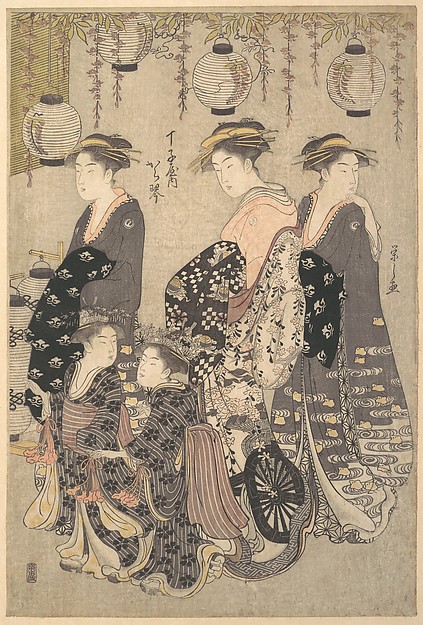
Chōbunsai Eishi · Karakoto of Chojiya on Parade · ca. 1790 · One sheet of a triptych of woodblock prints; ink and color on paper
Look closer: The sheet names the house of the courtesan, Chōjiya.
The Metropolitan Museum of Art, The Howard Mansfield Collection, Purchase, Rogers Fund, 1936, accession JP2423. Public domain (Open Access).
The Met’s prints are the best illustration. The triptych of about 1793 by Eishi shows courtesans and attendants beneath lanterns and blossoming branches; the hanging scroll by Hokuba shows a beauty of the Yoshiwara with an apprentice in moonlight; the surimono of 1789 by Shunman shows a courtesan with four attendants. In each, the dress takes up most of the picture.
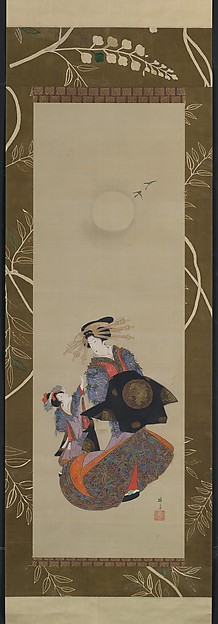
Teisai Hokuba · Beauty of the Yoshiwara with Apprentice in Moonlight · 19th century · Hanging scroll; ink, color, and gold on silk
Look closer: A seated beauty with her apprentice; the moon is a pale disk above.
The Metropolitan Museum of Art, Purchase, Friends of Asian Art Gifts, 2003, accession 2003.265. Public domain (Open Access).
Attendants and Arts
An oiran did not travel alone. The article names two kinds of attendant: the kamuro, child attendants, and the shinzō, apprentice courtesans, whose names were written in hiragana. A courtesan’s procession to the teahouse, the dōchū, was a public ceremony with the attendants in her train, as the prints on this page suggest.

Kubo Shunman · Procession of a Courtesan with Her Four Attendants · 1789 · Woodblock print (surimono); ink and color on paper
Look closer: One tall figure and four smaller ones: the attendants follow the courtesan in a line.
The Metropolitan Museum of Art, Purchase, Marjorie H. Holden Gift, 2012, accession 2012.248.1. Public domain (Open Access).
The arts were part of the rank. Wikipedia lists training in tea ceremony, ikebana and calligraphy, and music on the koto, shakuhachi, tsuzumi, shamisen and kukyū. Clients, the article says, expected an oiran to be well read and to converse with wit and elegance. In this respect she resembled the geisha who later became popular with merchants, but the article insists on the difference: geisha wore simpler clothing, played short kouta songs on the shamisen and were cheaper and more informal. They were forbidden from dressing like oiran and from sleeping with customers, could leave their houses and choose their patrons, whereas oiran were bound by long contracts and could not leave the quarters.

Hishikawa Moronobu · The Twelfth Scene from Scenes of the Pleasure Quarter at Yoshiwara in Edo · late 17th century · Woodblock print; ink and color on paper
Look closer: A century before the Eishi triptych, Moronobu pictured the quarter’s interiors.
The Metropolitan Museum of Art, Rogers Fund, 1918, accession JP229. Public domain (Open Access).
The same article is plain that the entertainment of an oiran included sex as well as the arts. We note it because it is the unavoidable context of the pictures in this chapter, and because the long contracts and the confinement mean that it is not a story of free choice. The beauty of the prints and the conditions of the quarter are both facts.
Reenactment and the Last Tayū
The tradition continues in two forms. First, the reenactment. Wikipedia lists three oiran dōchū processions: Bunsui in Niigata, held every April, in which three oiran, Shinano, Sakura and Bunsui, walk with roughly seventy attendants; Ōsu in Nagoya, a two-day festival around early October, with a procession through the Ōsu Kannon shopping arcade; and Minamishinagawa in Shinagawa, a parade held every September. The photograph on this page, from Sapporo’s Susukino district, shows a performer in a similar procession.

花魁道中@すすきの
Look closer: The tall hairstyle and the ornaments are those the sources describe; the person is a modern performer.
MIKI Yoshihito from Sapporo City,Hokkaido., JAPAN, CC BY 2.0, via Wikimedia Commons.

Second, the surviving tayū. The article says that Shimabara in Kyoto is the location of the last remaining tayū house and that fewer than five tayū remain in Kyoto, performing arts without the sexual aspect. The hanamachi chapter notes that Shimabara is now largely a living museum with tayū reenactors.
The Kanzashi chapter records that traditional hairstyles are worn today by, among others, modern tayū and oiran reenactors, some using pre-styled wigs. The reenactments are therefore a way of keeping the dress and the ritual in view without the conditions that produced them.
Prints of the quarter
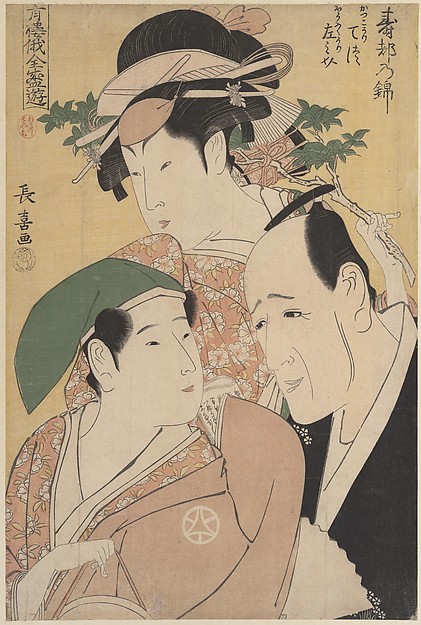
Eishōsai Chōki · Amusements at the Height of Yoshiwara’s Niwaka Festival (Seirō niwaka zensei asobi) · ca. 1796 · Woodblock print (nishiki-e); ink and color on paper
Look closer: A crowd at the festival.
The Metropolitan Museum of Art, The Howard Mansfield Collection, Purchase, Rogers Fund, 1936, accession JP2418. Public domain (Open Access).

Kubo Shunman · Courtesan Dreaming of the New Year Procession · 1814 · Woodblock print (surimono); ink and color on paper
Look closer: A courtesan at her desk, dreaming of a procession.
The Metropolitan Museum of Art, H. O. Havemeyer Collection, Bequest of Mrs. H. O. Havemeyer, 1929, accession JP1971. Public domain (Open Access).

Shōsai Ikkei · Shin Yoshiwara: The New Yoshiwara · ca. 1875 · Woodblock print; ink and color on paper
Look closer: The district in about 1875.
The Metropolitan Museum of Art, Gift of Lincoln Kirstein, 1959, accession JP3208. Public domain (Open Access).

Hishikawa Moronobu · Scene in the Yoshiwara · ca. 1680 · Woodblock print; ink and color on paper
Look closer: A print of about 1680.
The Metropolitan Museum of Art, Gift of Estate of Samuel Isham, 1914, accession JP813. Public domain (Open Access).
Prints and Heritage Pieces
The house’s print and textile shelves hold Edo and Meiji pieces from the world described here. The concierge desk can advise on dates and condition.
Answered plainly
What does oiran mean?
The article says it comes from a phrase meaning “the sister at our place”; the characters mean flower and leader.
What was the highest rank?
Tayū, followed by kōshi, according to Wikipedia. The last Yoshiwara tayū retired in 1761.
How tall were the geta?
About 20 centimetres, in paulownia wood with three teeth, and two attendants assisted the wearer.
Where was the obi tied?
At the front. Wikipedia says the manaita obi, wide and stiff, became their signature style.
How did oiran differ from geisha?
Geisha emerged in the late eighteenth century, wore simpler clothing, could leave their houses and choose patrons; oiran were bound by long contracts and could not leave the quarters.
Are there oiran today?
Not in the old sense. Reenactment processions are held in Niigata, Nagoya and Shinagawa, and fewer than five tayū remain in Kyoto, performing arts only.
Where next
Sources and image credits
- Oiran, Wikipedia
- Obi (sash), Wikipedia
- Kanzashi, Wikipedia
- Hanamachi, Wikipedia
- Metropolitan Museum of Art Open Access
- Image: Standing Courtesan, Kaigetsudō Ando (Public domain (Met Open Access))
- Image: A Courtesan and Her Attendants with a Revolving Shadow Lantern, Okumura Masanobu (Public domain (Met Open Access))
- Image: The Yoshiwara Parade in Autumn, Chōbunsai Eishi (Public domain (Met Open Access))
- Image: Karakoto of Chojiya on Parade, Chōbunsai Eishi (Public domain (Met Open Access))
- Image: Beauty of the Yoshiwara with Apprentice in Moonlight, Teisai Hokuba (Public domain (Met Open Access))
- Image: Procession of a Courtesan with Her Four Attendants, Kubo Shunman (Public domain (Met Open Access))
- Image: The Twelfth Scene from Scenes of the Pleasure Quarter at Yoshiwara in Edo, Hishikawa Moronobu (Public domain (Met Open Access))
- Image: An oiran dōchū procession in Susukino, Sapporo, MIKI Yoshihito from Sapporo City,Hokkaido., JAPAN (CC BY 2.0)
- Image: Amusements at the Height of Yoshiwara’s Niwaka Festival (Seirō niwaka zensei asobi), Eishōsai Chōki (Public domain (Met Open Access))
- Image: Courtesan Dreaming of the New Year Procession, Kubo Shunman (Public domain (Met Open Access))
- Image: Shin Yoshiwara: The New Yoshiwara, Shōsai Ikkei (Public domain (Met Open Access))
- Image: Scene in the Yoshiwara, Hishikawa Moronobu (Public domain (Met Open Access))
Last reviewed 28 October 2026. Pictures are public-domain or openly licensed and credited beneath each one; diagrams are drawn by Japonista.
Looking for an Edo or Meiji print of the quarters with its date and condition documented? The concierge desk replies within one to three business days.
Private concierge
Looking for something in particular?
Describe the piece or the project you have in mind. A senior advisor in Tokyo reads every case file personally and replies within two business days, with fees set out in writing before any work begins.