
Kimono and Obi in the Flower Towns | Japonista
Heritage Wing · Silk, Pattern
Kimono and Obi in the Flower Towns
着物と帯
Dress is the language of the flower towns. The length of a hem, the cut of a sleeve and the way a sash is tied tell a viewer, at a glance, who is wearing it and what she is training to become. This chapter reads that language from the sources.
Fact sheet
At a glance
- The hikizuri. A trailing kimono, typically 200 to 240 centimetres long; the formal version is black with five crests.
- The darari obi. The longest obi, worn by maiko and tied with long tails at the back.
- A sash that grew. The obi began as a thin Heian cord and had doubled in width by the 1680s.
- Kyoto weaving. Nishijin-ori is intricately woven and, Wikipedia says, can cost up to a million yen.
The Trailing Robe
The maiko’s main garment is the hikizuri, which Wikipedia’s maiko article says is typically 200 to 240 centimetres long, so that it trails along the floor. The article describes the formal version as black in the style of a kurotomesode, with five crests, the kamon. Tokyo apprentices, it adds, are called hangyoku and may wear a furisode and a wig; the details differ from town to town.

Over Robe (Uchikake) with Fans and Flowers · second half 18th–first half 19th century · Figured satin-weave silk with tie-dyeing, silk embroidery, and couched gold thread
Look closer: The robe is displayed with its sleeves open; the pattern repeats over the whole surface.
The Metropolitan Museum of Art, Purchase, Seymour Fund, Mrs. Donald Oenslager Gift and Gifts in memory of Gertrude Carp, 1988, accession 1988.165. Public domain (Open Access).
The Met’s textile galleries hold garments of the same world of dress, though not maiko garments themselves. Its uchikake, long outer robes, are catalogued as Edo-period and later pieces: one of the second half of the eighteenth or the first half of the nineteenth century with fans and flowers, worked in a figured satin-weave silk with tied resist-dyeing; one of the first half of the nineteenth century embroidered with books and mandarin oranges; and one of the late eighteenth or early nineteenth century with peonies, plum blossoms and a butterfly. They show the vocabulary of pattern: flowers and objects set across a single surface.
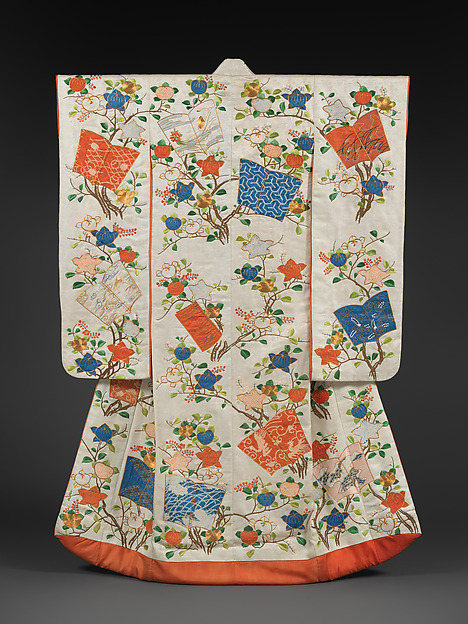
Woman's Overrobe (Uchikake) with Books and Mandarin Orange Branches · first half of the 19th century · Embroidery in silk and metallic thread; appliqué of resist-dyed (shibori) silk fabrics on silk satin damask
Look closer: Look at the lining: the red hem is the part that shows when the robe trails.
The Metropolitan Museum of Art, Gift of Mr. and Mrs. Earl Morse, 1972, accession 1972.18. Public domain (Open Access).
The uchikake belongs, in Wikipedia’s account of the oiran, to the courtesan, who wears it unbelted over her underkimono. The maiko’s trailing hikizuri is a different garment, and the oiran chapter in this wing takes up the difference.
From Cord to Wide Band
The obi began, Wikipedia says, as a thin cord or ribbon-like sash about eight centimetres wide in the Heian period. At the start of the Edo period the sleeves of the kosode grew longer and wider and the obi widened to match: by the 1680s women’s obi had doubled in width, reaching about 25 centimetres in the 1730s and about 30 centimetres at the turn of the nineteenth century. The chart on this page plots those figures.
Figures from Wikipedia’s article on the obi: about 8 cm in the Heian period, doubled by the 1680s, about 25 cm in the 1730s and about 30 cm around 1800. The 1680s bar is the doubled width.
Look closer: The last bar is almost four times the first.
Diagram by Japonista. Original drawing, no source image.
The article adds two details that surprise newcomers. Obi were originally tied at the front; by the end of the seventeenth century they were mostly tied at the back, though the custom was not firmly set until the early twentieth century. And one of the most common knots today, the taiko musubi, is described as created by geisha in 1823 to celebrate the opening of the Taikobashi bridge in Tokyo.

Obi with Dragon and Phoenix · 19th century · Silk satin with supplementary weft patterning in silk and metallic threads
Look closer: The panel runs the length of a sash; the dragon and phoenix are woven, not printed.
The Metropolitan Museum of Art, Gift of Phillip H. Rubin, 2006, accession 2006.572.5. Public domain (Open Access).
The obi that belongs to the maiko is the darari. Wikipedia gives it as the longest obi, roughly six metres and sometimes up to seven, worn by maiko in some regions, with a knot, the darari musubi, worn only by maiko, dancers and kabuki actors, whose long tails hang at the back. The maiko article gives its length as six to seven metres and its width as about 30 centimetres, with gold brocade for formal occasions. The older maru obi, the most formal, is now worn mainly by maiko and brides.
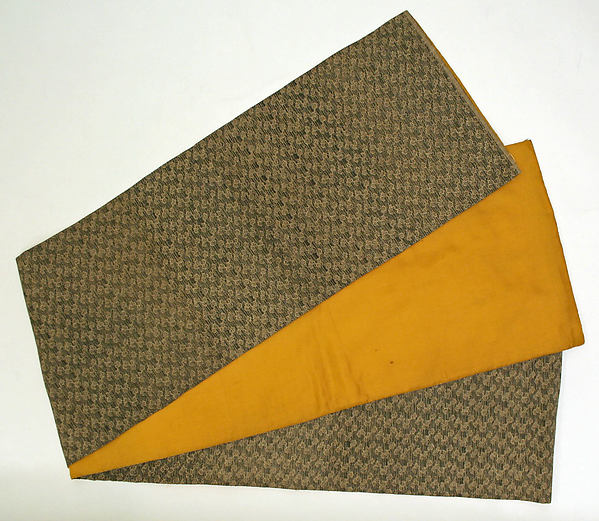
Obi · late 19th century · silk
Look closer: Folded to show both faces: a patterned outer side and a plain lining.
The Metropolitan Museum of Art, Gift of Miss Irene Lewisohn and Mrs. Alice Lewisohn Crowley, 1946, accession C.I.46.9.190. Public domain (Open Access).
Nishijin and Hakata
Wikipedia names two weaves for obi. Nishijin-ori, made in Kyoto’s Nishijin district, is intricately woven and can cost up to a million yen. Hakata-ori, from Fukuoka, is a stiff, tightly woven fabric prized for its craftsmanship. The formal obi, the article says, uses heavy brocade, and silk is considered essential for formal occasions, though cotton, hemp and polyester are also used.

Obi with Pattern of Checks and Floral Roundels · 19th century · Silk, metallic thread; twill with supplementary weft patterning and brocading
Look closer: Squares and roundels alternate in bands down the length.
The Metropolitan Museum of Art, Gift of Jean Mailey, 1981, accession 1981.229.2. Public domain (Open Access).
The Met’s own obi demonstrate how varied the field is. One of the nineteenth century has a pattern of checks and floral roundels in silk and metallic thread; another, of the early twentieth century, has stylised waves in silk and metallic thread; a third is catalogued as a woman’s obi in silk with gold, in a compound weave. The classification is the museum’s and the collection is not specifically geisha dress, but the weaving is the same craft.

Obi with Stylized Waves · early 20th century · Silk and metallic thread
Look closer: Waves in metallic thread on a dark silk ground.
The Metropolitan Museum of Art, Gift of Sue Cassidy Clark, in honor of Dr. Barbara Brennan Ford, 2005, accession 2005.171. Public domain (Open Access).
The accessories finish the effect. According to the article, the obi-jime is a decorative kumihimo cord about 150 centimetres long, tied around the obi; the obiage is a scarf-like cloth above the obi, often dyed using kanoko shibori; and the obi-ita is a long stiffener between the folds at the front, to give a flat, smooth line.
How to Read a Dressed Figure
The prints of the Edo period are the best guides to dress because they were made to be looked at closely. In the Met’s sheet by Utagawa Toyokuni I of about 1795, a geisha stands in a long patterned robe with a broad sash; in Eishi’s triptych sheet of about 1792, two geisha sit with a shamisen, one robe dark with a bold repeating pattern.
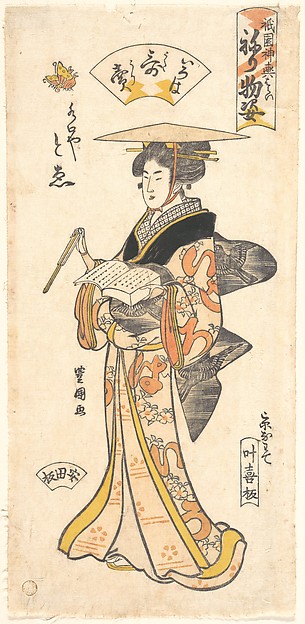
Utagawa Toyokuni I · “The Geisha To’e as a Vendor of Poems,” from the series Gion Festival Costume Parade (Gion mikoshi arai nerimono sugata) · ca. 1795 · Woodblock print; ink and color on paper
Look closer: The sash is broad; compare it with the width chart above.
The Metropolitan Museum of Art, Rogers Fund, 1922, accession JP1390. Public domain (Open Access).
A reader of such a print can look at four things in turn. First the sash, whose width and the way it is tied vary with the date, as the chart on this page shows. Second the pattern on the robe. Third the collar, and fourth the hem. The Kanzashi chapter returns to the seasonal vocabulary that Wikipedia records for hair ornaments, month by month.
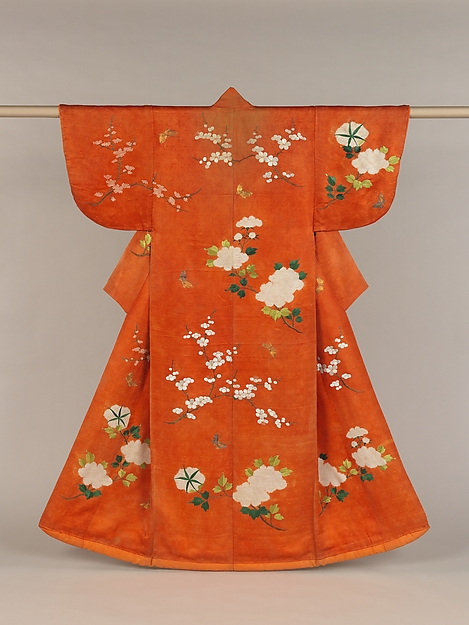
Outer Robe (Uchikake) with Peonies, Plum Blossoms, and Butterflies · late 18th–early 19th century · Silk damask embroidered with silk and metallic thread
Look closer: Embroidered flowers over a solid ground; the hem is padded.
The Metropolitan Museum of Art, Purchase, Friends of Asian Art Gifts, 2008, accession 2008.11. Public domain (Open Access).
We make no claim about identification beyond what the sources support. A print from the 1790s is not a record of what a maiko wears in the twenty-first century, and Wikipedia is explicit that conventions differ by district and by apprentice class. A careful viewer reads a print as a record of its own day.
Silk in the museum

Woman's Obi · 19th century · Silk;gold / Compound
Look closer: A pine design runs across a pale ground.
The Metropolitan Museum of Art, Gift of Courtland Palmer, 1950, accession 50.79.3. Public domain (Open Access).

Chōbunsai Eishi · Two Geisha · ca. 1792 · One sheet of a triptych of woodblock prints; ink and color on paper
Look closer: A bold repeating pattern on the robe.
The Metropolitan Museum of Art, The Howard Mansfield Collection, Purchase, Rogers Fund, 1936, accession JP2421. Public domain (Open Access).

Unknown · [Geisha Girls] · ca. 1880 · albumen silver print
Look closer: Two obi tied differently, side by side.
The Metropolitan Museum of Art, Museum Accession, transferred from the Costume Institute Library, accession 2011.533. Public domain (Open Access).

Unknown · [Tokyo Geisha with Shamisen] · 1870s · Albumen silver print from glass negative with applied color
Look closer: The sash is seen from the side.
The Metropolitan Museum of Art, Gilman Collection, Museum Purchase, 2005, accession 2005.100.505.1 (7b). Public domain (Open Access).
Kimono, Obi and Textile Pieces
The house’s textile shelves hold uchikake, kimono and obi in the Edo and Meiji traditions. The concierge desk can advise on fibre, dye and condition.
Answered plainly
How long is a hikizuri?
Typically 200 to 240 centimetres, according to Wikipedia’s maiko article.
How long is a darari obi?
Roughly six to seven metres and about 30 centimetres wide, according to Wikipedia.
When did the obi widen?
Wikipedia dates the widening to the Edo period: doubled by the 1680s, about 25 cm in the 1730s and about 30 cm around 1800.
What is Nishijin-ori?
An intricately woven Kyoto textile from the Nishijin district that Wikipedia says can cost up to a million yen.
What is a taiko musubi?
A box-shaped knot with a short tail. Wikipedia says geisha created it in 1823 for the opening of the Taikobashi bridge in Tokyo.
Is an uchikake the same as a hikizuri?
No. The uchikake is the heavy, padded-hem outer robe worn unbelted by courtesans; the hikizuri is the trailing garment of the maiko.
Where next
Sources and image credits
- Maiko, Wikipedia
- Obi (sash), Wikipedia
- Oiran, Wikipedia
- Metropolitan Museum of Art Open Access
- Image: Over Robe (Uchikake) with Fans and Flowers, Unknown maker (Public domain (Met Open Access))
- Image: Woman's Overrobe (Uchikake) with Books and Mandarin Orange Branches, Unknown maker (Public domain (Met Open Access))
- Image: Obi with Dragon and Phoenix, Unknown maker (Public domain (Met Open Access))
- Image: Obi, Unknown maker (Public domain (Met Open Access))
- Image: Obi with Pattern of Checks and Floral Roundels, Unknown maker (Public domain (Met Open Access))
- Image: Obi with Stylized Waves, Unknown maker (Public domain (Met Open Access))
- Image: “The Geisha To’e as a Vendor of Poems,” from the series Gion Festival Costume Parade (Gion mikoshi arai nerimono sugata), Utagawa Toyokuni I (Public domain (Met Open Access))
- Image: Outer Robe (Uchikake) with Peonies, Plum Blossoms, and Butterflies, Unknown maker (Public domain (Met Open Access))
- Image: Woman's Obi, Unknown maker (Public domain (Met Open Access))
- Image: Two Geisha, Chōbunsai Eishi (Public domain (Met Open Access))
- Image: [Geisha Girls], Unknown (Public domain (Met Open Access))
- Image: [Tokyo Geisha with Shamisen], Unknown (Public domain (Met Open Access))
Last reviewed 28 October 2026. Pictures are public-domain or openly licensed and credited beneath each one; diagrams are drawn by Japonista.
Looking for an uchikake, kimono or obi with its dye and fibre documented? The concierge desk replies within one to three business days.
Private concierge
Looking for something in particular?
Describe the piece or the project you have in mind. A senior advisor in Tokyo reads every case file personally and replies within two business days, with fees set out in writing before any work begins.