
Kanzashi: The Hair Ornaments of the Seasons | Japonista
Heritage Wing · Silk, Lacquer, Tortoiseshell
Kanzashi: The Hair Ornaments of the Seasons
簪
A kanzashi is a small thing worn at the highest point of the body. It can be a pin, a comb, a cluster of folded silk, or a bead on a stem. In the flower towns it also tells the time of year.
Fact sheet
At a glance
- A pin that became a language. Edo hairstyles grew larger and more complicated, and kanzashi came into wider use with them.
- Twelve months. A maiko’s ornaments change with the month, from pine and plum in January to rice-cake flowers in December.
- Folded silk. Tsumami kanzashi are made from squares of silk folded into flowers, plants and animals.
- A tool that crossed over. The kogai, a sword-fitting, is also a hair tool; Wikipedia lists a kogai-style kanzashi that resembles a sheathed sword.
Pins, Combs and Beads
The word kanzashi is written with the same character as the Chinese hairpin, zan, and Wikipedia’s article says it covers long rigid hairpins, barrettes, fabric flowers and fabric hair ties. In English it often refers specifically to tsumami kanzashi, the folding technique used to make fabric flowers. The article records a long prehistory: it says that in the Nara period Chinese hairpins and combs came to Japan through trade and envoys, and that in the Heian period “kanzashi” became a general term for any hair ornament.

Lacquer Comb with Maple Leaves · mid-19th century · Lacquered wood with gold, silver hiramaki-e, red lacquer on black ground
Look closer: The comb teeth are wood; the curved back is the lacquered field with maple leaves.
The Metropolitan Museum of Art, Bequest of Hope Skillman Schary, 1981, accession 1982.244.6. Public domain (Open Access).
The types are worth knowing by name. The kushi is comb-shaped and usually placed at the front of the bun; the hanagushi is a kushi decorated with tsumami flowers. The hirauchi is a two-pronged pin with a flattened end, worn at the back. The tama kanzashi is a single-pronged pin with a bead at the end; traditionally, the article says, red was worn in winter and green in summer. The bira-bira is a two-pronged kanzashi with a rounded plate and metal strips that move independently, and the ōgi bira is a fan-shaped one stamped with the wearer’s mon, typically worn by maiko.

Lacquer Comb with Flower-Shaped Roundels · mid-19th century · Lacquered wood with gold, silver, red hiramaki-e on gold ground
Look closer: Roundels of different colours sit along a gold back.
The Metropolitan Museum of Art, Edward C. Moore Collection, Bequest of Edward C. Moore, 1891, accession 91.1.658. Public domain (Open Access).
The materials are as varied as the shapes: lacquered wood, gold- and silver-plated metal, tortoiseshell, silk and, more recently, plastic. The article adds that early bakelite pieces are highly valued as collectables.

Look closer: A pin with a bead on the head: compare it with the tama kanzashi described above.
Anonymous (Japan)Unknown author, Public domain, via Wikimedia Commons.

The Edo Flowering
The kanzashi grew with the hairstyle. In the Azuchi-Momoyama period, Wikipedia says, hairstyles changed from hanging hair, taregami, to upswept styles, the forerunners of the nihongami, and these used more ornaments. In the Edo period, as hairstyles grew larger and more complicated, kanzashi came into wider use; the article says craftsmanship peaked in the latter part of the period.
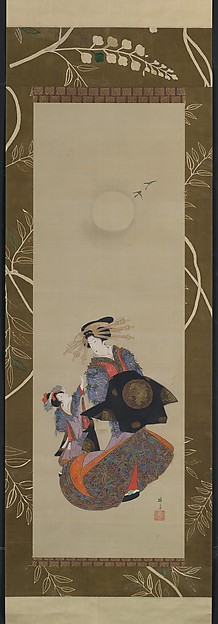
Teisai Hokuba · Beauty of the Yoshiwara with Apprentice in Moonlight · 19th century · Hanging scroll; ink, color, and gold on silk
Look closer: The hair is dressed high in the manner of the period.
The Metropolitan Museum of Art, Purchase, Friends of Asian Art Gifts, 2003, accession 2003.265. Public domain (Open Access).
The Edo print is the best illustration. The Met’s ink and colour hanging scroll of a Yoshiwara beauty with a young attendant in the moonlight, and the surimono of a courtesan and four attendants, show hair dressed in high, elaborate styles. Wikipedia’s article on the oiran says an oiran wore upwards of eight large kanzashi in tortoiseshell, silver, gold or gemstones, and that styles signalled rank, season and occasion.

Kubo Shunman · Procession of a Courtesan with Her Four Attendants · 1789 · Woodblock print (surimono); ink and color on paper
Look closer: Five women walk in procession, with hair dressed in high styles.
The Metropolitan Museum of Art, Purchase, Marjorie H. Holden Gift, 2012, accession 2012.248.1. Public domain (Open Access).
The tradition continues. The kanzashi article records that tsumami kanzashi were officially designated a traditional Japanese handcraft in the Tokyo region in 1982, and that traditional hairstyles today are mostly worn by geisha, maiko, sumo wrestlers, brides, and modern reenactors of tayū and oiran, some using pre-styled wigs.
Twelve Months in the Hair
The most distinctive thing about the maiko’s ornaments is that they change every month. Wikipedia’s article lists them. January brings shōchikubai, pine, bamboo and plum, with sparrows, spinning tops and hagoita paddles; February has pink or red plum blossoms, with pinwheels and kusudama for Setsubun; March has rapeseed, butterflies, peach, narcissus, camellia and peony; April has cherry blossoms with butterflies and lantern forms; May has wisteria and flag irises; June has willow leaves with carnations or hydrangea.
Motifs as listed in Wikipedia’s article on kanzashi. Words shortened for space; the article’s list is longer.
Look closer: Follow the ring clockwise from the top, January, through the Gion Festival fan in July.
Diagram by Japonista. Original drawing, no source image.
In July the ornaments turn to fans tied to the Gion Festival, with fireworks and dewdrops; August has morning glory or susuki grass; September has Japanese bellflower, often with bush clover; October has chrysanthemum, in which senior maiko wear one large flower and junior maiko a cluster of small ones; November has Japanese maple, ginkgo and liquidambar leaves; and December has mochibana, rice-cake flowers, and two blank maneki name plates. For New Year the article records unhusked rice, worn on the right by maiko and the left by geisha, and eyeless white doves.

A Kyoto maiko (geisha apprentice) Hanako wearing December kanzashi (hair ornaments) with maneki (small pieces of paper) that two kabuki actors have already sign
Look closer: December is the month of mochibana, rice-cake flowers, in the list above.
Takaaki Kawai, CC BY-SA 2.0, via Wikimedia Commons.

The ring on this page gathers the twelve months. The size, shape, variety and number of ornaments, the article adds, also indicate seniority and the apprentice stage, and so does the placing of the tachibana and the colour of the chirimen fabric. A figure in the hair can therefore be read as a date and as a rank.
The Kogai and the Sword
One of the types in Wikipedia’s list is the kogai, a two-piece, stick-shaped kanzashi that resembles a sheathed sword, often sold with a kushi. The word appears in this wing’s other chapters because the kogai is also a sword fitting: a slim tool that slides into a pocket on the scabbard. The Met catalogues its examples as “hair dressing tool (kogai)”, among them an iron example of the fifteenth century and one of the sixteenth century in shakudō and gold.

Hair Dressing Tool (Kogai) · 15th century · Iron
Look closer: Iron, with a plain slim shape; the pocket on the scabbard is where it lived.
The Metropolitan Museum of Art, Gift of Bashford Dean, 1914, accession 14.100.523. Public domain (Open Access).
The Met’s labels do not tell us whether a particular tool was used on the hair, on the scabbard, or only displayed. What the catalogue does show is a shared name and a similar shape across two worlds that look, at first sight, entirely separate. The sword chapters in this wing give the fittings’ history; the kanzashi article supplies the other half of the story.

Hair Dressing Tool (Kogai) · 16th century · Copper-gold alloy (shakudō), gold
Look closer: The same tool in shakudō and gold: dark ground, gold detail.
The Metropolitan Museum of Art, Rogers Fund, 1988, accession 1988.379.2. Public domain (Open Access).
For a collector, the point is to read the object, not the word. A kogai attached to a sword mounting is a fitting; one sold with a comb is an ornament; and a tsuba, menuki or kozuka described elsewhere in this wing belongs to the same craft of small metalwork.
Combs and ornaments

Hair Ornament · late 19th century · Silver and silver gilt
Look closer: Silver and silver-gilt; the hanging plates are the moving part.
The Metropolitan Museum of Art, Rogers Fund, 1930, accession 30.42.4. Public domain (Open Access).
Lacquer Comb with Maple Leaves · mid-19th century · Lacquered wood with gold, silver hiramaki-e, red lacquer on black ground
Look closer: The comb in a single photograph.
The Metropolitan Museum of Art, Bequest of Hope Skillman Schary, 1981, accession 1982.244.6. Public domain (Open Access).
Kubo Shunman · Procession of a Courtesan with Her Four Attendants · 1789 · Woodblock print (surimono); ink and color on paper
Look closer: Five women in a line, with hair dressed high.
The Metropolitan Museum of Art, Purchase, Marjorie H. Holden Gift, 2012, accession 2012.248.1. Public domain (Open Access).
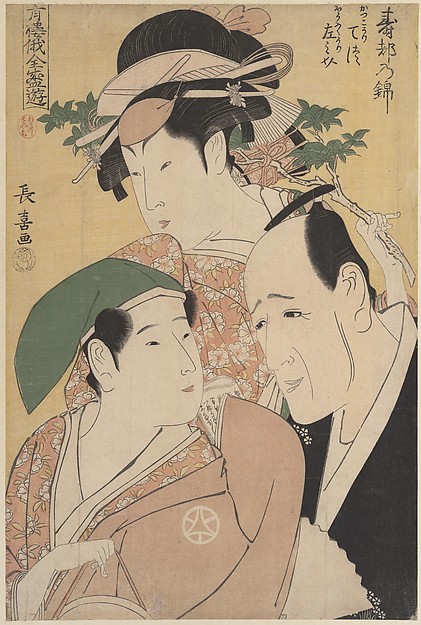
Eishōsai Chōki · Amusements at the Height of Yoshiwara’s Niwaka Festival (Seirō niwaka zensei asobi) · ca. 1796 · Woodblock print (nishiki-e); ink and color on paper
Look closer: Three figures lean together; the hair is dressed in the style of the 1790s.
The Metropolitan Museum of Art, The Howard Mansfield Collection, Purchase, Rogers Fund, 1936, accession JP2418. Public domain (Open Access).
Hair Accessories and Small Metalwork
The house’s shelves hold hair accessories and sword fittings, among them kogai. The concierge desk can advise on materials such as tortoiseshell, lacquer and silver.
Answered plainly
What is a kanzashi?
A traditional Japanese hair ornament: a pin, comb, bead pin, hair tie or a fabric flower, according to Wikipedia.
What is tsumami kanzashi?
The technique of folding squares of silk into flowers, plants and animals. A piece may use 5 to 75 squares or more.
What is a kogai?
A two-piece, stick-shaped kanzashi resembling a sheathed sword; the same word is used for a hair tool carried on a sword mounting.
Why do maiko change ornaments each month?
Wikipedia lists a motif for each month: for example plum blossoms in February, wisteria in May and chrysanthemum in October.
What do the size and number of ornaments show?
Seniority and apprentice stage, according to Wikipedia, together with the placing of the tachibana and the colour of the chirimen fabric.
When did tsumami kanzashi become a recognised craft?
In 1982, when they were officially designated a traditional Japanese handcraft in the Tokyo region, according to Wikipedia.
Where next
Sources and image credits
- Kanzashi, Wikipedia
- Oiran, Wikipedia
- Maiko, Wikipedia
- Metropolitan Museum of Art Open Access
- Image: Lacquer Comb with Maple Leaves, Unknown maker (Public domain (Met Open Access))
- Image: Lacquer Comb with Flower-Shaped Roundels, Unknown maker (Public domain (Met Open Access))
- Image: Hair ornament (kanzashi) with dangling orb, Anonymous (Japan)Unknown author (Public domain)
- Image: Beauty of the Yoshiwara with Apprentice in Moonlight, Teisai Hokuba (Public domain (Met Open Access))
- Image: Procession of a Courtesan with Her Four Attendants, Kubo Shunman (Public domain (Met Open Access))
- Image: A maiko wearing the December kanzashi, Takaaki Kawai (CC BY-SA 2.0)
- Image: Hair Dressing Tool (Kogai), Unknown maker (Public domain (Met Open Access))
- Image: Hair Dressing Tool (Kogai), Unknown maker (Public domain (Met Open Access))
- Image: Hair Ornament, Unknown maker (Public domain (Met Open Access))
- Image: Amusements at the Height of Yoshiwara’s Niwaka Festival (Seirō niwaka zensei asobi), Eishōsai Chōki (Public domain (Met Open Access))
Last reviewed 28 October 2026. Pictures are public-domain or openly licensed and credited beneath each one; diagrams are drawn by Japonista.
Looking for a comb, hairpin or sword fitting with its materials documented? The concierge desk replies within one to three business days.
Private concierge
Looking for something in particular?
Describe the piece or the project you have in mind. A senior advisor in Tokyo reads every case file personally and replies within two business days, with fees set out in writing before any work begins.