
Menuki, Kozuka and Kōgai: The Small Fittings | Japonista
Heritage Wing · Gold and Grip
Menuki, Kozuka and Kōgai: The Small Fittings
目貫・小柄・笄
A sword in daylight is a tool dressed as a jewel. Its smallest parts, a pair of ornaments under the cord, a knife handle, a hair spike, were the places where a maker could be most inventive, and where a lord could be most subtly proud.
Fact sheet
At a glance
- Menuki. Ornaments under the hilt wrapping; they began by covering the peg that holds the hilt.
- Kozuka. The handle of a small knife that rode in a pocket on the scabbard.
- Kōgai. A hair-arranging spike in a second pocket on the scabbard, often matched to the knife handle.
- Fuchi and kashira. The collar and cap of the hilt, made as a pair and designed to echo the rest.
A Sword in Daylight
A blade is one thing and what it wears is another. Wikipedia’s article on Japanese sword mountings separates two wardrobes. The koshirae is the ornate mounting used when a blade is worn; the shirasaya is a plain wooden mounting for storage, traditionally of magnolia wood, because lacquered wood can hold moisture and encourage corrosion if a blade lives in it too long. The first is for display and use, the second for sleep.
The diagram below shows a katana-style mounting from the side. It is our schematic, drawn from the parts the sources name, and the key beneath it explains each. The fittings that interest us in this chapter are the small ones, numbers 1 to 4 and 8 to 10: the pommel cap, the hilt, the grip ornaments and the collar, and the pockets that hold the knife handle and hair spike.
Twelve numbered parts; the key follows. Schematic, not a drawing of one museum piece.
Look closer: Find the two slim outlines on the scabbard: one is the pocket for the knife handle, the other for the hair spike.
Diagram by Japonista. Original drawing, no source image.
Styles differ. The article says the tachi mounting is worn edge down, suspended from two hangers, with two pegs through the hilt, and that it came first; the katana is worn edge up with one peg. A short sword without a guard, the aikuchi, became fashionable for the tantō from the Kamakura period onward, and the kaiken is a plain eight to ten inch dagger, carried by samurai men and women for self-defence indoors.
| No. | Part | Japanese | What it is |
|---|---|---|---|
| 1 | Pommel cap | kashira | The cap at the end of the hilt, usually made as a pair with the collar (Met). |
| 2 | Hilt | tsuka | Wrapped in ray skin, same-kawa, and cord, tsuka-ito. |
| 3 | Grip ornaments | menuki | Ornaments under the wrapping; originally covered the peg that holds the hilt. |
| 4 | Hilt collar | fuchi | The collar at the base of the hilt, paired with the kashira. |
| 5 | Guard | tsuba | The hand guard between blade and grip. |
| 6 | Blade collar | habaki | A wedge-shaped metal collar that holds the blade in the scabbard and locks the guard in place. |
| 7 | Scabbard | saya | Lightweight wood with an exterior lacquer. |
| 8 | Cord knob and cord | kurigata, sageo | The knob that carries the cord, and the cord itself. |
| 9 | Knife handle | kozuka | The handle of a small utility knife, carried in a pocket on the scabbard. |
| 10 | Hair spike | kōgai | A hair-arranging tool carried in a second pocket, often opposite the knife. |
| 11 | Scabbard mouth | koiguchi | Traditionally of buffalo horn. |
| 12 | Scabbard end cap | kojiri | Traditionally of buffalo horn. |
Menuki: The Ornament You Hold
Menuki are the small ornaments that sit beneath the cord wrapping of the hilt. Wikipedia’s account says they began by covering the peg that holds the hilt, the mekugi, and that they also help the grip. On a tachi they sit where the palm closes; on a katana, at the fingertips, so that the hand finds the sword’s orientation by feel. A decoration that is also a tactile guide is a good definition of Japanese craft.
The Met’s collection lets us see what makers did with so little space. A pair by Gotō Tsūjō, who lived from 1664 to 1721 and is counted the eleventh-generation master, shows dragons in dark shakudō, each about 3.5 centimetres long. A pair by Gotō Teijō in gold, of the seventeenth century, shows creatures among bamboo leaves; the museum gives no description of the subject, so we will say only what the image shows: gilded animals among leaves. These are not miniatures of something larger. They are made to the scale of the thumb.

Gotō Tsūjō · Sword-Grip Ornaments (Menuki) · late 17th–early 18th century · Copper-gold alloy (shakudō)
Look closer: Dragons are cast and chased in relief; each is under four centimetres long.
The Metropolitan Museum of Art, Rogers Fund, 1945, accession 45.24.46a–c. Public domain (Open Access).
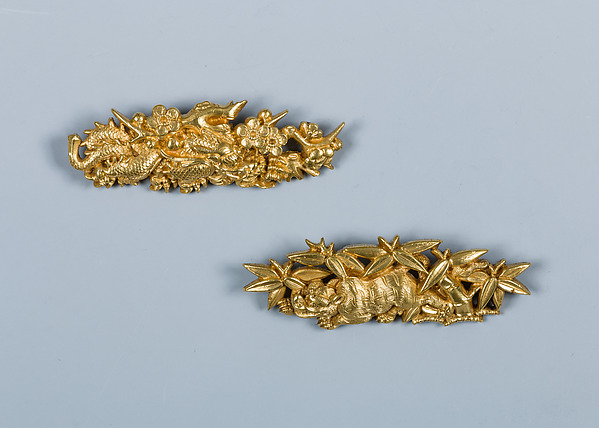
Gotō Teijō (Mitsumasa) · Sword-Grip Ornaments (Menuki) · 17th century · Gold
Look closer: Gold on gold: the leaves are the same metal as the creature, differentiated by chasing.
The Metropolitan Museum of Art, Rogers Fund, 1945, accession 45.24.44a–c. Public domain (Open Access).
The Knife and the Hair Spike
The two long fittings sit in pockets on the scabbard. Wikipedia says the kozuka is the handle of a small utility knife and the kōgai a hair-arranging spike, both carried in pockets on the scabbard; the Met’s records say the same in its own words: a kozuka is “a handle of a by-knife that is part of a sword mounting”, fitted into a slot on the reverse of a katana scabbard, often alongside a matching kōgai, a hairdressing tool, carried in a slot on the front.
The earliest we can see here is the kōgai. An iron one in the Met, given by Bashford Dean in 1914, is dated to the fifteenth century and is about twenty centimetres long. Another, of early fifteenth-century date in a copper alloy called yamagane with gold, is described by the museum as one of the oldest kōgai outside Japan; it is in the kokinko style and its crane, turtle, pine, bamboo and plum form a set of auspicious motifs meant to bring its owner good fortune. A later kozuka by Hamano Haruchika, who died about 1850, is made of shibuichi, a copper-silver alloy, with gold, copper and shakudō, and weighs 34 grams.

Hair Dressing Tool (Kogai) · 15th century · Iron
Look closer: The head of the spike carries the maker’s only decoration; the shaft is plain.
The Metropolitan Museum of Art, Gift of Bashford Dean, 1914, accession 14.100.523. Public domain (Open Access).

Hair Dressing Tool (Kogai) · early 15th century · Copper alloy (yamagane), gold
Look closer: The museum calls it one of the oldest kōgai outside Japan.
The Metropolitan Museum of Art, Gift of Kunio Iizuka, in memory of Bumpei Usui, 2017, accession 2017.378. Public domain (Open Access).
Like the guard, these are small enough to handle, and the Met’s metal list is a primer in the colours of Edo metalwork: shakudō for black, shibuichi for the silvery grey, gold and copper for the touches that bring a design to life.
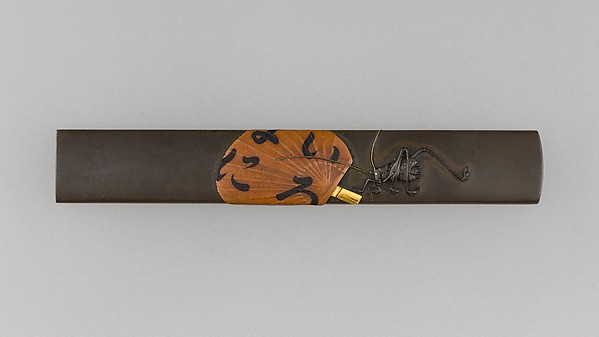
Hamano Haruchika · Knife Handle (Kozuka) · 19th century · Copper-silver alloy (shibuichi), gold, copper, copper-gold alloy (shakudō)
Look closer: Look for the tiny insect: the subject is a moment, not a monument.
The Metropolitan Museum of Art, The Howard Mansfield Collection, Gift of Howard Mansfield, 1936, accession 36.120.237. Public domain (Open Access).
Collar and Cap
At either end of the hilt are two more fittings. The Met defines a kashira as a pommel cap fitted to the end of a sword hilt, usually made as a pair with a matching fuchi, the collar at the base of the hilt. A pair by an unnamed maker, of the eighteenth century, in the Met’s collection shows crowded figures in gold and silver on a grained ground of iron and shakudō, a world seen around the curve of a hilt.

Sword Pommel (Kashira) · 18th century · Iron, copper-gold alloy (shakudō), silver, gold
Look closer: A narrative runs around the collar and over the cap: the two halves of one scene.
The Metropolitan Museum of Art, Gift of Bashford Dean, 1919, accession 19.154.112. Public domain (Open Access).
A pair that matches does so on purpose. The fuchi and kashira in a good mounting are the easiest parts for a maker to carry a theme across; the Met’s sets show the same idea at a larger scale, for the grip ornaments, the knife handle and the hair spike are made to match too.

Sword Pommel (Kashira) · 17th century · Gold
Look closer: The simplest fitting here: a cap in gold with understated decoration.
The Metropolitan Museum of Art, Gift of a Trustee of the Museum, 1917, accession 17.208.80. Public domain (Open Access).
The Three-Fitting Set
The Met catalogues many of its finest pieces not singly but as sets, which it names mitokoromono: a kōgai, a kozuka and a pair of menuki, made to one design. The sets by the Gotō masters are the best documented. One, by Gotō Sōjō, the second-generation master, who is dated to about 1461 to 1538, has a design of crabs in shakudō and gold; the hair spike and the knife handle are inscribed by Mitsutaka, thirteenth-generation master of the Gotō Shirōbei school, certifying the fittings as Sōjō’s work. Another, by Gotō Tsūjō, shows, in the museum’s words, Tawara Tōda battling a giant centipede. The signature here is on a certificate, an orikami, and refers only to the grip ornaments.

Gotō Sōjō · Set of Sword Fittings (Mitokoromono) · late 15th–early 16th century · Copper-gold alloy (shakudō), gold
Look closer: Three kinds of object share one design: the crabs recur on each.
The Metropolitan Museum of Art, Rogers Fund, 1945, accession 45.24.52a–d. Public domain (Open Access).
That detail matters, for it shows how the school kept its own history: a later master examined an earlier master’s work and certified it. The museum’s language is careful. It records the maker, the inscriber and what the inscription covers; it does not claim more than the paper does.

Gotō Tsūjō · Set of Sword Fittings (Mitokoromono) · late 17th–early 18th century · Copper-gold alloy (shakudō), gold, silver, ink, paper
Look closer: The set’s subject, as the museum puts it, is Tawara Tōda and the centipede.
The Metropolitan Museum of Art, Rogers Fund, 1945, accession 45.24.61a–e. Public domain (Open Access).
The ensemble is the point. Laid out together, the long, slim spike and knife handle beside the two small grip ornaments are an object lesson in a maker thinking in sets: one subject, three scales.
How Small, How Heavy
The most useful thing a museum record gives is a number. The Met measures its fittings to the millimetre and the gram, and the figures put the objects in the hand. The grip ornaments of a Gotō pair are about 3.5 centimetres long. A kozuka is about 9.7 centimetres long and a centimetre and a half wide; the Hamano Haruchika example weighs 34 grams. A hair spike runs from about 20 to 22 centimetres; the fifteenth-century iron example weighs 48.2 grams, the early fifteenth-century yamagane example is 22.7 centimetres long, and the Gotō spikes in the sets above are about 21 centimetres. A kashira of the eighteenth century is 3.3 centimetres high and weighs 11.3 grams.
The metals matter as much as the sizes. In the Met’s language shakudō is a copper-gold alloy, shibuichi a copper-silver alloy and yamagane a copper alloy; gold, silver and copper are added for line and highlight. A fitting is thus a composition in four or five metals, each chosen for a colour. Wikipedia’s sword-mounting article adds the materials of the larger parts: lightweight wood with exterior lacquer for the scabbard, buffalo horn for the mouth and end cap, silk, now usually cotton, sometimes leather, for the hilt cord.
| Fitting | Met object | Size | Weight |
|---|---|---|---|
| Menuki, Gotō Tsūjō | 45.24.46a–c | 3.5 and 3.6 cm | not given |
| Kozuka, Hamano Haruchika | 36.120.237 | 9.7 × 1.4 cm | 34 g |
| Kōgai, iron, 15th century | 14.100.523 | 20 cm | 48.2 g |
| Kōgai, yamagane and gold, early 15th century | 2017.378 | 22.7 cm | not given |
| Kashira, 18th century | 19.154.112 | 3.3 cm high | 11.3 g |
| Kōgai, Gotō Sōjō set | 45.24.52a–d | 21.1 cm | not given |
Four more small fittings
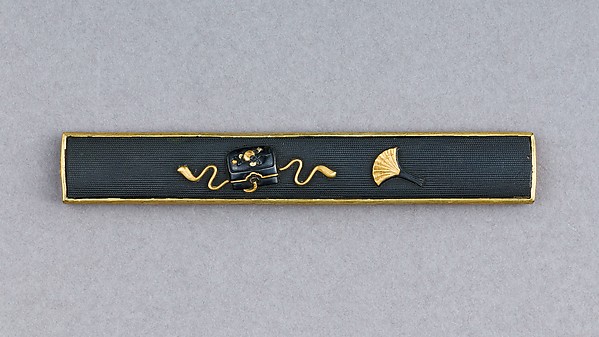
Knife Handle (Kozuka) · ca. 1615–1868 · Copper-gold alloy (shakudō), gold
Look closer: The kozuka is a canvas barely a centimetre wide.
The Metropolitan Museum of Art, H. O. Havemeyer Collection, Bequest of Mrs. H. O. Havemeyer, 1929, accession 29.100.1095. Public domain (Open Access).

Knife Handle (Kozuka) · second half 18th century · Copper-silver alloy (shibuichi), gold, copper-gold alloy (shakudō)
Look closer: A silvery shibuichi ground, quite different from black shakudō.
The Metropolitan Museum of Art, The Howard Mansfield Collection, Gift of Howard Mansfield, 1936, accession 36.120.293. Public domain (Open Access).

Hair Dressing Tool (Kogai) · 16th century · Copper-gold alloy (shakudō), gold
Look closer: An early gold-on-black spike.
The Metropolitan Museum of Art, Rogers Fund, 1988, accession 1988.379.2. Public domain (Open Access).

Gotō Renjō (Mitsutomo) · Set of Sword Fittings (Mitokoromono) · 17th century · Copper-gold alloy (shakudō), gold
Look closer: In the two Gotō sets described above, the hair spike measures about 21 centimetres.
The Metropolitan Museum of Art, Rogers Fund, 1945, accession 45.24.60a–e. Public domain (Open Access).
Fittings and Stands
The house’s sword-fittings and stands sit with the samurai heritage pieces; the tosogu glossary names each part, and the concierge desk can advise on a mounting or a fitting.
Answered plainly
What are menuki?
Small ornaments beneath the cord wrapping of a sword hilt. They began by covering the peg that holds the hilt and help the grip, according to Wikipedia.
What is a kozuka?
The handle of a small utility knife, carried in a pocket on the scabbard. The Met describes it as the handle of a by-knife that is part of a sword mounting.
What is a kōgai?
A hair-arranging spike carried in a slot on the scabbard, often matched with a kozuka. The Met calls it a hairdressing tool.
What is a mitokoromono?
The Met’s name for a set of fittings: a kōgai, a kozuka and a pair of menuki made to a single design.
What is the difference between koshirae and shirasaya?
Koshirae is the ornate mounting for wearing a blade; shirasaya is a plain wooden mounting for storage, traditionally of magnolia, according to Wikipedia.
What are fuchi and kashira?
The collar at the base of the hilt and the cap at its end. The Met notes that a kashira is usually made as a pair with a fuchi.
Where next
Sources and image credits
- Japanese sword mountings, Wikipedia
- Tosogu, Wikipedia
- Set of Sword Fittings, Gotō Sōjō, The Metropolitan Museum of Art
- Set of Sword Fittings, Gotō Tsūjō, The Metropolitan Museum of Art
- Sword-Grip Ornaments, Gotō Tsūjō, The Metropolitan Museum of Art
- Knife Handle (Kozuka), Hamano Haruchika, The Metropolitan Museum of Art
- Hair Dressing Tool (Kogai), The Metropolitan Museum of Art (early 15th century)
- Hair Dressing Tool (Kogai), The Metropolitan Museum of Art (15th century)
- Sword Pommel (Kashira), The Metropolitan Museum of Art
- Image: Sword-Grip Ornaments (Menuki), Gotō Teijō (Mitsumasa) (Public domain (Met Open Access))
- Image: Sword Pommel (Kashira), Unknown maker (Public domain (Met Open Access))
- Image: Knife Handle (Kozuka), Unknown maker (Public domain (Met Open Access))
- Image: Knife Handle (Kozuka), Unknown maker (Public domain (Met Open Access))
- Image: Hair Dressing Tool (Kogai), Unknown maker (Public domain (Met Open Access))
- Image: Set of Sword Fittings (Mitokoromono), Gotō Renjō (Mitsutomo) (Public domain (Met Open Access))
Last reviewed 28 October 2026. Pictures are public-domain or openly licensed and credited beneath each one; diagrams are drawn by Japonista.
Looking for a matched set of fittings, a signed knife handle or a mounting complete with all its pieces? The concierge desk replies within one to three business days.
Private concierge
Looking for something in particular?
Describe the piece or the project you have in mind. A senior advisor in Tokyo reads every case file personally and replies within two business days, with fees set out in writing before any work begins.