
Wood, Joint and Iron: How a Tansu Is Made
From Log to Lock Plate
Wood, Joint and Iron: How a Tansu Is Made
A tansu had to be light enough to carry and strong enough to be thrown on a man’s shoulders in a fire. Its makers answered with woods chosen for weight and grain, joints that flex without failing, and iron placed exactly where a chest is most likely to break.
Fact sheet
At a glance
- A pairing of woods. A hard wood for the face and a light wood for the case or lining is the commonest recipe in the sources: zelkova over cedar at Sendai, zelkova over paulownia in the ship’s chest, cypress over cedar at Sakai.
- Boards from one tree. Edward S. Morse noticed in 1885 that lumber yards tied boards in bundles in the order they came from the log, so that a cabinetmaker could match grain and colour.
- Wood where iron would rust. The Kishū and Kamo paulownia chests are put together with wooden nails and bamboo pegs, which avoid rust and let the boards move.
- Iron that was forged by hand. Wikipedia says all tansu iron was forged until pressed iron plate arrived from England in the 1880s, which made hardware easier to decorate.
- A craft that is still designated. Chest-making crafts in Niigata, Saitama, Aichi, Iwate, Wakayama, Osaka, Fukui and Miyagi are on the national list of Traditional Crafts of Japan.
The Woods: Zelkova, Paulownia, Cypress, Cedar, Chestnut and Pine
Wikipedia’s article on tansu gives the working list in two sentences. As tansu became a feature of Japanese culture and daily life, it says, both hard and softwoods were used by the tansuya, the tansu craftsmen, often in combination for a single chest. Woods commonly used included keyaki (Zelkova serrata), kuri (Japanese chestnut), ezo matsu (pine), sugi (Cryptomeria, or Japanese cedar), kiri (Paulownia tomentosa) and hinoki (Chamaecyparis obtusa, the Japanese cypress). The same list of woods, plus akamatsu, camphor laurel and magnolia, appears in the Wikipedia article on Japanese carpentry as the lumber of building and woodwork in general.

Utagawa Hiroshige II, 1859. Woodblock print; ink and color on paper. The Metropolitan Museum of Art, accession JP236. Rogers Fund, 1918. Open Access.
Look closer: A grove of tall paulownia trees at Akasaka in Edo, in the rain. The tree gives the pale, light timber of the clothing chest.
The Metropolitan Museum of Art, public domain (Open Access). Source: https://www.metmuseum.org/art/collection/search/36708
The roles are surprisingly consistent when the regional sources are laid side by side. Zelkova is the display wood: the Sendai chest takes it for the face, the shipboard funa-dansu takes it for every exposed surface, and the JR East account of Sendai names zelkova or chestnut as the chief woods of its chests. Cedar is the case wood, the unglamorous carcass behind a handsome face, and the Sendai and Sakai chests both pair it with a finer wood in front. Cypress is the architect’s wood: Hikone used it for framing and Sakai left it unfinished for the faces of doors and drawers.

Edward S. Morse, Japanese Homes and Their Surroundings (Boston: Ticknor and Company, 1886), figure 16. Wood-engraved illustration, public domain.
Look closer: The end of the log shows how boards radiate from the heart, which is why boards cut from one log match one another.
Edward S. Morse, 1886, public domain, via Project Gutenberg ebook 52868. Source: https://www.gutenberg.org/ebooks/52868
Paulownia has a role of its own. It is the wood of the sword polisher’s case, of the apothecary’s drawer, of the trousseau chests of Yahata on Sado, and the interior lining of the ship’s chest, and in four regions of Japan it is the whole chest. The Kamo paulownia chests of Niigata are described by the national craft-promotion site as made of a wood that is white and lustrous, often compared to silk, with a pale yellow grain. The tree grows fast, reaching four to five metres in its first year, but the timber is soft and prone to damage. About two-thirds of a tree is unsuitable for processing, the site says, and about one-third is good enough for chests.

Kiri wood (a kind of paulownia) with design in pottery relief. The Metropolitan Museum of Art, accession 29.100.678. H. O. Havemeyer Collection, Bequest of Mrs. H. O. Havemeyer, 1929. Open Access.
Look closer: The Met’s record gives the wood as kiri, a kind of paulownia. The wood of the box shows in the grained ground around the relief figures.
The Metropolitan Museum of Art, public domain (Open Access). Source: https://www.metmuseum.org/art/collection/search/58078
The drying is as important as the felling. For Kamo chests, natural drying takes about three years, and insufficient drying leaves tannins that turn the wood red. Kishū chests use logs 30 to 60 years old and air-dry them for six months to two years, which removes the lye that causes discoloration. Nagoya chests are dried for one to two years, sawn into planks and dried six to twelve months more, with rain exposure helping to wash out the lye, and warped boards are gently warmed over a fire to straighten them. Well-dried paulownia, the Kamo account says, resists discoloration and warping and absorbs moisture, which helps protect clothing from damp. The Kishū account adds that it is very stable, absorbs moisture in humid weather and releases it when dry, and has low thermal conductivity.
Boards from One Tree: Seasoning and Grain
Edward S. Morse, whose Japanese Homes and Their Surroundings is dated to the preface of November 1885, was an American zoologist and a trained observer, and he noticed the lumber yards first. In the finish of the interior, he says, the carpenter, the daiku, has finished his work and a new set of workmen, the sashi-mono-ya or cabinetmakers, come in. Great care, he adds, is taken to secure wood that matches in grain and colour, which can be done only with material from the same log. In the yards, boards of uniform lengths were tied up in bundles in precisely the position they occupied in the trunk before it was sawn, so that one never sees a promiscuous pile of boards.

Edward S. Morse, Japanese Homes and Their Surroundings (Boston: Ticknor and Company, 1886), figure 18. Wood-engraved illustration, public domain.
Look closer: Boards tied in the order in which they lay in the log, as Morse describes.
Edward S. Morse, 1886, public domain, via Project Gutenberg ebook 52868. Source: https://www.gutenberg.org/ebooks/52868
That small observation explains much that is characteristic of the finished chest. A cabinetmaker who is given boards in the order of the tree can lay them out so that the grain flows across a drawer front and a door as one piece. The Nagoya paulownia chests, the national craft-promotion site says, are made so that the front looks as if it were cut from a single piece of wood, with matched grain. For Kishū chests the door and drawer-front boards are chosen for straight grain with lines spaced two to three centimetres apart, then glued into single panels. And the Kamo makers use a method they call grain straightening, bonding thin split layers of wood to a core so that boards look straight-grained.

Morse’s caption: method of removing boards from a bundle to preserve uniformity of grain. Edward S. Morse, Japanese Homes and Their Surroundings (Boston: Ticknor and Company, 1886), figure 24. Wood-engraved illustration, public domain.
Look closer: Opened like a book, the boards show their grain running on from one to the next.
Edward S. Morse, 1886, public domain, via Project Gutenberg ebook 52868. Source: https://www.gutenberg.org/ebooks/52868
Morse’s other remark in this passage bears on waste. Japanese rooms are built in sizes corresponding to the number of mats they will hold, so the beams, uprights, rafters, floor and ceiling boards and all the strips are got out in sizes to fit, and the lumber yard keeps the lengths required. He compares this to the American builder who finds his cellar and shed choked with the waste of a new house. A tansu is built on the same sort of logic. It is a modest module in a house of modules, and the drawer, the tray and the case are sized to fit one another and the room.

Commons: a Sendai-dansu from the Meiji period, made in Sendai from keyaki (zelkova) and lined with sugi (cedar). Photographed in 2007.
Look closer: Matched grain across a chest front, with the iron laid over it.
Kunchan (English Wikipedia uploader), CC BY-SA 3.0, via Wikimedia Commons. Source: https://commons.wikimedia.org/wiki/File:Sendai_Tansu.jpg

Commons: detail of a Sendai-dansu from the Meiji period, showing a lockable door and compartment drawers. The wood is zelkova.
Look closer: The fitted drawers behind the door are the work of the sashimono-shi, the joiner.
Unknown photographer (Commons upload), CC BY-SA 3.0, via Wikimedia Commons. Source: https://commons.wikimedia.org/wiki/File:Tansu_door.jpg
Seasoning at Sendai follows the same discipline. According to the Sendai tourism story, timber is divided into panels and stacked in a well-ventilated area to prevent warping and distortion, and it is cut to a drawing with an eye to the grain and the part of the tansu the piece will become. The wood does not go into a chest until it has stopped moving.
Joinery: Dovetail, Tenon and the Wooden Nail
Wikipedia’s article on Japanese carpentry says the craft first developed in the twelfth century, was influenced by Chinese architectural styles but evolved its techniques independently because of differences in earthquakes and climate, and is characterised by wooden joints and almost no nails. It names four kinds of carpenter: the miyadaiku who build shrines and temples, the sukiya-daiku of tea houses and houses, the tateguya who make shōji and transoms, and the sashimono-shi, the furniture makers. The tansu belongs to the last of these, and the word sashimono, which means a thing that is inserted, is the old name for work in which pieces are fitted together rather than nailed.

A surimono, a privately commissioned print. Ryūryūkyo Shinsai, 19th century. Part of an album of woodblock prints (surimono); ink and color on paper. The Metropolitan Museum of Art, accession JP2328. H. O. Havemeyer Collection, Bequest of Mrs. H. O. Havemeyer, 1929. Open Access.
Look closer: A nineteenth-century print that gives the carpenter’s tools the full treatment of colour and verse.
The Metropolitan Museum of Art, public domain (Open Access). Source: https://www.metmuseum.org/art/collection/search/54112
Morse, who admired the carpenters while doubting some of their elaborations, is a useful witness. Describing the joints of a mortised frame he says the carpenter employs the most elaborate methods of mortising, of which there are many formulas, but an American architect told him they had no advantage of strength over American methods, and that there seemed to be much unnecessary work about many of the framing joints. He also records the samisen-tsugi, a common scarf joint named for the joint in the neck of the samisen, which he says was precisely similar to one used in America. It is a salutary reminder that Japanese joinery was not magical; it was skilled and conservative, and its advantages were as much in the patience of the people who made it as in any single joint.

early 19th century. Lacquer, red-brown ground, nashiji, gold, red and silver hiramakie, raden; Interior: nashiji and fundame. The Metropolitan Museum of Art, accession 36.100.184. The Howard Mansfield Collection, Purchase, Rogers Fund, 1936. Open Access.
Look closer: The carpenter’s kit appears here among the tools of other trades, in gold on red lacquer.
The Metropolitan Museum of Art, public domain (Open Access). Source: https://www.metmuseum.org/art/collection/search/58872
For the chest itself, the best descriptions come from the national craft-promotion pages. The Kamo account sets out a specification. The boards must be solid wood, at least 19 millimetres thick for the top, sides, shelves and supports, and at least 7 millimetres for the base, back and drawer bottom. The top and bottom boards join the sides with dovetail joints, and the shelves use mortise and tenon. Side panels are fixed to the legs with what are called sewn nails, bamboo pegs of about ten centimetres, and wooden pegs replace iron nails entirely. The wooden nails are made of deutzia wood or its equivalent.

Edward S. Morse, Japanese Homes and Their Surroundings (Boston: Ticknor and Company, 1886), figure 26. Wood-engraved illustration, public domain.
Look closer: Morse’s description: a big wooden wedge bound to an upright with a stout rope.
Edward S. Morse, 1886, public domain, via Project Gutenberg ebook 52868. Source: https://www.gutenberg.org/ebooks/52868
Kishū chests, from Wakayama, add detail. The craftsmen use finger joints, dovetail joints and lap dovetail joints, which hide the joint on one side, and the type of joint depends on its location in the chest. Drawer joints are compressed by striking them so that the wood’s own restoring force closes the gaps. Wooden nails replace iron ones to prevent rust, they are driven in before the glue dries, and the surface is wiped with a damp cloth to hide the nailing. Kimono trays are held together with hemp string and have a rounded outer edge. In Nagoya the body is assembled with mortise and tenon joints and Japanese cedar pegs secure the boards, and the drawer’s bottom board is fitted into a frame.
This is a philosophy of structure that Wikipedia’s Tansu article states in one sentence. Because the joinery of cases was simple and thus flexible, it says, to facilitate structural integrity during movement from place to place, hardware placement at vulnerable points was consistent with the need for reliability. A chest that is carried must flex a little, and the iron is put where flexing would otherwise break it. The next section turns to that iron.

Edward S. Morse, Japanese Homes and Their Surroundings (Boston: Ticknor and Company, 1886), figure 27. Wood-engraved illustration, public domain.
Look closer: The saw cuts on the pull stroke, which is why its blade can be so thin.
Edward S. Morse, 1886, public domain, via Project Gutenberg ebook 52868. Source: https://www.gutenberg.org/ebooks/52868
The tools that cut these joints are among the best described in Wikipedia’s article on Japanese carpentry. The Japanese saw cuts on the pull stroke, which allows the blade to be thin, and planes are generally pulled rather than pushed, with work done seated. Planes and chisels are made with a hard blade metal, ha-gane, forge-welded to a softer base metal, ji-gane, which absorbs shock and protects the brittle edge. Kamo craftsmen, according to the craft-promotion account, hand-plane drawers and doors to fit without gaps and use twenty to thirty types of plane. Morse drew the carpenter’s vice of the day: a big wooden wedge bound to an upright post with a stout rope and driven down to pinch the block to be sawn.
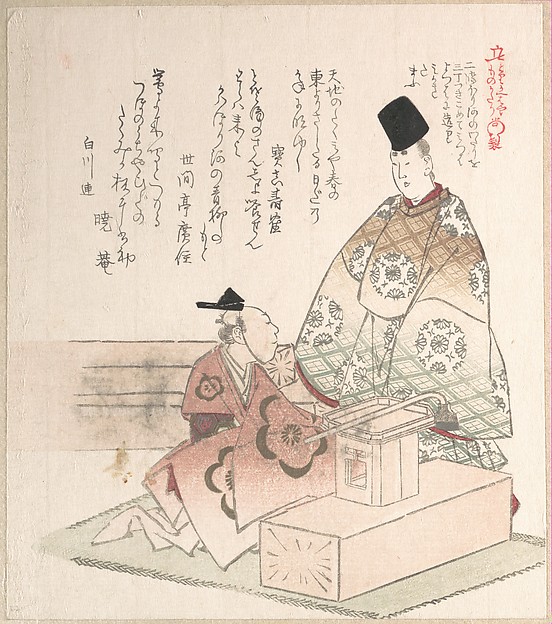
Kubo Shunman, 19th century. Woodblock print (surimono); ink and color on paper. The Metropolitan Museum of Art, accession JP1999. H. O. Havemeyer Collection, Bequest of Mrs. H. O. Havemeyer, 1929. Open Access.
Look closer: A nineteenth-century print that sets the craftsman beside his patron.
The Metropolitan Museum of Art, public domain (Open Access). Source: https://www.metmuseum.org/art/collection/search/54719

Edward S. Morse, Japanese Homes and Their Surroundings (Boston: Ticknor and Company, 1886), figure 32. Wood-engraved illustration, public domain.
Look closer: Morse copied the figure from an old painting.
Edward S. Morse, 1886, public domain, via Project Gutenberg ebook 52868. Source: https://www.gutenberg.org/ebooks/52868
| Joint or fastener | Where it appears | Source |
|---|---|---|
| Dovetail | Top and bottom boards to the sides of Kamo chests; also Kishū chests | Kamo and Kishū craft pages |
| Lap dovetail | Kishū chests, where it hides the joint on one side | Kishū craft page |
| Finger joint | Kishū chests, by location | Kishū craft page |
| Mortise and tenon | Kamo shelves; the body of Nagoya chests; Hikone cypress framing | Kamo, Nagoya and Wikipedia |
| Bamboo peg (sewn nail) | Side panels fixed to legs in Kamo chests, about 10 cm long | Kamo craft page |
| Wooden nail | Kamo and Kishū chests, in place of iron nails; deutzia wood in Kamo | Kamo and Kishū craft pages |
| Cedar peg | Securing the boards of Nagoya chests | Nagoya craft page |
| Samisen-tsugi | A scarf joint in beams, recorded by Morse in 1885 | Morse, Japanese Homes |

Edward S. Morse, Japanese Homes and Their Surroundings (Boston: Ticknor and Company, 1886), figure 28. Wood-engraved illustration, public domain.
Look closer: The container for what Japanese joinery used least.
Edward S. Morse, 1886, public domain, via Project Gutenberg ebook 52868. Source: https://www.gutenberg.org/ebooks/52868

Edward S. Morse, Japanese Homes and Their Surroundings (Boston: Ticknor and Company, 1886), figure 30. Wood-engraved illustration, public domain.
Look closer: The inked line and the bamboo pen that marked every cut.
Edward S. Morse, 1886, public domain, via Project Gutenberg ebook 52868. Source: https://www.gutenberg.org/ebooks/52868

Edward S. Morse, Japanese Homes and Their Surroundings (Boston: Ticknor and Company, 1886), figure 31. Wood-engraved illustration, public domain.
Look closer: A level and a plumb in one.
Edward S. Morse, 1886, public domain, via Project Gutenberg ebook 52868. Source: https://www.gutenberg.org/ebooks/52868
Iron: The Hardware of a Moving House
Wikipedia is unusually exact about tansu hardware. It says that although decorative to the contemporary eye, tansu hardware remained largely functional through the Meiji period, and that, until the introduction of iron plate pressing from England in the 1880s, all the iron for hardware was forged. With the arrival of Western technology the hardware could be made more decorative, with creative embellishments as well as functional ones. It also dates the double-action lock, the urajo, to the 1860s and calls it of foreign origin, while the single-action omotejo, a lock using a split spring for activation, worked for unlocking only.

Edward S. Morse, Japanese Homes and Their Surroundings (Boston: Ticknor and Company, 1886), figure 157. Wood-engraved illustration, public domain.
Look closer: The iron on the corners and ends is the iron of a chest: thick, plain and put where the box would otherwise break.
Edward S. Morse, 1886, public domain, via Project Gutenberg ebook 52868. Source: https://www.gutenberg.org/ebooks/52868
The article’s glossary of hardware is a short course in how a chest is protected. Herikanagu line the edges and corners, and obikanagu, the sash hardware, span a face such as the top or a cabinet door. The sumikanagu cap the corners of drawer faces and generally match the edge hardware. For carrying there are two kinds: the mochiokuri, a handle loop on the side near the top, and the sao-toshi, a sliding carrying loop designed to hold a pole when used with its mate on the other side. That last is exactly what Morse recorded, long hanging iron handles that turn upward to make loops through which a stick may be passed. For opening there are the hikite, the drawer pull, with its zagane, the escutcheon, and the toshi-zagane, the back plate; the choban, the hinge; the kasugai, the staple that fixes hardware to the wood; and the meita, the lock jamb plate.

19th century. Hammered iron with relief inlay in silver, gold and shibuichi. The Metropolitan Museum of Art, accession 91.1.1068. Edward C. Moore Collection, Bequest of Edward C. Moore, 1891. Open Access.
Look closer: Hammered iron worked into a small, finished object, with silver and gold inlay.
The Metropolitan Museum of Art, public domain (Open Access). Source: https://www.metmuseum.org/art/collection/search/52099

Edward S. Morse, Japanese Homes and Their Surroundings (Boston: Ticknor and Company, 1886), figure 106. Wood-engraved illustration, public domain.
Look closer: A flat metal plate with a scrolling ground: a pull in miniature.
Edward S. Morse, 1886, public domain, via Project Gutenberg ebook 52868. Source: https://www.gutenberg.org/ebooks/52868
Regional hardware is as distinct as regional wood. Sendai’s iron, the article says, was commissioned from former sword-fitting craftsmen, and the Sendai tourism story describes it as mostly embossed iron, with dragons, peonies, lions, arabesques and family emblems. The metalworker hammers from the reverse side over a lead table, then chases the pattern from the front, with as many as 1,300 kinds of tools, and finishes the iron by baking urushi onto it. The copper fittings are coloured with a sulphide treatment against corrosion. At Ogi on Sado the iron is thick and carries a four-diamond motif on the handle back plates. At Hikone the hardware is copper. At Nagoya, the craft pages say, fittings are chased with gold and silver. At Kamo the fittings are copper, copper alloy or iron, and the national craft page says that until around 1950 nearly all of them were made in the city of Sanjō, with hardware production later moving largely to Tokyo, Osaka and Kyoto.
There is a logic of sequence as well. In the Kishū and Nagoya accounts the metal fittings are attached last, after the doors and drawers have been fitted, and in Nagoya with attention to the proportions of the chest. A maker who fits hardware last can set it to the finished object, not the drawing.
| Hardware term | Meaning, per Wikipedia |
|---|---|
| Herikanagu | Edge hardware lining the edges and corners |
| Obikanagu | Sash hardware spanning a face such as the top or a door |
| Sumikanagu | Drawer or drawer-corner hardware, matching the edge hardware |
| Mochiokuri | A carrying handle, a loop on the side near the top |
| Sao-toshi | A sliding carrying loop that holds a carrying pole, used with its mate on the other side |
| Meita | Lock jamb plate |
| Sashikomijo | Sliding-door lock |
| Bo | Vertical locking bar |
| Hikite | Drawer pull |
| Zagane | An escutcheon or flange around the contact point of a drawer pull |
| Toshi-zagane | Back plate for a drawer pull |
| Choban | Hinge |
| Kasugai | Staple affixing hardware to the wood |
| Omotejo | Single-action lock with a split spring, for unlocking only |
| Urajo | Double-action lock of foreign origin dating from the 1860s |

Edward S. Morse, Japanese Homes and Their Surroundings (Boston: Ticknor and Company, 1886), figure 108. Wood-engraved illustration, public domain.
Look closer: Pulls could be quatrefoil, octagonal or round.
Edward S. Morse, 1886, public domain, via Project Gutenberg ebook 52868. Source: https://www.gutenberg.org/ebooks/52868

Edward S. Morse, Japanese Homes and Their Surroundings (Boston: Ticknor and Company, 1886), figure 110. Wood-engraved illustration, public domain.
Look closer: The cord and the tassel turn the pull into an ornament.
Edward S. Morse, 1886, public domain, via Project Gutenberg ebook 52868. Source: https://www.gutenberg.org/ebooks/52868
Finish: Burnished Clay, Straw Brush and Lacquer
Tansu finishes, Wikipedia says, fall into two categories: dry and lacquered. For a dry finish, clay or chalk powder was rubbed into the soft wood surface, paulownia, cryptomeria or cypress, then burnished with an eulalia root whisk. For lacquer, applied from Rhus verniciflua, the lacquer tree, the application could be only for sealing plain wood to enhance a natural visible grain, or for creating a perfect opaque surface. The two kinds correspond to the translucent kijiro and the opaque tama-nuri of the regional chapter.
The paulownia chests develop the dry finish into a craft of its own. The Kamo account describes uzukuri, in which a straw brush is used to bring out the grain by scouring away the softer wood, and yashabushi colouring, in which a mixture of polishing powder and yasha fruit is applied several times. The Kishū account says a brush made from karukaya grass roots does the scouring, and a mixture of fine stone powder and the boiled fruit of the Japanese green alder is applied to enhance the grain. In Nagoya the stain is a decoction of the same fruit mixed with polishing powder, brushed on in two coats. All three finish with wax, applied along the grain. The Kamo account notes the wood then shows dark reddish-brown lines across a light base colour, and that surfaces can be planed down, including the wooden pegs, with sanding renewing the grain and colour.

18th century. Black lacquer. The Metropolitan Museum of Art, accession 25.215.54a–f. Fletcher Fund, 1925. Open Access.
Look closer: A black lacquer frame built from slender parts, with the surface carrying the whole effect.
The Metropolitan Museum of Art, public domain (Open Access). Source: https://www.metmuseum.org/art/collection/search/53433

19th century. Lacquered wood. The Metropolitan Museum of Art, accession 1984.497a–h. Gift of Shoji Yamanaka, in memory of Alan Priest, 1984. Open Access.
Look closer: Lacquer over a minimum of wood: a frame, not a box.
The Metropolitan Museum of Art, public domain (Open Access). Source: https://www.metmuseum.org/art/collection/search/56379
The lacquer chests take a different road. At Sendai, the tourism story says, kijiro-urushi is smeared on with a special spatula after the base coat so that the grain shows, then polished with magnolia charcoal. The smearing and water-polishing are repeated until the grain is flat, and a final polish follows the overcoat. The finish becomes more transparent as the years pass. The Hikone type uses a translucent kijiro finish on the door and drawer faces to lighten the visual mass of the case.
Morse, who looked for wax on the wood of a staircase chest and found none, was told that water from the bath is often used to moisten the cloth with which the wood is wiped, and he surmised that the oils of the skin did much of the polishing. It is a nice reminder that the surface of a chest is the work of its owners as much as its makers.
Eight Chest Crafts on the National List
Several chest-making crafts survive as officially designated Traditional Crafts of Japan. Wikipedia’s list, which says 244 crafts had been designated as of 27 October 2025 under an act of 1974, includes a group of paulownia and wooden chests. The table gives them with the prefecture and the year of designation, as that list states them, and then the facts the national craft-promotion pages and Wikipedia’s Tansu article supply.

Edward S. Morse, Japanese Homes and Their Surroundings (Boston: Ticknor and Company, 1886), figure 177. Wood-engraved illustration, public domain.
Look closer: Each step of the stair is a drawer: the step chest that Wikipedia’s article on tansu lists among the larger types.
Edward S. Morse, 1886, public domain, via Project Gutenberg ebook 52868. Source: https://www.gutenberg.org/ebooks/52868
Kasukabe, in Saitama, is a town on the old Nikkō road, and its craft is traced to the craftsmen who built the Tōshōgū shrine at Nikkō and settled there. A mid-Edo document records ten paulownia chest craftsmen, and a chest dated 1772 survives. Its style, the craft page says, is linear and quiet, with minimal decoration, reflecting a warrior culture that valued strength and undecorated elegance. Kamo, in Niigata, is said to have begun with a carpenter at the start of the nineteenth century; a chest inscribed as purchased in Bunka 11 (1814) is still in use, the Yashatoso arrow-wheel painting technique was developed in the early Shōwa era, the craft was designated on 15 December 1976, and the city produces 70 percent of all the paulownia chests of drawers in Japan.
Nagoya’s account begins with the building of Nagoya Castle in 1610, when artisans are said to have first made the chests; the craft was designated in 1981, it is made by one artisan from start to finish in about a month through as many as 134 processes, and the chests are about twenty centimetres wider than those of other regions. High-quality chests were an essential dowry item, especially in Nagoya, where families traditionally spent large sums on dowries, and the page notes that the dowry custom is slowly fading and that there is a shortage of successors. Kishū’s account is dated by fire: after an 1846 lightning strike and fire at Wakayama Castle, fire-damaged chests were repaired in 1850, which suggests the craft already existed, and records of the 1850s show tansu used as bridal dowries even by common families. Improved transport in the Meiji period allowed sales to the Osaka region and production grew rapidly.
| Craft | Prefecture | Designated | Wood and character |
|---|---|---|---|
| Kamo paulownia tansu | Niigata | 1976 | Paulownia; dovetails and wooden pegs; 70 percent of Japan’s paulownia chests of drawers |
| Kasukabe paulownia chests | Saitama | 1979 | Paulownia; linear and plain; craftsmen from the Nikkō shrine works |
| Nagoya paulownia tansu | Aichi | 1981 | Paulownia; gold and silver fittings; made in about a month by one artisan |
| Iwadayō tansu | Iwate | 1982 | Listed by Wikipedia; not described in the sources used here |
| Kishū tansu | Wakayama | 1987 | Paulownia; finger and dovetail joints; wooden nails; fire-dated to 1846 and 1850 |
| Ōsaka Senshu paulownia tansu | Osaka | 1989 | Listed by Wikipedia; not described in the sources used here |
| Echizen tansu | Fukui | 2013 | Listed by Wikipedia; not described in the sources used here |
| Sendai tansu | Miyagi | 2015 | Zelkova and lacquer, embossed iron; designated June 2015 |
Four Stories of Wood and Fire
Boards in the order of the tree. In a Japanese lumber yard in the years before 1885, an American zoologist saw bundles of boards of the same length tied together in exactly the position they had held in the log. He understood at once what it meant: the cabinetmaker, when he came, would have wood that matched. The habit survives in the chests, whose front boards look like one piece.

Edward S. Morse, Japanese Homes and Their Surroundings (Boston: Ticknor and Company, 1886), figure 57. Wood-engraved illustration, public domain.
Look closer: Chests were made to be carried out of fires; the kura was built to resist them.
Edward S. Morse, 1886, public domain, via Project Gutenberg ebook 52868. Source: https://www.gutenberg.org/ebooks/52868
The lightning at Wakayama. Kishū’s craft page dates its tansu to a disaster. In 1846 lightning struck Wakayama Castle and fire followed, and in 1850 the fire-damaged chests were repaired, which is the evidence that the craft was already established. A craft whose chests were built to be carried out of fires dates its first firm evidence to the repair of fire-damaged ones.
Castle builders and chest makers. Two of the craft pages begin with a building. Kasukabe’s begins with the craftsmen who built the Tōshōgū shrine at Nikkō and settled on the road, and Nagoya’s begins with the building of Nagoya Castle in 1610. In both, the people who made the chests had first made something taller.
A chest of 1814. A chest inscribed with the date Bunka 11, the year 1814, is still in use in the city of Kamo, according to the craft page. A chest that is two centuries old and still in daily use is a better argument for paulownia than any statement about its moisture.
Fun Facts for the Curious
Each of these is drawn from one of the sources listed at the end of the chapter.
- The Nagoya paulownia chest is said to pass through as many as 134 processes in the hands of a single artisan, in about a month.
- Kamo craftsmen use between 20 and 30 types of plane, according to the craft-promotion account.
- Kamo wooden nails are made of deutzia wood, and the bamboo pegs that fix side panels to the legs are called sewn nails.
- Kishū makers strike the drawer joints so that the wood’s own restoring force closes the gaps.
- About two-thirds of a paulownia tree is unsuitable for chest-making, the Kamo account says; only about one-third is good.
- Paulownia grows four to five metres in its first year.
- The Nagoya chest is about twenty centimetres wider than the chests of other regions.
- Wikipedia says the double-action lock, the urajo, is of foreign origin and dates from the 1860s.
- Wikipedia also says a few workshops make tansu in imitation of the classic antiques, and some reproduction tansu have been made in Korea using elm veneer.
- The Japanese saw cuts on the pull stroke, which allows the blade to be thin, and Japanese planes are generally pulled rather than pushed.
Glossary of the Chest Maker’s Shop
A short vocabulary of materials, joints, tools and finishes used in this chapter.
| Term | Meaning |
|---|---|
| Tansuya | A tansu craftsman |
| Sashimono-shi | A furniture maker in the Japanese carpentry tradition; sashimono means a thing that is inserted |
| Sashi-mono-ya | Morse’s spelling for the cabinetmakers who followed the carpenters into a house |
| Daiku | A carpenter |
| Keyaki | Zelkova serrata, a hard wood used for faces and exteriors |
| Kiri | Paulownia tomentosa, a light soft wood for linings and for whole chests |
| Hinoki | Japanese cypress, used for framing and unfinished faces |
| Sugi | Cryptomeria or Japanese cedar, used for cases and pegs |
| Kuri | Japanese chestnut |
| Ha-gane and ji-gane | The hard edge metal and the soft base metal laminated in Japanese plane and chisel blades |
| Uzukuri | Scouring a surface with a brush of straw or grass roots to raise the grain |
| Yashabushi | A colouring of polishing powder and fruit, applied to paulownia; the Kishū and Nagoya accounts name the fruit of the Japanese green alder |
| Kijiro-nuri | Translucent lacquer that shows the grain |
| Tama-nuri | Opaque lacquer |
| Urushi | The lacquer made from the sap of Rhus verniciflua |
| Sewn nail | A bamboo peg about 10 cm long that fixes side panels to legs in Kamo chests |
| Wooden nail | A peg used in place of an iron nail to avoid rust |
| Repoussé | Raising a design in metal by hammering from the reverse side |
| Mochiokuri | A carrying handle loop on the side of a chest |
| Sao-toshi | A sliding carrying loop for a pole |
A Collector’s Eye for Construction
This house does not value or authenticate individual chests in its chapters, and the points below are a way of reading the sources and looking at a piece, not a test of age or origin. They are drawn from the descriptions already quoted.
Look first at the joints. In the paulownia chests the sources describe dovetails at the corners, mortises for shelves, wooden nails in place of iron and bamboo pegs at the legs; iron nails in such a chest would be a question. Look at the drawers, which the Kamo account says should fit tightly and open smoothly, and the Kishū account says the drawer joints are compressed by striking. Look at the grain on the front: a chest whose fronts look cut from one piece of wood has been made as the sources describe.

Edward S. Morse, Japanese Homes and Their Surroundings (Boston: Ticknor and Company, 1886), figure 224. Wood-engraved illustration, public domain.
Look closer: Joinery built into the house, a cousin of the chest.
Edward S. Morse, 1886, public domain, via Project Gutenberg ebook 52868. Source: https://www.gutenberg.org/ebooks/52868

Edward S. Morse, Japanese Homes and Their Surroundings (Boston: Ticknor and Company, 1886), figure 223. Wood-engraved illustration, public domain.
Look closer: Furniture made as part of the house.
Edward S. Morse, 1886, public domain, via Project Gutenberg ebook 52868. Source: https://www.gutenberg.org/ebooks/52868
Look at the iron. Wikipedia says all iron was forged until pressed plate arrived from England in the 1880s, and that the urajo double-action lock dates from the 1860s. A chest whose hardware is stamped in thin pressed plate belongs, on that evidence, to the later decades; one with hand-chased iron and an omotejo lock may belong earlier, though the Sendai makers still chase iron by hand today. Look at the wood where iron meets it: hardware, the article notes, was placed at vulnerable points.
Finally, remember what Wikipedia says about the market. Tansu are collectable and many collectors focus on genuine antique pieces, but there are only a few workshops producing tansu in imitation of the classic antiques, because of the high cost of materials and the very low prices of second-hand tansu. Larger chests such as futon chests, step chests and others with deep drawers are sometimes reduced in size, and some reproductions have been made in Korea using elm veneer. Condition, repair and alteration deserve as much attention as origin.
Furniture on the Shelf
The house holds no tansu at present, and this chapter does not value or authenticate individual chests. For lacquered furniture of a different kind, see the Temple Furniture tag on the Japanese Arts, Vintage and Antiques shelf. The archive page Tansu and Traditional Furniture gives a short working map, and the guide to importing large items from Japan covers freight for heavy pieces.
Answered plainly
What wood is used for tansu?
Wikipedia lists keyaki (zelkova), kuri (chestnut), ezo matsu (pine), sugi (cedar), kiri (paulownia) and hinoki (cypress), often combined in a single chest. Paulownia is the wood of the national paulownia chest crafts.
Why is paulownia used for clothing chests?
The Kamo and Kishū craft accounts say well-dried paulownia resists warping and discoloration, absorbs moisture in humid weather and releases it when dry, and has low thermal conductivity, which protects clothing.
Are tansu made with nails?
Wooden pegs and nails rather than iron ones are described for the Kamo and Kishū paulownia chests; the joinery is dovetail, finger and mortise and tenon. Wikipedia’s article on Japanese carpentry describes the tradition as wooden joints and almost no nails.
What is the difference between kijiro and tama-nuri?
Kijiro-nuri is a translucent lacquer that lets the grain show; tama-nuri, associated with the Kyoto style, is an opaque lacquer technique.
When did tansu hardware become decorative?
Wikipedia says hardware stayed largely functional through the Meiji period, and that after iron plate pressing was introduced from England in the 1880s it could be made more decorative, though forged iron had been the rule until then.
How is a Sendai tansu made?
By division of labour among a woodworker, a lacquerer and a metalworker, with seasoned zelkova panels, kijiro-urushi smeared on and polished with magnolia charcoal, and iron embossed and chased using as many as 1,300 kinds of tools, according to the Sendai tourism story.
What are the national chest crafts of Japan?
Wikipedia’s list of Traditional Crafts of Japan includes Kamo (1976), Kasukabe (1979), Nagoya (1981), Iwadayō (1982), Kishū (1987), Ōsaka Senshu (1989), Echizen (2013) and Sendai (2015) among the tansu crafts.
What is a sao-toshi?
A sliding carrying loop designed to hold a pole when used with its mate on the other side of a chest, so that two men could carry it.
Can a paulownia chest be repaired?
The Kamo account says surfaces can be planed down, including the wooden pegs, and that sanding renews the grain and colour.
Are there reproduction tansu?
Wikipedia says there are only a few workshops producing tansu in imitation of the classic antiques, and that some reproduction tansu have been made in Korea using elm veneer.
Where next
Sources and image credits
- Tansu, Wikipedia (woods, hardware glossary, finishes, collecting)
- Japanese carpentry, Wikipedia (schools of carpenters, tools, lumber)
- List of Traditional Crafts of Japan, Wikipedia
- Edward S. Morse, Japanese Homes and Their Surroundings, preface dated November 1885, Project Gutenberg ebook 52868 (carpenters and cabinetmakers, lumber yards, tools, staircase chest)
- Kamo Kiri Tansu, Traditional Crafts of Japan, Association for the Promotion of Traditional Craft Industries
- Kasukabe Kiri Tansu, Traditional Crafts of Japan, Association for the Promotion of Traditional Craft Industries
- Kishu Tansu, Kogei Japan
- Nagoya Kiri Tansu, Kogei Japan
- Sendai Tansu, Sendai Tourism, Convention and International Association, on Google Arts and Culture
- Sendai Tansu, East Japan Railway Company
- Image credits are given beneath each picture; see the Commons categories for Tansu and Paulownia
Last reviewed 28 October 2026. Pictures, where shown, are public-domain or open-access and credited beneath each one.
Looking for a piece of Japanese furniture with its history intact? The concierge desk replies within one to three business days.
Private concierge
Looking for something in particular?
Describe the piece or the project you have in mind. A senior advisor in Tokyo reads every case file personally and replies within two business days, with fees set out in writing before any work begins.