
Regional Tansu and the Ship’s Chest
From Sendai to the Sea Road
Regional Tansu and the Ship’s Chest
After 1868 the chest of drawers learned the accent of its town: zelkova and lacquer in Sendai, copper hardware in Hikone, Noto lacquer in Kyoto’s taste, and aboard the coastal ships a captain’s cabinet that was carried ashore to impress the people he had come to meet.
Fact sheet
At a glance
- Class gave way to place. Wikipedia says tansu design in the Meiji era saw more regional diversification after the abolition of the feudal class system. The earlier Edo chests, covered in the first chapter, followed the owner’s class and trade.
- Seven towns, seven faces. The article names Hikone, Kyoto, Sado, Sakai, Sendai and Yonezawa as chest styles, plus the wheeled merchant’s chest that spread across the country.
- A chest for the cabin. Funa-dansu, the ship’s chests, were built for the owners of small coastal vessels licensed to carry government rice.
- The chest as a stage prop. When a ship of a thousand koku reached a port, Wikipedia says, the captain’s tansu was unloaded and placed where the negotiating would happen, lending the visitor an air of affluence and respectability.
- A craft in small numbers. At a December 2023 lecture the Sendai maker Yunome Rikiya said only about fifteen people now work in the Sendai tansu craft.
When the Class System Fell, the Towns Began to Speak
The first chapter of this almanac ended on a rule of the Edo period: the chest you kept followed the class and the trade you belonged to. A merchant had a choba-dansu, a blade polisher a katana-dansu, a merchant’s wife a double-doored ryōbiraki chest, and the sumptuary laws, as Wikipedia puts it, discouraged conspicuous consumption. The article then turns to the Meiji period, which it dates 1868 to 1911, and says the design of tansu developed further, seeing more regional diversification following the abolition of the feudal class system.
Wikipedia’s own list of regional types is short and unusually concrete. Each entry names a town, a wood, a finish and a piece of hardware, and the entries are best read as a set of small portraits. Hikone, on Lake Biwa, made kitchen chests. Kyoto’s style was lacquered with the help of craftsmen from Wajima. Sado Island’s Ogi made chests that borrowed from ship cabinetry. Sakai, the old port of Osaka, made the merchant’s counter chest that spread across the country. Sendai made clothing chests with iron hardware by former sword-fitting makers, and Yonezawa made chests on chests under the influence of coastal lacquer.

Kurumadansu, the wheeled chest of the shop floor. 1715. The Cleveland Museum of Art, accession 1992.355. Gift of George Gund. Open Access (CC0).
Look closer: Look under the base for the small wheels, and across the front for the lattice doors that give the chest its face.
The Cleveland Museum of Art, CC0 (Open Access). Source: https://clevelandart.org/art/1992.355
Read together, the entries suggest a reading of the map that is this chapter’s thesis, and it is a reading of the sources rather than a sentence in any one of them. At least four of the seven types are tied, in the article’s own words, to the Sea of Japan coast and its trade: Kyoto through the Wajima lacquerers, Sado through the funa-dansu tradition, Yonezawa through the lacquer techniques of the Mikune area, and Sakai through its role as the port of Osaka. The sea road is the hidden cartographer of the tansu. The second half of this chapter follows it.
| Type | Town and region | What defines it, per Wikipedia |
|---|---|---|
| Hikone mizuya-dansu | Hikone, Lake Biwa, Shiga | Kitchen chest fitted to the old shaku measure; cypress framing with mortise and tenon joints; translucent kijiro lacquer on door and drawer faces; copper rather than iron hardware |
| Kuruma choba-dansu | Across Japan | Wheeled merchant’s chest of fine woods; a status symbol in the Meiji period; wider popularity from the 1860s; kept on the shop platform by the owner’s side, often chained to a post |
| Kyoto isho-dansu | Kyoto style, with Wajima craftsmen on the Noto Peninsula | Opaque tama-nuri lacquer; flowers and auspicious motifs; a status symbol |
| Sado shima-dansu | Ogi and Yahata, Sado Island | Thick iron hardware with a four-diamond motif on the handle plates at Ogi; ship-cabinet joinery; paulownia clothing chests at Yahata |
| Sakai choba-dansu | Sakai, the port town of Osaka | Merchant’s chest; unfinished cypress faces with a cedar case; admired for the proportions of its compartments |
| Sendai isho-dansu | Sendai, Miyagi | Out-of-season clothing storage; open-grain zelkova faces on a cedar case; long top drawer with a double-action lock; iron by former sword-fitting makers |
| Yonezawa isho-dansu | Yonezawa, Tōhoku | Chest on chest for clothing; lacquer influenced by the Mikune area; lock plate with five-petal cherry blossom and ivy; hinged-door compartment in the top chest |

late 16th–early 17th century. Gold lacquer with hiramaki-e and mother-of-pearl inlay; gilt copper fittings. The Metropolitan Museum of Art, accession 2008.182a, b. Purchase, Barbara and William Karatz Gift, 2008. Open Access.
Look closer: Compare the diamond panels of this earlier chest with the plain fitted faces of the Edo chests of drawers.
The Metropolitan Museum of Art, public domain (Open Access). Source: https://www.metmuseum.org/art/collection/search/74490

mid-19th century. Gold, silver hiramaki-e, takamaki-e, cut-out gold foil application on gold ground. The Metropolitan Museum of Art, accession 81.1.218. Bequest of Stephen Whitney Phoenix, 1881. Open Access.
Look closer: Corner fittings and a handle: a chest made to be moved.
The Metropolitan Museum of Art, public domain (Open Access). Source: https://www.metmuseum.org/art/collection/search/42625
Sendai: Zelkova, Lacquer and Iron
Sendai’s chest is the best documented of the regional types, partly because the craft is still alive and its makers talk about it. Wikipedia describes the Sendai isho-dansu as a chest used primarily for out-of-season clothing storage. The finest examples had open-grain zelkova, the keyaki tree, for the face wood and cryptomeria, sugi, for the case. A long top drawer carried an elaborate double-action lock, or a long vertical locking bar took its place, and the ironwork was commissioned from former sword-fitting craftsmen.

Commons: a Sendai-dansu from the Meiji period, made in Sendai from keyaki (zelkova) and lined with sugi (cedar). Note the elaborate ironwork, the handles for carrying on the side and the lockable compartment. Photographed in 2007.
Look closer: Find the carrying handles on the end of the case. The chest was furniture, and it was also luggage.
Kunchan (English Wikipedia uploader), CC BY-SA 3.0, via Wikimedia Commons. Source: https://commons.wikimedia.org/wiki/File:Sendai_Tansu.jpg
The Commons photograph is a model of the type. It shows a Meiji chest in zelkova lined with cedar, and its caption draws attention to the elaborate ironwork, the carrying handles on the side and the lockable compartment. The iron is of two kinds. Each drawer has a loop pull that drops against a plate, and each plate is chased with a pattern. Around the corners, plain iron straps hold the joints. A second photograph, a little further down, shows the door and its compartment drawers close up.
Where did the craft come from? The JR East account says it began in the late Edo period, when the Date clan encouraged low-ranking samurai to make chests as a cottage industry, and that samurai and merchant families kept them for valuables and clothing. The Sendai tourism story on Google Arts and Culture, produced with the Sendai Tansu Cooperative, says the design of today’s Sendai tansu was established between 1830 and 1877 on the basis of samurai-style chests made for samurai and merchants. Japan House London’s notice of a 2025 talk, in turn, calls them furnishings for the samurai class of the Sendai domain, the earliest roomy enough to hold swords. In the Meiji period the variety of lacquers and fittings grew, and in the early twentieth century many were exported to Europe and America.

Commons: detail of a Sendai-dansu from the Meiji period, showing a lockable door and compartment drawers. The wood is zelkova.
Look closer: Every drawer front has its own round lock plate and loop pull. The open door hides yet more drawers.
Unknown photographer (Commons upload), CC BY-SA 3.0, via Wikimedia Commons. Source: https://commons.wikimedia.org/wiki/File:Tansu_door.jpg
The making has the character of a relay. Pieces are made under a division of labour among a woodworker, a lacquerer and a metalworker. The wood is cut into panels and stacked in a well-ventilated place to season, so that it will not warp, and timber is cut to a drawing with an eye to the grain and the part of the chest it will serve. Panels are assembled by traditional joinery and planed smooth, with iron nails and adhesive used here and there for strength. Then the lacquer: kijiro-urushi, a transparent lacquer smeared on with a spatula over the base coat, so that the grain shows, and polished with magnolia charcoal. The smearing and the water polishing are repeated until the grain is flat, and a last meticulous polish follows the overcoat. The Sendai account says the lacquer grows more transparent as the years pass.
The iron is the craft’s signature. The Sendai tourism story describes the hardware as lavish metalwork, mostly embossed iron, with dragons, peonies, lions, arabesques and family emblems as the usual motifs. The metalworker hammers from the reverse side over a lead table, which is the technique called repoussé, then chases the pattern from the front, carves lines, trims, chamfers, files and rounds the corners. The story says craftspeople use as many as 1,300 kinds of tools, such as chisels and hammers, in this work. The finished iron is baked with urushi, and copper fittings are coloured with a sulphide treatment to prevent corrosion. JR East adds that the heavy, majestic fittings are the most distinctive feature, with lions, dragons and peonies attached to the handles and locks.
Yonezawa, Kyoto Style and the Wajima Hand
Two of Wikipedia’s regional types are best understood as lacquer stories. Yonezawa, a castle town in Tōhoku, developed a chest-on-chest for clothing that the article says was strongly influenced by the refined lacquer finishing of the Mikune area on the Sea of Japan coast. Its distinguishing marks are a lock plate engraved with a five-petal cherry blossom and an arabesque of ivy, and the placement of the hinged-door compartment, the kobirakido, in the top chest rather than the lower chest. A mountain-ringed castle town, in other words, took its surface from the coast.

Shown for the lacquer craft, not as one of the regional tansu types. 18th century. Red lacquer with painted decoration, inlaid with mother-of-pearl. The Metropolitan Museum of Art, accession 2015.500.2.1. Gift of Florence and Herbert Irving, 2015. Open Access.
Look closer: A surface of red lacquer in a cabinet form that is neither a chest nor a tansu.
The Metropolitan Museum of Art, public domain (Open Access). Source: https://www.metmuseum.org/art/collection/search/40535
Kyoto’s style is defined, in the same article, by a sophisticated opaque lacquer technique called tama-nuri. Chests with lacquered flowers, auspicious symbols and motifs rendered by craftsmen from Wajima on the Noto Peninsula were a popular status symbol. The wording matters. It does not say that Wajima made the chests, only that Wajima hands made the lacquer pictures which gave the Kyoto style its name.
Wajima’s lacquer is a subject in its own right, and its histories do not quite agree. The English Wikipedia article says the lacquerware is thought to date to ancient times, that the oldest surviving dated piece is the vermilion door of the former main hall of Jūzō Shrine, said to have been made in 1524, and that the current technique is said to have been established in the Kanbun era in the early Edo period. A Japan House London notice dates the craft to the sixteenth century. A tourism account places its start in the Muromachi period, with roots more than 600 years old. The disagreement is a reminder that craft histories are often written backwards from the oldest object that happens to survive.
What the sources do agree on is how it is made. The mark of Wajima-nuri is a durable undercoating of many layers of urushi mixed with powdered diatomaceous earth, called jinoko, applied to delicate zelkova bases. Chinkin, the gold-line inlay, is said to have begun in the Kyōhō era and maki-e in the Bunsei era, and Japan House says production involves more than one hundred steps carried out by specialist craftspeople. The same notice says the objects are designed to be repaired and used for years, even if cracked or chipped.
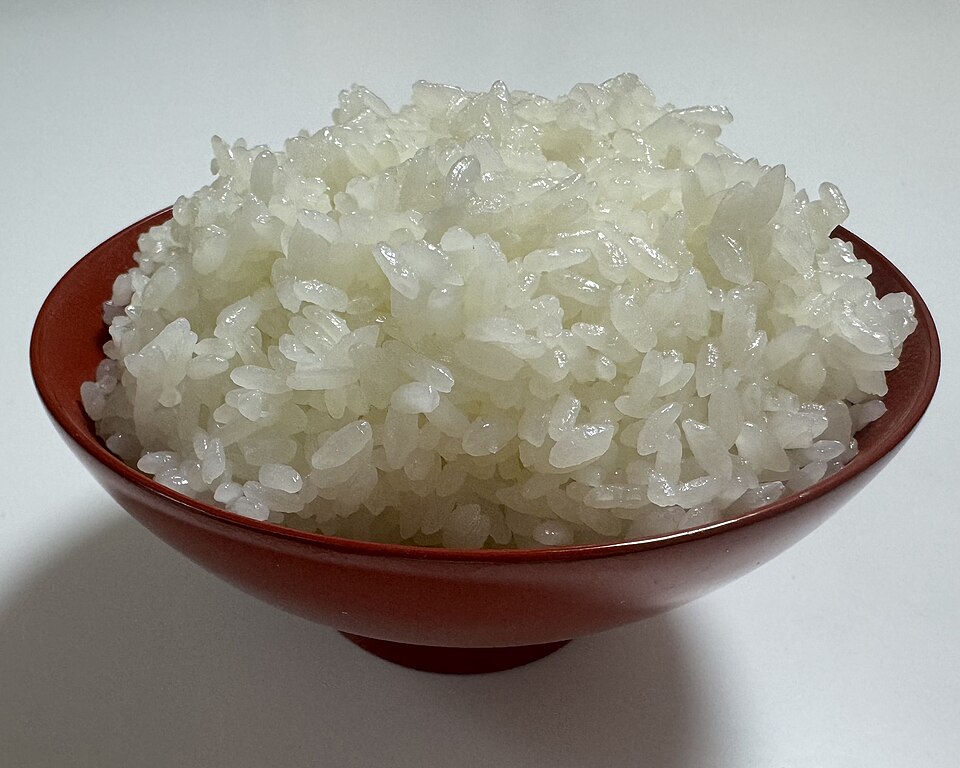
Commons: one gō of cooked Japanese rice served in a Wajima-nuri lacquer rice bowl.
Look closer: Wajima lacquer is made to be eaten from. The same undercoat of urushi and diatomaceous earth that protects a chest’s painted panel protects a bowl.
yuuki (金野裕希), CC BY-SA 4.0, via Wikimedia Commons. Source: https://commons.wikimedia.org/wiki/File:Japanese_rice_in_Wajima-nuri_lacquerware.jpg
And Wajima was a port. Wikipedia says it was a port of call for the kitamae ships and sold its lacquerware by land peddling, and the Japanese government’s tourism database says that by the mid-1800s the ships were carrying Wajima lacquerware to buyers beyond Ishikawa. That is the quiet link between this section and the next: the lacquer that decorated a Kyoto-style chest, and the chests carried aboard the ships that called at Wajima, came to the same harbour.

Shown to illustrate the gold-sprinkled lacquer technique, maki-e, named in the text. 19th century. Sprinkled gold on lacquer (maki-e). The Metropolitan Museum of Art, accession 10.7.3. Frederick C. Hewitt Fund, 1910. Open Access.
Look closer: The painting is done in gold powder sprinkled onto wet lacquer.
The Metropolitan Museum of Art, public domain (Open Access). Source: https://www.metmuseum.org/art/collection/search/57870

19th century. Gold lacquer ground with gold and silver takamaki-e and hiramaki-e. The Metropolitan Museum of Art, accession 81.1.277a–d. Bequest of Stephen Whitney Phoenix, 1881. Open Access.
Look closer: Gold lacquer at miniature scale: the same craft as the chest, a hand span wide.
The Metropolitan Museum of Art, public domain (Open Access). Source: https://www.metmuseum.org/art/collection/search/57707
Hikone’s Pantry and Sakai’s Shop Counter
Hikone and Sakai, the two remaining types, are less ornamental than Sendai and more architectural. Wikipedia’s Hikone entry begins with the mizuya, a kitchen chest. Mizuya of one section or of chest-on-chest form had been made to fit into or beside kitchen alcoves since at least the mid-Edo period, and the ones made at Hikone on Lake Biwa united storage needs with the building itself, because they were proportioned on the archaic shaku unit of measurement. Primary framing was of hinoki cypress with mortise and tenon joints, and the craftsmen lightened the mass of the case by using a translucent kijiro lacquer on the door and drawer faces. For the hardware they preferred copper to iron. Everything in that sentence is a decision about how a chest should sit in a room: low-key finish, light colour, soft metal.
Sakai’s chest sat in a different room, the shop. The article says Sakai is still thought of as the port town for Osaka even though it has been landlocked for centuries, and that during the Meiji period the merchant chest design associated with it successfully diffused throughout Japan. Its best examples use unfinished hinoki for the drawer and door faces and sugi for the case, and its compartments are known for their visually pleasing proportionality. Where the Sendai chest announces itself with iron and lacquer, the Sakai chest advertises with restraint: pale unlacquered faces and a counter of small doors in good proportion.

Commons: the day before her wedding, Hideko Hosokawa and her siblings prepare her belongings to her bridegroom’s house. Photographed in Ishinomaki, Miyagi, 21 November 1957.
Look closer: Behind the family, a wall of small drawers. Chests of all sizes were still part of a household’s move well into the twentieth century.
Yasuhiko Ito (from Sendai, Japan), CC BY 2.0, via Wikimedia Commons. Source: https://commons.wikimedia.org/wiki/File:Hosokawa_family_1957.jpg
The Meiji merchant’s wheeled chest belongs here as well, as the national counterpart to these local types. As the first chapter notes, the kuruma choba-dansu spread from the 1860s and stood on the shop platform at the owner’s side, quite often chained to a sturdy post. Wikipedia remarks that when private collections show one in the best room of the house, that is not how it was first used.
The Kitamae Ships and the Captain’s Chest
The funa-dansu, literally ship’s chests, belong to a story that begins with a policy mistake. Wikipedia’s Tansu article says that with the enforced closure of the country in 1633 and a prohibition in 1636 against building ships with a keel, more than two masts, or a cargo capacity above 2,550 bushels of rice, the shōgun inadvertently crippled the transport of rice from the countryside, causing shortages and even riots in some cities. The remedy came from reforms of coastal navigation and regulations suggested by the merchant Kawamura Zuiken in the early 1670s. The two Wikipedia articles give 1670 and 1672 for the reform, and a tourism page gives 1672 for the route being made official, so the date is best left at the early 1670s. The article says his recommendations included designating reliable sea transporters of government rice as goyō-chōnin, merchants representing the shogunate’s interests, and allowing designated vessels to trade on their own account at the coastal towns on the way.
The route they sailed is the kitamae route, from the Japanese for ships heading north. The Wikipedia article on the Kitamaebune says it ran from Osaka through the Seto Inland Sea and the Kanmon Straits to ports in Hokuriku on the Sea of Japan and later to Hokkaidō. One tourism account counts more than 100 ports along it. The Kaga domain, which sold about 70,000 koku of rice in Osaka each year, sent 100 koku by boat along the route in 1639. Kaga sailors had already crewed expeditions, led by wealthy merchants from Ōmi, to explore Hokkaidō a few decades earlier, and many of those sailors later became ship owners.

Drawing of a sengokubune from the National Diet Library digital collection, by Tayama Sōgyō.
Look closer: One mast and one square sail: the whole propulsion system of a thousand-koku ship.
Tayama Sōgyō (田山宗尭), Public domain, via Wikimedia Commons. Source: https://commons.wikimedia.org/wiki/File:NDL-DC_762376_0099_0012crd-Sengokubune.jpg
The ships were not large, and the regulations kept them modest for a long time. Wikipedia’s funa-dansu passage says they were usually under 90 feet, about 27 metres, in length, with a crew of eleven or fewer. The early boats had a single sail and made one round trip a year, from spring to autumn. A Japanese-government tourism summary says that by the 1870s the ships carried up to four sails, could carry hundreds of tons, and made three or four return trips a year, and a separate account credits Western-style schooners of the Meiji era for that change. The famous type was the sengokubune, the thousand-koku ship, of about 150 tons by one account, with a crew of about a dozen; its first 24-metre examples are said to have been built at the beginning of the eighteenth century.
The trade was a trade in differences. Ships left Osaka in late March, one tourism account says, and reached Hokkaidō in late May, trading at ports on the way, then left Hokkaidō in early July and were back in Osaka in early November. They carried sugar, sake and salt, iron from Shimane, and paper and knives from Fukui, with granite slabs as ballast. They brought back kombu kelp, herring, dried sardines, sea cucumber, salmon and cod. Herring turned into fertilizer is said to have sold for five to ten times its purchase price. The kombu travelled further than the ships: the same account says it reached Kyoto and Osaka and was passed on to China by way of Kagoshima and Okinawa, along what it calls the Kombu Road.

Commons: the Sengokubune exhibition hall in Sado City.
Look closer: Imagine a chest the size of a wardrobe carried down a plank from a hull like this one.
Suikotei, CC BY-SA 4.0, via Wikimedia Commons. Source: https://commons.wikimedia.org/wiki/File:Sengokubune_Tenjikan_Sado.jpg
The profits were large enough to make a class. By the mid-1800s, the government tourism summary says, the owners were among the wealthiest merchants in Japan. One account says some had fleets of up to 200 large and small ships and mentions the Honma family of Sakata, whose land holdings grew until their wealth exceeded that of feudal lords, with a saying of the day that a man might hope to become a Honma, or at least a lord. The ships were nicknamed bai-bune, double ships, because the profit could double in a single journey. Owners built large houses in places such as Hashitate in Kaga and Kuroshima in Wajima, and some of those houses survive.
It ended in the late Meiji. The Japanese-government account says the telegraph let prices spread nationwide quickly, which removed the markups on which the voyages depended, and that the railways gave the Sea of Japan coast a competitor. Another account adds steamships, and a 1885 regulation that banned Japanese-style ships over 500 koku, which hurt the shipbuilding along the route; some builders are said to have emigrated to Hokkaidō.
Into this world came the captain’s cabinet. Wikipedia says there is evidence that from the Kyōhō era (1716 to 1735) specific designs of elaborate cabinetry began to be used on the kitamae route. Well into the Meiji period, when a sengokubune arrived at a coastal town for trading, the crew would ceremoniously offload the captain’s or owner’s personal tansu and position it at the place where negotiations would be held, thus lending, in the article’s phrase, a calculated air of affluence and respectability to the visitor’s aura. The chest, in other words, was carried ashore to testify on its owner’s behalf.

Original drawing built from Wikipedia’s lists of regional tansu and its Kitamaebune article. Not a geographic map.
Look closer: Read along the top line and the chest towns hang below it like tags on a luggage rail: Sakai at the Osaka end, Wajima and Mikune on the Hokuriku coast, Ogi and Yahata on Sado. The grey boxes are the inland towns that borrowed from the coast.
Diagram by Japonista (original drawing), The Japonista Curation and Concierge Team, Tokyo, Japan.
Anatomy of a Ship’s Chest
Wikipedia divides the funa-dansu into three categories of design, and each answers a question a captain would ask. Where do I keep the money and the seals? Where do I keep my clothes? Where do I keep the books? The three answers are the kakesuzuri, the hangai and the cho-bako.
The kakesuzuri is a seals and money chest with a single hinged door, often covered with intricate iron plating, with multiple interior drawers or door-covered compartments. The hangai is a clothing chest with a single drop-fit door, often made as a set of two identical chests, so that one could be placed on top of the other and locked together. The cho-bako is a chest for accounting and writing materials and was made in many configurations. Wikipedia lists six of its features, which are worth reading as a vocabulary of secrecy and speed.

Not a ship’s chest. It shows the general idea of a lacquered cabinet built to be carried, with a lockable door and drawers behind it. Kōami School, late 17th century. Lacquered wood with gold and silver takamaki-e, hiramaki-e, and applied gold foil on nashiji ground. The Metropolitan Museum of Art, accession 81.1.133a–h. Bequest of Stephen Whitney Phoenix, 1881. Open Access.
Look closer: A hinged door with drawers behind it and a handle on top: the arrangement Wikipedia gives the kakesuzuri, which was also plated with iron.
The Metropolitan Museum of Art, public domain (Open Access). Source: https://www.metmuseum.org/art/collection/search/57585
Whatever the type, the wood was fixed. Funa-dansu intended for shipboard use were always built of zelkova on every exposed surface, with paulownia for interior compartments and for drawer and box linings. Zelkova is the hard wood of the faces, and paulownia, which the article elsewhere calls light and protective against oxidation, lines the inside. The article does not explain the pairing aboard ship, but it is the same pairing it describes for the sword polisher’s case: a strong outer wood and a light inner one.
| Feature of a cho-bako | What Wikipedia says it is |
|---|---|
| Kendon-buta | A drop-fit door cut into the case, used to hide a money box |
| Kobiraki-do | A small swinging door in the lower right corner |
| Ryobiraki-do | Double doors with half-faced hinges on the lower half of the box |
| Dezura hikidashi | One or two drawers exposed to the exterior |
| Hiki-do | Removable double sliding doors running the full width of the box, in the top or middle third |
| Zuri-do | A removable single sliding door in the lower left, typically paired with a kobiraki-do |

Not a ship’s chest; an early lacquer cabinet shown for its rank of small drawers behind a drop front. late 16th century. Lacquered wood with gold and silver hiramaki-e and mother-of-pearl inlay. The Metropolitan Museum of Art, accession 1989.17a–l. Purchase, Harris Brisbane Dick Fund and Mary Griggs Burke Gift, 1989. Open Access.
Look closer: A drop front over rows of small drawers: the same logic of hidden compartments that the cho-bako list above describes.
The Metropolitan Museum of Art, public domain (Open Access). Source: https://www.metmuseum.org/art/collection/search/44577
Ogi, Yahata and the Shipwrights’ Hand
On Sado Island the funa-dansu turned into something else. Wikipedia says that, with funa-dansu as an experience base, the tansu makers of Ogi applied their skill to merchant chests and clothing chests from the later Edo period, and that the Sado shima-dansu are prized as among the finest examples of the craft. Apart from thick iron hardware with a four-diamond motif cut into the handle back plates, Ogi chests often show ship-cabinet joinery, which the article calls atypical of other tansu not made on the Sea of Japan coast. The sea had taught the cabinetmaker a way of building.

Kawase Hasui, Yuki no akebono (Sado Ogi minato), from the series Souvenirs of Travel, second series. Commons describes it as dawn snow at the port of Ogi on Sado Island.
Look closer: The sheltered inlet is the point. Ogi’s cabinetmakers worked beside the water that fed their trade.
Kawase Hasui, Public domain, via Wikimedia Commons. Source: https://commons.wikimedia.org/wiki/File:Tabi_miyage_dai_nish%C5%AB%2C_Yuki_no_akebono_%28Sado_Ogi_minato%29_by_Kawase_Hasui.jpg
The second Sado town was Yahata, a late producer, where makers built paulownia chests primarily for the trousseau clothing of merchant families, with hardware that the article calls unique, from the early twentieth century. Paulownia is the wood of the bride’s chest, chosen, as the first chapter said of the sword polisher’s case, for its light weight and its protection against the damp.
Today the evidence of that world is in Sado’s museums. The Sadokoku Ogi Minzoku Museum at Shukunegi opened in 1972 in a school building put up in 1920, and its main exhibit, according to a travel page, is a copy of a boat built at Shukunegi in 1858, the type called a sengokubune, which could carry 150 tons of rice. A second tourism account says the former school holds kitamae relics. The Hasui print beside this paragraph, from the series Souvenirs of Travel, shows the port of Ogi in a dawn snow, a reminder of how much of this trade was done in the cold.
Fifteen Makers, One Earthquake and a Lacquered Cube
The best way to see how fragile a regional craft is, is to hear a maker count. In December 2023 Yunome Rikiya of the Sendai Tansu Cooperative Association gave a lecture at the University of Tokyo’s Komaba campus, in the Craft x Tech series, in which he said that only about fifteen people now work in the craft. He traced the decline in demand to the Taishō period, when Western-style housing and wardrobes replaced chests. Plywood and urethane are cheap alternatives to labour-intensive work, and training successors is difficult. His company, Yunome Furniture, was founded in 1871 and was in its 152nd year of operation. The family’s founder helped establish the Sendai Furniture Association in 1907, and the family set up the Sendai Tansu Cooperative Association in 2008 and a history and craft museum in 2011.

Commons: Metropolis.1 by Sendai Tansu x Studio SWINE, a large wooden lacquered chest based on a samurai or merchant chest.
Look closer: The black lines divide the surface into drawers and doors, and the wood grain between them is the same zelkova-and-lacquer pairing as the Meiji chest above.
14GTR, CC0, via Wikimedia Commons. Source: https://commons.wikimedia.org/wiki/File:Metropolis.1_by_Sendai_Tansu_x_Studio_SWINE_01.jpg
What reawakened the museum was a disaster. After the great earthquake of 2011, Yunome’s company found old chests discarded as debris, which prompted efforts to preserve the craft. The adaptations that followed are practical: adding legs, reducing the metal fittings, using champagne-gold fittings for export and modern interiors, and using urethane for some colours. In 2025 Japan House London invited him to give a talk and live demonstration, with metal-embossing and mini tansu-making workshops over three days in July.
The most striking recent collaboration is with Studio SWINE, the design collective of the Japanese architect Azusa Murakami and the British artist Alexander Groves. The Craft x Tech programme paired six traditional crafts from six prefectures of the Tōhoku region with six designers, and Studio SWINE’s plan for Sendai was a modern piece drawing on the square forms of ukiyo-e prints and the 1970s Supergrid. The result, Metropolis I, shown above, is a large lacquered chest in grid form. The Craft x Tech Tohoku project itself, Commons records, was shown at the Victoria and Albert Museum in London in September 2024 and at Design Miami during Art Basel that year.
The Noto Peninsula’s craft was struck on 1 January 2024, when a magnitude 7.6 earthquake hit the region. Wallpaper reported that Ishikawa was the hardest-hit region, that Wajima is one of Japan’s three most important hubs for lacquerware, and that, according to local government figures, as many as 1,100 of Wajima’s 20,000 residents work in the lacquer industry. The historic Asaiichi market, about a thousand years old, was destroyed by fire, the Kawaimachi lacquer district was engulfed in flames, and a supplier of wooden bases lost its newly opened showroom; the supplier’s owner said that without wooden bases, making lacquerware is not possible. A later report says more than a dozen lacquer studios were lost entirely and that the Kirimoto studio rebuilt a temporary workspace with support from the architect Shigeru Ban.
In March 2026 Japan House London presented a talk and demonstration by the Wajima urushi artist Hakose Junichi, who began his apprenticeship in 1975 and has collaborated with Christofle and Van Cleef & Arpels. The notice says that local artisans have kept working to protect and pass on the techniques, moving steadily toward recovery. One repair method reported from the recovery, called nuno-kise, reinforces a cracked wooden base with cloth before lacquer is reapplied, which is the same thing the craft’s philosophy of repair would suggest.
Stories from the Counter and the Cabin
The chest on the quay. Picture a sengokubune arriving at a coastal town in the Meiji period. Before any bargaining begins, the crew carries the captain’s tansu ashore, with ceremony, and sets it down where the talking will happen. Wikipedia’s account of this custom is brief, and its word for the intention is calculated. The chest is a letter of credit in wood and iron: lacquer and zelkova say that this man has capital and a home port to which he returns.
The rice that nearly starved a city. The rule against ships with a keel, more than two masts, or more than 2,550 bushels of capacity was meant to keep the country closed. It produced shortages in the cities and even riots, and what ended the shortage was not a stronger law but a better-organised sea road, which gave the shogunate’s rice a licensed transporter and gave the shipowner the right to trade for himself on the way. The ship’s chest is, in that sense, a product of a regulation that had to be loosened.
A saying of the day. Of the Honma family of Sakata, one tourism account says their wealth grew past that of feudal lords, and that merchants of the age said a man should aim to become a Honma or at least a lord. The detail speaks of a social order in which a shipowner could dream of exceeding the class above him, and it sits oddly beside the sumptuary laws that had once dictated what chests a merchant’s wife could use.
Songs on the hill. Yamanaka Onsen, in the mountains of Kaga, was a winter retreat for kitamae captains and sailors, and the Japanese tourism account says their influence shaped the local song Yamanaka-bushi, which geisha perform daily at the Yamanaka-za theatre. Another account says a Kyushu song, Haya-bushi, travelled up the coast and turned into local folk songs in Niigata and Aomori. The chests carried the owners’ goods; the ships carried the tunes.
The debris that became a museum. After the 2011 earthquake Yunome Rikiya found old chests that had been thrown out with the wreckage of houses, and that sight prompted efforts to preserve the craft. Four years later, Sendai tansu was named a Traditional Craft of Japan.
Fun Facts for the Curious
The details below come from the sources named in each line. Each can be checked against the pages listed at the end of the chapter.

Shown for its nest of small boxes held inside a cabinet, the same layered storage the ship’s chests used. 19th century. Tortoiseshell on wood with sprinkled gold lacquer. The Metropolitan Museum of Art, accession 29.100.725. H. O. Havemeyer Collection, Bequest of Mrs. H. O. Havemeyer, 1929. Open Access.
Look closer: Count the boxes that live inside the frame.
The Metropolitan Museum of Art, public domain (Open Access). Source: https://www.metmuseum.org/art/collection/search/45081
- A Sendai maker can use as many as 1,300 kinds of tools, according to the Sendai tourism story, for chasing, hammering and cutting the iron fittings alone.
- Granite slabs rode in the holds of kitamae ships as ballast, according to a tourism account of the route.
- The nickname bai-bune means double ships, because a voyage’s profit could double.
- Herring made into fertilizer is said to have sold for five to ten times its purchase price.
- Kombu from Hokkaidō reached China by way of Kagoshima and Okinawa along what one account calls the Kombu Road.
- Hikone’s kitchen chests were fitted with copper hardware rather than iron, according to Wikipedia.
- Wajima’s lacquer is said to take more than one hundred steps, by Japan House London’s count.
- Recycled Osaka cotton, one account says, became sakiori cloth on the Sea of Japan coast and led to sashiko embroidery; boatmen wore sakiori garments.
- The Shin Nihonkai Ferry, which stops at Maizuru, Niigata, Akita, Tomakomai and Otaru, is sometimes called the modern kitamaebune, according to Wikipedia.
- The 1,300 tools of the Sendai ironworker, the 100 steps of the Wajima lacquerer and the 150 tons of a sengokubune are three numbers that describe three different scales of the same Japanese preference: many small, careful operations making one durable thing.
Glossary of the Sea Road and the Chest Towns
A short vocabulary for reading the regional chests and the ships that carried them.
| Term | Meaning |
|---|---|
| Funa-dansu | Ship’s chest; a cabinet for the captain or owner of a coastal trading vessel |
| Kitamaebune | The merchant ships and route running between Osaka and the northern coasts of Japan; the name is thought to mean ships heading north |
| Sengokubune | A ship of one thousand koku; the best-known kitamae vessel |
| Koku | A measure of rice; one account gives about 150 kilos to the koku |
| Goyō-chōnin | A merchant representing the shogunate’s interests, here a licensed carrier of government rice |
| Kakesuzuri | A funa-dansu for seals and money, often plated with iron |
| Hangai | A funa-dansu for clothing, made as a pair that stack and lock together |
| Cho-bako | A funa-dansu for accounts and writing, in many configurations |
| Mizuya-dansu | A kitchen chest; the Hikone type used cypress framing and copper hardware |
| Isho-dansu | A clothing chest; Kyoto, Sendai and Yonezawa each had their own |
| Choba-dansu | A merchant’s chest kept on the shop platform; Sakai’s was the type that spread |
| Kijiro-nuri | A translucent lacquer that lets the wood grain show |
| Tama-nuri | An opaque lacquer technique associated with the Kyoto style |
| Jinoko | Powdered diatomaceous earth mixed with lacquer for the undercoat of Wajima ware |
| Keyaki | Zelkova serrata, the hard wood used for the faces of Sendai and funa-dansu |
| Kiri | Paulownia, the light wood used for linings and for Yahata’s clothing chests |
| Sugi | Cryptomeria or Japanese cedar, used for chest cases |
| Hinoki | Japanese cypress, used for Hikone’s framing and Sakai’s faces |
| Urajyo | The double-action lock found on the long top drawer of Sendai chests |
| Repoussé | Hammering a metal plate from the reverse over a soft base to raise a pattern; used for Sendai iron fittings |
A Collector’s Eye for Regional Chests
The sources above describe regional chests in language that can be used as a checklist for looking, though not as a method of authentication. Condition, repair, replaced hardware and later reproduction all matter, and this house does not value or authenticate individual chests in its chapters. The checklist below is a way of reading what is in front of you, drawn only from the descriptions already quoted.
Begin with the face wood and the case. Open-grain zelkova faces on a cedar case are Wikipedia’s description of the finest Sendai chests; unfinished cypress faces on a cedar case describe Sakai; cypress framing with translucent lacquered faces describes Hikone; all-zelkova exteriors with paulownia linings describe shipboard funa-dansu. Then look at the metal. Embossed iron with lions, dragons or peonies suggests Sendai; copper suggests Hikone; thick iron with a four-diamond motif suggests Ogi on Sado; iron plating over a money chest suggests a kakesuzuri.

A nineteenth-century cabinet shown for its surface and metal fittings, which are the two things the checklist asks the eye to read. 19th century. Lacquer decorated with gold. The Metropolitan Museum of Art, accession 91.1.729. Edward C. Moore Collection, Bequest of Edward C. Moore, 1891. Open Access.
Look closer: Read the surface first: here it is painted lacquer rather than open-grain wood.
The Metropolitan Museum of Art, public domain (Open Access). Source: https://www.metmuseum.org/art/collection/search/57801

A plain cabinet shown for contrast with the painted one. 18th–19th century. Lacquer. The Metropolitan Museum of Art, accession 36.100.150a–n. The Howard Mansfield Collection, Purchase, Rogers Fund, 1936. Open Access.
Look closer: The opposite choice: a smooth dark surface, with the metalwork doing the decorating.
The Metropolitan Museum of Art, public domain (Open Access). Source: https://www.metmuseum.org/art/collection/search/58331
Next the lock and the door. A long top drawer with a double-action lock or a long vertical bar is Wikipedia’s sign of Sendai; an engraved lock plate with a five-petal cherry blossom and ivy, and a hinged-door compartment in the upper chest, is its sign of Yonezawa. Finally the surface: translucent lacquer that shows the grain, opaque tama-nuri lacquer with painted flowers and motifs, or plain unlacquered wood. The Sendai tourism story adds that a kijiro surface grows more transparent with age, a reminder that a chest’s colour changes over the decades and that its condition tells part of its story.
Where to See the Chests and the Ships
The following places are named in the sources used for this chapter. Opening hours and admission change, so confirm them before travelling.
- The Sendai Tansu Historical Museum, on the fourth floor of Yunome Furniture, 2-7-3 Honcho, Aoba-ku, Sendai, per the Sendai tourism story.
- The Kitamaebune Ship Museum in the city of Kaga, in an 1878 house built for a prosperous shipowner, with navigation tools, ship cabinets and scale models of boats, per the Japanese tourism account.
- The Tenryo-Kitamaebune Museum and the Kadomi residence in Kuroshima, Wajima, a district that resembles its Edo-period appearance.
- The Sadokoku Ogi Minzoku Museum at Shukunegi, Sado, with its copy of a boat built in 1858.
- The Wajima Lacquer Art Museum in Wajima, a tourist spot named on Wikipedia; given the 2024 earthquake, check its status before travelling.
Furniture on the Shelf
The house holds no regional tansu or funa-dansu at present, and this chapter does not value or authenticate individual chests. For lacquered furniture of a different kind, see the Temple Furniture tag on the Japanese Arts, Vintage and Antiques shelf. The earlier archive page Tansu and Traditional Furniture gives a short working map, and the guide to importing large items from Japan covers freight for heavy pieces.
Answered plainly
What is a funa-dansu?
A ship’s chest, made for the captain or owner of a small coastal trading vessel on the kitamae route. Wikipedia names three kinds: the kakesuzuri for seals and money, the hangai for clothing and the cho-bako for accounts and writing.
What is a sengokubune?
A thousand-koku ship, the best-known type of kitamae vessel. One account puts its capacity at about 150 tons and its crew at about a dozen, and says the first 24-metre examples were built at the beginning of the eighteenth century.
What was the kitamae route?
The sea route from Osaka through the Seto Inland Sea and the Kanmon Straits to the Sea of Japan coast of Hokuriku and later Hokkaidō. Ships carried sugar, sake, salt, iron and paper north, and kombu, herring and salmon south.
What is Sendai tansu made of?
Mainly zelkova and chestnut, according to JR East, with cedar and paulownia also used. The surface is finished with kijiro-urushi lacquer and the hardware is mostly embossed iron.
Is Sendai tansu a designated traditional craft?
Yes. The Sendai tourism story says it was designated as an official traditional craft in June 2015, and Japan House London says the Ministry of Economy, Trade and Industry granted the status in 2015.
How many people still make Sendai tansu?
Yunome Rikiya said at a December 2023 lecture that only about fifteen people now work in the craft.
What is a mizuya-dansu?
A kitchen chest. Hikone, on Lake Biwa, produced a famous type with cypress framing, translucent lacquered faces and copper hardware, built to the old shaku module.
What was the Great Noto Earthquake’s effect on Wajima lacquer?
The 1 January 2024 earthquake damaged or destroyed many workshops. Wallpaper reported that as many as 1,100 of Wajima’s 20,000 residents work in the industry; a later report said more than a dozen studios were lost entirely, with work continuing in temporary workshops.
Why were ship’s chests made of zelkova and paulownia?
Wikipedia says shipboard funa-dansu always used zelkova for exterior surfaces, which is hard and durable, and paulownia for the interior compartments and linings, which is light and protects against oxidation.
Where can I see tansu in Japan?
The Sendai Tansu Historical Museum in Sendai, the Kitamaebune Ship Museum in Kaga, the Tenryo-Kitamaebune Museum in Wajima and the Sadokoku Ogi Minzoku Museum on Sado are all named in the sources for this chapter.
Where next
Sources and image credits
- Tansu, Wikipedia (Meiji regional types, funa-dansu, woods)
- Kitamaebune, Wikipedia
- Wajima-nuri, Wikipedia
- Sendai Tansu, East Japan Railway Company (JR East), Toreiyu Tohoku Emotion and Shiki-shima craft pages
- Sendai Tansu, Sendai Tourism, Convention and International Association, on Google Arts and Culture
- The Story of Sendai Tansu: samurai chests from Miyagi, Japan House London, 17 July 2025
- Craft x Tech Lecture Series Vol. 2, Sendai Tansu x Studio SWINE, University of Tokyo, 11 December 2023
- The Enduring Craft of Wajima Lacquerware, Japan House London, 3 March 2026
- In the aftermath of Japan’s Noto earthquake, what’s next for Ishikawa crafts? Wallpaper
- Japanese Lacquerware: The Amazing Recovery of Wajima-nuri, Sakura
- Kitamaebune: Transporting the Essence of Japan, Japan Ministry of Land, Infrastructure, Transport and Tourism multilingual database
- Treasure ships that brought goods, wealth, and culture, More Than Tokyo
- Kitamaebune, Old and New Destination, i-travel-square
- Sadokoku Ogi Minzoku Museum, Artessere
- Wikimedia Commons credits: Kunchan (CC BY-SA 3.0); 14GTR (CC0); yuuki (CC BY-SA 4.0); Suikotei (CC BY-SA 4.0); Yasuhiko Ito (CC BY 2.0); Kawase Hasui and Tayama Sōgyō (public domain)
Last reviewed 28 October 2026. Pictures, where shown, are public-domain or open-access and credited beneath each one.
Looking for lacquered furniture or a chest with its history intact? The concierge desk replies within one to three business days.
Private concierge
Looking for something in particular?
Describe the piece or the project you have in mind. A senior advisor in Tokyo reads every case file personally and replies within two business days, with fees set out in writing before any work begins.