
The Vimalakirti Sutra
Yuima-kyō · Scripture of a layman
The Vimalakirti Sutra
維摩経
Among the great Mahayana scriptures, one has a hero who is not a monk. Vimalakīrti is a rich householder who lives in a city, keeps a family and does business, and who feigns illness so that the Buddha's greatest disciples must come to his bedside. When the bodhisattva Mañjuśrī arrives to ask what the highest teaching is, the layman answers with silence. In Japan the scripture is the Yuima-kyō. It gave a name to one of the great temples of Nara, it was lectured on at court every year for centuries, and its small square room became a model for the abbot's quarters and, through a medieval essayist, for a hermit's hut.138
Fact sheet
Five things to notice
- The hero. The protagonist is a householder, not a monk, and he outshines the Buddha's ten major disciples.1
- The silence. Asked what non-duality is, Vimalakīrti makes no reply; the silence is the teaching.16
- The room. His small chamber, one fāngzhàng or ten feet square, became the model for the abbot's room in Chan and Zen monasteries.1
- The temple. Kōfuku-ji in Nara is said to take its name from the sutra, and held a seven-day lecture on it each year.34
- The hut. Kamo no Chōmei based his ten-foot hut, and much of his outlook, on the accounts of Vimalakīrti.8
A Scripture With a Layman for a Hero
First lookThe Vimalakirti Sutra, in Sanskrit the Vimalakīrtinirdeśa, is a Mahayana scripture in which the chief teacher is a layman. Burton Watson, whom the English Wikipedia article follows on the point, argues that it was composed around 100 CE.1 It is not a long sutra by the standards of the Flower Garland, but it is among the most read in East Asia, and the same article says it has been especially popular among Zen practitioners.1

Wall painting, Cave 103, Mogao Caves, Dunhuang; Tang dynasty, eighth century
Look closer: The debate is shown on a cave wall in Tang China. Vimalakīrti, the layman, holds his own against the bodhisattva who has come to visit him. The Commons description of the file names the wall, Cave 103 at Mogao, and dates it to the Tang dynasty.
Image: Chinese artist, Tang dynasty. Public domain. Source: Wikimedia Commons. File record

Its premise is simple. Vimalakīrti, a wealthy lay bodhisattva, pretends to be ill. The Buddha asks each of his ten major disciples to visit the sick man, and each declines, recalling an occasion on which Vimalakīrti had corrected his understanding. The bodhisattva Mañjuśrī agrees to go, and the discussion between the two in Vimalakīrti's room forms the centre of the sutra.1
The sutra does not reject the monastic life. What it does is refuse to let the monastic life become the whole of the path. Its hero eats, drinks, raises a family and moves through the world, and the scripture holds him up as a model precisely because his freedom does not depend on having left it.1
Ten Disciples Who Would Rather Not Go
The connoisseur's eyeThe illness is a device, since Vimalakīrti merely feigns it, and the visit it provokes brings the debate to the assembly. Each of the ten great disciples excuses himself, and in each case the reason is an old defeat. The sutra thereby arranges, before any teaching has begun, a comic reversal of the usual order, with the Buddha's own senior monks cast as the students.1
Mañjuśrī, the bodhisattva of wisdom, is the one who does go. Behind him comes a crowd of monks, bodhisattvas and gods. The discussion between the two takes place in Vimalakīrti's room, which comes to stand for the sutra itself, and it culminates in the question of non-duality.1
The sutra also contains a goddess who talks with Śāriputra, and a visit to the Amra Gardens. It closes with the entrusting of the teaching to Maitreya.1
- Around 100 CEComposition, on Burton Watson's view.1
- 188Lokakṣema's Chinese translation, now lost.1
- 223 to 228Zhi Qian's translation in two fascicles.1
- 308Dharmarakṣa's translation.1
- 406Kumārajīva's translation in three fascicles, the most popular.1
- 545 and 591Versions by Upaśūnya and Jñānagupta.1
- 650Xuanzang's translation in six fascicles.1
The Thunder of Silence
The connoisseur's eyeThe celebrated episode comes near the end of the debate. Each bodhisattva in the assembly offers his own account of non-duality, and Mañjuśrī then says that to explain it at all is to fall into the dualism of speech. He asks Vimalakīrti for his view, and Vimalakīrti says nothing.1 The Wikipedia article summarises it as the moment at which the sutra's teaching is delivered without a word.1

China · Yuan dynasty (1271–1368) · dated 1308 · Handscroll; ink on silk
Look closer: Wang Zhenpeng's handscroll of 1308 shows the great debate with Vimalakīrti still and silent while the others lean toward him. Notice how the painter keeps the layman's figure calm and lets the crowd supply the movement. It is ink on silk, the line work doing everything that colour might.
The Metropolitan Museum of Art, New York, Purchase, The Dillon Fund Gift, 1980, accession 1980.276. Public domain, Met Open Access. Museum record
The Metropolitan Museum owns a handscroll by Wang Zhenpeng, dated 1308, which illustrates the scene. The museum explains that it is ink on silk, 39.2 by 218.3 centimetres, and was a preparatory draft made for the approval of the future Emperor Renzong. Its subject, the museum says, is the debate in which Vimalakirti stays silent.6 That a court painter should present the scene to a prince shows how well known the episode was in the Yuan period.6
The sutra adds a second silencing. A goddess talks with Śāriputra, the senior disciple, who in the end falls silent.1
Seven Chinese Translations
The connoisseur's eyeThe sutra was translated into Chinese at least seven times between the second and seventh centuries. Lokakṣema produced the first, dated 188, which is lost. Zhi Qian followed in 223 to 228, Dharmarakṣa in 308, and Kumārajīva in 406. His version is in three fascicles and became the most popular. Upaśūnya's of 545 and Jñānagupta's of 591 are later, and Xuanzang's of 650, in six fascicles, is the last.1
The English Wikipedia article dates the Tibetan translation to the early eighth century in one place and to the ninth century in another, so its date should be treated as uncertain.1
The Sanskrit text, long lost, was published in a 1981 edition and in a romanised version of 2007, which allows the Chinese and Tibetan versions to be compared with it.1
| Translator | Date | Note |
|---|---|---|
| Lokakṣema | 188 | Lost1 |
| Zhi Qian | 223 to 228 | Two fascicles1 |
| Dharmarakṣa | 308 | Chinese version1 |
| Kumārajīva | 406 | Three fascicles; the most popular1 |
| Upaśūnya | 545 | Chinese version1 |
| Jñānagupta | 591 | Chinese version1 |
| Xuanzang | 650 | Six fascicles1 |
Prince Shōtoku's Commentary
The connoisseur's eyeThe sutra reached Japan early. The Sangyō Gisho, the three commentaries ascribed to Prince Shōtoku, include one on the Vimalakirti Sutra, the Yuimagyō Gisho, dated 613 and in three volumes. It is an annotated edition based on the commentary of Zhizang of the Liang dynasty, and it survives only in later copies without a colophon.2

Kōfuku-ji, Nara; photograph by Daderot
Look closer: This pagoda stands in the grounds of the temple that took its name from the sutra. The present structure dates from 1426; the building was ordered, according to Wikipedia, in 730, and the one seen here is a National Treasure.
Photograph: Daderot. CC BY-SA 3.0, with attribution. Source: Wikimedia Commons. CC BY-SA 3.0 File record

The other two commentaries are on the Lotus Sutra, dated 615, and on the Śrīmālādevī Sūtra, dated 611. The oldest known attribution of the set to Shōtoku is in the Hōryūji Garan Engi of 747, and the Nihon Shoki records that in 606 he lectured on the Śrīmālā and the Lotus.2 Scholars have not agreed whether he wrote them.2
Whatever its authorship, the Yuima commentary tells us that, on the traditional attribution, the sutra was being studied in Japan by 613. For the sutra's companions among Japan's early scriptures, see the pages on the Lotus Sutra and on the Nara schools.
Seven Days at Kōfuku-ji
The connoisseur's eyeThe Yuima-e, the Vimalakirti Assembly, was a lecture and debate on the sutra held each year at Kōfuku-ji. Bauer's study of the rite, based on the temple's own records, says that it was established by Fujiwara no Kamatari after he recovered from an illness. The temple's later history, written by Fujiwara no Yoshiyo (823 to 900), credits a nun from Paekche who chanted the sutra at his bedside, a story Bauer treats with scepticism.4

Hokuen-dō, Kōfuku-ji, Nara, autumn 2017; photograph by MemColorLab
Look closer: The Hokuen-dō is an octagonal hall, and Wikipedia dates it to 1210. Look at the eight-sided plan, which gives the roof its pointed, tent-like outline, and at the autumn colour around the hall.
Photograph: MemColorLab. CC BY-SA 4.0, with attribution. Source: Wikimedia Commons. CC BY-SA 4.0 File record

The rite lapsed for about thirty years and was revived by Kamatari's son Fuhito.4 Wikipedia says that Fuhito named the temple after the sutra and that the temple was founded in 669 at Yamashina by Kagami-no-Ōkimi for Kamatari's recovery, moved in 672, and moved again in 710 to Nara.3
As Bauer describes it, the rite lasted seven days, with morning and evening sessions of lectures and rongi, formal debates, held before an imperial emissary. It became one of the three Sanne, the great assemblies that a monk had to attend and complete to advance to the rank of Sōgō. By the mid-Heian period the judge of the debates, the tandai, was reserved for the abbot of Kōfuku-ji, and from 900 there were forty monks in the audience.4
The scale grew. In the session of 1196 nine of the questioners came from Tōdai-ji and three from Yakushi-ji.4 The rite thus served as a place where the great Nara temples met, and, because Kōfuku-ji was the Fujiwara family temple, as a place where that family's religious standing was displayed.
A Great Temple Named for a Sutra
The connoisseur's eyeKōfuku-ji is the Fujiwara family temple and the headquarters of the Hossō school. The five-storey pagoda, a National Treasure, was ordered in 730 on Wikipedia's account and is dated in its present form to 1426. The Central Golden Hall was rebuilt and reopened in 2018, the Tō-kondō dates from 1425, the octagonal Hokuen-dō from 1210 and the Nan'en-dō, which holds an Amoghapāśa Kannon, from 1741.3
The temple is also famous for its dry-lacquer sculpture, of which the Asura is the best known. For the technique and its place in Nara sculpture, see the page on dry lacquer in this chapter.3
A second Kōfukuji needs separating from the Nara temple. The Kōfukuji in Nagasaki had an abbot named Yiran Xingrong, Itsunen Shōyū in Japanese (1601 to 1668), who painted a Vimalakīrti that the Metropolitan Museum now holds (see below).5
A Layman Painted in Nagasaki
The connoisseur's eyeThe Metropolitan Museum has a hanging scroll of 1665, The Lay Buddhist Vimalakirti, painted by Yiran Xingrong (Itsunen Shōyū, 1601 to 1668), the abbot of the Kōfukuji monastery in Nagasaki, with an inscription by Jifei Ruyi (Sokuhi Nyoitsu, 1616 to 1671). It is ink and colour on silk and was the gift of Mary and Cheney Cowles in 2024.5
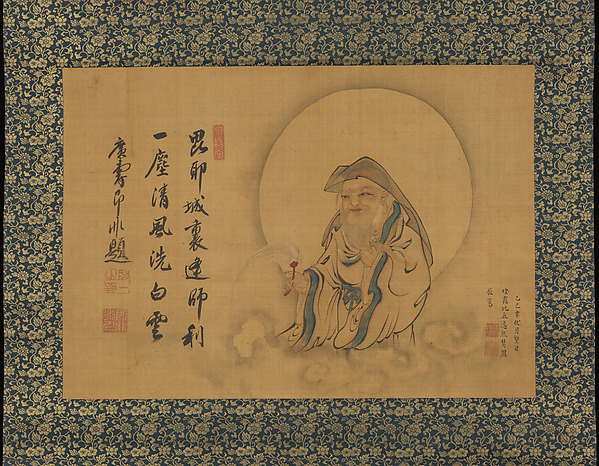
Japan · Edo period (1615–1868) · 1665 · Hanging scroll; ink and color on silk
Look closer: This hanging scroll of 1665 in ink and colour on silk shows the layman as a single portrait rather than in the debate. Look at the pose of the figure and at the inscription by a second hand, Jifei Ruyi, that the museum records.
The Metropolitan Museum of Art, New York, Mary and Cheney Cowles Collection, Gift of Mary and Cheney Cowles, 2024, accession 2024.412.11. Public domain, Met Open Access. Museum record
The Nagasaki Kōfukuji is not the Nara temple, and the two are easy to confuse. It was a monastery in Nagasaki, and its abbot, Yiran Xingrong, was a painter.5 That a Japanese Zen painter of the seventeenth century should choose Vimalakīrti as a subject shows how long the layman held his place in East Asian religious painting.5
The Ten-Foot Room and the Hermit's Hut
The connoisseur's eyeThe sutra's best-known single image is a space. Vimalakīrti's room, a fāngzhàng in Chinese, a hōjō in Japanese, is one jō (ten feet) square. The English Wikipedia article says that the abbot's room in a Chan or Zen monastery, also called the fāngzhàng, was patterned on it. The same two characters are read hōjō in Japanese.18
The same measurement gave its title to the Hōjōki, written by Kamo no Chōmei in March 1212. The title means the record of the ten-foot square, and the English Wikipedia article on the work says that Chōmei "based his small hut, and much of his philosophical outlook, on the accounts of the Indian sage Vimalakīrti".8 The book opens with the river that is always changing and recounts the disasters of Kyoto: fire, whirlwind, famine, earthquake. It then describes the hut, which has a simple foundation and a makeshift roof and is fitted with latches so that it can be moved.8
The hut is a hermit's reply to the world, but it takes its measure from a householder's room. That is typical of how the sutra worked in Japan: it licensed a freedom that could be found anywhere, in a temple lecture hall, a court debate or a hut by a stream.
Gold on Purple Silk
The connoisseur's eyeThe sutra was copied as an act of piety as well as read. The Metropolitan Museum holds a handscroll dated 13 January 1119, with chapters five to nine of the Vimalakirti Sutra written in gold and silver on purple silk. The museum says it was made in Yunnan for the prime minister of the Dali kingdom.7
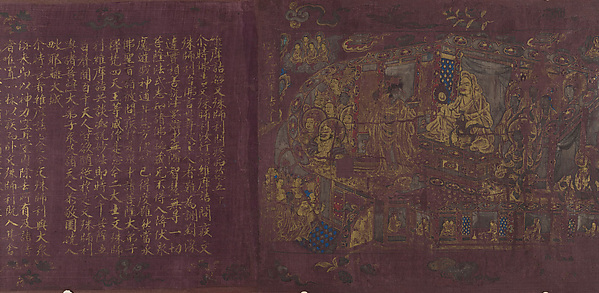
China · Northern Song dynasty (960–1127 · dated January 13, 1119 · Handscroll; gold and silver on purple silk
Look closer: Gold and silver text on purple silk, a luxury format for a scripture. The characters are small, even and set between ruled lines. Compare the rich dark ground with the simple paper of the Nara scrolls on the Flower Garland page.
The Metropolitan Museum of Art, New York, From the Collection of A. W. Bahr, Purchase, Fletcher Fund, 1947, accession 47.18.2. Public domain, Met Open Access. Museum record
The scroll is a reminder that the sutra's reach was wide: from the Tang caves of Dunhuang to the Yuan court painter's scroll and a Dali-kingdom copy of 1119, and on to Kōfuku-ji and the Nagasaki monastery.567
Fun Facts and Loose Ends
First lookA scripture with a hero this unusual attracts small curiosities. These are the ones worth keeping.
- The ten great disciples all decline the Buddha's request to visit Vimalakīrti, each recalling an occasion on which he had been corrected.1
- The most popular Chinese version, Kumārajīva's of 406, is in only three fascicles.1
- Prince Shōtoku's Yuima commentary survives only in later copies without a colophon.2
- The Yuima-e was one of three assemblies a monk had to complete to advance to the rank of Sōgō.4
- The judge of the Kōfuku-ji debates was reserved for the temple's own abbot from the mid-Heian period.4
- Kamo no Chōmei's hut was fitted with latches so that it could be taken apart and moved.8
Reading and Visiting
The connoisseur's eyeKōfuku-ji is open to visitors in the centre of Nara, with the Central Golden Hall, rebuilt in 2018, the five-storey pagoda and the Hokuen-dō in the precinct.3 The sutra itself is short enough to read in a sitting, and the Sanskrit edition of 1981 is the base for modern comparison with the Chinese and Tibetan.1
For the Dunhuang painting of the debate, the Mogao Caves in Gansu remain the place to see the scene on a wall. The Metropolitan Museum's Wang Zhenpeng scroll, the Itsunen Shōyū portrait and the Dali-kingdom sutra are part of its Asian art collection.567
Householders in Other Traditions
The deep endThe idea that a layperson can outdo the monks is not unique to this sutra. The Śrīmālā, also the subject of a Shōtoku commentary, has a queen for its preacher.2 The Vimalakirti Sutra gives the same lesson a more fully realised hero. Its popularity in Chan and Zen, noted by the English Wikipedia article, owes something to the fact that those schools also trusted ordinary life as the place of practice.1
The silence of Vimalakīrti has a Zen echo in the teaching that transmission is outside the scriptures. The page on the Platform Sutra and the page on Zen Buddhism explain how that thought developed.
How to Read a Vimalakīrti Image
The deep endA painting of Vimalakīrti is usually one of two kinds. The first is the debate, in which the layman faces Mañjuśrī among a crowd of listeners. The second is the single portrait of the layman alone. The Wang Zhenpeng scroll (1308) and the Dunhuang wall painting (Tang) show how the subject was staged in two centuries and two media.6
A scroll showing Vimalakīrti alone, like the Itsunen Shōyū portrait, is the second kind. If it carries a second hand's inscription, the inscription may name the painter and date, as it does in the Met example.5
The house keeps a changing shelf of Buddhist scrolls and sculpture, and the concierge desk can search Japan for a particular subject.
Words Worth Knowing
The terms below recur on this page and across the almanac.
| Term | Reading | Meaning |
|---|---|---|
| Yuima-kyō | Yuima-kyō | The Vimalakirti Sutra.1 |
| Yuima | Vimalakīrti | The lay bodhisattva of the sutra.1 |
| Monju | Mañjuśrī | The bodhisattva of wisdom who visits him.1 |
| Hōjō | fāngzhàng | A room ten feet square; the model for the abbot's room.1 |
| Yuima-e | Yuima-e | The annual Vimalakirti Assembly at Kōfuku-ji.4 |
| Rongi | rongi | Formal doctrinal debate.4 |
Related Pieces
The house keeps a changing shelf of Buddhist sculpture, scrolls and ritual objects from Japan. The shelf below fills with pieces on the day you read this, and the collection page lists them all.
Pieces in the house now
- Buddhist statues and sacred artSculpture, scrolls and ritual objects
Answered plainly
What is the Vimalakirti Sutra?
A Mahayana scripture, probably composed around 100 CE, in which a wealthy lay bodhisattva, Vimalakīrti, outdebates the Buddha's disciples and Mañjuśrī. In Japan it is the Yuima-kyō.1
Why is Vimalakīrti silent?
When Mañjuśrī asks him for his view of non-duality, he says nothing, which the sutra presents as the highest answer.16
Who translated it into Chinese?
There are seven Chinese translations. Kumārajīva's of 406, in three fascicles, is the most popular.1
What is the Yuima-e?
A seven-day lecture and debate on the sutra, held at Kōfuku-ji in Nara and one of the three major assemblies of the Nara and Heian monastic calendar.4
Did Prince Shōtoku write a commentary?
A commentary on the sutra, the Yuimagyō Gisho of 613, is attributed to him, but there is no academic consensus on authorship.2
How is the Hōjōki related?
Kamo no Chōmei wrote it in 1212 and based his ten-foot hut, and much of his outlook, on the accounts of Vimalakīrti.8
Where next
Sources and image credits
- Wikipedia, Vimalakirti Sutra Composition, plot, translations, the ten-foot room and modern editions.
- Wikipedia, Sangyō Gisho The three commentaries attributed to Prince Shōtoku.
- Wikipedia, Kōfuku-ji Founding, moves, name and buildings.
- Bauer, study of the Yuima-e (White Rose eprint 74755) Origin, format and later history of the Vimalakirti Assembly.
- The Metropolitan Museum of Art, The Lay Buddhist Vimalakirti (2024.412.11) Itsunen Shōyū scroll, 1665.
- The Metropolitan Museum of Art, Vimalakirti and the Doctrine of Nonduality (1980.276) Wang Zhenpeng handscroll, 1308.
- The Metropolitan Museum of Art, The Vimalakirti Sutra (47.18.2) Gold and silver sutra on purple silk, 1119.
- Wikipedia, Hōjōki Kamo no Chōmei, the ten-foot hut and its link to Vimalakīrti.
Last reviewed 28 October 2026. Dates in this chapter follow the cited pages; where the sources disagree, the chapter says so. Every picture is public-domain or openly licensed, and its credit and licence stand beneath it.
If this subject has drawn you to an object, the concierge desk can search Japan for it.
Private concierge
Looking for something in particular?
Describe the piece or the project you have in mind. A senior advisor in Tokyo reads every case file personally and replies within two business days, with fees set out in writing before any work begins.