
Tea Ceramics: Grading and Ranking Terms
Chanoyu Almanac · Names, Rungs, Boxes
Tea Ceramics: Grading and Ranking Terms
No official scale grades a tea bowl. What ranks a piece of tea ceramic is a web of old terms: where it was made, whose hands held it, which book names it, which kiln it belongs to, which saying places its ware, and whose writing is on the box. This chapter sets out each term with the sources that give it, shows two diagrams of the ladders that retailers and scholars describe, and marks every dealer's claim as attributed.
Fact sheet
At a glance
- A rating by lineage. The corpus calls meibutsu a rating of tea utensils, and says Edo records graded them by the rank of the owning house.
- Three grades. Ōmeibutsu, meibutsu and chūkō-meibutsu became the common grades after a late Edo record.
- A saying. Raku first, Hagi second, Karatsu third is repeated in several articles for the order of tea bowl wares.
- A list made later. Enshū's seven kilns were listed after his death; the earliest known mention is of 1857.
- Boxes carry weight. A dealer says a fitted box with an inscription raises a piece's standing; the claim is attributed.
How a Bowl Earns Its Rank
A visitor to a tea room who asks which bowl is the best will be given a story and not a score. The ranking terms of Japanese tea ceramics are old and mostly social. They record who owned a piece, which book names it, where its ware comes from and who has signed its box, and they say very little about glaze thickness or the height of the foot.

Tea bowl, 11th–12th century, Stoneware with iron-oxide glaze (Jian ware). The Metropolitan Museum of Art, H. O. Havemeyer Collection, Bequest of Mrs. H. O. Havemeyer, 1929, accession 29.100.226.
Look closer: a small conical bowl with a glossy black-brown glaze that carries fine pale streaks running down the inside from the rim, a slightly inturned lip and a narrow foot with an unglazed ring. The museum catalogues it as a Tea bowl, 11th to 12th century, stoneware with iron-oxide glaze (Jian ware), 6.4 cm high and 11.7 cm in diameter, from the H. O. Havemeyer Collection, bequest of Mrs. H. O. Havemeyer, 1929.
Image: The Metropolitan Museum of Art, Open Access (CC0)
Wikipedia's article on the tea ceremony gives the working habits behind this. Bowls are often named by their creators, owners or a tea master, and some bowls more than four hundred years old are still used, though only on unusually special occasions. Irregularities are prized and are often displayed as the front of the bowl. The article adds that Sen no Rikyū, in the sixteenth century, introduced rustic, distorted bowls made specifically for the tea ceremony, which is the point at which the old taste for polished Chinese ware began to give way.
The corpus of Wikipedia's Kyoto articles puts the matter in one line: meibutsu can be regarded as a rating of tea utensils. The rest of this chapter follows that rating through its parts. It begins with the question of origin, moves to the ladder of tenmoku bowls and the rarest of them, takes the three grades of famous objects, Enshū's seven kilns and the saying that orders the bowl wares, and finishes with the ten craft houses, the box and the honours that the state gives. The chapter does not value any piece; it reports what each source says and marks the sources that are dealers.
Karamono, Wamono and the Shogun's Treasures
The oldest rung is a rung of place. Wikipedia describes the Higashiyama Treasure, the Higashiyama gyomotsu, as a collection of important artefacts owned by the Ashikaga shogunate and named after the residence of the eighth shōgun, Ashikaga Yoshimasa, who lived from 1436 to 1490, in the eastern hills of Kyoto. It was mostly karamono, Chinese items, among them ceramics, lacquerware, paintings and calligraphy, and the article calls it the peak of Higashiyama culture.
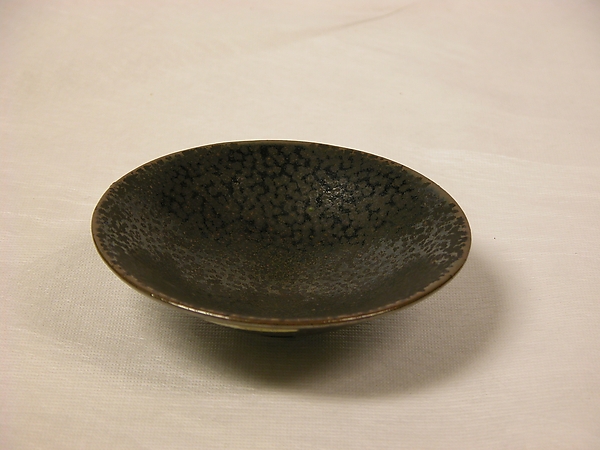
Tea bowl, 12th–13th century, Stoneware with golden-black hare's fur glaze (Tenmoku ware?). The Metropolitan Museum of Art, Gift of Alan L. Wolfe, 1966, accession 66.187.4.
Look closer: a shallow, wide-mouthed bowl with a dark brown glaze flecked with small golden-brown spots across the inside, a thin rim and a small foot, set on a pale cream ground. The museum catalogues it as a Tea bowl, 12th to 13th century, stoneware with golden-black hare's fur glaze (Tenmoku ware?), from the Jin dynasty, 3.2 cm high and 11.3 cm in diameter, a gift of Alan L. Wolfe, 1966.
Image: The Metropolitan Museum of Art, Open Access (CC0)
After the shogunate fell, says the same article, the treasures were scattered, though some survive and are designated National Treasures or Important Cultural Properties. Oda Nobunaga and Toyotomi Hideyoshi went on collecting, with their attention on Japanese tea utensils as the way of tea developed. These were called meibutsu, and the most prized were ōmeibutsu. The corpus fills in the earlier taste: by the Muromachi period the appreciation of Chinese tea utensils had grown, and tea men set their own criteria of form and midokoro, the points to be seen, for ranking them. A famous utensil was distinguished from an ordinary one by the name of the tea man who had owned it.
The Kundaikan sōchōki is the book most often linked with this world. JAANUS describes it as a single volume on Chinese objects, especially tea ceremony utensils, that were given to the shogunal family, and it describes the shoin kazari, the formal reception-room displays, such as those of Yoshimasa's Higashiyama villa. It offers contemporary appraisals of paintings, incense containers, censers, flower vases, tea containers and trays. The page does not say how it ranked them, and it does not settle who wrote it, naming Nōami, who lived from 1397 to 1471, or Sōami, from 1455 to 1525.
A second pair of terms follows the origin of the object. The Wikipedia article on the tea caddy sorts ceramic caddies by country of origin, import being karamono, Japan wamono and island-made shimamono, and notes that the kilns of Seto in the old province of Owari are counted the original Japanese chaire kilns, so that Seto caddies do not fall into kuniyakimono, the provincial ware. The distinction matters because the corpus says that Kobori Enshū picked up domestically made caddies that had been undervalued until then.
Sōami's Order of Tenmoku Bowls
The bowls that Japan called tenmoku were the preferred bowls of the tea ceremony until the sixteenth century, according to Wikipedia's article on the chawan. The name is said to come from Tianmu Mountain, where Japanese priests obtained such bowls from Chinese temples, and by the end of the Kamakura period Seto in what is now Aichi Prefecture was producing copies. Wikipedia's article on tenmoku adds that in 1406 the Yongle Emperor sent ten Jian ware bowls to the shōgun Ashikaga Yoshimitsu, who lived from 1358 to 1408.
Diagram by Japonista. After the order reported by Tezumi, a retailer (attributed); the order is not confirmed in the encyclopaedia pages used here.
Look closer: seven horizontal bars stacked from the longest at the top to the shortest at the bottom, each with a numbered circle at the left and a name and short description. The top two bars are shaded copper and the rest are cream.
Diagram by Japonista
A retailer, Tezumi, gives an order of seven grades in a blog article on tenmoku according to Sōami, and the order is shown in the diagram beside this text. It places yōhen first, as the most exquisite of the Jian bowls, with a stated value of 10,000 rolls of silk; yūteki second, at 5,000 rolls; the streaked Jian bowls called kensan, with the hare's-fur and nogime glazes, third, at 3,000 pieces of silk; usan fourth; bessan fifth; taihisan sixth, noted as cheap; and ordinary tenmoku last, the Chinese bowls from outside the Jian kilns, of which hai-katsugi was the top grade.
The retailer's own notes qualify the table. The listed order is not strictly by value, because bessan, at 1,000 rolls, comes after usan, at 300. The meaning of usan is uncertain, and some copies of the text give only the word cheap as a price. The account is a retailer's and the chapter has not found the underlying text; the Wikipedia articles used here do not give a ranking of tenmoku types. The figures are therefore given as attributed and are best read as a record of how the bowls were thought of, not as a market price.
| Rank | Term | Description as the retailer gives it | Stated value (retailer) |
|---|---|---|---|
| 1 | Yōhen, 曜変 | Dark base with starry spots and iridescence; the retailer calls it the most exquisite of the Jian bowls | 10,000 rolls of silk |
| 2 | Yūteki, 油滴 | Dark glaze with oil-drop spots | 5,000 rolls of silk |
| 3 | Kensan, nogime | Jian bowls not classed as yōhen or yūteki; streaked silver, blue and rust glazes | 3,000 pieces of silk |
| 4 | Usan, 烏盞 | Plain jet-black bowls of the Jian type; the meaning of the name is uncertain | 300 rolls of silk |
| 5 | Bessan | Tenmoku clay with light brown and black glaze and flower or bird crests | 1,000 rolls of silk |
| 6 | Taihisan | Tenmoku clay with light amber glaze and pale purple stars | Listed as cheap |
| 7 | Tenmoku, ordinary | Chinese tea bowls from outside the Jian kilns; hai-katsugi was the top grade | Not priced; one later copy gives 500 rolls of silk |
Four Bowls With Starry Glaze
Yōhen tenmoku is the glaze that every retailer and encyclopaedia mentions first. The corpus says it is said to have been made at the Kenyō kilns in present-day Jianou, Fujian Province, in the Southern Song, by unknown makers. It reports four identified bowls, all in Japan, and notes that some count only three. Three are National Treasures, at the Seikadō Bunko, the Fujita Museum and Ryūkō-in, and the fourth, at the MIHO Museum, is an Important Cultural Property.
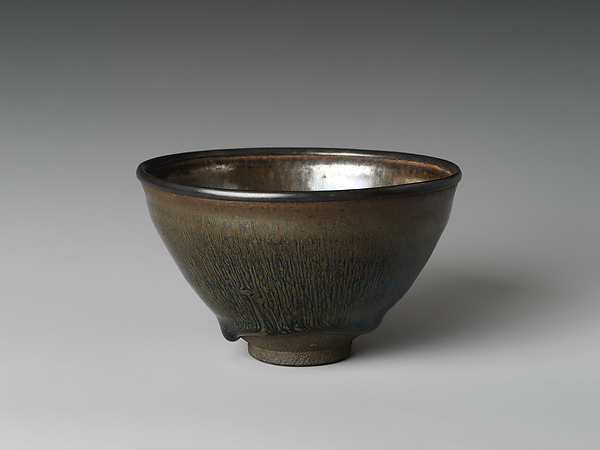
Tea bowl, 11th–12th century, Stoneware with iron-oxide glaze, metal rim (Jian ware). The Metropolitan Museum of Art, H. O. Havemeyer Collection, Bequest of Mrs. H. O. Havemeyer, 1929, accession 29.100.230.
Look closer: a conical tea bowl with a glossy dark glaze streaked with rust brown, a fitted metal band around the rim and a narrow foot. The museum catalogues it as a Tea bowl, 11th to 12th century, stoneware with iron-oxide glaze and a metal rim (Jian ware), 7.6 cm high and 12.7 cm in diameter, from the H. O. Havemeyer Collection, bequest of Mrs. H. O. Havemeyer, 1929. It is shown as a kind of bowl, not as one of the four named above.
Image: The Metropolitan Museum of Art, Open Access (CC0)
The table gives the corpus's account of each, with the height, diameter and base in centimetres. The Seikadō bowl is the one called the Inaba tenmoku. It passed from the Tokugawa shōgun family, where Iemitsu gave it to Kasuga no Tsubone, to the Inaba clan of the Yodo domain, and later to Iwasaki Koyata of Mitsubishi, who reportedly never used it. The Fujita bowl came through the Mito Tokugawa family and was obtained by Fujita Heitarō in 1918. The Ryūkō-in bowl was handed down within the sub-temple, and the MIHO bowl came from the Maeda clan of Kaga and then to Ōsaragi Jirō.
The corpus adds that the MIHO bowl's classification as yōhen is disputed, with some arguing that it belongs to the yūteki category, the silvery oil spot. This is a reminder that the ranking terms are descriptions of a surface as well as of a rank: a bowl is placed in the grade whose look it shows, and the placing can be contested. The Wikipedia article on tenmoku lists the glaze types, among them youhen, yuteki, haikatsugi, nogime, konoha, moji and ran, and says that three Southern Song vessels are National Treasures without naming them.
| Bowl and place | Ownership as the corpus gives it | Status | Height / diameter / base (cm) |
|---|---|---|---|
| Seikadō Bunko Art Museum (the Inaba tenmoku) | Tokugawa shogun family; given by Iemitsu to Kasuga no Tsubone; then the Inaba clan of Yodo; then Iwasaki Koyata | National Treasure | 6.8 / 12.0 / 3.8 |
| Fujita Museum of Art | Mito Tokugawa family; obtained by Fujita Heitarō in 1918 | National Treasure | 6.8 / 12.3 / 3.8 |
| Ryūkō-in, Daitoku-ji, Kyoto | Handed down within the sub-temple; no earlier owners given | National Treasure | 6.6 / 12.1 / 3.8 |
| MIHO Museum | Maeda clan of Kaga; then Ōsaragi Jirō | Important Cultural Property; its yōhen status is disputed | 6.6 / 12.1 / 3.9 |
Great, Named and Later Renowned Objects
The corpus article on meibutsu is the clearest account of the three grades. In the broad sense, meibutsu are good tea utensils that have names, those chosen and recorded in books such as the Meibutsuki. In the narrow sense the word is sometimes limited to the utensils famous in Rikyū's time, set against the ōmeibutsu and the chūkō-meibutsu. The article says that values shifted in the Tenshō era, between 1573 and 1591, mainly at Sakai, and that the shift fed into the new wabi tea. Tea jars had been the most valued things at first, but in Rikyū's age the chaire, the tea container, became more important than the jar, a change recorded in the Yamanoue Sōji ki, the book of secrets of Rikyū's best pupil.
Diagram by Japonista. After the bilingual corpus of Wikipedia's Kyoto articles; the grades are those said to have become common after the Unshū Meibutsu chō.
Look closer: three stacked bands that widen from top to bottom: ōmeibutsu in copper at the top, meibutsu in a lighter tone in the middle and chūkō-meibutsu in the palest tone at the bottom, each with a short note beneath the name.
Diagram by Japonista
The Edo period made the rating a public matter. The Ganka meibutsuki and other records of named objects spread the values to a wider public, and the corpus says the Ganka meibutsuki graded utensils by the lineage of their owners, such as the three privileged Tokugawa branches, so that prices depended on the rank of the owning daimyo house and not on the look of the piece. The grades that are used now arrived late. The corpus says that after the Unshū Meibutsu chō, a record of tea utensils of Izumo Province by Matsudaira Harusato, called Fumai, the grades ōmeibutsu, meibutsu and chūkō-meibutsu became common.
The corpus lays them out in three steps. Ōmeibutsu is the upper grade, formed in the framework of the Unshū Meibutsu chō, and is sometimes used today for top-tier utensils; the corpus ties it to the Ashikaga holdings, the Higashiyama gyomotsu, including the most prized utensils of Rikyū's age. Meibutsu are the utensils famous in Rikyū's age, and chūkō-meibutsu are ranked below them, with the domestic caddies that Enshū loved at their centre. The page gives no number of objects in any list and does not give the full lists, and the chapter does not supply them.
Enshū and the Seven Kilns
Kobori Enshū lived from 1579 to 1647, taught the third Tokugawa shōgun, Iemitsu, and gave his name to the Enshū school of tea. Wikipedia's article on his life names the tea houses he designed at Daitoku-ji and the gardens credited to him, among them the Katsura Imperial Villa, but it says nothing of a ranking. The Wikipedia article on Enshū's seven kilns is the link between his taste and the grades of ceramic.

Tea Jar, 1650, Clay covered with glaze (Zeze ware). The Metropolitan Museum of Art, Gift of Charles Stewart Smith, 1893, accession 93.3.145a, b.
Look closer: a black and white photograph of a rounded, shouldered jar with a dark glossy glaze, a short neck and a pale lid with a small round knob. The museum catalogues it as a Tea Jar, 1650, clay covered with glaze (Zeze ware), 10.2 cm high, a gift of Charles Stewart Smith, 1893.
Image: The Metropolitan Museum of Art, Open Access (CC0)
That article says the list of seven was not drawn up in his lifetime. It was compiled after his death from his correspondence and his known patronage. He used many tea utensils and wrote about them to friends, connoisseurs and provincial lords, and he is assumed to have commissioned works, which helped establish some newer and lesser-known kilns and sustained long ties with established ones. The earliest known mention of the list is in the late Edo book Honchō tōki kōshō, of 1857.
The seven are Asahi, Agano, Akahada, Kosobe, Shitoro, Takatori and Zeze. The article places Agano in Buzen, Akahada in Yamato, Kosobe in Settsu, Takatori in Chikuzen and Zeze in Ōmi, and says Shitoro was later associated with Tōtōmi. Its wording for Asahi is ambiguous. The Metropolitan Museum holds a tea jar of 1650 in Zeze ware, shown beside this text, which is catalogued as clay covered with glaze, 10.2 centimetres high, and the museum does not connect it with Enshū.
Enshū's other contribution to the grading vocabulary is his naming. The corpus says he picked up kuniyaki caddies that had been undervalued and wrote inscriptions based on waka themes, matching each utensil's character. The University of Michigan Museum of Art labels the Seto caddy Hitorine as chosen and named by Enshū, made by Seto Shinbei about 1600 to 1647, with a name meaning sleeping alone from a poem by Enshū. The MOA Museum of Art says its caddy Yamazakura comes with a box inscribed by Enshū.
| Kiln | Place as the article gives it |
|---|---|
| Asahi | The article's wording places it with a later Buzen Province Agano ware, and is ambiguous |
| Agano | Buzen Province |
| Akahada | Yamato Province |
| Kosobe | Settsu Province |
| Shitoro | Later associated with Tōtōmi Province |
| Takatori | Chikuzen Province |
| Zeze | Ōmi Province |
Ido Bowls and the Wabi Taste
The tea world also ranks the bowls it learned to love. Wikipedia says the Ido chawan originated from a large Korean bowl used for rice, and that Ido bowls became highly prized with the rise of wabi tea in the late Muromachi period. Rikyū favoured them for their rough simplicity. The corpus adds that the Ido bowl owned by Hideyoshi was counted among the meibutsu, which shows how a rice bowl from the Korean peninsula could stand beside the treasures of the Ashikaga.

Tea bowl with decoration of chrysanthemums and wavy lines, first half of the 17th century, Stoneware with stamped, white-slip design. The Metropolitan Museum of Art, The Howard Mansfield Collection, Gift of Howard Mansfield, 1936, accession 36.120.502.
Look closer: a tall-sided tea bowl with pale grey-white slip pressed into bands of small stamped flowers and wavy lines, a slight flare at the rim and a short foot. The museum catalogues it as a Tea bowl with decoration of chrysanthemums and wavy lines, probably Korea, Joseon dynasty, first half of the 17th century, stoneware with stamped white-slip design, 8.3 cm high, from the Howard Mansfield Collection, gift of Howard Mansfield, 1936.
Image: The Metropolitan Museum of Art, Open Access (CC0)
Ido-gata, the well type, is one of the named shape categories, and the article on the chawan gives a related shape, Komogai, once imported from the Korean port of Ungcheon-dong, now part of Changwon. A Kōrai bowl is a bowl of Korean origin, and the Geidai tea site calls the bowl named Kizaemon, an Ido-style Kōrai bowl in the care of Kohōan, a sub-temple of Daitoku-ji, one of the most famous. That page says Ido bowls hold a high status among Kōrai bowls and that the bowl is a National Treasure, but it gives no formal grade and no date for the bowl, saying only that Ido bowls were probably made at a kiln near a port that Japanese visitors frequented in the fifteenth and sixteenth centuries.
The Metropolitan Museum's tea bowl with chrysanthemums and wavy lines, catalogued as probably Korean, of the first half of the seventeenth century, is a stamped white-slip bowl and not an Ido, but it shows a Korean manner of stamped decoration. The museum also holds a Japanese gohon, a Korean-style bowl, with cranes, made in Kyoto in the second half of the eighteenth century and attributed to Kiyomizu Rokubei I. The museum's title uses the word gohon for a Korean-style bowl made in Japan, which is a reminder that the vocabulary of tea follows taste and not only the place of making.
Raku First, Hagi Second, Karatsu Third
The best-known ranking of bowls is a proverb. Wikipedia's article on the chawan says that the most esteemed bowls for the tea ceremony are Raku, Hagi and Karatsu ware, and that a saying in the tea schools gives the preferred order as Raku first, Hagi second and Karatsu third, citing a Japan Times article of 22 January 2000. The articles on Hagi ware and Karatsu ware repeat the saying, so that three pages state it, though none says where it began.

Black Raku Tea Bowl, early 17th century, Earthenware with black raku glaze (Raku ware). The Metropolitan Museum of Art, Rogers Fund, 1917, accession 17.118.74.
Look closer: a squat, straight-sided bowl with a dark, slightly matt glaze, a gently irregular rim and a narrow foot, photographed against a grey ground. The museum catalogues it as a Black Raku Tea Bowl, early 17th century, earthenware with black raku glaze (Raku ware), 9.2 cm high and 9.5 cm in diameter, from the Rogers Fund, 1917.
Image: The Metropolitan Museum of Art, Open Access (CC0)
Raku comes first because of its place in the history of wabi tea. Wikipedia says that in the sixteenth century Rikyū had the tile-maker Chōjirō make hand-moulded bowls for the wabi style, first called ima-yaki, contemporary ware, and Juraku-yaki after the red clay. Hideyoshi gave Chōjirō's son Jōkei a seal with the character raku, enjoyment, and the word became the family name. The line has passed to the sixteenth generation, Raku Kichizaemon XVI. Traditional Raku is hand-shaped, low-fired and porous, and the article notes that it was the first Japanese ware to use a seal mark and to stress close work between the potter and the patron.
Hagi is second. The Wikipedia article says it traces its origin to Korean potters brought to Hagi in Yamaguchi after the Japanese invasions, and that Mōri Terumoto appointed potters at Matsumoto, now Hagi, to make wares for his tea ceremonies and for gifts. The clay is soft and fine, filtered for about two weeks, and the glaze is translucent beige. The fine crackle called kannyū forms as the glaze shrinks faster than the clay, and the article says the glaze can darken over time as the porous surface absorbs tea or sake. The same article notes that the bright green of matcha sits well against the warm neutral tones, and that a deliberate chip on the foot let pieces be sold to merchants and not given to the Mōri house.
Karatsu is third. The Wikipedia article places it in and around Karatsu in Saga Prefecture, with techniques believed to have come from the Korean peninsula during the late sixteenth-century invasions, though some theories place them earlier. It names e-Karatsu, with iron-brush painting under a semitransparent grey glaze; Chōsen Karatsu, with a black glaze beneath a white glaze fired with straw so that the two run together; and the types madara and ao. It adds that in western Japan pottery in general is often called Karatsu because so much was made there. The chapter does not rank any one piece within these wares.
A Vocabulary of Shape and Foot
Before a bowl is ranked it is described, and the vocabulary of description is large. The Wikipedia article on the chawan lists named shapes, among them wa-nari, the circle or iron-bowl shape; wan-nari, the wooden-bowl shape; tsutsu-gata, the cylinder; dōjimari-gata, the waist type; sugi-nari, the cedar shape; kutsu-gata, the clog; and shihō-gata, the four-sided. It also gives ido-gata and tenmoku-gata, which name a bowl by the ware it recalls, so that a Japanese bowl can be a well type or a tenmoku type whatever its clay.

Red Raku Tea Bowl (Chawan), 18th century, Earthenware with red slip under milky glaze (Raku ware, unknown workshop); gold lacquer repairs. The Metropolitan Museum of Art, The Howard Mansfield Collection, Gift of Howard Mansfield, 1936, accession 36.120.525.
Look closer: a rounded bowl in a red-orange glaze flecked with fine dark spots, with a dark branching crack at the upper left repaired in gold lacquer and a short foot. The museum catalogues it as a Red Raku Tea Bowl (Chawan), 18th century, earthenware with red slip under milky glaze (Raku ware, unknown workshop), with gold lacquer repairs, 8.9 cm high and 12.4 cm in diameter, from the Howard Mansfield Collection, gift of Howard Mansfield, 1936.
Image: The Metropolitan Museum of Art, Open Access (CC0)
The foot has its own words. The article lists the ring foot, the snake's-eye foot, the crescent-moon foot, the shamisen-plectrum foot and the Go-stone-box foot. Each is a short description of a form that the eye can learn to see, and a catalogue that uses the term is saying something checkable about the bowl and not offering an opinion of it.
The same article describes how special bowls are kept. A chakin cloth wipes the bowl, an orange turmeric-coloured cloth, ukon-nuno, usually wraps it for storage in its box, and a shifuku, a silk or brocade bag with four small cushions, protects the most special bowls, especially tenmoku types. A simpler bag is the gomotsu-bukuro. These accessories belong in a discussion of rank because the bag, the cloth and the box are often handed on with the bowl, and a record of them forms part of its history.
Wikipedia says bowls come in a wide range of sizes and styles, that shallow bowls are used in summer so the tea cools quickly and deep bowls in winter, and that thick and thin tea use different styles. A vocabulary of shape is therefore also a vocabulary of season and use, and the chapter on the tea bowl in this almanac takes up the anatomy of the bowl, from rim to foot, in detail.
| Shape | Characters | Meaning in the article |
|---|---|---|
| Wa-nari | 輪形 | Circle or iron-bowl shape |
| Wan-nari | 椀形 | Wooden-bowl shape |
| Tsutsu-gata | 筒形 | Cylinder type |
| Dōjimari-gata | 胴締形 | Waist type |
| Sugi-nari | 杉形 | Cedar shape |
| Kutsu-gata | 沓形 | Clog or shoe shape |
| Shihō-gata | 四方形 | Four-sided shape |
| Idō-gata | 井戸形 | Well type, after the Ido bowls |
| Tenmoku-gata | 天目形 | Tenmoku type, after the Jian bowls |
The Ten Houses of the Senke
A tea bowl is ranked in part by who made it, and for the three main schools there is a named circle. Wikipedia says that the honorary title Senke jisshoku, the ten Senke crafts, is given to ten artisans who supply utensils for events held by the three main iemoto schools, the san-senke. It does not describe any ranking within the group.
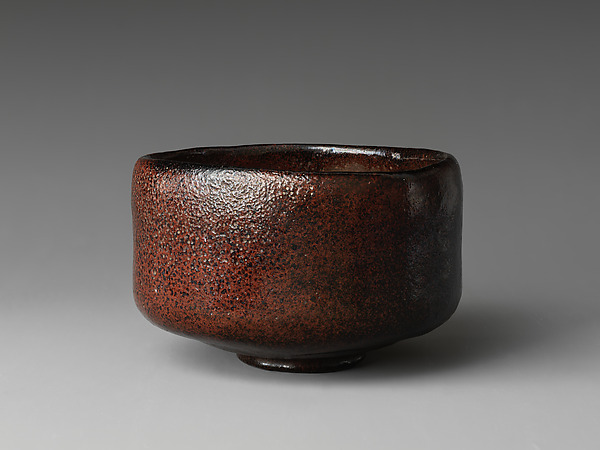
Raku Ichinyū, Black Raku Teabowl, named “Setting Sun” (Sekiyō), late 17th century, Earthenware with black raku glaze (Raku ware). The Metropolitan Museum of Art, Mary and Cheney Cowles Collection, Gift of Mary and Cheney Cowles, 2024, accession 2024.443.1.
Look closer: a low, broad bowl with a mottled dark glaze that shows red-brown speckling, a slightly irregular rim and a small foot. The museum catalogues it as a Black Raku Teabowl, named Setting Sun (Sekiyō), late 17th century, earthenware with black raku glaze (Raku ware), credited to Raku Ichinyū, 7.5 cm high and 11.1 cm in diameter, from the Mary and Cheney Cowles Collection, gift of Mary and Cheney Cowles, 2024.
Image: The Metropolitan Museum of Art, Open Access (CC0)
Tenpyodo, a dealer in Ginza, gives the ten in a glossary, and the table reproduces its list as a dealer's page. It describes the group as a family of ten people and ten professions who prepare tea utensils in the tradition of the Senke. It says that other craftsmen worked in the same way earlier, but that in the Meiji period these ten were regarded as the current ten. The name, it says, is not historical, and it took root after the Ten Jobs Exhibition at Mitsukoshi in Osaka in 1915.
The dealer adds two societies. The Jubi-kai was formed about 1933 and holds exhibitions every three years, and the Jisshoku-kai was formed in 1985 to advance technique and creativity while preserving history and tradition. The first of the ten crafts in its list is the tea bowl, held by the house of Kichizaemon Raku, the same house whose ware heads the saying of the previous section, and the last is the brazier and pottery, held by Zengorō Eiraku. The page does not describe the specialities beyond the names of the crafts, and the chapter adds nothing.
| Craft as listed | House name as listed |
|---|---|
| Tea bowl | Kichizaemon Raku |
| Kettle | Seiemon Onishi |
| Nuri, lacquer | Sōtetsu Nakamura |
| Sashimono, joinery | Risai Komazawa |
| Kanamono, metalwork | Jōeki Nakagawa |
| Pouch | Yūkō Tsuchida |
| Hyōgu, mounting | Kichibē Okumura |
| Ikkanbari, paper-lacquer | Ikkan Hiki |
| Bamboo work | Shōgen Kuroda |
| Brazier and pottery | Zengorō Eiraku |
Boxes, Names and Inscriptions
The last rung is paper and wood. A tea utensil often comes in a fitted box, and the box can carry the evidence on which the other rungs depend. The Japan Classic retailer's page on the tomobako, the box made to go with its piece, says it is traditionally made of paulownia, that it protects against light, dust and changes in humidity, and that it is inscribed by the artist or by an expert appraiser. It lists what the inscription may contain: the artist's name, often with a seal; the title of the piece, sometimes a poetic name; the kiln or type of ware; and a date or dedication, occasionally with a waka or haiku. These are the retailer's claims.

Red Raku Tea Bowl (copy of the Kaga Kōetsu Tea Bowl), 18th century, Earthenware with red slip under clear lead glaze (Raku ware). The Metropolitan Museum of Art, The Howard Mansfield Collection, Gift of Howard Mansfield, 1936, accession 36.120.492.
Look closer: a tall, loosely shaped bowl with an orange-red glaze, a wavy rim, vertical streaks and a cream-coloured patch near the foot. The museum catalogues it as a Red Raku Tea Bowl (copy of the Kaga Kōetsu Tea Bowl), 18th century, earthenware with red slip under clear lead glaze (Raku ware), 13 cm high and 15.9 cm in diameter, from the Howard Mansfield Collection, gift of Howard Mansfield, 1936. The title records that the bowl is a copy.
Image: The Metropolitan Museum of Art, Open Access (CC0)
The same page says a piece with its original box commands greater respect and value, because the box signifies the artist's endorsement and the piece's authentic line. It gives no figures and no market evidence for this, and the chapter reports it only as a claim. Two further terms that collectors use for inscriptions and attributions, hakogaki and kiwame, are not defined on the pages read for this chapter, and the chapter leaves them undefined.
Museum labels give firmer cases. The MOA Museum of Art says that its caddy Yamazakura comes with a box bearing inscriptions by Kobori Enshū, and the University of Michigan Museum of Art says that Hitorine was chosen and named by Enshū. In both cases the museum's text, not the box alone, is what the chapter relies on. Wikipedia adds that the tea storage jar Chigusa was revered enough to receive a proper name, and that several diarists admired and documented it. A name, a box and a diary are three different kinds of paper trail, and a piece may have one without the others.
State Honours for Objects and Makers
The state adds its own ranks. Several objects named in this chapter are National Treasures: the Kizaemon Ido bowl at Kohōan, and three yōhen tenmoku bowls, at the Seikadō Bunko, the Fujita Museum and Ryūkō-in. The MIHO bowl is an Important Cultural Property. Wikipedia's article on the Higashiyama Treasure adds that some of the scattered Ashikaga treasures, among them paintings, are designated National Treasures or Important Cultural Properties, and names examples held in temples and museums in Kyoto, Yamanashi and Tokyo.
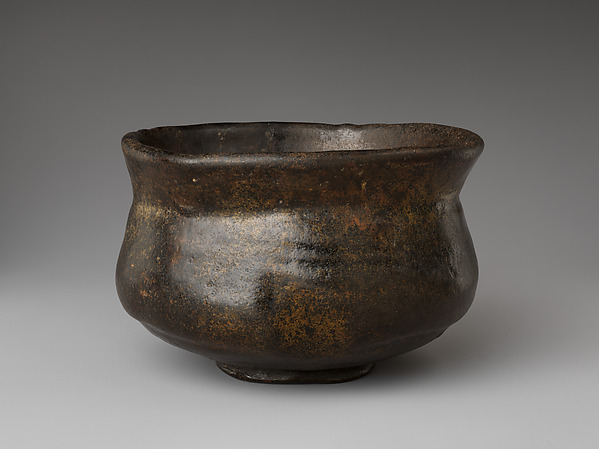
Raku Chōjirō, Black Raku Tea Bowl, Named “Kaedegure” (Twilight by the Maples), 17th century, Earthenware with black Raku glaze (Raku ware). The Metropolitan Museum of Art, Gift of Peggy and Richard M. Danziger, 2024, accession 2024.553.19.
Look closer: a waisted bowl with a wide mouth that rises unevenly, a dark brown glaze that shows lighter tan patches on the shoulder and a short foot. The museum catalogues it as a Black Raku Tea Bowl, named Kaedegure (Twilight by the Maples), 17th century, earthenware with black Raku glaze (Raku ware), credited to Raku Chōjirō, 9 cm high and 12.1 cm in diameter, from a gift of Peggy and Richard M. Danziger, 2024.
Image: The Metropolitan Museum of Art, Open Access (CC0)
Living makers are honoured as people and not as objects. The Wikipedia article on Hagi ware says that Miwa Kyūwa, Kyūsetsu X, revitalised the Hagi tea world in the 1930s and was named a Living National Treasure in 1970, and that his younger brother Miwa Jusetsu, Kyūsetsu XI, was named in 1983. Jusetsu's eldest son, Ryōsaku, became Kyūsetsu XII in April 2003.
The Raku house is the line that Wikipedia describes as continuing to the sixteenth generation. The article notes a dispute in 1979, between the fourteenth Kichiemon and the Western artist Paul Soldner, over the use of the title raku, since Western raku differs from the traditional Japanese practice. It states that the Western version is typically fired at a high temperature and then placed in combustible material to create a reducing atmosphere, a method Soldner introduced in the 1960s, while traditional Raku is hand-shaped, low-fired, porous and cooled in open air.
These honours are the most recent layer of the vocabulary, and they differ in kind from the older ones. A meibutsu rating belonged to a book and to an owner; a National Treasure designation belongs to the state; a Living National Treasure designation belongs to a person. A catalogue that uses any of them is naming the authority, and a reader can ask which one is meant.
Reading Chaire by Origin and Kiln
A caddy is ranked in the same words as a bowl. The Wikipedia article on the tea caddy gives the order of questions that the chapter on caddies in this almanac follows: for which tea, thick or thin; of which origin, karamono or wamono; of which kiln or potter; in which shape; and with what lid, bag and box. The shapes it names include nasu, bunrin, katatsuki and taikai, and it says that the natsume is used for thin tea and the chaire for thick.
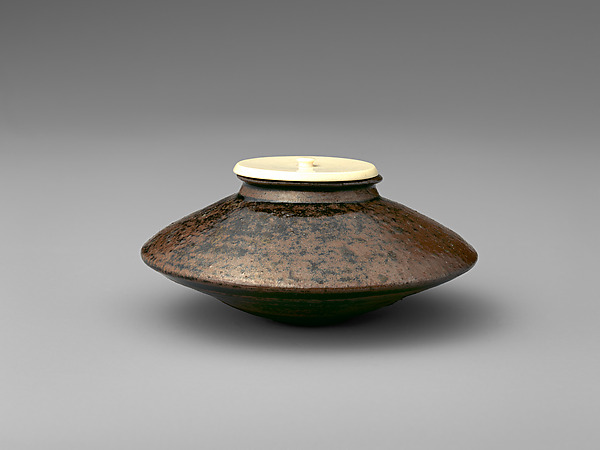
Tea Caddy (Chaire), 18th century, Stoneware with iron glaze (Seto ware); ivory lid. The Metropolitan Museum of Art, Edward C. Moore Collection, Bequest of Edward C. Moore, 1891, accession 91.1.157.
Look closer: a flat, wide-shouldered caddy with a dark brown glaze touched with bluish grey, and a round ivory lid with a small cut. The museum catalogues it as a Tea Caddy (Chaire), 18th century, stoneware with iron glaze (Seto ware) with an ivory lid, 4.4 cm high and 10.2 cm wide, from the Edward C. Moore Collection, bequest of Edward C. Moore, 1891.
Image: The Metropolitan Museum of Art, Open Access (CC0)
The corpus adds a clue about what had changed by the Edo period. When it explains that chaire became more important than jars in Rikyū's age, it also says that Enshū's attention to domestic caddies lifted a class of ware that had been neglected. The Wikipedia article says that Seto is counted the original home of Japanese chaire, and so a Seto caddy is wamono and not kuniyakimono. The Metropolitan Museum holds an eighteenth-century Seto caddy in stoneware with iron glaze and an ivory lid, which measures 4.4 centimetres high and 10.2 centimetres wide.
The museum also holds a caddy of the eighteenth century in Satsuma ware, with iron and rice-straw ash glazes, 10.2 centimetres high, and a number of tea jars in Satsuma, Bizen and other wares. Each is catalogued by the kiln named on the record. A reader who meets such a term on a card can ask the same questions in the same order, and the answers will usually place the piece on one of the ladders of this chapter without any need to value it.
How to Read a Grading Term
A label can be read one word at a time. The table sets out the terms of this chapter in the order a card is likely to give them, with the source that defines each. None of the terms is a guarantee of quality, and several name an authority and not a grade.
Three habits help. First, ask which authority the term names: a book, a family, a museum, a state or a dealer. Second, ask whether the term describes the object, as shape and foot terms do, or the object's history, as meibutsu and box inscriptions do. Third, ask whether the claim can be checked in a page that is not the page of a dealer in the piece. The house describes pieces in plain words, says what the record shows and what it does not, and will say so when the answer is that the record is silent.
| Term | What the sources say |
|---|---|
| Karamono | Chinese, or made to resemble Chinese ware; the chaire article on Wikipedia sorts caddies by origin. |
| Wamono, kuniyakimono | Made in Japan; kuniyakimono is the provincial ware that Enshū esteemed, and Seto is excluded from it because Seto is counted the original home of Japanese chaire (Wikipedia, Chaire). |
| Ōmeibutsu, meibutsu, chūkō-meibutsu | The three grades of famous utensils that became common after the Unshū Meibutsu chō (corpus). |
| Higashiyama gyomotsu | The treasures of the Ashikaga shōguns, named after Yoshimasa's eastern-hills residence; mostly Chinese (Wikipedia). |
| Enshū nana-gama | Enshū's seven kilns, a list compiled after his death (Wikipedia). |
| Raku, Hagi, Karatsu | The three bowl wares that the old saying puts first, second and third (Wikipedia). |
| Tomobako | A fitted wooden box that stays with the piece; a retailer says it carries the maker's or an expert's inscription (attributed). |
| Senke jisshoku | The ten crafts that supply the three Senke schools (Wikipedia; a dealer's glossary gives the names). |
| Kokuhō, jūyō bunkazai | National Treasure and Important Cultural Property; the Kizaemon Ido bowl and three yōhen bowls are National Treasures. |
Fun Facts
- Wikipedia says some tea bowls over four hundred years old are still used, though only on unusually special occasions.
- The corpus says that the Ido bowl owned by Hideyoshi was counted among the meibutsu, though it began as a Korean rice bowl.
- Enshū's seven kilns were not listed in his lifetime; the earliest known mention is of 1857, over two centuries after his death.
- The dealer Tenpyodo says the name Senke jisshoku is not historical and took root after a 1915 exhibition in Osaka.
- The Raku seal given by Hideyoshi means enjoyment, according to Wikipedia.
- A retailer gives the stated value of the top tenmoku grade as 10,000 rolls of silk, which is the retailer's figure and not a confirmed price.
- The corpus says the Ganka meibutsuki priced pieces by the rank of the owning daimyo house and not by their look.
- Wikipedia says the Hagi glaze can darken as the porous surface absorbs tea or sake.
- The Yongle Emperor sent ten Jian bowls to Ashikaga Yoshimitsu in 1406, according to Wikipedia.
A Timeline of Rank in Tea Ceramics
Dates are given as the sources give them, with the source named. Where a date is a lifespan, it is marked as one.
| Date | Event | Source |
|---|---|---|
| 1358 to 1408 | Lifespan of Ashikaga Yoshimitsu, who received ten Jian bowls from the Yongle Emperor in 1406. | Wikipedia, Tenmoku |
| 1397 to 1471 | Lifespan of Nōami, to whom the Kundaikan sōchōki is attributed in one account. | JAANUS |
| 1436 to 1490 | Lifespan of Ashikaga Yoshimasa, eighth shōgun, whose eastern-hills residence names the Higashiyama gyomotsu. | Wikipedia, Higashiyama Treasure |
| 1455 to 1525 | Lifespan of Sōami, the other candidate author of the Kundaikan sōchōki. | JAANUS |
| 1476 and 1511 | The Nōami and Sōami versions of the Kundaikan sōchōki illustrate matcha jars. | Wikipedia, Matcha |
| Late 16th century | Rikyū has Chōjirō make hand-moulded bowls for wabi tea; Hideyoshi's seal gives Raku its name. | Wikipedia, Raku ware |
| 1579 to 1647 | Life of Kobori Enshū, who named the Seto caddy Hitorine. | Wikipedia; Univ. of Michigan label |
| 1596 | The date the Hagi article gives for the second invasion of Korea, after which Korean potters came to Hagi. | Wikipedia, Hagi ware |
| 1663 | The Miwa family kiln at Hagi is established. | Wikipedia, Hagi ware |
| 1857 | Earliest known mention of Enshū's seven kilns, in the Honchō tōki kōshō. | Wikipedia, Enshū's Seven Kilns |
| 1915 | The Ten Jobs Exhibition at Mitsukoshi, Osaka, after which the name Senke jisshoku took root. | Tenpyodo glossary (dealer) |
| 1933 | The Jubi-kai is formed, with exhibitions every three years. | Tenpyodo glossary (dealer) |
| 1970 | Miwa Kyūwa, Kyūsetsu X, is named a Living National Treasure. | Wikipedia, Hagi ware |
| 1983 | Miwa Jusetsu, Kyūsetsu XI, is named a Living National Treasure. | Wikipedia, Hagi ware |
| 1985 | The Jisshoku-kai is formed. | Tenpyodo glossary (dealer) |
A Glossary of Rank and Name
The words of the chapter, with the sense the sources give them.
| Term | Meaning |
|---|---|
| Meibutsu | 名物. Named tea utensils; in the corpus's words, a rating of tea utensils. |
| Ōmeibutsu | 大名物. The great famous objects, the upper grade. |
| Chūkō-meibutsu | 中興名物. The later famous objects, ranked below meibutsu. |
| Meibutsuki | 名物記. A record of named objects, such as the Ganka meibutsuki. |
| Higashiyama gyomotsu | 東山御物. The Ashikaga shōguns' treasures, mostly Chinese. |
| Kundaikan sōchōki | 君台観左右帳記. A book on Chinese objects and shoin displays for the shōgunal house. |
| Karamono | 唐物. Chinese objects, or those made to resemble them. |
| Wamono | 和物. Objects made in Japan. |
| Kuniyakimono | 国焼物. Provincial wares; Enshū loved the caddies of this kind. |
| Tenmoku | 天目. Iron-glazed bowls in the manner of Jian ware. |
| Yōhen | 曜変. The rarest tenmoku, with starry spots and a sheen. |
| Yūteki | 油滴. Oil-spot tenmoku. |
| Ido | 井戸. A Korean rice bowl type prized in wabi tea. |
| Kōrai chawan | 高麗茶碗. Korean tea bowls. |
| Raku | 樂. The ware of the Raku family, from a seal given by Hideyoshi. |
| Kannyū | 貫入. The fine crackle of a glaze that shrinks faster than its clay. |
| Kōdai | 高台. The foot of a bowl. |
| Enshū nana-gama | 遠州七窯. Enshū's seven kilns. |
| Senke jisshoku | 千家十職. The ten crafts that serve the Senke schools. |
| Tomobako | 共箱. A fitted box that goes with a piece, often inscribed. |
| Iemoto | 家元. The head of a tea school. |
| Shifuku | 仕覆. A silk or brocade bag with small cushions for a special bowl. |
| Ukon-nuno | 鬱金布. An orange turmeric-coloured wrapping cloth. |
More Bowls, Jars and Caddies to Look At

Teabowl, ca. 1700, Dark brown clay (Karatsu ware). The Metropolitan Museum of Art, The Howard Mansfield Collection, Gift of Howard Mansfield, 1936, accession 36.120.497.
Look closer: a black and white photograph of a wide bowl with a thick rolled rim, a pale crackled glaze inside and a tall, plain foot. The museum catalogues it as a Teabowl, about 1700, dark brown clay (Karatsu ware), 7 cm high and 13 cm in diameter, from the Howard Mansfield Collection, gift of Howard Mansfield, 1936.
Image: The Metropolitan Museum of Art, Open Access (CC0)

Teabowl, 18th century, Clay covered with a mottled glaze (Karatsu ware). The Metropolitan Museum of Art, Gift of Mr. and Mrs. Samuel Colman, 1893, accession 93.1.124.
Look closer: a black and white photograph of a deep bowl with a dark, even glaze, a flared rim and a low foot. The museum catalogues it as a Teabowl, 18th century, clay covered with a mottled glaze (Karatsu ware), 7.1 cm high and 14 cm in diameter, a gift of Mr. and Mrs. Samuel Colman, 1893.
Image: The Metropolitan Museum of Art, Open Access (CC0)

Kiyomizu Rokubei I, Gohon (Korean-Style) Tea Bowl with Cranes, second half of the 18th century, Stoneware with white-slip inlay, underglaze iron, and red and white slip under transparent glaze (Kyoto ware, Kiyomizu type). The Metropolitan Museum of Art, The Howard Mansfield Collection, Gift of Howard Mansfield, 1936, accession 36.120.518.
Look closer: a straight-sided bowl in a warm honey-yellow glaze with a pale crane drawn in dark brush lines at the left and a short foot. The museum catalogues it as a Gohon (Korean-Style) Tea Bowl with Cranes, second half of the 18th century, stoneware with white-slip inlay, underglaze iron, and red and white slip under transparent glaze (Kyoto ware, Kiyomizu type), credited to Kiyomizu Rokubei I, 9.5 cm high, from the Howard Mansfield Collection, gift of Howard Mansfield, 1936.
Image: The Metropolitan Museum of Art, Open Access (CC0)
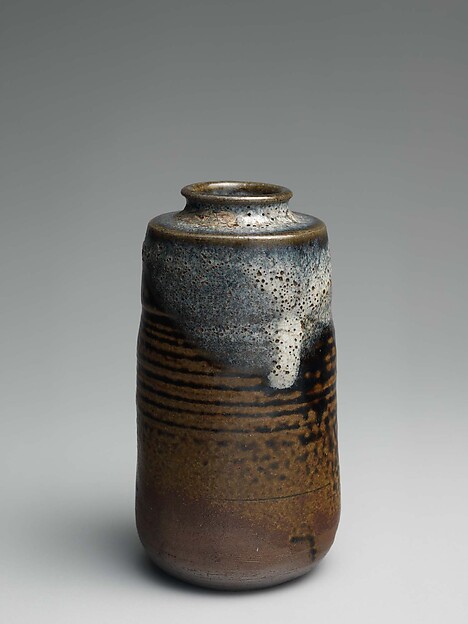
Tea Caddy (Chaire), 18th century, Stoneware with iron and rice-straw ash glazes (Satsuma ware). The Metropolitan Museum of Art, Edward C. Moore Collection, Bequest of Edward C. Moore, 1891, accession 91.1.146.
Look closer: a tall caddy with a narrow neck, turned ridges around the body, a brown glaze with a pale pooled drip at the shoulder and an ivory lid. The museum catalogues it as a Tea Caddy (Chaire), 18th century, stoneware with iron and rice-straw ash glazes (Satsuma ware), 10.2 cm high, from the Edward C. Moore Collection, bequest of Edward C. Moore, 1891.
Image: The Metropolitan Museum of Art, Open Access (CC0)
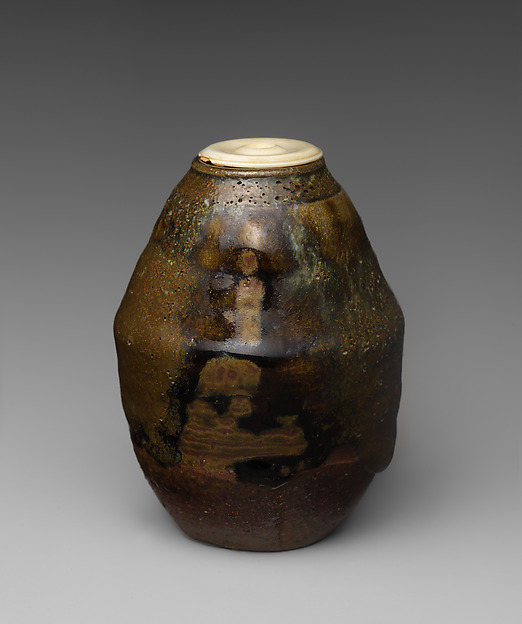
Tea Jar, 17th century, Clay with glaze (Satsuma ware). The Metropolitan Museum of Art, Edward C. Moore Collection, Bequest of Edward C. Moore, 1891, accession 91.1.148.
Look closer: a rounded jar that narrows to a short neck with an ivory lid, its brown surface marked with a glossy dark patch and pale streaks. The museum catalogues it as a Tea Jar, 17th century, clay with glaze (Satsuma ware), 8.3 cm high, from the Edward C. Moore Collection, bequest of Edward C. Moore, 1891.
Image: The Metropolitan Museum of Art, Open Access (CC0)

Tea Jar, 1700, Clay covered with glaze (Satsuma ware). The Metropolitan Museum of Art, Gift of Charles Stewart Smith, 1893, accession 93.3.153a, b.
Look closer: a cylindrical caddy in an olive-green and brown glaze with a pale blue-grey drip down one side and a small ivory lid with a knob. The museum catalogues it as a Tea Jar, 1700, clay covered with glaze (Satsuma ware).
Image: The Metropolitan Museum of Art, Open Access (CC0)
Tea-Room Ware from the Collection
The shop's tea-room ware passes through the house with the rest of the tea room. The concierge desk will say in plain words what each piece is made of, who made it where the record says so, whether it has been used or repaired, what box or cloth comes with it and what the record does and does not show. The atlas of utensils and the glossary of tea utensils are companions to this chapter.
Answered plainly
Is there an official ranking of tea bowls?
Not in the pages used here. The ranking terms record origin, ownership, wares, makers and boxes, and the corpus calls meibutsu a rating of tea utensils.
What do ōmeibutsu, meibutsu and chūkō-meibutsu mean?
The three grades of famous utensils that, the corpus says, became common after the Unshū Meibutsu chō: the great famous objects, the famous objects and the later famous objects.
What is the saying about Raku, Hagi and Karatsu?
Wikipedia gives it as Raku first, Hagi second and Karatsu third, citing a Japan Times article of 2000.
What are Enshū's seven kilns?
Asahi, Agano, Akahada, Kosobe, Shitoro, Takatori and Zeze, a list compiled after his death and first mentioned in 1857.
What is yōhen tenmoku?
The rarest glaze of the Jian bowls, with starry spots and a sheen; the corpus identifies four bowls in Japan, three of them National Treasures.
How many yōhen bowls survive?
Sources differ: the corpus identifies four and says some count three; a retailer says three intact bowls.
What are karamono and wamono?
Chinese, or Chinese-style, objects and objects made in Japan; Wikipedia sorts caddies this way.
What is the Kundaikan sōchōki?
A single volume on Chinese objects, especially tea utensils, given to the shōgunal family, attributed to Nōami or Sōami, according to JAANUS.
Who are the Senke jisshoku?
Ten craft houses that supply utensils for the three main tea schools; a dealer's glossary lists them and dates the name to a 1915 exhibition.
Does a box raise a piece's rank?
A retailer says so, without figures; the chapter treats the claim as attributed.
Does the chapter value any piece?
No. It reports what the sources say of the terms and does not appraise objects.
Where next
Sources and image credits
- Chawan, Wikipedia
- Japanese tea ceremony, Wikipedia
- Tenmoku, Wikipedia
- Higashiyama Treasure, Wikipedia
- Enshū's Seven Kilns, Wikipedia
- Kobori Enshū, Wikipedia
- Raku ware, Wikipedia
- Hagi ware, Wikipedia
- Karatsu ware, Wikipedia
- Meibutsu (good tea utensils), a bilingual corpus of Wikipedia's Kyoto articles
- Yohen Tenmoku Tea Bowl, a bilingual corpus of Wikipedia's Kyoto articles
- Kundaikan sōchōki, JAANUS
- Kizaemon Ido bowl, Geidai tea site
- A Comprehensive Guide to Tenmoku, Part 2, Tezumi (retailer, attributed)
- Senke Jisshoku, Tenpyodo (dealer, attributed)
- Tomobako, Japan Classic (retailer, attributed)
- Object record, Tea bowl, 29.100.226, The Metropolitan Museum of Art
- Object record, Tea bowl, 66.187.4, The Metropolitan Museum of Art
- Object record, Tea bowl, 29.100.230, The Metropolitan Museum of Art
- Object record, Tea Jar, 93.3.145a, b, The Metropolitan Museum of Art
- Object record, Tea bowl with decoration of chrysanthemums and wavy lines, 36.120.502, The Metropolitan Museum of Art
- Object record, Black Raku Tea Bowl, 17.118.74, The Metropolitan Museum of Art
- Object record, Red Raku Tea Bowl (Chawan), 36.120.525, The Metropolitan Museum of Art
- Object record, Black Raku Teabowl, named “Setting Sun” (Sekiyō), 2024.443.1, The Metropolitan Museum of Art
- Object record, Red Raku Tea Bowl (copy of the Kaga Kōetsu Tea Bowl), 36.120.492, The Metropolitan Museum of Art
- Object record, Black Raku Tea Bowl, Named “Kaedegure” (Twilight by the Maples), 2024.553.19, The Metropolitan Museum of Art
- Object record, Tea Caddy (Chaire), 91.1.157, The Metropolitan Museum of Art
- Object record, Teabowl, 36.120.497, The Metropolitan Museum of Art
- Object record, Teabowl, 93.1.124, The Metropolitan Museum of Art
- Object record, Gohon (Korean-Style) Tea Bowl with Cranes, 36.120.518, The Metropolitan Museum of Art
- Object record, Tea Caddy (Chaire), 91.1.146, The Metropolitan Museum of Art
- Object record, Tea Jar, 91.1.148, The Metropolitan Museum of Art
- Object record, Tea Jar, 93.3.153a, b, The Metropolitan Museum of Art
Last reviewed 28 October 2026. Pictures, where shown, are public-domain or open-access and credited beneath each one.
Looking for a tea bowl, a caddy or another piece of tea-room ware? The concierge desk replies within one to three business days.
Browse tea ceremony and chagama pieces · Make a private request
Private concierge
Looking for something in particular?
Describe the piece or the project you have in mind. A senior advisor in Tokyo reads every case file personally and replies within two business days, with fees set out in writing before any work begins.