
Samurai Clans and the Battles That Made Them | Japonista
Heritage Wing · Banners and Memory
Samurai Clans and the Battles That Made Them
武家と合戦
A clan was a name, a banner and a claim on land. A battle was the afternoon on which the claim was tested. This chapter follows five of those afternoons, says plainly where the evidence is thin, and looks at how later artists chose to remember them.
Fact sheet
At a glance
- Two colours. In the Genpei War the Taira fought under red and the Minamoto under white, a pairing that Japanese memory kept for centuries.
- A date that closes an age. At Dan-no-ura on 25 April 1185 the Taira were destroyed; Minamoto no Yoritomo became shogun in 1192.
- A famous tactic in doubt. The “three volleys” of Nagashino in 1575 are told in every popular history and questioned by historians.
- A map redrawn. After Sekigahara in 1600 about 6.8 million koku of land changed hands, and in 1603 Tokugawa Ieyasu was appointed shogun.
Two Names, Many Banners
A samurai clan was a family, a following and a claim. Wikipedia’s survey of the samurai dates the origin of the two great warrior lines to the ninth century: the Minamoto to 814 and the Taira to 825. Both descended from imperial stock, and for a long time both served at court. It was the moment each decided to serve itself that made their names the stuff of epic.

Tosa School · The Battle of Yashima, from The Tale of the Heike (Heike monogatari) · 17th century · One of a pair of six-panel folding screens; ink, color, gold, and gold leaf on paper
Look closer: Look for the tiny figures at the water’s edge; the painter keeps the war in the corner of a golden landscape.
The Metropolitan Museum of Art, Gift of General and Mrs. Hugh J. Casey, 1960, accession 60.40. Public domain (Open Access).
Their quarrel became the Genpei War, which Wikipedia places between 1180 and 1185. The colours are the first thing a visitor to a museum learns: the Taira fought under red banners and the Minamoto under white. The war was written up in the Heike Monogatari, the Tale of the Heike, a text to which later painters and printmakers returned, as the Met’s screens and prints in this chapter show.

The Battle at Ichinotani, from The Tale of the Heike (Heike monogatari) · 17th century · One of a pair of six-panel folding screens; ink, color, gold, and gold leaf on paper
Look closer: A companion subject from the same epic; the museum catalogues it as a pair of folding screens.
The Metropolitan Museum of Art, Rogers Fund, 1989, accession 1989.283. Public domain (Open Access).
The clans that followed were never so neatly sorted. Wikipedia’s timeline marks the Ashikaga in 1336 and the Ōnin War in 1467, and the sixteenth century that followed was a time of many rival houses, each with a crest to put on a flag, a coat and a helmet. The armour chapters of this wing show what that looked like on the body. This one shows what it looked like on the field.
The Sea at Dan-no-ura
The Genpei War ended on the water. Wikipedia gives the date of the sea battle of Dan-no-ura as 25 April 1185, and its result as the destruction of the Taira. Minamoto no Yoritomo became shogun in 1192.
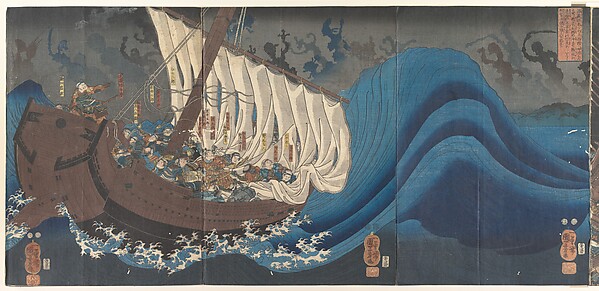
Utagawa Kuniyoshi · Ghosts of the Taira at Daimotsu Bay · 1849–52 · Triptych of woodblock prints (nishiki-e); ink and color on paper
Look closer: The wave is drawn in rows of blue curves; look at how the ship is set against it.
The Metropolitan Museum of Art, Gift of Harold de Raasloff, 1918, accession JP1115.2a–c. Public domain (Open Access).
Dan-no-ura is also a subject for artists. The print on this page, a nineteenth-century triptych by Utagawa Kuniyoshi at the Met, shows the ghosts of the Taira at a place called Daimotsu Bay; the museum’s title says as much. The drama is in the sea: a heavy blue wave rises beside a ship with a full sail.

Utagawa Kuniyoshi · The Great Battle of Yashima · ca. 1848 · Triptych of woodblock prints; ink and color on paper
Look closer: Warriors in armour stand on the decks; the same print series draws water as a character in the story.
The Metropolitan Museum of Art, Gift of Harold de Raasloff, 1918, accession JP1115.9a–c. Public domain (Open Access).
This is how the Edo period remembered a medieval war: not as a result but as a story. The artist did not stand where a soldier stood. He drew from the story, centuries after the event.
Two Fleets and the Wind
In 1274 and again in 1281 the Mongol empire sent fleets against Japan. Wikipedia’s account of the invasions puts the landings at Hakata Bay on the northern coast of Kyushu. After the first attempt the shogunate built a wall around the bay, a barrier that the article gives as about two metres high, begun in 1276. In both campaigns, the article records, typhoons played a part in the fate of the fleets.
For the samurai the victory was costly in a way the story rarely mentions. The campaigns were defensive, so there was no conquered land with which to pay the warriors who had fought. The article connects this to the strain on the shogunate’s retainers, the gokenin, and on the Hōjō. A victory with nothing to distribute can unsettle a regime as surely as a defeat.

Battle at Rokuhara, from The Tale of the Heiji Rebellion · first quarter 14th century · Fragment of a handscroll mounted as a hanging scroll; ink, color, and gold on paper
Look closer: The museum catalogues this fragment as a scene from the Tale of the Heiji Rebellion; look at the mounted figure in red.
The Metropolitan Museum of Art, Mary Griggs Burke Collection, Gift of the Mary and Jackson Burke Foundation, 2015, accession 2015.300.20. Public domain (Open Access).
Wikipedia also names a participant in the campaigns, the samurai Takezaki Suenaga, among the sources for what the defenders experienced.
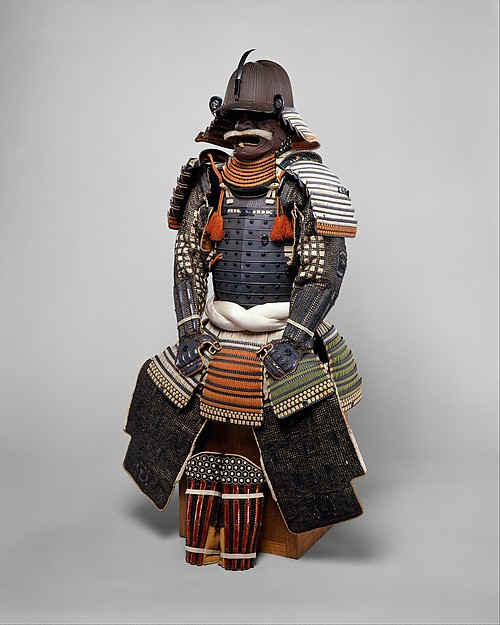
Bamen Tomotsugu · Armor (Gusoku) · 18th century · Iron, lacquer, copper-gold alloy (shakudō), silver, silk, horse hair, ivory
Look closer: By the Edo period armour had become heritage. This suit is an eighteenth-century work.
The Metropolitan Museum of Art, Gift of Etsuko O. Morris and John H. Morris Jr., in memory of Dr. Frederick M. Pedersen, 2001, accession 2001.642. Public domain (Open Access).
Nagashino and the Three Volleys
By the sixteenth century the matchlock had reached Japan; Wikipedia’s timeline dates its arrival to 1543. The battle that is always told as its triumph took place at Nagashino on 28 June 1575, when the combined forces of Oda Nobunaga and Tokugawa Ieyasu defeated Takeda Katsuyori. The Takeda cavalry, the story says, broke on three ranks of gunners firing in volleys.
The story is better than the evidence. Wikipedia’s account of the battle notes that the “three volleys” tactic is disputed among historians. This chapter will not choose a side; it records that the most famous detail of the most famous gun battle in Japan is one on which the scholars part company.

Tsukioka Yoshitoshi · Hideyoshi and His Troops Leaving Nagoya Camp (Mashiba Hideyoshi kō nagoya jin saki te no shoshō kuridashi no zu) · 19th century · Triptych of woodblock prints; ink and color on paper
Look closer: A Meiji-era artist draws a sixteenth-century departure; the banners are the point of the picture.
The Metropolitan Museum of Art, Bequest of William S. Lieberman, 2005, accession 2007.49.309. Public domain (Open Access).
What is not in doubt is that the victory was decisive for the Oda–Tokugawa side, and that it was not the end of the Takeda: the clan was not destroyed until 1582. Nagashino is a battle that mattered, and also a battle that grew in the telling. The reader who knows both the legend and the doubt is better placed to enjoy the many prints and paintings of it.
Sekigahara, 21 October 1600
If one day divides the country that was Sengoku from the country that was Edo, it is 21 October 1600. At Sekigahara, in the old province of Mino, two armies met, an Eastern force and a Western one, in the contest that decided who would govern Japan after Toyotomi Hideyoshi. Tokugawa Ieyasu won.
Almost everything else about the day is argued over. Wikipedia’s account says that historians disagree about when Kobayakawa Hideaki turned against the Western side, about when the fighting started, and about the numbers who died. The legend, in which the whole battle turns on a single defection, is as appealing as the Nagashino volleys and as contested.
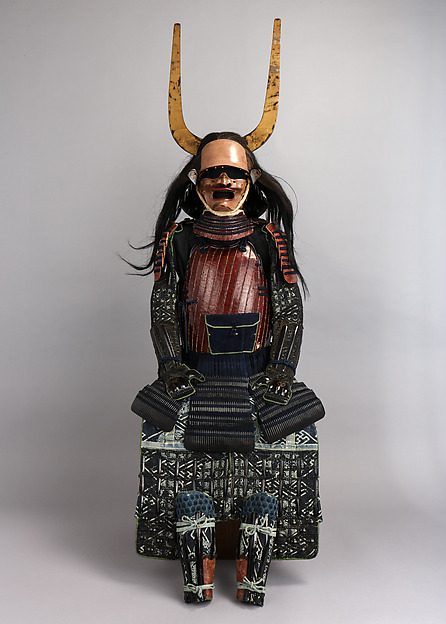
Armor (Nimai-Dō Gusoku) with Box · late 16th–early 17th century · Iron, leather, lacquer, textile, wood, yak hair, boar bristle, hemp
Look closer: The museum catalogues it as a nimai-dō gusoku, a suit with a two-piece cuirass.
The Metropolitan Museum of Art, Gift of Rosemarie and Leighton R. Longhi, in honor of John Carpenter, 2023, accession 2023.735.2a–n. Public domain (Open Access).
What followed is clearer. Wikipedia reports that about 6.8 million koku of land were redistributed to the victors, a measure of how completely the map was redrawn, and that Ieyasu was appointed shogun in 1603. A koku was a unit of rice, so the figure counts, in effect, a harvest’s worth of land.

Tsukioka Yoshitoshi · Masakiyo’s Challenging Battle, from Taiheiki (Chronicle of great peace) · 10th month of 1866 · Triptych of woodblock prints (nishiki-e); ink and color on paper
Look closer: Yoshitoshi draws a battle as a burst of lines. Compare the spears with the ordered ranks of the earlier prints.
The Metropolitan Museum of Art, Purchase, Friends of Asian Art Gifts, 2005, accession 2005.351a–c. Public domain (Open Access).
Osaka and the End of the Wars
The last campaigns were fought for a single castle. Wikipedia’s account of the siege of Osaka says there were two phases: a winter campaign from November 1614 to January 1615, and a summer campaign in May and June 1615. The winter campaign ended with the Genna Armistice, as the article calls it, and in the summer the Toyotomi forces were defeated. Sanada Yukimura died at Tennōji, in the fighting that summer.
The peace that followed had a legal form. The article ties the end of the war to a rule known as ikkoku ichijō, one castle to a domain, which limited the number of fortresses each lord could hold. A warrior class that had been formed by two centuries of war now lived under a regime that kept its fortresses few and its roads watched.

Utagawa Yoshitsuya · The Great Battle at Horikawa · 1847–52 · Triptych of woodblock prints (nishiki-e); ink and color on paper
Look closer: A later artist’s picture of an earlier fight; the composition runs the whole width of the sheet.
The Metropolitan Museum of Art, Gift of Harold de Raasloff, 1918, accession JP1115.13a–c. Public domain (Open Access).
The sword survived as a symbol and the armour as a ceremonial dress. Wikipedia reports that the last recorded use of samurai armour in war was in the Satsuma Rebellion of 1877, more than two hundred and sixty years after the fall of Osaka. The line between those two dates is the Edo period, and the best of its prints are a kind of memorial to what had come before it.
How Edo Remembered
By the time a Kuniyoshi triptych was printed, around 1848, Dan-no-ura was centuries in the past. The print was an act of recollection, and like all recollection it tidied things. Tall waves, bright colours and a clear centre made a battle readable at a glance, which an actual battle seldom was.
Dates as reported by Wikipedia’s articles on the Genpei War, the Mongol invasions, Nagashino, Sekigahara and Osaka, and the samurai timeline. Shown in order, not to scale.
Look closer: The Edo period begins in the gap between the last two dates on the bar.
Diagram by Japonista. Original drawing, no source image.
This is why a collector learns to read a battle print as a pair of documents. It says something about the event and something about the age that drew it. The best of them are visually bold and historically cautious, and they repay being looked at beside the written account, with the doubts of the historians held in mind.
The pieces in our shelves belong to the age of armour and the age of memory alike. An armour, a helmet and a print of an earlier war share a single idea: that the warrior’s name is worn, carried and drawn.
Armour and banners
Bamen Tomotsugu · Armor (Gusoku) · 18th century · Iron, lacquer, copper-gold alloy (shakudō), silver, silk, horse hair, ivory
Look closer: An eighteenth-century armour, made after the wars.
The Metropolitan Museum of Art, Gift of Etsuko O. Morris and John H. Morris Jr., in memory of Dr. Frederick M. Pedersen, 2001, accession 2001.642. Public domain (Open Access).
Armor (Nimai-Dō Gusoku) with Box · late 16th–early 17th century · Iron, leather, lacquer, textile, wood, yak hair, boar bristle, hemp
Look closer: Two gilt horns rise from the helmet; the body is a two-piece cuirass.
The Metropolitan Museum of Art, Gift of Rosemarie and Leighton R. Longhi, in honor of John Carpenter, 2023, accession 2023.735.2a–n. Public domain (Open Access).
Battle at Rokuhara, from The Tale of the Heiji Rebellion · first quarter 14th century · Fragment of a handscroll mounted as a hanging scroll; ink, color, and gold on paper
Look closer: A mounted warrior in red armour, in motion.
The Metropolitan Museum of Art, Mary Griggs Burke Collection, Gift of the Mary and Jackson Burke Foundation, 2015, accession 2015.300.20. Public domain (Open Access).
The Battle at Ichinotani, from The Tale of the Heike (Heike monogatari) · 17th century · One of a pair of six-panel folding screens; ink, color, gold, and gold leaf on paper
Look closer: Screens like this decorated a lord’s hall.
The Metropolitan Museum of Art, Rogers Fund, 1989, accession 1989.283. Public domain (Open Access).
Armour, Helmets and Heritage Pieces
The house’s samurai shelf keeps armour, helmets and fittings that carry the banners and crests this chapter describes. The concierge desk can advise on provenance, signatures and condition.
Answered plainly
Which colours did the Taira and Minamoto use?
Wikipedia’s account of the Genpei War gives red for the Taira and white for the Minamoto.
When did the Genpei War end?
With the sea battle of Dan-no-ura on 25 April 1185, according to Wikipedia. Minamoto no Yoritomo was named shogun in 1192.
Did three ranks of gunners really win at Nagashino?
Historians dispute it. Wikipedia’s article on the battle treats the “three volleys” tactic as disputed, so this chapter reports the doubt.
What happened after Sekigahara?
About 6.8 million koku of land were redistributed to the victors, and Tokugawa Ieyasu was appointed shogun in 1603, according to Wikipedia.
What was ikkoku ichijō?
A rule of one castle to a domain, which Wikipedia associates with the end of the wars after the siege of Osaka.
When was samurai armour last used in war?
Wikipedia gives the Satsuma Rebellion of 1877 as the last recorded use.
Where next
Sources and image credits
- Samurai, Wikipedia
- Genpei War, Wikipedia
- Mongol invasions of Japan, Wikipedia
- Battle of Nagashino, Wikipedia
- Battle of Sekigahara, Wikipedia
- Siege of Osaka, Wikipedia
- Metropolitan Museum of Art Open Access
- Image: The Battle of Yashima, from The Tale of the Heike (Heike monogatari), Tosa School (Public domain (Met Open Access))
- Image: The Battle at Ichinotani, from The Tale of the Heike (Heike monogatari), Unknown maker (Public domain (Met Open Access))
- Image: Ghosts of the Taira at Daimotsu Bay, Utagawa Kuniyoshi (Public domain (Met Open Access))
- Image: The Great Battle of Yashima, Utagawa Kuniyoshi (Public domain (Met Open Access))
- Image: Battle at Rokuhara, from The Tale of the Heiji Rebellion, Unknown maker (Public domain (Met Open Access))
- Image: Armor (Gusoku), Bamen Tomotsugu (Public domain (Met Open Access))
- Image: Hideyoshi and His Troops Leaving Nagoya Camp (Mashiba Hideyoshi kō nagoya jin saki te no shoshō kuridashi no zu), Tsukioka Yoshitoshi (Public domain (Met Open Access))
- Image: Armor (Nimai-Dō Gusoku) with Box, Unknown maker (Public domain (Met Open Access))
- Image: Masakiyo’s Challenging Battle, from Taiheiki (Chronicle of great peace), Tsukioka Yoshitoshi (Public domain (Met Open Access))
- Image: The Great Battle at Horikawa, Utagawa Yoshitsuya (Public domain (Met Open Access))
Last reviewed 28 October 2026. Pictures are public-domain or openly licensed and credited beneath each one; diagrams are drawn by Japonista.
Looking for armour or a helmet that carries a crest or a documented line? The concierge desk replies within one to three business days.
Private concierge
Looking for something in particular?
Describe the piece or the project you have in mind. A senior advisor in Tokyo reads every case file personally and replies within two business days, with fees set out in writing before any work begins.