
Kabuto and Menpō: The Helmet and the Face | Japonista
Heritage Wing · Iron and Expression
Kabuto and Menpō: The Helmet and the Face
兜と面頰
The helmet was the part of the warrior that others saw first, and the mask was the part they were meant never to forget. Between them they carried a rank, a lineage, a sense of humour and sometimes a threat.
Fact sheet
At a glance
- A bowl of plates. The dome is built from riveted plates; how the rivet heads are finished names the type.
- A mask that anchors. Posts and hooks on the mask held the helmet’s chin cord, so the two pieces worked as one.
- A taste for the strange. From the sixteenth century armourers made helmets shaped as waves, masks of goblins and crests of antlers.
- A revival. In the peaceful Edo period, makers copied thirteenth-century helmets for display and parade.
Plates, Rivets and Ridges
Pick up a samurai helmet, if a museum will let you, and the first surprise is how quiet it is. There is no single piece of metal. Wikipedia’s article on the kabuto says the dome, the hachi, is built of overlapping elongated plates, from three to more than a hundred, riveted together and radiating from a small opening at the top, the tehen. That opening was once thought to be for the warrior’s topknot, a practice the article says was largely abandoned after the Muromachi period, and it is also called hachimanza, the “seat” of the war god Hachiman. A cloth lining, a peak at the brow, mabizashi, and a hanging neck guard, shikoro, usually of three to seven lacquered lames, complete the piece. At the sides the guard turns outward in the wing-like fukigaeshi.
How the rivets are finished gives the helmet its type. The same article distinguishes hoshi-bachi, “star” helmets, with the rivet heads left raised; suji-bachi, “ridged” helmets, with the rivets hammered flat so that raised ridges mark the seams; and hari-bachi, with the rivets filed flush. The Met’s catalogue gives an exact example. A helmet of the late fifteenth or sixteenth century in the museum is a suji-kabuto whose bowl is built from 52 ridged plates, in the form called akoda-nari, after a squash-like fruit, that the museum says was fashionable in the Muromachi period. It was remounted for use in the late 1600s or early 1700s; its bowl carries a character associated with the Haruta school of armourers in Nara, and the badge on the neck guard belongs to the Sanada family, lords of Ueda.

Helmet (Suji-kabuto Akoda-nari) · late 15th–16th century · Iron, lacquer, copper, gold, silk
Look closer: Count the ridges that run from the crown to the brow: the museum counts 52 plates.
The Metropolitan Museum of Art, Rogers Fund, 1913, accession 13.112.10. Public domain (Open Access).
Another ridged helmet in the Met, of the eighteenth century, is catalogued as worn by upper-class samurai from the Muromachi period onward, and has its ridges covered in brass, which the museum calls an uncommon decoration.

Helmet (Suji-Kabuto) · 18th century · Iron, copper, gold, lacquer, silk, wood
Look closer: The brass over the ridges is the unusual detail; the ridges themselves are the plate seams.
The Metropolitan Museum of Art, Gift of Etsuko O. Morris and John H. Morris Jr., 2018, accession 2018.833.12a–f. Public domain (Open Access).
Helmets from the Burial Mounds
The oldest helmets in this chapter were not made for the lacquered world of the samurai. Wikipedia’s account says that helmets of the Kofun period, in the fifth century, have been recovered from excavated tombs; they are known as mabizashi-tsuke kabuto, helmets with an attached visor, and their style came from China and Korea. The Met holds two. One, of iron, is dated probably to the fifth or sixth century and was excavated from a burial mound at Kobayashi in what is now Nara Prefecture; it went from the Tokyo Imperial Museum to the Met in 1906, in the exchange that Bashford Dean arranged. The other, of bronze, is dated probably to the eighth century and is attributed to Saitama Prefecture.

Helmet (Shokakutsuki Kabuto) · probably ca. 5th–6th century · Iron
Look closer: This helmet was excavated from a burial mound; compare its plain dome with the elaborate helmets later in the chapter.
The Metropolitan Museum of Art, Gift of Bashford Dean, by exchange, 1906, accession 06.310.1. Public domain (Open Access).
Between those and the great helmets of the Genpei War lies a gap in what the sources tell us, and we will not fill it with guesses. What Wikipedia does say is that kabuto as we know them appeared in the tenth century with the great armour, made until the early Muromachi period from dozens of thin iron plates, and that only daimyo and commanders at first wore the large front crests in the shape of a hoe.

Helmet (Shokakutsuki Kabuto) · probably ca. 8th century · Bronze
Look closer: A bronze helmet: the metal itself is a clue to date and purpose.
The Metropolitan Museum of Art, Rogers Fund, 1917, accession 17.229.5. Public domain (Open Access).
The Past Worn Again
In the sixteenth century the old great armour and its helmets became obsolete. Wikipedia’s article links the change to the arrival of the matchlock in the Sengoku period, when iron-plate helmets for tōsei-gusoku replaced them and crests grew larger and stranger. In the Edo period, after the Siege of Osaka brought peace, the pendulum swung back: medieval styles were revived.
The Met shows what that looked like. One of its helmets, of the late seventeenth or early eighteenth century, is catalogued as a hoshi kabuto that follows thirteenth-century design and was made to be worn with a medieval-style yoroi; its fittings carry the badge of the Hota family, daimyo of Sakura. It is a copy, but a respectful one, made in an age that wanted its ancestors visible.
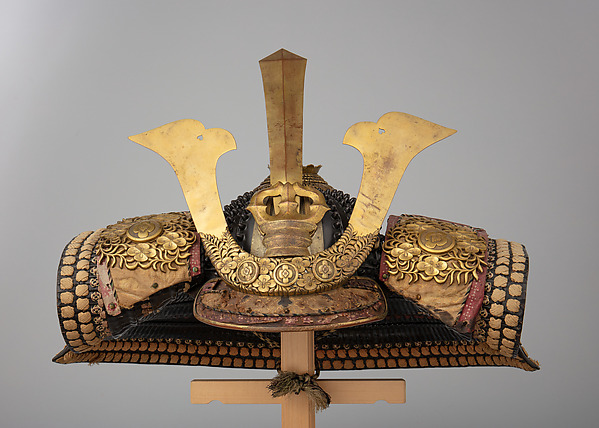
Helmet (Hoshi Kabuto) and Mask with Gorget · late 17th or early 18th century · Iron, lacquer, gilt copper, leather, silk
Look closer: This is a revival: a seventeenth-century helmet that imitates a thirteenth-century form.
The Metropolitan Museum of Art, Rogers Fund, 1917, accession 17.221.18–.19. Public domain (Open Access).
The real medieval article is in the same museum: the mid-fourteenth-century helmet long associated with the armour of Ashikaga Takauji, which weighs 5.56 kilograms and, the museum says, belongs to a rare medieval yoroi. The gap in age between the two, perhaps three centuries, is a lesson in reading a helmet by its rivets, its neck guard and its crest rather than by its look of antiquity.
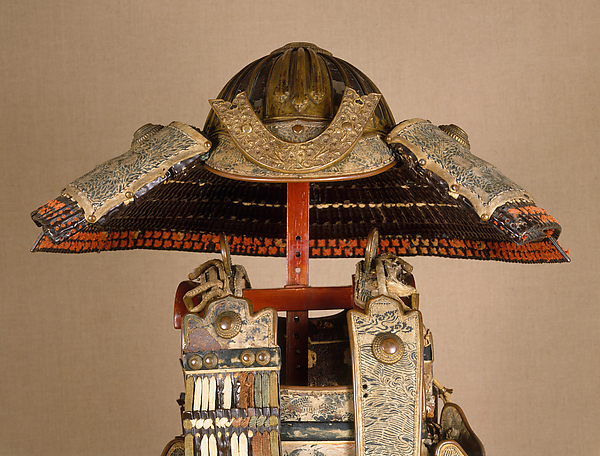
Helmet of Ashikaga Takauji (1305–1358) · mid-14th century · Iron, lacquer, leather, silk, gilt copper
Look closer: Compare the width of the neck guard with the later helmets: the medieval shikoro spreads like a skirt.
The Metropolitan Museum of Art, Gift of Bashford Dean, 1914, accession 14.100.121a. Public domain (Open Access).
Waves, Goblins and Antlers
Then there are the helmets that make a visitor laugh and, after a moment, stop laughing. The Met’s catalogue explains the kawari-kabuto, or “exotic helmet”: it became popular in the sixteenth century, in the late Muromachi period, and these helmets likely helped elite soldiers to be recognised on crowded, smoky battlefields, so that commanders could tell ally from enemy. They also expressed taste and rank in processions and state receptions. Samurai often chose bold, symbolic designs from nature. One example in the Met has an iron bowl and a dramatic peak, made of leather, shaped like a cresting wave; the Hikone Castle Museum, which keeps a related helmet with wave-shaped ornament, says the cresting waves were intended to convey power and strength, and that the helmet is thought to have been worn by Andō Shigenori, who died in 1684.

Hiromichi Miura · Helmet (Kawari-Kabuto) in the Shape of a Wave · 17th century; restorations, 2015 · Iron, textile, lacquer, copper, gold, leather, silk, wood
Look closer: The peak is leather, shaped like a wave about to break; the gilt badge repeats the wave motif.
The Metropolitan Museum of Art, Gift of Etsuko O. Morris and John H. Morris Jr., 2018, accession 2018.833.8a, b. Public domain (Open Access).
Others are stranger. A nineteenth-century iron helmet at the Met has a face of a tengu, the mischievous mountain spirit, with a beaked mouth and embossed crows to each side; the museum notes that from the sixteenth century armourers made eccentrically shaped helmets, sometimes of papier-mâché mixed with lacquer, or, as here, wholly of iron, often drawing on mythology. Wikipedia’s kabuto article adds that harikake helmets, an iron bowl with a papier-mâché and lacquer shell over a wooden form, took fantastic shapes in the Azuchi-Momoyama period, and that in the Edo period the form flourished in materials from lacquer to leather, wood, gesso and bone.

Exotic Helmet with Tengu Mask and Crows · 19th century · Iron
Look closer: The beak is the tengu’s, the horns and wings frame it; the metal is iron throughout.
The Metropolitan Museum of Art, Bequest of George C. Stone, 1935, accession 36.25.133a–d. Public domain (Open Access).
The most famous crest of all is a pair of antlers. Wikipedia’s article on Honda Tadakatsu, who lived from 1548 to 1610, describes his black-lacquered helmet with large side crests in the shape of deer antlers, and a black-lacquered armour with a two-piece body joined by iron hinges. The article calls him a samurai of exceptional reputation and says he took part in fifty-seven or more campaigns; it words his record of wounds in two ways, never wounded at all and never significantly wounded, so we pass on only the reputation, not the claim.
The Face Behind the Iron
A helmet is a hat until it has a face under it. Wikipedia’s article on the menpō and its relatives sorts face armour into types by how much it covers. The sōmen covers the entire face; the menpō in the narrower sense covers from the nose down to the chin; the hanbō covers the lower face from under the nose and is dated by the article to the second half of the sixteenth century; the happuri covers forehead and cheeks and may go back to the tenth or eleventh century; and the hōate was in use by the fourteenth century, though historians disagree on how widely, and it restricted the wearer’s sight.
The purpose is practical first. The article says the mask protected the face and, importantly, secured the top-heavy helmet: the helmet’s chin cord ran to small posts and hooks, odome and ori-kugi, on the mask. The mask also carried a small drainage hole beneath the chin for sweat and a throat guard, yodare-kake, and often a detachable nose. The Met’s catalogue adds the cultural side: masks mattered in religious ceremony, dance, Noh theatre and military dress; most surviving half masks, it says, are of iron finished in lacquer or dark russet with red-lacquered interiors, and from the Edo period armourers of the Myōchin clan, among others, showed their ingenuity and skill in increasingly varied designs.

Half Mask (Menpō) · 15th–16th century · Iron, lacquer
Look closer: The small posts at the cheek are where the helmet’s cord ties on.
The Metropolitan Museum of Art, Bequest of George C. Stone, 1935, accession 36.25.321. Public domain (Open Access).
The expressions are the point. A moustache and fierce teeth were part of the vocabulary, according to Wikipedia, and the Met’s holdings run from stern old men with horsehair beards to demons with gilt eyes. They were made to be looked at across a field and from a gallery rail. Look at two of them side by side and you will begin to see the Noh stage under the iron.
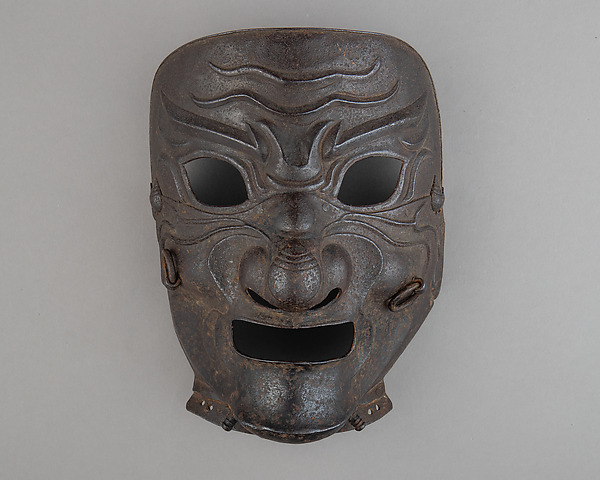
Full Mask (Sōmen) · 17th century · Iron, lacquer
Look closer: Iron made to look like a face aged by anger; the wrinkles are hammered.
The Metropolitan Museum of Art, Bequest of George C. Stone, 1935, accession 36.25.328. Public domain (Open Access).
Faces and crowns

Mask (Sōmen) · possibly 15th century · Iron, lacquer, hair, textile (silk)
Look closer: Real horsehair gives the beard; a face like this belongs to the old-man characters of the stage.
The Metropolitan Museum of Art, Gift of Bashford Dean, 1914, accession 14.100.33. Public domain (Open Access).
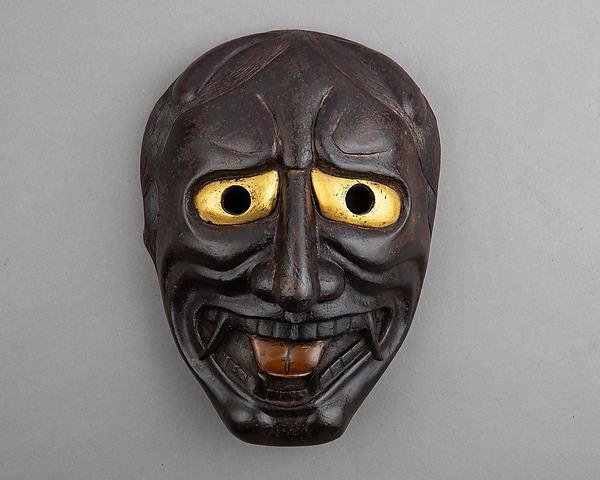
Mask (Sōmen) · 18th century · Lacquered iron, copper, gold
Look closer: The gilt eyes and fangs are the demon’s; compare the restrained iron masks beside it.
The Metropolitan Museum of Art, Gift of Giles Whiting, 1920, accession 20.32. Public domain (Open Access).
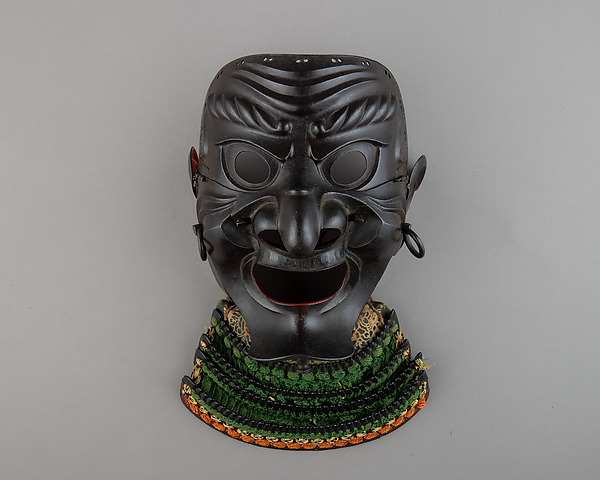
Full Mask (Sōmen) with Gorget · 18th century · Iron, leather, lacquer, silk
Look closer: The gorget below the chin is the yodare-kake, the throat guard.
The Metropolitan Museum of Art, Bequest of George C. Stone, 1935, accession 36.25.266a–c. Public domain (Open Access).
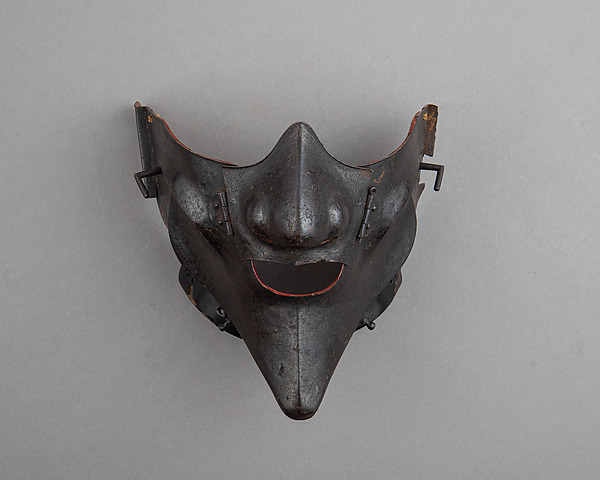
Half Mask (Menpō) · 17th century · Iron, lacquer
Look closer: Half masks end at the nose; the iron here is thin and finished with a lacquered interior.
The Metropolitan Museum of Art, Gift of Bashford Dean, 1915, accession 15.11.1. Public domain (Open Access).
Helmets and Masks
The house’s samurai shelf holds helmets and face masks; its Noh-mask shelf is a quiet companion to the iron faces above. The concierge desk can advise on a piece’s parts, signatures and condition.
Answered plainly
What is the difference between a kabuto and a menpō?
The kabuto is the helmet; the menpō is face armour worn beneath it. Wikipedia says the mask protected the face and held the helmet’s chin cord.
What is a kawari-kabuto?
An exotic or eccentric helmet, popular from the sixteenth century. The Met says it helped elite soldiers be recognised on crowded, smoky battlefields and expressed taste and rank.
What do suji, hoshi and hari mean?
They describe how the rivets are finished. Hoshi means raised “star” rivets, suji means flattened rivets with raised ridges at the seams, and hari means rivets filed flush, according to Wikipedia’s kabuto article.
How many plates does a helmet have?
Wikipedia gives a range of three to over a hundred. The Met counts 52 ridged plates in one of its suji-kabuto.
Who wore antler crests?
Wikipedia’s article on Honda Tadakatsu describes his helmet with large deer-antler-shaped side crests, in black lacquer.
Is a helmet always the same age as its armour?
Not necessarily. The Met catalogues helmets and bodies separately, with different dates; one of its helmets was remounted a few centuries after it was made.
Where next
Sources and image credits
- Kabuto, Wikipedia
- Men-yoroi (menpō), Wikipedia
- Honda Tadakatsu, Wikipedia
- Helmet (Kawari-Kabuto) in the Shape of a Wave, The Metropolitan Museum of Art
- Exotic Helmet with Tengu Mask and Crows, The Metropolitan Museum of Art
- Helmet (Suji-kabuto Akoda-nari), The Metropolitan Museum of Art
- Helmet of Ashikaga Takauji, The Metropolitan Museum of Art
- Half Mask (Menpō), The Metropolitan Museum of Art
- Helmet with Wave-Shaped Ornament, Hikone Castle Museum
- Image: Helmet (Suji-Kabuto), Unknown maker (Public domain (Met Open Access))
- Image: Helmet (Shokakutsuki Kabuto), Unknown maker (Public domain (Met Open Access))
- Image: Helmet (Shokakutsuki Kabuto), Unknown maker (Public domain (Met Open Access))
- Image: Helmet (Hoshi Kabuto) and Mask with Gorget, Unknown maker (Public domain (Met Open Access))
- Image: Full Mask (Sōmen), Unknown maker (Public domain (Met Open Access))
- Image: Mask (Sōmen), Unknown maker (Public domain (Met Open Access))
- Image: Mask (Sōmen), Unknown maker (Public domain (Met Open Access))
- Image: Full Mask (Sōmen) with Gorget, Unknown maker (Public domain (Met Open Access))
- Image: Half Mask (Menpō), Unknown maker (Public domain (Met Open Access))
Last reviewed 28 October 2026. Pictures are public-domain or openly licensed and credited beneath each one; diagrams are drawn by Japonista.
Looking for a helmet or a face mask with signature, crest or remounting documented? The concierge desk replies within one to three business days.
Private concierge
Looking for something in particular?
Describe the piece or the project you have in mind. A senior advisor in Tokyo reads every case file personally and replies within two business days, with fees set out in writing before any work begins.