
Netsuke, Inrō and Sagemono: The Hanging Objects
Accessories · Carried at the sash
Netsuke, Inrō and Sagemono: The Hanging Objects
根付・印籠・提物
The kimono has no pockets, so a man hung what he carried from his sash. A small carved toggle held the cord, a stack of lacquered boxes held the medicine, and a bead kept the whole thing closed.
Fact sheet
The hanging set in one glance
- Sagemono. Anything hung from the sash: pouch, basket, pipe case or inrō.
- Netsuke. The toggle at the top of the cord, hooked over the obi.
- Ojime. The bead on the cords that locks the inrō cases together.
- Inrō. A stack of tiny nested boxes, most often for medicine.
- Maki-e. Gold and silver powder sprinkled onto wet lacquer.
A pocket made of cord
Wikipedia explains the whole system from a single fact: traditional Japanese garments, the kosode and later the kimono, had no pockets. Men therefore carried their pipes, tobacco, money and seals in sagemono, which could be pouches, woven baskets or boxes, hung from the sash. The article on netsuke defines netsuke as tiny carved objects that began in seventeenth-century Japan as simple toggles and later became elaborate art, and relates the name to two characters, ne, ‘base’, and tsuke, ‘attached’. The netsuke was the carved toggle at the top of the cord, passed between sash and clothing, that held everything in place.

Shibata Zeshin, Case (Inrō) with Fox Wedding Procession, 19th century, Colored lacquer and gold maki-e on wood Netsuke: ivory in form of fox reclining on large leaf; Ojima: gold bead; connecting cord, dark green silk Inro with netsuke and ojime. The Metropolitan Museum of Art, Rogers Fund, 1957, accession 57.53.
Look closer: Look for the set rather than the case. The Met records an ivory netsuke in the form of a fox reclining on a leaf, a gold bead for ojime and a green silk cord.
Image: The Metropolitan Museum of Art, Open Access (CC0)
The inrō entry describes the commonest of the hung boxes. An inrō is a case for small objects, the name combining the characters for ‘seal’ or ‘stamp’ and ‘basket’. The entry places its invention in the Sengoku period, 1467 to 1615, as a portable identity seal and medicine container for travel, and says that in the mid-Edo period inrō became popular men’s accessories, collected by wealthy townsmen and samurai and often lacquered. The cases are a stack of tiny nested boxes, most commonly used to carry medicine. A cord runs through the cases, and a bead, the ojime, slides down to hold the boxes together while worn and up towards the netsuke to release them.
The Metropolitan Museum’s inrō show the range of makers’ ambition. One of the nineteenth century carries a fox-wedding procession in coloured lacquer and gold maki-e on wood, attributed by the museum to the style of Shibata Zeshin, with a reclining fox of ivory for netsuke, a gold bead for ojime and a dark green silk cord, and measures 7.7 centimetres high. Another, of the mid-nineteenth century, is a basketry inrō of bamboo and rattan, with a marbled ceramic bead and a lacquered wooden netsuke decorated with mandarin ducks in gold and silver hiramaki-e.
From toggle to treasure
The netsuke entry gives a compact social history. Edo, 1603 to 1867, was the peak of production. Ivory was the most common material until the trade in live-animal ivory became illegal, and mammoth ivory is used today; boxwood and other hardwoods were popular in the Edo period and are still used, and other materials include metal, bamboo, lacquer, agate and tagua nut. The entry lists six main types: katabori, the compact three-dimensional figure and the most common; manjū, thick, flat and round, with relief carving; ryūsa, manjū-shaped pieces carved so that light passes through; sashi, elongated katabori of about 150 millimetres; kagamibuta, manjū-shaped with a metal disc lid over a shallow bowl; and masks, the largest category after katabori, often imitating Noh masks.

Basketry Inrō, mid-19th century, Inrō: single case; bamboo, rattan; ojime: marbled ceramic bead; netsuke: lacquer box with mandarin ducks; lacquered wood with gold and silver hiramaki-e. The Metropolitan Museum of Art, Edward C. Moore Collection, Bequest of Edward C. Moore, 1891, accession 91.1.2114.
Look closer: Look at the case. The Met gives bamboo and rattan for the basketry, a marbled ceramic bead for the ojime and a lacquered wooden netsuke of mandarin ducks.
Image: The Metropolitan Museum of Art, Open Access (CC0)
Carvers are called netsuke-shi, and the entry notes that the Sōken Kishō, published in Osaka in 1781 by Inaba Tsūryū, is the earliest compilation of them, naming over fifty masters. It names Tametaka as the founder of the Nagoya school, followed there by Ikkan, and Seiōdō Tomiharu, 1733 to 1810, as the founder of the Iwami school. The Met’s eighteenth-century netsuke of wood, 4.4 by 4.8 centimetres, is catalogued without a maker.
The end of everyday use came with the Meiji period. Netsuke and inrō declined as clothing became westernised, the entry says, and the interest of foreign collectors meant that many of the finest collections are now outside Japan. Go Seinosuke, 1865 to 1942, donated 274 pieces to the Tokyo National Museum out of concern that too many netsuke were leaving Japan. Edmund de Waal’s memoir The Hare with Amber Eyes of 2010 follows a collection of 264 netsuke. The inrō entry adds that because foreign collectors bought many, few of the highest-quality inrō were made from the end of the Edo period to the Meiji period.
A related object is the tobacco pouch. The Met holds a lacquer tobacco pouch of 1850 to 1880. A pouch is a sagemono too, hung from the sash on the same principle as the inrō, and the sources above list pipes and tobacco among the things a man carried this way. The Kyoto Seishu Netsuke Art Museum, the netsuke entry adds, holds over five thousand netsuke, a measure of how large the field became.
Lacquer, paper and the sliding bead
The inrō entry names the materials. Paper was the commonest: layers of washi were wound and hardened with lacquer. Wood, metal and ivory were also used. Inrō are decorated with lacquer designs, and expensive examples feature maki-e, raden, which is mother-of-pearl inlay, ivory inlay and metal foiling. The Met’s inrō of the first half of the nineteenth century with floating fans is of lacquered wood decorated in togidashi-maki-e and hiramaki-e in gold and silver, with a lacquer ojime and an ivory netsuke of Shōki, the Demon Queller.
A reader studying a description should keep three tests in mind. The first is that the three parts, inrō, ojime and netsuke, are separate objects, and the museum’s own records list them separately: the fox-wedding set has an ivory netsuke and a gold bead, the basketry set a ceramic bead and a lacquered netsuke, the floating-fans set a lacquer bead and an ivory netsuke. A set whose parts differ in material is therefore not unusual in itself. The second is the cord, which carries the whole assembly and should be sound. The third is the decoration of the case, which on the Met’s pages is recorded as gold and silver maki-e in several techniques.
Ojime are small objects in their own right. The Met holds ojime in several materials, among them a blue-and-white porcelain bead of the nineteenth century, 1.5 centimetres across. The entry on inrō says that the ojime slides to lock and release the cases, which is the whole of its function, and the beauty of its form is a bonus.
A final practical point concerns ivory. The netsuke entry says ivory was the most common material until the trade in live-animal ivory became illegal. A reader who intends to buy, sell or move an ivory netsuke should take advice on the rules in the relevant country, and the concierge desk can advise on a particular piece. The wider group of hung objects, from the pouch to the pipe case, is gathered in the house’s Netsuke and Sagemono collection, with a glossary in the netsuke terms.
| Netsuke type | Form | Note from the sources |
|---|---|---|
| Katabori | Compact three-dimensional figure | The most common type |
| Manjū | Thick, flat, round, relief carved | Relief carving |
| Ryūsa | Manjū-shaped, carved through | Light passes through the carving |
| Sashi | Elongated katabori | About 150 mm long |
| Kagamibuta | Manjū with metal disc lid over a shallow bowl | A bowl-and-lid form |
| Mask | Often imitates Noh masks | Largest category after katabori |
Medicine, status and the sumo referee
The inrō was never only decoration. The entry stresses its original use as a portable identity seal and medicine container for travel. The nested cases made it a compact apothecary, and that practical origin sits beside the luxury of maki-e: the same object carried a traveller’s medicine and displayed a maker’s skill.
A curious survival is noted by the entry: inrō are rarely worn with kimono today, but higher-ranking sumo referees, the gyōji, are still allowed to equip them. The same entry records that in 1985 the lacquer craftsman Tatsuo Kitamura founded the studio Unryuan and recreated the late Edo to Meiji lacquer techniques, which had nearly been lost, and that the Kiyomizu Sannenzaka Museum, managed by the collector Masayuki Murata, houses many fine inrō.
For the reader of this almanac the sagemono complete a picture begun in Obi and Its Companions: Scarf, Cord and Brooch, where the sash and its fittings are described, and in Geta, Zōri and Tabi: The Footwear of the Kimono, which completes the dressed figure from the ground up. The hanging objects also link to the world of the stage through the Noh mask netsuke described above, a subject treated in Noh Costume: Karaori, Atsuita and Mizugoromo.
Within the house, the shelf strip below shows an Edo gold maki-e inrō, a Kajikawa-school inrō with ojime and netsuke, and carved netsuke of the Meiji period. The concierge desk can look for a particular subject or school on request.
Fans, wood and lacquer
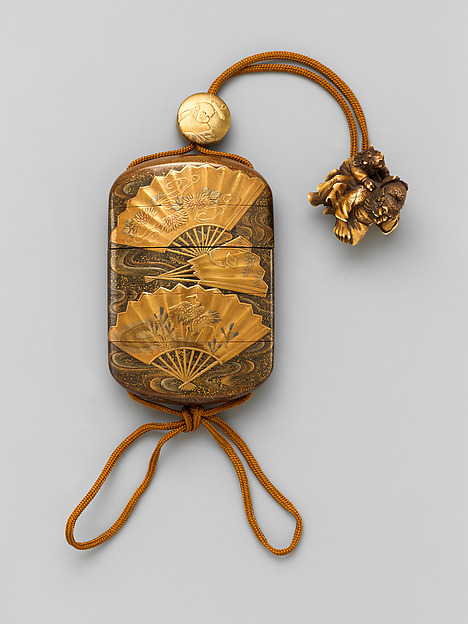
Inrō with floating fans, first half 19th century, Lacquered wood with gold and silver togidashimaki-e and hiramaki-e Ojime: lacquer bead with maki-e decoration Netsuke: ivory toggle of Shōki, the Demon Queller. The Metropolitan Museum of Art, Rogers Fund, 1913, accession 13.67.47.
Look closer: Find the fans on the lacquer. The Met names the techniques and records an ivory netsuke of Shōki, the Demon Queller.
Image: The Metropolitan Museum of Art, Open Access (CC0)

Netsuke, 18th century, Wood. The Metropolitan Museum of Art, Gift of Mrs. Russell Sage, 1910, accession 10.211.2273.
Look closer: Note the size. The Met gives 4.4 by 4.8 centimetres and a date in the Edo period, with no maker named.
Image: The Metropolitan Museum of Art, Open Access (CC0)

Tobacco Pouch, 1850–80, Lacquer. The Metropolitan Museum of Art, Edward C. Moore Collection, Bequest of Edward C. Moore, 1891, accession 91.1.722.
Look closer: Compare this with the inrō. The Met records lacquer and a date of 1850 to 1880, a pouch rather than a stack of cases.
Image: The Metropolitan Museum of Art, Open Access (CC0)

Ojime, 19th century, Blue-and-white porcelain bead. The Metropolitan Museum of Art, Bequest of Stephen Whitney Phoenix, 1881, accession 81.1.424.88.
Look closer: Look at the bead. The Met gives 1.5 centimetres across, and a material of blue-and-white porcelain.
Image: The Metropolitan Museum of Art, Open Access (CC0)
Hanging objects in the house
The shelf holds Meiji carved netsuke and Edo maki-e inrō, among them a Kajikawa-school piece with its ojime and netsuke. Each is described as what it is, with its age and condition set out plainly on its own page.


Netsuke and sagemono
Netsuke, inrō and the other hung objects are gathered in one collection, and the concierge desk can look for a subject, school or material on request.
Answered plainly
What is a netsuke?
A small carved toggle at the top of the cord, hooked over the sash to hold a hanging object such as an inrō or pouch.
Why were they needed?
Because the kosode and the kimono have no pockets, so men hung their belongings from the obi.
What is an inrō?
A stack of small nested cases, usually lacquered, hung from the sash, most commonly used for medicine.
What does the ojime do?
It is a bead on the cords that slides down to hold the cases together and up to release them.
What are netsuke made of?
Ivory was the commonest material until the trade became illegal; boxwood and other hardwoods, metal, bamboo, lacquer, agate and tagua nut are also used.
Does anyone still wear an inrō?
Rarely. Higher-ranking sumo referees are still allowed to equip them.
Where next
Sources and image credits
- Netsuke, Wikipedia
- Inrō, Wikipedia
- Case (Inrō) with Fox Wedding Procession, Metropolitan Museum of Art, 57.53
- Inrō with Floating Fans, Metropolitan Museum of Art, 13.67.47
- Basketry Inrō, Metropolitan Museum of Art, 91.1.2114
- Tobacco Pouch, Metropolitan Museum of Art, 91.1.722
- Object record: Netsuke, The Metropolitan Museum of Art
- Object record: Ojime, The Metropolitan Museum of Art
Last reviewed 28 October 2026. Pictures, where shown, are public-domain or open-access and credited beneath each one.
Looking for a netsuke, an inrō or a hanging object you have seen described here? The concierge desk replies within one to three business days.
Private concierge
Looking for something in particular?
Describe the piece or the project you have in mind. A senior advisor in Tokyo reads every case file personally and replies within two business days, with fees set out in writing before any work begins.