
Hanamatsuri and the Buddha's Birthday
Kanbutsu-e · Eighth of April
Hanamatsuri and the Buddha's Birthday
花まつり
On the eighth of April, in temple courtyards across Japan, a small gilded figure of a newborn child stands in a shallow basin under a canopy of flowers, one finger raised to heaven and one pointing to the earth. Visitors take a bamboo ladle and pour sweet hydrangea tea over his head. It is Hanamatsuri, the Flower Festival, and its older and more exact name is Kanbutsu-e, the bathing of the Buddha. Its bath is a re-enactment of a birth that the sutras tell with dragons and flowers, and the whole festival fits into a single gesture of the hand.123
Fact sheet
Five things to notice
- The bath. The infant Buddha is bathed with amacha, a sweet tea made from hydrangea leaves, poured with a bamboo ladle.123
- The flowers. The figure stands in a small flower-covered shrine, the hanamidō, which gives the festival its popular name.23
- The gesture. The child points one hand to heaven and one to earth, and the verse he speaks is Tenjō tenge yuiga dokuson.5
- The dragons. The bath is traced to a legend in which dragon kings, or a nine-headed dragon, pour water on the newborn.23
- The name. Hanamatsuri is a twentieth-century name; the older term is Kanbutsu-e.234
The Festival of Flowers and Bathing
First lookHanamatsuri is the Japanese celebration of the birth of the historical Buddha. The English Wikipedia article on Buddha's Birthday gives it as 8 April and notes that it is not a national holiday in Japan.1 The Kanpai Japan guide describes the day as the one on which most temples celebrate the birth of Shakyamuni.3

Hana-Matsuri, Sensō-ji, Asakusa, Tokyo; photograph by Maarten Heerlien
Look closer: The Commons description calls this a children's ceremony held every year on 8 April at Sensō-ji, with the white paper elephant visible far in the back as it is pulled along Nakamise-dōri. Look for the shrine in the foreground and the elephant in the distance.
Photograph: Maarten Heerlien from Voorschoten, The Netherlands. CC BY 2.0, with attribution. Source: Wikimedia Commons. CC BY 2.0 File record

The festival has two kinds of name. Kanbutsu-e, written 灌仏会, is the religious term, and the Kanpai Japan page glosses it as the Buddha bathing party. The Wikipedia article lists several more temple names for the same observance: Gōtan-e, Busshō-e, Yokubutsu-e, Ryūge-e and Hana-eshiki.13 Hanamatsuri, the Flower Festival, is the popular name, and a section below traces how it arrived.
At its simplest the day involves a statue, a basin, a ladle and a drink. The japanese-culture.info site says that believers visit temples and pour amacha, a slightly sweet tea, over a statue of the newborn Buddha that sits in a basin, and that Japanese people often call Buddha o-shaka-sama out of respect.2 The English Wikipedia article says the tea is made from Hydrangea serrata and is poured over small Buddha statues decorated with flowers, as if bathing a newborn baby.1
Dragons Over a Newborn
The connoisseur's eyeThe bath belongs to the birth story. In the account summarised in the English Wikipedia article on the Tōdai-ji statue, Māyā gave birth in the Lumbinī gardens and the Buddha emerged from her right side. The same article adds that the Lalitavistara says two nāga, Nanda and Upananda, bathed the infant.5
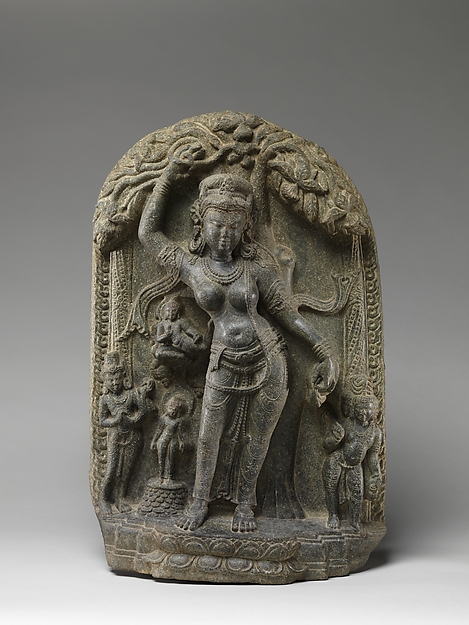
India (Madhya Pradesh or Bihar) · Pala period · 11th century · Black stone
Look closer: The Metropolitan Museum describes the scene: Queen Maya reaches up to grasp a branch as the Buddha is born, and the newborn appears a second time, standing on flower petals as he receives his first bath. It is the same bath that Hanamatsuri repeats.
The Metropolitan Museum of Art, New York, Purchase, Gift of Dr. Mortimer D. Sackler, Theresa Sackler and Family, and Joseph Pulitzer Bequest, 2007, accession 2007.305. Public domain, Met Open Access. Museum record
Other versions in the sources name different bathers. The Kanpai Japan guide says that Shakyamuni was purified by a sweet rain triggered by eight great dragon kings, or by the nine-headed dragon Kuzuryu, depending on the version. It adds that he was born in a field of flowers, which is why flowers honour him, and that a white elephant appeared in his mother's dream at the conception, so the animal is often represented at temples on the day.3 The japanese-culture.info site gives a single dragon in the heavens pouring perfumed warm water over the newborn, and says that some temples place imitation white elephants on their grounds.2
The Japanese Wikipedia article on Kanbutsu-e gives a count of nine dragons who poured water to bathe the child.4 The number of dragons therefore differs from source to source, and this page records the variation, not a ruling.
The Infant Who Points
The connoisseur's eyeThe statue at the centre of the rite is the tanjōbutsu, the birth image. The Kanpai Japan guide describes the statuette as Shakyamuni at birth, shown as a miniature standing adult, with the left hand toward the ground and the right hand toward the sky, and says that it stands in a large shallow bowl.3 The JAANUS dictionary lists the related terms: tanjōbutsu, the birth image; kanbutsuban, the shallow metal bowl that holds it; and hanamidō, the small flower-decorated shrine.6
The gesture has a text behind it. According to the English Wikipedia article on Shaka at Birth, the Dīrghƒgāma Sūtra says that the infant took seven steps in four directions and declared that in the heavens and on earth he alone is the venerable one. The Japanese form of the verse is 天上天下唯我独尊, Tenjō tenge yuiga dokuson. The article adds that the phrase is sometimes used in modern Japanese to mock self-important conceit.5
The oldest great example is at Tōdai-ji in Nara. The English Wikipedia article says that the statue and its basin date to the Nara period, are generally dated to the 750s, and are both National Treasures. The statue is gilt bronze cast by the lost-wax method, in a single piece except for the right forearm, which is a restoration with a visible join, and pieces of the clay core remain inside. The raised right arm points to heaven and the left arm hangs down, and the bare-chested child wears a skirt, with the long earlobes and snail-shell curls that are among the eighty secondary marks of a Buddha.5
The basin, called the kanbutsuban, is described there as the largest of its type known. It is also gilt bronze, shows Tang-influenced design and carries incised figures, animals, birds, butterflies, flowers, pagodas and mountains, with hermits on birds, foreigners on Chinese lions and tiger hunters. The article notes that these motifs resemble the metalwork in the Shōsōin and that much of the decoration is secular.5
Hydrangea Tea and Bamboo Ladles
The connoisseur's eyeThe ritual in the courtyard is brief. The japanese-culture.info site says that worshippers use bamboo ladles to pour amacha, or perfume, over the statue, which stands in a basin.2 The Kanpai Japan guide says they pour it on the head, reproducing Shakyamuni's first bath, and that afterwards people can drink the tea or take home a small bottle offered by the temple.3

Hana-Matsuri, Sensō-ji, Asakusa, Tokyo; photograph by Maarten Heerlien
Look closer: The Commons title and description say people are pouring amacha over the Buddha as part of the annual festival. Look at how many hands share the ladles: the rite is something the whole congregation does.
Photograph: Maarten Heerlien from Voorschoten, The Netherlands. CC BY 2.0, with attribution. Source: Wikimedia Commons. CC BY 2.0 File record

The liquid has changed over time. The English Wikipedia article on Shaka at Birth says that perfumed water was used originally, and that since the nineteenth century the liquid has usually been sweet hydrangea tea or plain water. It adds a variant in which the image is wiped with silk instead of being drenched.5 The Japanese Wikipedia article on Kanbutsu-e is more specific: it says that the custom began with fragrant water in the eighth and ninth centuries, became five-fragrance water and five-colour water in the Kamakura period, and became amacha in the Edo period.4
The Kanpai Japan guide describes amacha as made from the leaves of a specific hydrangea species, with a strong sugary taste that is not exactly that of a sweet tea. It says that the tea is said to have insecticide and anti-allergic properties and to improve calligraphy when used to prepare ink.3 The Japanese Wikipedia article carries a more cautious note: it warns that strong amacha can cause poisoning and should be diluted for infants.4
The ritual also has a sutra behind it. The Wikipedia article on Shaka at Birth records that the sutra on bathing the Buddha's image was translated into Chinese in 710.5
Hanamidō, the House of Flowers
The connoisseur's eyeThe statue is not set out in the open. The Kanpai Japan guide describes the hanamidō, literally the flower pavilion, as a small aedicule placed in front of an important temple hall. It shelters the statuette and is covered and surrounded with flowers.3 The Japanese Wikipedia article calls it a flower-decorated shrine that houses the birth image, which is bathed with amacha.4

Hana-mido, Jishō-ji; photograph by Reggaeman
Look closer: The Commons description says the hanamidō is where sweet tea is poured over the statue of the Buddha at Jishō-ji. Look at the small roofed frame covered in flowers: it is a miniature hall made for one morning.
Photograph: Reggaeman. CC BY-SA 3.0, with attribution. Source: Wikimedia Commons. CC BY-SA 3.0 File record

At Tōdai-ji the hall is temporary. The English Wikipedia article on Shaka at Birth says that a temporary flower hall is erected each year in front of the Daibutsuden, the Great Buddha Hall.5
The flowers explain the festival's popular name, but the legend gives a second reason. The Kanpai Japan guide says that the Buddha was born in a field of flowers, which is why flowers honour him.3
From Gangō-ji to Hibiya Park
The connoisseur's eyeThe ceremony came to Japan from China. The JAANUS dictionary gives Gangō-ji in Nara in the year 606 as the earliest recorded Japanese observance and says that it became a regular part of Buddhist practice at temples, at court and among ordinary people.6 The Kanpai Japan guide says that the custom was imported from China in the seventh century by the Imperial Court.3
The English Wikipedia article on Buddha's Birthday says that the tradition of bathing the Buddha originated in China and was first held in Nara in 606. The article attaches that date to a single citation of poor quality, a community events page, so the date is best read as the traditional one.1
The Wikipedia article on the Tōdai-ji statue adds two further facts: vegetarian feasts were ordered in all temples in 606, and kanbutsu-e sprinkling ceremonies were held at the Seiryōden, in the imperial palace, in 840.5
- 606Earliest recorded observance, at Gangō-ji in Nara, on the JAANUS entry.6
- 710The sutra on bathing the Buddha's image is translated into Chinese.5
- 750sThe gilt-bronze birth image and basin at Tōdai-ji are generally dated to this decade.5
- 840Kanbutsu-e ceremonies are held at the Seiryōden.5
- Kamakura periodFragrant water gives way to five-fragrance and five-colour water.4
- Edo periodAmacha becomes the liquid of the bath.4
- 1873Japan adopts the Gregorian calendar.1
- 1901A "Blumen Fest" is held in Berlin by Chikakado Jōkan and others.4
- 1916The term hanamatsuri is first used, for an observance at Hibiya Park.4
How the Flower Festival Got Its Name
The connoisseur's eyeThe name Hanamatsuri is modern. The Kanpai Japan guide says it is said to date from the early twentieth century and was chosen because the date coincides with the cherry-blossom season in the Kantō region.3 The japanese-culture.info site gives a different account, in which the late Meiji confusion of the rite with a folk hana-matsuri around 1900 gave the date its popular name.2
The Japanese Wikipedia article on Kanbutsu-e gives the most detailed version. It credits Andō Reimaru, a priest of the Jōdo Shinshū school, with proposing the name, and says that the term hanamatsuri was first used for an observance at Hibiya Park in 1916. It also links the name to the 1901 Blumen Fest in Berlin, organised by Chikakado Jōkan and others, with eighteen organisers and more than three hundred German attendees, though it describes any later influence of that event on the Japanese name as likely but not proven.4
The same article records another possibility, taken from a Buddhist Times article: that the novelist Iwaya Sazanami may have coined the name, which would mean a layman rather than a priest gave the festival its popular title.4
The Other Flower Festival
The connoisseur's eyeThe japanese-culture.info site separates the temple rite from a folk custom of the same name. It says the folk hana-matsuri rests on the belief that a god descends from the mountains to the villages in spring to guard the rice fields and returns to the mountains in autumn. People pick flowers in the mountains and attach them to tall bamboo poles set up in their yards to welcome the god.2
That folk event had no fixed date originally. The site says it probably came to be held on 8 April after it was confused with kanbutsu-e.2 The two festivals thus met in spring, in flowers, and in the idea of something divine arriving among the living, and the Buddhist festival gave a fixed day to the older village rite.
Two Dates for One Birthday
The connoisseur's eyeThe date is the eighth day of the fourth month, but of which calendar? The Kanpai Japan guide says that the traditional date was the eighth day of the fourth month of the lunar calendar, which now falls between late April and early June, and that Japan fixed the festival at 8 April in the Meiji era after adopting the Gregorian calendar.3
The English Wikipedia article gives 8 April for Japan and says the country adopted the Gregorian calendar in 1873. Its body text also states that religious festivities did not switch to the new calendar until about 1945, and that only a few temples, mainly in Okinawa, keep the Chinese lunar date.1 The Japanese Wikipedia article adds that some temples hold the festival on 8 May.4
One school stands outside the common practice. The Kanpai Japan guide says that the temples of the Nichiren school are the exception to the 8 April rule.3 The Japanese Wikipedia article says that Nichiren Shōshū does not hold the observance because it does not treat Shaka as the principal Buddha.4
Seeing the Festival Today
The connoisseur's eyeThe Kanpai Japan guide lists the places to see the festival. In Tokyo it names Gokoku-ji near Ikebukuro, where children in costume pour amacha; Sensō-ji in Asakusa, with a gilded hanamidō and a white elephant statue; and Tsukiji Hongan-ji, with a white elephant on its forecourt and a large family picnic.3

Hana-Matsuri, Nakamise-dōri, Asakusa, Tokyo; photograph by Maarten Heerlien
Look closer: The Commons description calls this a children's parade celebrating Buddha's birthday at Hana-Matsuri, held every year on 8 April at Sensō-ji. Look at the children in procession.
Photograph: Maarten Heerlien from The Hague, The Netherlands. CC BY 2.0, with attribution. Source: Wikimedia Commons. CC BY 2.0 File record

In Osaka, it names Shitennō-ji, where the first ceremony begins at 10.30 am and a second follows early in the afternoon; flower offerings there are paid and must be booked in advance. In Kyoto it names Nishi Hongan-ji near Kyoto Station, Mibu-dera, where children pull a float decorated with a white elephant, and the Shinkyōgoku shopping arcades near Teramachi. It also names Chikurin-ji in Kōchi on Shikoku, and Kōsen-ji in Kusatsu, which holds its festival on 8 May.3
The same guide notes that the day lacks the parties and parades of Shinto festivals and that many Japanese have forgotten the tradition. Some temples nevertheless hold chigo gyōretsu, parades of children in historical costume, and the festival is associated with prayers for children's health.3
The guide was updated in April 2026, and the details of each temple can change from year to year, so it is wise to check with the temple before travelling.

Hana-Matsuri, Sensō-ji, Asakusa, Tokyo; photograph by Maarten Heerlien
Look closer: The Commons title calls the white elephant the guest of honour. The Kanpai Japan guide explains why it appears: a white elephant came to the mother's dream at the conception.
Photograph: Maarten Heerlien from Voorschoten, The Netherlands. CC BY 2.0, with attribution. Source: Wikimedia Commons. CC BY 2.0 File record

Fun Facts and Loose Ends
First lookA festival built from a baby, a basin and a drink collects odd facts. These are the ones worth keeping.
- The Japanese Wikipedia article reports a popular belief that the expression o-shaka, meaning a ruined piece of metalwork, comes from Edo blacksmiths' jargon, and presents it as a popular belief and not an established fact.4
- Daibutsu no hi, on 9 April, commemorates the eighth-century inauguration of the Great Buddha of Tōdai-ji, according to the Kanpai Japan guide.3
- The Tōdai-ji statue's right forearm is a restoration, and the join is visible.5
- The Tōdai-ji basin is described as the largest of its type known, and its decoration is mostly secular.5
- The Japanese Wikipedia article reports that Northern Wei sources record temple events on three different days of the fourth month, the fourth, seventh and eighth, in the Luoyang qielan ji.4
- Southern Buddhism marks the birth in the second lunar month, on day fifteen, and Nepal in May, according to the Japanese Wikipedia article.4
- Hawaii has recognised 8 April as Buddha Day since 1963.1
Regional Parallels and Echoes Abroad
The deep endThe same birth is marked across Asia on different days. The English Wikipedia article says the Japanese festival is held on 8 April; the Kanpai Japan guide notes that in South Korea and Taiwan the date is a holiday or national celebration.13 The Japanese Wikipedia article gives the East Asian date as the eighth of the fourth lunar month, Southern Buddhism's date as the fifteenth of the second lunar month, and Nepal's as May.4
The bathing has Indian roots, as the Metropolitan Museum's eleventh-century stone relief of the Birth of the Buddha shows. It was made in Madhya Pradesh or Bihar, in the Pala period, and shows Queen Maya grasping a branch while the newborn appears twice, the second time standing on petals for his first bath. The museum's text adds that the figure of Maya reflects the status that the Tara goddesses had reached in the esoteric Buddhist communities of eastern India.7
The festival has also travelled with Japanese emigrants. The English Wikipedia article records that Brazil's Hanamatsuri, locally called Festa das Flores, has been celebrated in the Liberdade district of São Paulo since 1966; that the Bay Area's Japanese celebration on 8 April has been significant for decades; that the first Mount Tamalpais circumambulation was in 1968; and that Hana-Matsuri was celebrated at Tassajara from 1969.1
Infant Buddhas and Their Basins
The deep endA collector who meets the Hanamatsuri through objects meets it in three forms: the birth image, the basin and the ladle. The Tōdai-ji pair shows what to look for in the first two. The statue's pose, with the right arm to heaven and the left arm to earth, is the first test, and the bare torso, long earlobes and snail-shell curls are the second.5
The basin is the more unusual object. The Tōdai-ji example carries incised scenes against a fish-roe ground, and the article compares its secular motifs to the metalwork in the Shōsōin.5
As a general rule, ask whether a statuette is a bathing image, meant to stand in a basin, or a devotional figure that only resembles one. The pose is the clue. The Tōdai-ji article also reminds the collector that restorations can be as telling as the original: its statue has a replaced right forearm, and the join is plain to see.5
The house keeps a changing shelf of Buddhist sculpture and ritual objects, and the concierge desk can search Japan for a particular subject.
Words Worth Knowing
The terms below recur on this page and across the almanac.
| Term | Reading | Meaning |
|---|---|---|
| Hanamatsuri | hanamatsuri | The Flower Festival, the popular name for the Buddha's birthday on 8 April.13 |
| Kanbutsu-e | kanbutsu-e | The bathing of the Buddha; the religious name of the rite.13 |
| Amacha | amacha | Sweet tea from hydrangea leaves, poured over the infant Buddha.13 |
| Hanamidō | hanamidō | The flower-decorated shrine that houses the birth image.36 |
| Tanjōbutsu | tanjōbutsu | The birth image of the Buddha.6 |
| Kanbutsuban | kanbutsuban | The shallow metal basin in which the image stands.56 |
| Tenjō tenge yuiga dokuson | tenjō tenge yuiga dokuson | The verse spoken by the newborn Buddha: in the heavens and on earth, only I am the venerable one.5 |
Related Pieces
The house keeps a changing shelf of Buddhist sculpture, scrolls and ritual objects from Japan. The shelf below fills with pieces on the day you read this, and the collection page lists them all.
Pieces in the house now
- Buddhist statues and sacred artSculpture, scrolls and ritual objects
Answered plainly
What is Hanamatsuri?
Japan's celebration of the Buddha's birth, held on 8 April at most temples, in which a statue of the newborn Buddha is bathed with sweet hydrangea tea.123
What is Kanbutsu-e?
The religious name for the same rite, written 灌仏会 and meaning the bathing of the Buddha.13
What is amacha?
A sweet tea made from hydrangea leaves, poured over the infant Buddha with a bamboo ladle and often given to visitors to drink or take home.123
What is a hanamidō?
The small flower-covered shrine in front of a temple hall in which the infant Buddha statue is set for the festival.36
Why does the baby Buddha point up and down?
He is shown at the moment he declares that in the heavens and on earth he alone is the venerable one, Tenjō tenge yuiga dokuson, with one hand to heaven and one to earth.35
When did the festival begin in Japan?
The JAANUS dictionary gives Gangō-ji in Nara in 606 as the earliest recorded observance; the Wikipedia article also dates it to 606 but on a weak citation.16
Is 8 April a public holiday in Japan?
No. It is not a national holiday in Japan, though it is a holiday or national celebration in South Korea and Taiwan.13
Which temples hold the biggest celebrations?
The Kanpai Japan guide names Sensō-ji, Gokoku-ji and Tsukiji Hongan-ji in Tokyo, Shitennō-ji in Osaka, and Nishi Hongan-ji and Mibu-dera in Kyoto.3
Where next
Sources and image credits
- Wikipedia, Buddha's Birthday Japanese names, date, amacha, the 1873 calendar change, festivals abroad.
- japanese-culture.info, Hana-matsuri Hanamidō, the dragon, the folk festival and the confusion c. 1900.
- Kanpai Japan, Hana Matsuri (Kanbutsue) Birth legend, amacha, temples to visit, dates.
- Wikipedia (Japanese), 灌仏会 History of the liquid, the name Hanamatsuri, Berlin 1901 and Hibiya 1916.
- Wikipedia, Shaka at Birth (Tōdai-ji) The statue and basin, the verse, the ceremony at Tōdai-ji.
- JAANUS, kanbutsu-e Origin in China, Gangō-ji 606, related terms.
- The Metropolitan Museum of Art, Birth of the Buddha (2007.305) The newborn and his first bath in an eleventh-century Indian relief.
Last reviewed 28 October 2026. Dates in this chapter follow the cited pages; where the sources disagree, the chapter says so. Every picture is public-domain or openly licensed, and its credit and licence stand beneath it.
If this subject has drawn you to an object, the concierge desk can search Japan for it.
Private concierge
Looking for something in particular?
Describe the piece or the project you have in mind. A senior advisor in Tokyo reads every case file personally and replies within two business days, with fees set out in writing before any work begins.