
Obon, the Festival of the Dead
Urabon-e · Summer rite for ancestors
Obon, the Festival of the Dead
お盆
For a few days in high summer, Japan believes, the dead come home. Families clean the graves, light a small fire at the door, set out a cucumber for a horse and an aubergine for a cow, and put on cotton robes to dance in a circle around a wooden tower. At the end, bonfires are lit on mountains and lanterns are floated away to send the visitors back. This is Obon, which Britannica calls one of the most popular annual festivals in Japan, and its root is a single story in a short sutra about a monk who saw his mother suffering among the hungry ghosts.124
Fact sheet
Five things to notice
- The story. Mokuren (Maudgalyayana) frees his mother from the realm of hungry ghosts by making offerings to the monks.124
- The visit. The dead are believed to return home; a fire welcomes them and another sends them off.13
- The animals. A cucumber horse brings the ancestors quickly, and an aubergine cow carries them slowly back.13
- The dance. The bon odori, a circle dance around a tower, grew from nenbutsu dancing.13
- The mountains. On 16 August five bonfires blaze on the hills around Kyoto.35
The Weeks When the Dead Come Home
First lookObon, or simply Bon, is the Japanese festival of ancestors. The English Wikipedia article calls it a fusion of an ancient Japanese belief in ancestral spirits and a Japanese Buddhist custom of honouring ancestors, and says that a pre-Buddhist custom summoned the dead home twice a year, in spring and autumn, at the full moon.1 Britannica describes it as one of the most popular annual festivals in Japan and, with the New Year, one of the two main times at which the dead are believed to return to their birthplaces.2

Japan · Edo period (1615–1868) · circa 1860 · Woodblock print (nishiki-e); ink and color on paper
Look closer: Shibata Zeshin's print of about 1860 shows the lantern that is hung for the festival, the household act at the heart of Obon. The title names the act, the lighting of a hanging lantern, which is the household's way of making ready for the returning dead.
The Metropolitan Museum of Art, New York, The Howard Mansfield Collection, Purchase, Rogers Fund, 1936, accession JP2743. Public domain, Met Open Access. Museum record
The festival is called Urabon-e in its full form. The Nippon.com guide explains that Obon is a shortened form of Urabon'e, from the Sanskrit ullambana, and notes that Urabon'e merged with older Japanese folk beliefs about welcoming ancestral spirits. The customs and ceremonies differ among Buddhist sects.3
Obon is not a public holiday, but it is customary for people to be given leave.1
A Mother Among the Hungry Ghosts
The connoisseur's eyeThe festival rests on the Ullambana Sutra, known in Chinese as the Yulanpen jing and in Japanese as the Urabon-kyō. Britannica says it tells the story of the festival's founding.2 The English Wikipedia article on the sutra describes a short Mahayana text on filial piety, preserved as Taishō numbers 685 and 686 in volume sixteen of the Taishō canon.4
In the story the Buddha's disciple Maudgalyayana, in Japanese Mokuren, attains supernormal knowledge and searches for his dead parents. He finds his mother reborn as a hungry ghost, a preta, and the rice he offers her turns to burning coal. The Buddha advises him to make offerings to the monastic community on the day the monsoon retreat ends, so that the merit can pass to his parents. The sutra says that this helps parents in the present life and in the past seven lives.4
The Japanese reading of the tale adds a detail. Britannica notes that in the Japanese interpretation the monks danced joyfully when Mokuren's mother was released, which is why the bon dance has such a prominent place in the festival.2 The English Wikipedia article on Obon links the dance to the same moment, though it also dates the dance to a much later time as public entertainment, a point returned to below.1
July, August or the Moon
The connoisseur's eyeThe sutra fixes the offering at the end of the rains retreat. The Wikipedia article on the sutra explains the reckoning: the Chinese lunar calendar places the start of the three-month retreat in the fourth month, so that its ending, the pravāraṇā, falls on the fifteenth day of the seventh month. Southeast Asia follows the Indian calendar, so the matching festival there falls about two months away, and few people recognise the two as the same event.4
Japan inherited the lunar date and then divided it when it changed calendars. The English Wikipedia article on Obon describes three timings. The first, Shichigatsu Bon, is on 15 July and is observed in Tokyo and in some urban parts of Tōhoku and Hokuriku. The second, Hachigatsu Bon, or Tsukiokure Bon, is on 15 August and is the most common date nationwide. The third follows the lunar calendar and is kept in Okinawa and the Amami Islands as Bun or Usōro, so that its dates shift each year and can reach September.1
Britannica gives the dates as 13 to 15 July or 13 to 15 August in some places.2 The Nippon.com guide gives the familiar sequence for the August festival: welcoming fires on 13 August, the festival around 15 August, and farewell fires on 16 August.3
| Name | Date | Where |
|---|---|---|
| Shichigatsu Bon | 15 July | Tokyo and some urban parts of Tōhoku and Hokuriku1 |
| Hachigatsu Bon (Tsukiokure Bon) | 15 August | Most of Japan1 |
| Bun, Usōro | Lunar calendar; can reach September | Okinawa and the Amami Islands1 |
From Empress Suiko to the Muromachi Dance
The connoisseur's eyeThe English Wikipedia article says that Obon was first practised as a Buddhist tradition under Empress Suiko, who reigned from 592 to 628, and that by 733 it seems to have been introduced as a customary Buddhist holiday at court.1 Those two dates are not in conflict, since the first speaks of a practice and the second of an institution, but the article gives no further detail.

Japan · Edo period (1615–1868) · 1830 · Woodblock printed book; ink and color on paper
Look closer: A page from a woodblock printed book of 1830 by Kitoku, titled for the moon of the Festival of the Dead. Look at the title, which ties the festival of the dead to the moon of the season, the full moon at which, on the Wikipedia account, the dead were called home.
The Metropolitan Museum of Art, New York, Purchase, Mary and James G. Wallach Foundation Gift, 2013, accession 2013.655. Public domain, Met Open Access. Museum record
The bon odori is later. The Wikipedia article calls the dance nearly six hundred years old and says that it started in the later Muromachi period as public entertainment, its religious meaning fading over time.1 The Nippon.com guide gives a different account of its roots: it is believed to have come from nenbutsu odori, ritual dances to comfort the spirits of the dead, and it is now a community summer festival in which people of all ages take part.3
Britannica adds that the celebrations include odorinembutsu, the chanting of invocations to Amida Buddha with dancing and singing.2 It also records an unusual feature of the setting: two altars are built, one for offerings to the ancestral spirits and one for offerings to the hungry ghosts.2
- 592 to 628Reign of Empress Suiko, under whom Obon is said to have first been practised as a Buddhist tradition.1
- 733Obon seems to have been introduced as a customary Buddhist holiday at court.1
- Later Muromachi periodThe bon odori begins as public entertainment, on one account.1
- c. 1830Kitoku's printed book of the moon of the Festival of the Dead.7
- c. 1860Shibata Zeshin's print of the hanging lantern.6
- 1885The first recorded Obon in the United States, at Wainaku, Hawaii.1
Fires, Animals and Graves
The connoisseur's eyeObon begins at home. The English Wikipedia article describes how families decorate the household altar with flowers, offerings and straw figures of animals and food, and place offerings before the tablets bearing the names of the dead. They return to ancestral places to visit and clean the graves.1 Britannica adds that people take a break from work and visit relatives, and that paper lanterns and fires are lit to welcome the dead and to bid them farewell.2
Two fires frame the festival. On the first evening the mukaebi, the welcome fire, is lit to guide the souls home; on the Wikipedia account it is lit by families who have lost a member that year, and in the past lines of lights led to the cemetery. On the last day the okuribi, the sending fire, sends them back.1 The Nippon.com guide places the welcome fires at the entrances of houses or in cemeteries on 13 August and the farewell fires on 16 August.3
The best-known object is the shōryō uma, the spirit horse. The Nippon.com guide explains that cucumbers are made into horses, so that the ancestors come quickly, and aubergines into cows, so that they return slowly and carry the offerings.3 The Wikipedia article gives the same pair, with the cucumber horse as the vessel in which ancestors return home and the aubergine cow serving for their return journey.1 Small lanterns are also floated down rivers, a custom that the article reads as the souls going back to the other world.1
The clothing is practical. Light cotton yukata are worn because Obon falls in the heat of summer, and many events add stalls, games and summer food.1
Bon Odori Around the Tower
The connoisseur's eyeIn a bon odori the dancers usually circle a yagura, a wooden scaffold that also holds the musicians. The Wikipedia article lists regional variations in the direction of movement and in the props used: fans, hand towels called tenugui, and kachi-kachi clappers. Its examples include Sōran Bushi in Hokkaidō, which draws on the work of fishermen, Tankō Bushi in Kyushu, which draws on the work of miners, and Tokushima's Awa Odori, a street dance.1

Bon odori dance festival, Hanazono Shrine, Shinjuku, Tokyo; photograph by Yasu
Look closer: The dancers circle a raised wooden stage. That stage is the yagura, which according to the Wikipedia article also holds the musicians.
Photograph: Yasu. Public domain. Source: Wikimedia Commons. File record

The Nippon.com guide names the three most famous bon dances as the Gujō Odori in Gifu Prefecture, the Awa Odori in Tokushima Prefecture and the Nishimonai Bon Odori in Akita Prefecture, and notes that international visitors increasingly join in.3
In the Ryukyu Islands the dance takes other forms. The article gives the eisā of the Okinawa Islands, the Angama of the Yaeyama Islands and the Suruburi of Yonaguni.1

Mitama Matsuri, Sōji-ji; photograph by KQuhen
Look closer: At Sōji-ji, the Commons description of the file records, dancers gather in front of the yagura while monks lead the moves on stage. The temple setting is a reminder that the dance began as a Buddhist observance.
Photograph: KQuhen. CC BY-SA 4.0, with attribution. Source: Wikimedia Commons. CC BY-SA 4.0 File record

Five Bonfires Above Kyoto
The connoisseur's eyeThe grandest of the sending fires is Kyoto's Gozan no Okuribi, held on 16 August. The Wikipedia article gives the five figures and their lighting times: the large character on Daimonji-yama at 8.00 pm, the characters Myō and Hō on Matsugasaki at 8.10, a boat on Funa-yama and a second large character on Hidari-daimonji-san at 8.15, and a shrine gate on Mandara-yama at 8.20. Each burns for about thirty minutes, and all the figures can be seen by 8.30.5
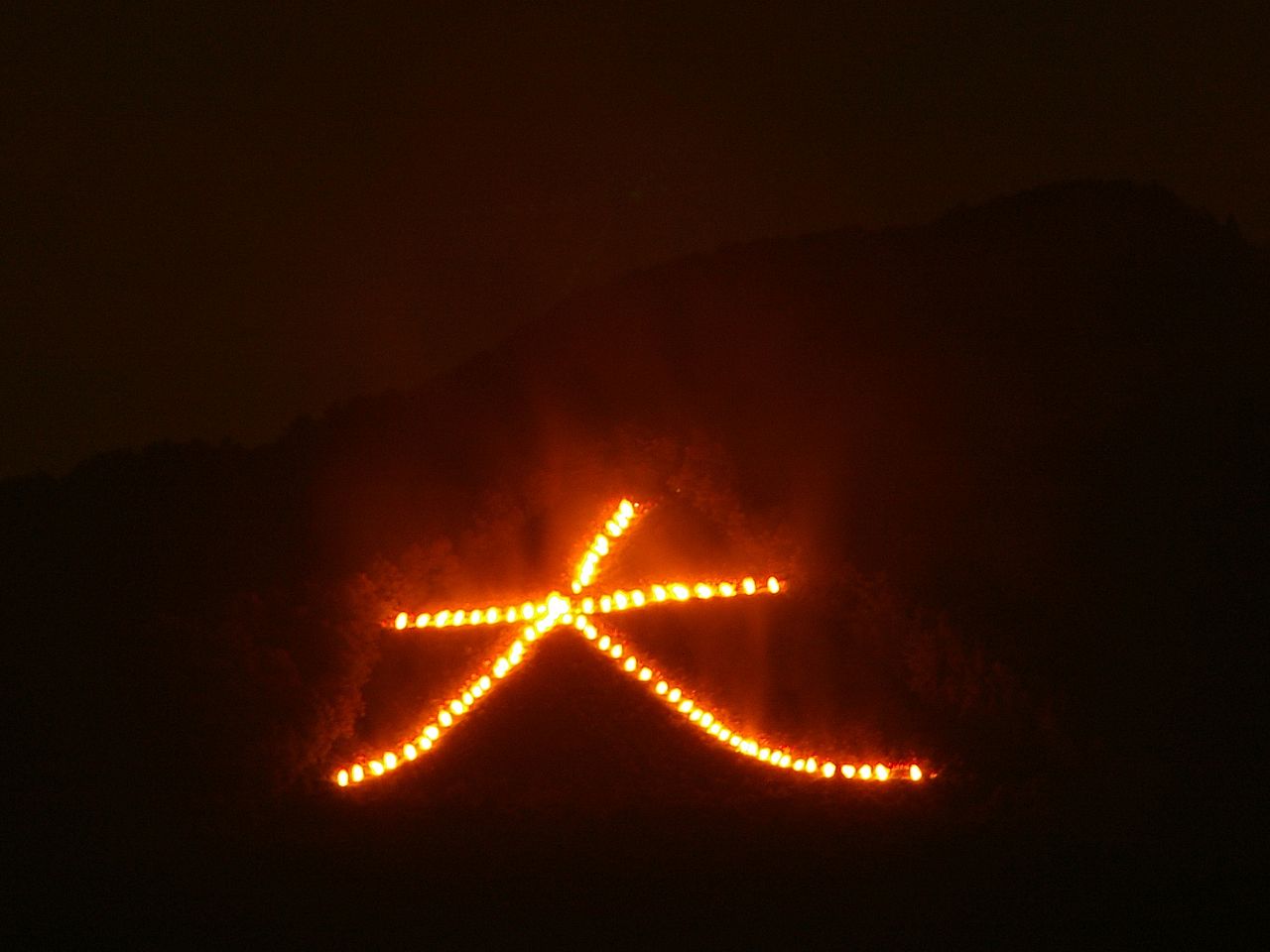
Gozan no Okuribi, Kyoto; photograph by J_o, taken at Funaokayama Park
Look closer: The fire is a single large character, the kanji for great, traced in flame on a hillside. The Wikipedia article speaks of points of fire at each site, six of them for the Daimonji.
Photograph: J_o. CC BY-SA 3.0, with attribution. Source: Wikimedia Commons. CC BY-SA 3.0 File record

The page says that the origins are obscure, though the festival is believed to be ancient. Specific families have the hereditary duty of organising it and give many hours each year as volunteers.5 In 2020, because of the pandemic, the event was greatly scaled back: six points of the Daimonji were lit, and one point at each of the other four sites.5
For viewing, the article suggests Nakagyō Ward in central Kyoto and the banks of the Kamo River between Marutamachi and Misono bridges for the Daimonji. Many hotels offer paid Daimonji specials that include views of all five fires.5
Fun Facts and Loose Ends
First lookA festival with this many parts gathers small facts. These are the ones worth keeping.
- The word bon comes from the Chinese Yulanpen, which transliterates the Sanskrit ullambana.1
- Britannica notes that in China the same festival is called the Hungry Ghost Festival.2
- The first recorded Obon in the United States was held at Wainaku, Hawaii, in 1885, organised by Japanese labourers on a sugar plantation.1
- The first public bon odori in San Francisco was held by the Reverend Yoshio Iwanaga at the Buddhist Church of San Francisco in 1931.1
- The Japanese Botanical Garden in St Louis has held an Obon festival over Labor Day weekend since 1977.1
- Brazil, home to the largest Japanese population outside Japan, holds major Obon festivals, notably in São Paulo.1
- The Gozan no Okuribi figures are lit in sequence over twenty minutes, from 8.00 to 8.20 pm.5
Joining In and Looking On
The connoisseur's eyeObon is a festival to attend, not only to read about. The Nippon.com guide describes the bon odori as a community summer festival in which people of all ages take part, and observes that international visitors increasingly join in.3
Those who want to see the Kyoto fires should plan for 16 August, with the lighting at 8.00 pm. Many hotels sell paid Daimonji specials with a view of all five fires.5 The three famous dances, in Gifu, Tokushima and Akita, are the other organised pilgrimages for dance lovers.3
Overseas, Obon is a living festival in communities of Japanese descent: weekend evenings in Hawaii from June to August, large festivals in São Paulo, and events in the Philippines, Argentina and Malaysia, often with a stronger cultural than religious focus, as the English Wikipedia article notes.1
Ghost Festivals Across Asia
The deep endThe Ullambana tradition travelled far. The Wikipedia article on the sutra says that Chinese festival guides picked it up quickly and that it shaped the Chinese Ghost Festival, which in turn influenced ghost festivals across East Asia, including the Bon Festival.4 Korea has the Baekjung, which the article on Obon describes as involving offerings at temples and masked dances, and as much an agricultural festival as a religious one.1
The story has older parallels in the Buddhist canon. The article on the sutra cites the Petavatthu, in which Sāriputta rescues his mother, and the Avadānaśataka, in which Maudgalyayana helps five hundred pretas through their relatives' offerings. Both share the idea that merit can be passed to the dead.4
Reading a Bon Print
The deep endPrints and painted scrolls of Obon fall into three kinds: the household lantern, the dance and the moon. The two Metropolitan Museum examples show the first and the third, Zeshin's lantern of about 1860 and the 1830 printed book of the moon.67 A collector should note which moment of the festival the picture shows, since the welcome fire, the dance and the farewell fire belong to different evenings.
Look for the hanging lantern, the cucumber and aubergine animals, and the circle of dancers around a tower. Each is a named feature of the festival in the sources.13
The house keeps a changing shelf of Buddhist scrolls, lanterns and ritual objects, and the concierge desk can search Japan for a particular subject.
Words Worth Knowing
The terms below recur on this page and across the almanac.
| Term | Reading | Meaning |
|---|---|---|
| Obon, Bon | Obon | The festival of ancestors.1 |
| Urabon-e | Urabon-e | The formal name of the rite, from ullambana.3 |
| Mokuren | Maudgalyayana | The disciple who freed his mother from the hungry ghosts.24 |
| Mukaebi | mukaebi | The welcome fire.1 |
| Okuribi | okuribi | The sending fire.13 |
| Shōryō uma | shōryō uma | The cucumber spirit horse.13 |
| Bon odori | bon odori | The circle dance of the festival.1 |
| Yagura | yagura | The wooden tower at the centre of the dance.1 |
Related Pieces
The house keeps a changing shelf of Buddhist sculpture, scrolls and ritual objects from Japan. The shelf below fills with pieces on the day you read this, and the collection page lists them all.
Pieces in the house now
- Buddhist statues and sacred artSculpture, scrolls and ritual objects
Answered plainly
What is Obon?
The Japanese festival of ancestors, held in July or August, when the spirits of the dead are believed to return home.12
Where does it come from?
From the Ullambana Sutra, in which the disciple Mokuren (Maudgalyayana) frees his mother from the realm of hungry ghosts, combined with older Japanese beliefs about ancestral spirits.124
When is Obon?
On 15 July in some regions, 15 August in most, and on the lunar calendar in Okinawa and the Amami Islands.1
What are the cucumber horse and aubergine cow?
Spirit animals made from vegetables: the horse so that the ancestors come quickly and the cow so that they leave slowly, carrying offerings.3
What is a bon odori?
A circle dance around a wooden tower, grown from nenbutsu dances and now a community summer festival.13
What is the Gozan no Okuribi?
Five bonfires lit on mountains around Kyoto on 16 August to send off the spirits.35
Is Obon a public holiday?
No, but people are customarily given leave.1
Is the festival celebrated outside Japan?
Yes. The first recorded Obon in the United States was in Hawaii in 1885, and Brazil and Hawaii hold large festivals today.1
Where next
Sources and image credits
- Wikipedia, Obon Origins, dates, customs, bon odori, Ryukyu, diaspora.
- Encyclopædia Britannica, Bon Dates, altars, the Ullambana story, odorinembutsu.
- Nippon.com, Obon: A Summer Festival for Honoring Ancestors Fire dates, spirit animals, the three famous dances.
- Wikipedia, Ullambana Sutra The sutra, its translations, authenticity and the date of the retreat.
- Wikipedia, Gozan no Okuribi The five fires, lighting times and viewing.
- The Metropolitan Museum of Art, Lighting a Hanging Lantern for the Obon Festival (JP2743) Shibata Zeshin print, about 1860.
- The Metropolitan Museum of Art, Moon of the Festival of the Dead (2013.655) Kitoku printed book, 1830.
Last reviewed 28 October 2026. Dates in this chapter follow the cited pages; where the sources disagree, the chapter says so. Every picture is public-domain or openly licensed, and its credit and licence stand beneath it.
If this subject has drawn you to an object, the concierge desk can search Japan for it.
Private concierge
Looking for something in particular?
Describe the piece or the project you have in mind. A senior advisor in Tokyo reads every case file personally and replies within two business days, with fees set out in writing before any work begins.