

The Most Comprehenesive Japanese Wagara Brands Encyclopedia
A Thorough Introduction to Men’s Japanese Wagara Brands
From sukajan embroidery houses to minimalist Kyoto aesthetics, character labels, collaboration drops, and collector-grade craft.
Curator’s Preface: How to Read the Wagara Brand Ecosystem
Japanese wagara (和柄)—traditional Japanese patterns—are not “prints” in the Western sense. They are a visual language with centuries of symbolic weight: dragons that signal sovereignty and chaos, tigers that embody ferocity and protection, waves that communicate inevitability, cranes that promise longevity, and blossoms that remind us beauty is inseparable from impermanence. When these motifs moved from kimono and formal arts into modern menswear, they did not lose meaning. They gained new context—especially through the postwar collision of U.S. base culture, souvenir jackets, and the street-level aesthetics that later defined Japanese amekaji and rebel fashion.
This guide is designed as a field manual—a map of the ecosystem. Some brands here function like modern embroidery ateliers: stitch-heavy, sukajan-adjacent, and technically uncompromising. Others are graphic-driven and playful, fusing wagara taste with mascots, manga, or pop-myth character worlds. Some are quiet, minimalist, Kyoto-toned interpretations of Japaneseness. And some are hybrids: denim + embroidery, workwear + folklore, rock iconography + traditional pattern grammar.
Collector’s Buying Guide Overlay (Entry → Advanced → Grail)
- Entry Tier: Approachable pricing, daily wearability, and clear wagara flavor—start with printed tops and lighter embroidery.
- Advanced Tier: Heavier embroidery, better base garments, motif storytelling, and statement silhouettes (sukajan / embroidered denim / premium shirts).
- Grail Tier: Rarity + technique—dense stitchwork, dormant lines, special collaborations, or archive-level pieces you can’t easily replace.
Brand Taxonomy Diagram (Collector Map)
Use this map to understand what kind of wagara you’re buying: technique, intent, and silhouette—not just motif.
Companion Reads (Internal Links — Intro Only)
- Sukajan origins (Yokosuka + base culture): /blogs/news/originated-in-yokosuka-the-charm-of-sukajan
- Ametora context (American trad + Japanese precision): /blogs/news/ametora-the-intriguing-blend-of-american-trad-style-and-japanese-precision
- Bad-boy mythology & street codes (style as identity): /blogs/news/japanese-bad-boy-culture-the-cult-following-of-the-series-crows-zero-and-crows-worst

Introducing Japanese pattern brands for men. From traditional flashy brands to simple brands, accessories, character designs, and collaboration brands with anime and manga, you can get a complete understanding of Japanese pattern brands here!


"Karakuri Tamashi'' (Entangled Soul), which is extremely popular in the Japanese pattern world, offers a wide range of items such as Japanese pattern T-shirts, jeans, sukajans, hats, and accessories.
In the past, this brand was worn by Matsutchan in Downtown, and is often worn on Yakuza TV.
One of the charms of Tsuguri Tamashii is that it comes in a wide variety of designs, including the classic patterns of cherry blossoms, dragons, and carp, as well as wind and thunder gods, phoenixes, skulls, tigers, wolves, and recently, bears.

We carry not only maximal, “in-your-face” pieces but also calmer designs—recommended if you want to step into wagara fashion without going full theatrical on day one.
Curator notes (why collectors chase it): Karakuri sits at the intersection of street swagger and wearable craft. The brand’s strongest pieces behave like “walking posters”—big back graphics, high-contrast iconography, and a fearless willingness to mix traditional Japanese symbolism with biker and rock cues. It’s the gateway to the “yakuza denim / yakuza jacket” keyword universe because the silhouettes naturally complement leather, boots, and amekaji layering.
Signature vibe: bold dragons + koi, heroic scale, modern street-styling compatibility.
How to wear: pair a Karakuri tee with raw denim, engineer boots, and a minimal black outer layer so the back print becomes the focal point. For colder months, treat the sukajan as an “armor piece”—the outfit can be simple; the jacket carries the narrative.
Hanatabi Band

When collectors talk about high-grade wagara sukajan, Hanatabi Gakudan is one of the names that comes up first. The embroidery is especially delicate, with a “museum illustration” level of detail that reads beautifully from a distance and becomes even more impressive up close.
The brand is often cited for extremely dense embroidery—up to 1.2 million stitches on certain pieces—illustrating how wagara can be closer to textile art than “just” streetwear.

Beyond sukajan, they also produce items such as jeans and Japanese-pattern shirts—finished products that clearly inherit the embroidery discipline cultivated in their jacket work.
Curator notes: If Karakuri is “poster art,” Hanatabi often feels like “scroll-painting translated into thread.” This is where wagara becomes collector-grade: thread density, tonal layering, and motif placement that respects symmetry and negative space.
Signature vibe: precision embroidery, dramatic back panels, artisan-heavy production energy.
Buying tip: photograph the jacket under indirect light—high-end embroidery reveals depth (thread sheen, directional stitch flow). If you’re building a “grail” collection, prioritize pieces with complex scenic compositions (multi-character scenes, layered landscapes, or elaborate dragons).
Satori

Satori blends the sensibility of wagara with rock influence, creating a distinctive worldview that feels both Japanese and aggressively modern. If you like the idea of traditional motifs but want them filtered through a sharper, more contemporary attitude, Satori is a strong lane.
Recommended for those who want sukajan with rich embroidery, but with a different “temperature” than Hanatabi—less classical, more edgy.

Curator notes: Satori is often loved by people who want wagara to feel like stage-costume energy: dramatic, nightlife-friendly, and easy to pair with monochrome wardrobes. This is also a strong bridge into “j-core” styling—where bold iconography plays well with black denim, silver accessories, and combat footwear.
How to wear: all-black base (tee + denim) + Satori sukajan = instant silhouette. Add one silver accessory for balance; let the embroidery be the “noise.”
Kacho Fugetsu

Kacho Fugetsu is admired for fresh ideas and technical execution—releasing innovative, high-impact items that still feel rooted in Japanese visual tradition.
Both flashy patterns and calmer patterns have their own taste and are widely appreciated.
Motifs that spark trends are often associated with this lane—such as contemporary interpretations of the nine-tailed fox and wolf motifs—making Kacho Fugetsu a strong “trend engine” within wagara fashion.

The brand’s sibling line Oboro is also known for strong impact; if you want a more accessible entry into the same visual atmosphere (especially for sukajan), Oboro is worth checking.

Curator notes: Kacho Fugetsu is where “heritage iconography” meets “street narrative.” Pieces often feel cinematic—like the jacket wants to be seen at night under city lighting. This is why it overlaps so naturally with “yakuza fashion” search intent: the silhouettes and motifs share a visual language of intimidation, mystery, and controlled violence.
Styling tip: keep your palette tight (black/indigo/white). Let the motif do the talking. If you want the “thug fashion” edge without looking costume-y, choose one hero piece and keep everything else clean.
NISHIKI

NISHIKI evokes the tradition of “nishiki” (brocade)—a gorgeous, tasteful, distinctly Japanese visual identity that historically reads as celebratory and formal. The brand’s modern move is to translate that splendor into Western garments, creating a unique worldview where classical Japanese richness lives on contemporary silhouettes.
Unfortunately, there have been periods where new releases feel limited, making it closer to a semi-dormant label depending on season.
Evangelion collaboration items are especially rare and tend to become instant conversation pieces.
Curator notes: NISHIKI is the “heritage-to-street” switch: the pieces can look festive at first glance, but when styled with boots and denim, the effect becomes strikingly modern—an elegant cousin to yakuza-inspired opulence.
Kinozakura (Koromo Zakura)

Koromo Zakura offers a wide range—from simple to flashy—making it familiar to anyone who likes Japanese patterned shirts.
Shirts made with wagara fabric create an immediate atmosphere and become key items for “beautiful Japanese pattern fashion,” especially when you want a refined look that still has cultural impact.
The price range can sit from the low to higher ¥10,000s; it’s not the cheapest, but the quality tends to justify the spend.
Don’t miss the emphasis on domestic production—often cited as a strong point for those who want an authentic, made-in-Japan wagara shirt experience.

Curator notes: This is the “grown-up wagara” lane for daily wear. If your wardrobe already leans minimal, a Koromo Zakura shirt lets you inject Japan-ness without turning the whole outfit into cosplay.
Kijin

Kijin has a warm, playful philosophy: “Make the wearer and the viewer smile.” Even without words, the designs aim to communicate joy—an approach that positions wagara not only as “tough-guy” gear, but as approachable Japanese storytelling through clothing.
The brand produces many printed wagara items and incorporates playful twists—recommended if you want something different from the usual dragon/koi hierarchy.
Many designs are relatively gentle, making Kijin beginner-friendly for first-time wagara wearers.
Curator notes: In a world where wagara is often indexed as yakuza aesthetics, Kijin provides a counterpoint: folk charm, humor, and friendly symbolism. It’s useful in the taxonomy because it shows wagara’s emotional range.
Dorobo Nikki (Thief Diary)

Dorobo Nikki has long been loved for constant experimentation and evolution. The balance between casual comfort and Japanese pattern identity is excellent, and the brand’s artistic colors and compositions attract dedicated fans.
In some periods, the label has been on hiatus with uncertain new releases—making certain pieces surprisingly collectible on the second-hand market.
Curator notes: If you like “amekaji with Japanese ink,” Dorobo Nikki is a deep-cut. This lane is great for people who want wagara to feel like art-school streetwear rather than pure delinquent cinema.
■ Japanese pattern brand with popular character designs

Battō Musume

Battō Musume breaks away from “classic” wagara by fusing Japanese beauty with character-driven heroines—built around a strong, consistent identity. The concept is famously defiant: “If heaven doesn’t judge, we will judge ourselves.”
The character world is fixed and recognizable—part of why the brand is so popular, including among overseas fans.
Pricing often sits near major wagara staples. Many tees are printed and bright, while embroidered jeans/hoodies exist for those who want a heavier “collector” feel.
Mini character versions have also become popular, especially among women who want wagara energy with a playful twist.
Curator notes: Battō Musume is a strong bridge between wagara and anime culture—meaning it performs well in search spaces that include Japanese street fashion, j-core, and character apparel. It can also read “tough” when styled right: pair a character jacket with black denim and boots and it becomes “comic-noir” rather than cute.
Pandiesta

Pandiesta began as a panda concept within wagara, then expanded into a full brand after it sold far beyond expectations.
Panda elements appear across almost every item, with wagara motifs used occasionally—creating a signature mix of bold-cute and street presence.
Because the range is wide, you can build a full Pandiesta outfit if you want a coherent character-first wardrobe.

Curator notes: Pandiesta is proof that wagara culture isn’t only “serious masculinity.” It’s also pop, masc-cute, and hyper-graphic. Great for casual street fits and festival energy.
Sanmaruichi

Sanmaruichi is famous for frogs—building an entire brand universe from kaeru motifs, Edo-style patterns, and playful storytelling.
They release a large number of new products, so you can choose from a wide variety of patterns.
Recommended if you don’t want to overlap with others—Sanmaruichi has a highly recognizable worldview.
They use embroidery and prints well, and many T-shirts are relatively thin—comfortable for people sensitive to heat.

Curator notes: “Frog wagara” might sound cute, but in practice it’s a masterclass in branding: one icon, endless variations. It works especially well with denim and workwear (amekaji styling), giving you a low-key entry into wagara streetwear.
Goku Honpo

Goku Honpo incorporates a monkey silhouette (Goku) into its design language, offering not only wagara but also American casual (amekaji) vibes.
The Japanese pattern taste is especially popular, and the brand has many long-time fans.
After years of focusing mainly on tees and hoodies, the brand expanded into jeans and other categories—making head-to-toe coordination easier.
Curator notes: This is a strong “street-to-casual” bridge brand. Great if your wardrobe is denim-forward and you want wagara accents that still feel easy.
Now and then (今昔 / Konjaku)

Konjaku mixes embroidery and prints with fox motifs, creating designs that feel both mythic and cute—popular with men and women.
Jeans are also part of the lineup, so you can coordinate tops and bottoms in the same visual universe.
Curator notes: Fox motifs in Japanese iconography can carry trickster energy; in streetwear, that becomes “mysterious charm.” Konjaku performs well as a daily-wear wagara option.
CHIGIRI
 CHIGIRI is built on “Japanese & American” as a core concept, with attention to shape, comfort, and domestic production.
They develop products with comfort as a priority, while also using innovative designs.
Highlights include jeans using sashiko-like textures and clever Japanese fabric placements—especially on sleeves and panel details.
The “Chigiri-chan” series is particularly popular, and collaborations (e.g., Devilman, Cutie Honey) have strong fan followings.
Curator notes: CHIGIRI is the “craft-forward” wing of wagara streetwear. It’s less about intimidation and more about texture, construction, and wearable Japanese detail—ideal for collectors who love garment engineering.
CHIKIRIYA

CHIKIRIYA is rabbit-focused; production has been discontinued, though occasional collaboration items can appear.
Curator notes: Discontinued wagara labels can become sleeper grails. If you see a rare collab, treat it like a “limited chapter” in wagara history.
■ Japanese pattern brand with handwritten designs

Zen (禅)

ZEN is often described as a Kyoto-origin wagara brand focused on hand-painted items—pieces that carry the “soul of craftsmen” and feel closer to art objects than mass products.
A typical drawback is time: certain hand-finished items can take around a month to produce. But the impact is real—these pieces stand out in a way embroidery and printing often can’t replicate.
This brand is highly recommended if you prefer painted expression over embroidery.

Curator notes: Think “Kyoto restraint + artisan brushwork.” For collectors, ZEN pieces can function like wearable shodō or painted screens—especially powerful when the motif is a single deity, animal, or calligraphic stroke.
Usui

Usui specializes in hand-painted items. Motifs such as Fudō Myōō and Aun can look especially powerful—the quality of the brushwork is visible immediately, and the presence is undeniable.
Because each T-shirt is hand-finished, even “the same” design becomes slightly different—creating a true one-of-a-kind piece.

Curator notes: Hand-painted wagara is the opposite of fast fashion. Treat these like functional art: wash gently, store properly, and avoid harsh UV exposure if you want the pigment to remain crisp over time.
■ Japanese pattern brand focusing on accessories

Hanayama (Kazan)

Kazan is known for wallets made from gorgeous gold brocade textiles (linked to Kyoto’s Nishijin-ori tradition) combined with carefully selected genuine leather.
Beyond wallets, the label produces coin purses, bags, and leather jackets—built to be used long-term rather than treated as disposable accessories.

Curator notes: Accessories are how many collectors “season” a wagara outfit: one Nishijin wallet or brocade leather piece can carry the entire Japanese mood without needing a full printed top.
MOTONO

MOTONO (geta) is described as being made in a region associated with cedar heritage. The comfort and ease-of-wear of these traditional sandals has also been reconsidered from a health perspective, creating a quiet modern craze.

Curator notes: Footwear and sandals can shift wagara styling from “costume” to “lifestyle.” A subtle traditional element below the waist balances an aggressive jacket above.
Dragon figure (crown)

The brand previously sold shoes with Japanese patterns, but production has now been discontinued.
RYUZU Silver accessory crown (Ryuzu)

Ryuzu is associated with the “arare” technique—known historically in metalwork contexts—and produces silver accessories with weight, presence, and delicate technique.

Curator notes: In “yakuza fashion” search culture, jewelry matters: weighty silver, symbolic motifs, and tactile surfaces complete the silhouette. A single serious ring can elevate basic denim + tee into a deliberate outfit.
A Japanese pattern brand that focuses on simple designs.


Japanesque

Japanesque is often associated with the same production lineage as Satori and Hanatabi Gakudan. It is recommended for those who want a slightly more mature sukajan aesthetic—less maximal, more composed.

Curator notes: “Mature” wagara doesn’t mean boring—it means controlled: fewer colors, cleaner compositions, and silhouettes that can survive more situations (restaurants, travel, casual nights out) without feeling like costume.
Wajin

Wajin was born from the desire to convey Japanese culture and traditions in a more familiar way. This is described as “purely made in Japan,” with processes—cutting, printing, and production—kept domestic.
Curator notes: Wajin reads as “quiet Japan-ness.” Ideal if you want wagara mood that can also live in a minimalist wardrobe. This is a good brand lane for people who love Japanese aesthetics but don’t want the full yanki/yakuza drama.
Bitchu Kurashiki Workshop/Kura (Bitchu Kurashiki Koubou)

Bitchu Kurashiki Koubou is associated with indigo-dyed production and a “one-of-a-kind” stance. Many items are made with skilled craftsmanship, and because they are not produced in huge numbers, they can become rare and long-lasting.
Denim and jeans are especially popular—one of the strongest “yakuza denim / wagara jeans” intersections for collectors who want Japanese symbolism embedded into indigo culture.
In some periods, the brand is described as being on hiatus, but pieces continue to circulate and remain admired.
Curator notes: This is the deep heritage lane: indigo, craft, and scarcity. If you’re building a serious wagara denim cabinet, this name belongs on your radar.
A Japanese pattern brand that collaborates with manga and anime
Evangelion × Nishiki
When this collaboration first appeared, it was an unexpected combination that caused a stir across the wagara space.
Collaboration items have tended to appear in limited drops rather than constant release.

Dragon Ball × Karakuri Tamashi
This collaboration has been a long-awaited one for many fans.
It’s often praised for detailed embroidery of Dragon Ball characters—turning pop icons into collector-grade threadwork.

Galaxy Express × Karakuri Tamashi
Maetel drew strong attention in the wagara context, and the combination of Japanese patterns and Galaxy Express imagery remains rare and memorable.

Other collaboration lanes can include heavyweight franchises such as Fist of the North Star, One Piece, and Ultraman—where nostalgia and wagara intensity amplify each other.
Introducing Japanese pattern brands by item
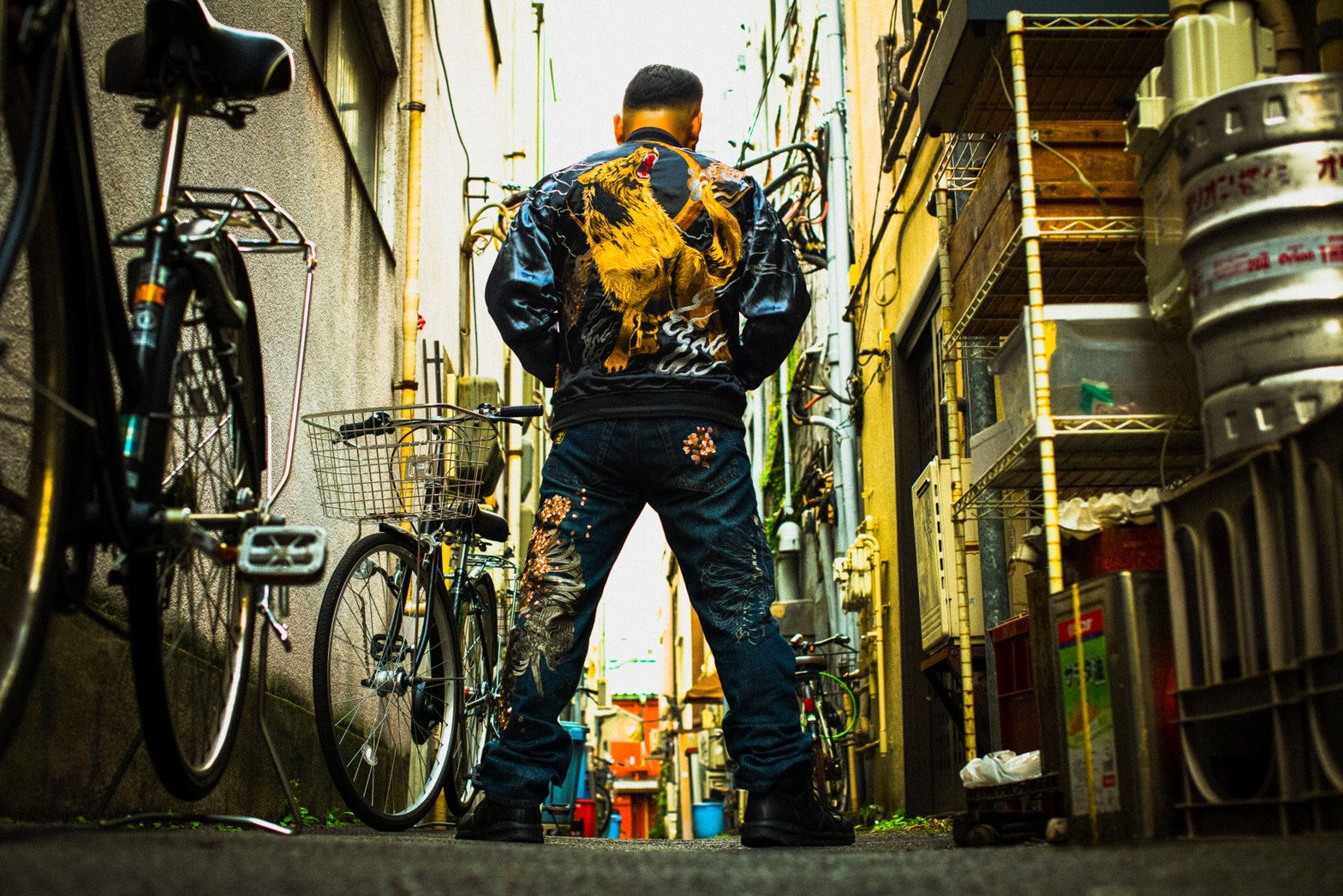
Introducing brands that carry standard wagara items such as T-shirts, jeans, and sukajans♪


Brands that often carry Japanese pattern jeans
There aren’t many brands that carry a large volume of wagara denim, and comparisons can get confusing. Here’s a visual summary—each of these labels delivers its own unique “Japanese denim myth,” from embroidery-first lanes to indigo-craft heritage.


Brands that often carry Sukajan
Japanese-patterned sukajan is a universe of its own—equal parts embroidery house, street badge, and wearable folklore. Here are key lanes represented visually:


If you are interested in men’s Japanese pattern brands that we do not currently carry, please contact us.
Tell us the brand you’re chasing—we’ll review it, and if it fits Japonista’s curation standards, we’ll look at carrying it.
We also share exhibition updates and release news on our blog, including planned products that have not yet launched—so check back regularly.
We hope this article helps anyone who loves Japanese wagara design for inspiration, styling, and collecting.