

Originated in Yokosuka - The Charm of Sukajan
Yokosuka has always been more than a dot on the map—it’s a port city shaped by crossings: foreign ships arriving, uniforms moving through streets, languages overlapping in storefronts, and local crafts evolving under the pressure (and possibility) of contact. Before the war it was a former Japanese Navy base; today it remains closely tied to the Self-Defense Forces and the U.S. Navy presence in Japan—an “exotic atmosphere,” yes, but also a working, lived-in culture built by decades of movement.
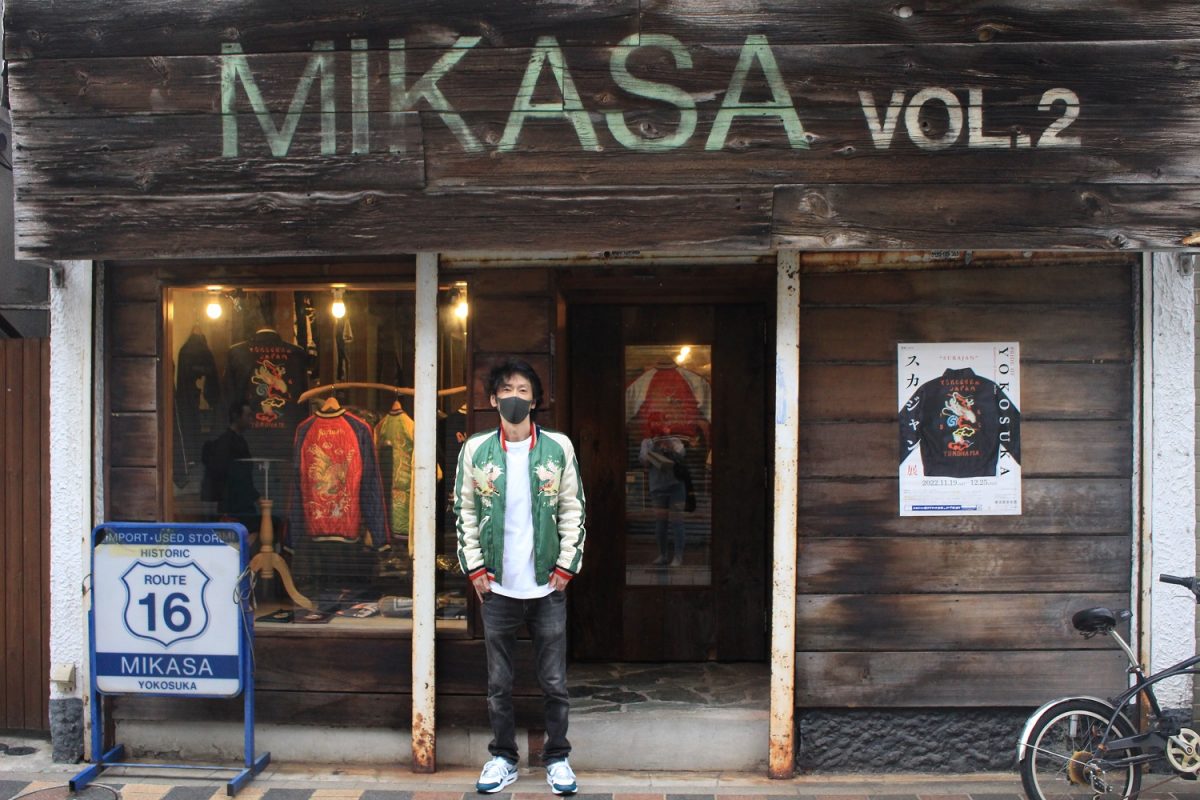
And Yokosuka has a habit of turning identity into edible folklore—Navy Burger, Navy Curry, cherry cheesecake—plus icons like the commemorative battleship Mikasa, Sarushima, Uraga Dog. In that same lineage of “local pride you can carry,” there’s the Yokosuka jumper—Sukajan—the wearable artifact that traveled from postwar souvenir to global style signal.
What Sukajan Really Is (Beyond the Nickname)
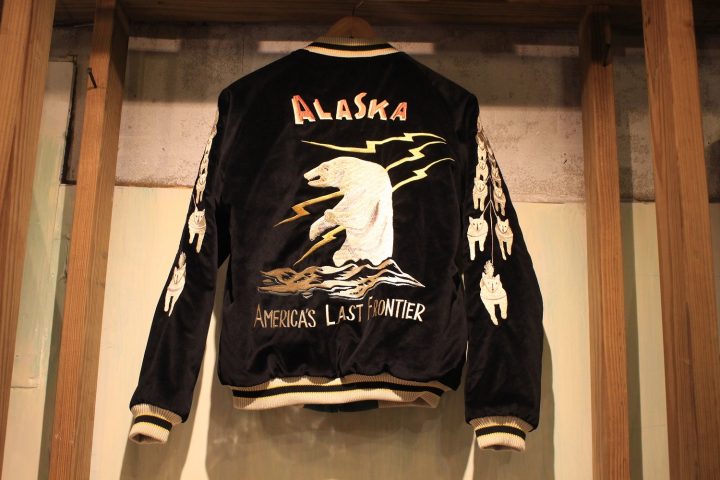
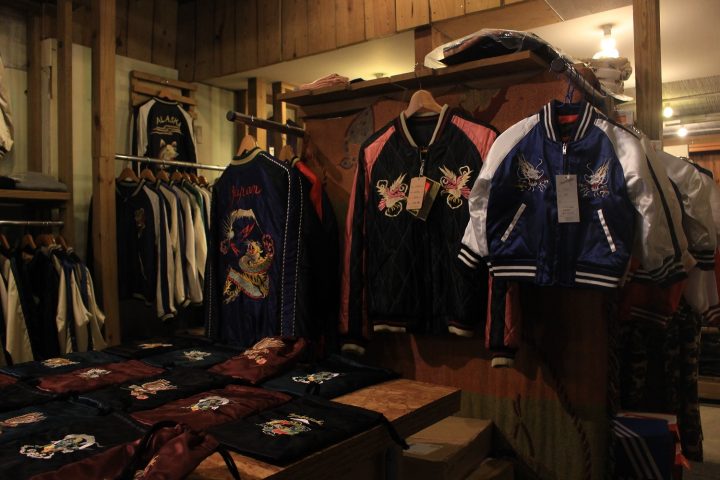
In the simplest words: Sukajan is the abbreviation of “Yokosuka jumper”—“Suka” from Yokosuka and “Jan” from jumper. But the deeper truth is that Sukajan isn’t merely a jacket; it’s a set of design decisions that encode an era. The satin sheen (and sometimes velveteen warmth), the rib-knit collar/cuffs/hem, the bomber-like silhouette, and above all the embroidery—eagles, tigers, dragons—build a vocabulary that’s instantly recognizable even from across a room.
That embroidery matters. Vintage Sukajan is often discussed as imagery, but historically it’s also technique: Japanese “yokoburi” (横振り刺繍) chain-stitch-style machine embroidery that produces depth, color layering, and a sculptural feeling that photographs can’t fully explain. Curatorial writing on Sukajan history highlights this distinctive embroidery method as one reason mid-century pieces remain so magnetic.
The Origin Story: “Souvenir Jacket” Becomes Sukajan
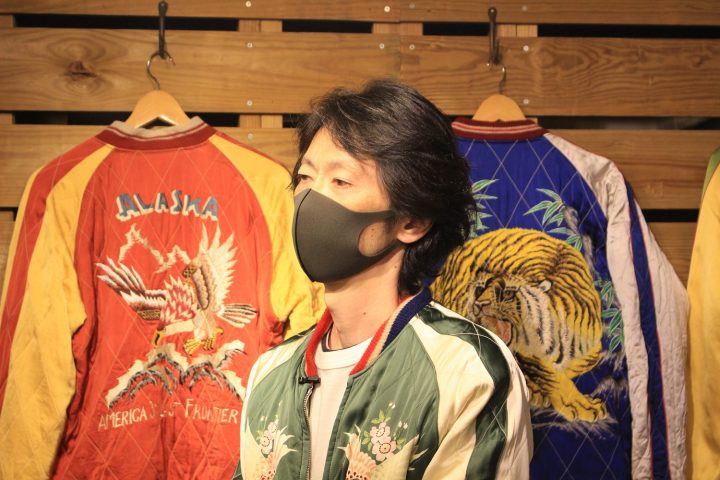
In the interview section of the original article, the history is clear: Sukajan begins after the war as a souvenir for American soldiers stationed in Japan—originally called the “souvenir jacket.” The motifs that became “classic” weren’t random; they were readable symbols of the “Orient/Asia” to Americans at the time—dragons, tigers, eagles—bold enough to feel like a trophy, wearable enough to become a habit.
Then something culturally fascinating happens: the jacket doesn’t stay a one-directional souvenir. Over time, Sukajan becomes beloved in Japan too—eventually settling into the name “Sukajan” and weaving itself into the larger ecosystem of amekaji, vintage collecting, and postwar cultural memory. That arc—souvenir → street object → collectible heritage—shows why Sukajan keeps returning every generation: it’s always both fashion and evidence.
Dobuita Street: The Birthplace as a Character
If Sukajan is the artifact, Dobuita Street is the stage that taught the artifact how to speak. The article describes Dobuita-dori prospering as an Edo-era shipyard town, then a Meiji-era navy town, then a postwar U.S. Navy town—each layer leaving behind commerce, slang, taste, and a certain swagger. Even the street’s name carries an improvised, industrial origin story (a river running through the middle, later covered).
Curatorial accounts of Sukajan history keep returning to Dobuita for a reason: it’s where “base culture” was visible—shops selling to servicemen, products designed for an outsider’s gaze, and local makers adapting fast. Exhibitions that focus on Sukajan often frame Dobuita not as trivia, but as the retail corridor where postwar cross-cultural desire became a market—and then a style.
MIKASA (est. 1955): Sukajan as Living Craft
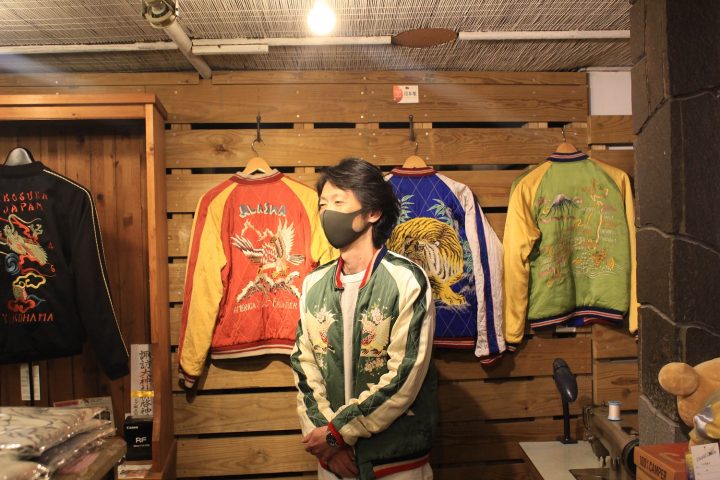
In Yokosuka’s Dobuita-dori context, the article spotlights MIKASA, a specialist Sukajan shop founded in 1955, selling pieces from Tailor Toyo, Minato Sho-era lineage and styles, originals, custom-made Sukajan, and even celebratory “Kanreki” Sukajan—an important clue that Sukajan isn’t frozen in the 1950s; it’s continuously re-authored for real people and real milestones.
The interview also gives us something collectors often forget: custom work is not a side story—it’s part of what Sukajan does. The maker notes that, with custom orders, the customer’s wishes often become the design itself, and that certain couples’ embroidered custom jackets left a deep impression. That’s the emotional engine behind the object: Sukajan is not only “heritage,” it’s “commissioned memory.”
Why It Keeps Traveling: Gender, Age, and the Universal Silhouette
When asked about appeal, the answer is disarmingly modern: Sukajan can be worn by a variety of people regardless of gender or age. In a world where many “heritage” garments are policed by subculture rules, Sukajan stays surprisingly open. The silhouette is easy; the imagery is loud; the meaning is layered—so wearers can enter at any depth: purely aesthetic, purely historical, or fully collector-minded.
Museum-Level Validation: PRIDE OF YOKOSUKA Sukajan Exhibition
The original article mentions the “15th Anniversary PRIDE OF YOKOSUKA Sukajan Exhibition” at the Yokosuka Museum of Art, describing roughly 140 Sukajan (including precious vintage examples from Tailor Toyo/Toyo Enterprises holdings) and contextual materials like photos, Dobuita Street documents, and products sold to U.S. soldiers—essentially: Sukajan shown not as costume, but as cultural history.
Independent coverage confirms key exhibition framing: Sukajan as a postwar souvenir for U.S. soldiers; Dobuita Street as a core sales/culture site; and the gathering of approximately 140 vintage pieces from Tailor Toyo’s collection, presented alongside broader “base culture” context. This is exactly the kind of institutional lens that turns “cool jacket” into “curated object.”
The Collector’s Takeaway: How to Read Sukajan with Authority
If you want to approach Sukajan like a curator—not just a wearer—train your eye on a few signals:
- Material and sheen: satin’s light-reflection changes the emotional tone of embroidery; velveteen shifts it toward depth and seasonality.
- Embroidery as technique: dimensionality and color transitions are part of the “why,” not just the picture.
- Place-memory: Yokosuka isn’t a decorative word; it’s the jacket’s original theater—Dobuita, base culture, souvenir economy.
- Commissioned meaning: custom Sukajan collapses the boundary between fashion and personal archive.
Sukajan survives because it’s built from contradictions that don’t cancel out: it’s flashy yet historical, personal yet collectible, local yet global. And it begins—still—where Yokosuka’s port energy turns contact into culture.