Rare Vintage, Antiques and Art Collector / Curator / Personal Shopper From Japan
Vintage Tailor Toyo M18279 Skull Snake Reversible Sukajan Japan Map Velvet Souvenir Jacket
Vintage Tailor Toyo M18279 Skull Snake Reversible Sukajan Japan Map Velvet Souvenir Jacket
Couldn't load pickup availability
Have a reasonable price in mind? Submit your best offer and our concierge will review it personally.
Rare Early Toyo Enterprise Serpent Skull, Spider Web and Dragon Embroidered Velveteen Jacket with Quilted Gold Japan Map Reverse
Description
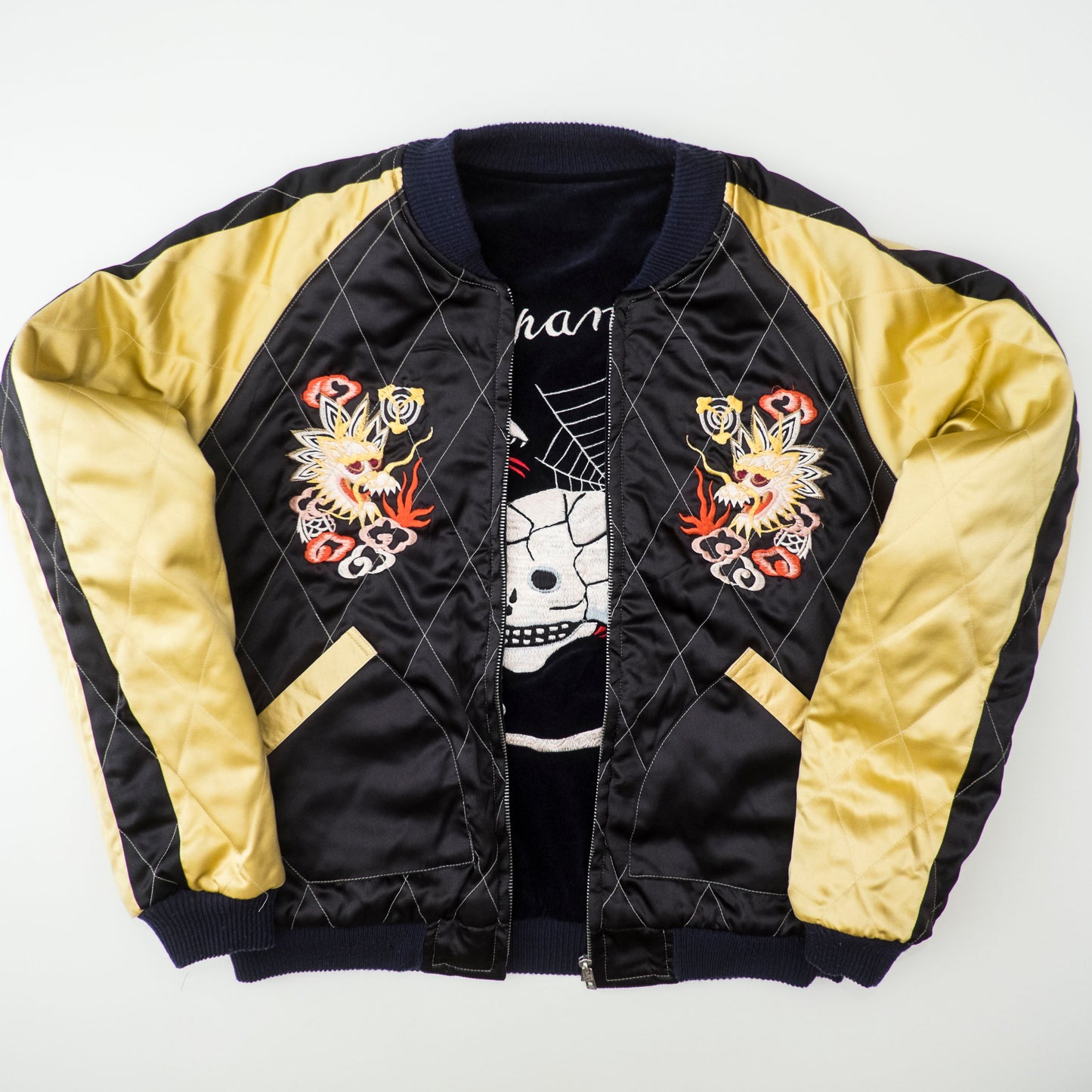
A formidable early Tailor Toyo / Toyo Enterprise reversible sukajan, combining one of the most coveted dark motifs in Japanese souvenir-jacket history with a richly embroidered Japan map reverse.
The primary face is constructed in midnight navy-black velveteen. Its back presents a cracked skull entwined by serpents beneath a precisely embroidered spider web, with crossed bones forming a stark memento mori emblem below. Long ascending dragons travel down both sleeves, transforming the entire jacket into a continuous embroidered composition rather than limiting the artwork to a single back panel.
Turn the jacket inside out and its atmosphere changes completely.
The reverse is made in glossy black quilted satin with antique-gold sleeves. Across the back, an embroidered map of Japan is surrounded by regional names, Mount Fuji, stylized clouds and a dragon emerging from curling blue waves. Matching dragon heads appear on the chest, while diamond quilting gives the satin face an unmistakably archival souvenir-jacket character.
One side is shadowy, rebellious and almost occult.
The other is luminous, geographical and unmistakably Japanese.
Together, they create a reversible jacket with two fully developed visual identities rather than one decorated exterior and one secondary lining.
Opening Impression
The jacket arrives like a midnight folktale stitched into fabric.
On the velveteen side, a serpent rises from behind a fractured skull while a web spreads across the darkness. White dragons descend along the sleeves with red tongues and claws, their bodies interrupted by curling cloud forms.
The reverse replaces death imagery with geography. Japan becomes the central subject, its islands outlined in gold and surrounded by place names that recall the original souvenir jackets purchased by overseas servicemen after assignments throughout the country.
It is a meeting of danger and memory, shadow and travel, rebellion and nostalgia. 🐍💀🐉
Identification
Maker
Attributed to Tailor Toyo / Toyo Enterprise
Model
M18279
Matching Japanese secondary-market records identify the serpent-skull and Japan-map configuration as an early Toyo Enterprise M18279 model. Documented examples describe the combination as 蛇髑髏 × JAPAN MAP, or “Snake Skull × Japan Map.”
Garment Type
Reversible sukajan
Japanese souvenir jacket
Velveteen and quilted satin bomber
Embroidered Yokosuka jacket
Amekaji collectible outerwear
Primary Motifs
Serpent-entwined skull
Spider web
Crossed bones
Ascending sleeve dragons
Japan map
Mount Fuji
Regional and city names
Dragon emerging from waves
Colorway
Midnight navy-black
Ivory white
Crimson red
Cloud blue
Black satin
Antique gold
Sky blue
Soft pink
Pale yellow
Size
The tagged size is not visible in the supplied photographs.
Comparable M18279 serpent-skull examples are often documented in Japanese size M, although the final listed measurements should always be used as the primary fit guide rather than relying on comparable examples alone.
Design Character
This jacket belongs to the darker, more elusive branch of sukajan design.
Traditional souvenir jackets frequently feature tigers, eagles, dragons, landscapes and military maps. The serpent-skull motif takes that familiar vocabulary somewhere stranger. It introduces a Western-style memento mori emblem into a distinctly Japanese embroidered garment, then surrounds it with dragons, clouds and the word “Japan.”
The velveteen side is restrained almost entirely to black, ivory, red and pale blue. That restricted palette gives the embroidery tremendous clarity. The white skull and serpents appear to float above the dense dark pile, while the red tongue and ribbed underside of the snake strike through the composition like exposed live wire.
The reverse offers the opposite experience. Gold sleeves, blue waves and multicolored place names turn the jacket from a nocturnal object into an illuminated travel map.
Neither face feels secondary. This is a genuine two-sided artwork.
The Serpent Skull and Spider-Web Side
Central Back Composition
The principal motif features an ivory skull with an irregularly cracked crown.
A pale serpent coils around the skull, its head rising toward the upper left with open mouth, visible fang and extended red tongue. A second length of serpent curves beneath the jaw and around the crossed bones, binding the design together.
Behind the skull, a geometrically embroidered spider web expands toward the shoulder. Its fine white strands create a fragile counterpoint to the heavy forms of bone and snake.
The embroidered word Japan appears above in flowing script. Its elegance contrasts sharply with the macabre imagery below, creating the kind of visual contradiction that makes exceptional sukajan designs memorable.
Front Embroidery
Two smaller skulls sit across the chest, facing inward toward the zipper.
Their simplified pale forms immediately identify the jacket even when the large back artwork is hidden. Because the skulls are mirrored, the front maintains the symmetrical balance traditionally associated with souvenir-jacket chest embroidery.
Sleeve Dragons
The sleeve embroidery is especially significant.
Long ivory dragons travel almost the full length of both arms. Red claws, tongues and underbellies give the otherwise pale creatures sharp flashes of color. Small blue-grey clouds interrupt their bodies and create the impression that the dragons are moving through mist.
This full-sleeve treatment dramatically increases the jacket’s presence when worn. The artwork remains visible from the side, while walking and arm movement animate the dragons across the velveteen surface.
The Japan Map and Gold Satin Side
The reverse is constructed in glossy black satin with antique-gold raglan sleeves and dark rib-knit trim.
Diamond quilting spreads across the black body and portions of the sleeves. Originally practical for stabilizing light insulation, the quilting has become one of the defining visual signatures of reversible souvenir jackets. Sukajan are commonly made from satin or velveteen, and their reverse faces often use quilting as both structure and decoration.
Japan Map Embroidery
The back centers on a stylized outline of the Japanese archipelago.
Place names appear in a lively assortment of ivory, pink, blue and yellow embroidery, including visible references to:
Sapporo
Aomori
Sendai
Tokyo
Yokohama
Gifu
Kyoto
Osaka
Nagoya
Yokosuka
Gamagori
Kobe
Kure
Hiroshima
Mizuru or Maizuru
Etajima
Kokura
Hakata
Nagasaki
Beppu
The spelling and placement reflect the graphic, souvenir-oriented nature of the design rather than a modern cartographic map. That hand-drawn quality is part of its character.
Mount Fuji
A snow-covered Mount Fuji rises above the main island.
Its summit is embroidered in white and red, creating the appearance of sunrise or red light touching the snow. Fuji functions as both sacred geography and immediate visual shorthand for Japan, making it one of the most enduring motifs in souvenir embroidery.
Dragon and Waves
At the lower right, a dragon rises from blue waves.
The dragon is rendered in white, red and black thread, giving it a sharper and more animated personality than the pale sleeve dragons on the velveteen side. Stylized water curls around it in several shades of blue.
The motif connects the geographic map to the mythic language of the opposite face. Even when the jacket becomes brighter and more travel-oriented, the dragon remains its guardian.
Chest Motifs
Mirrored dragon heads appear across the chest, framed by compact flame and cloud forms.
They echo the sleeve dragons concealed on the opposite face and maintain the jacket’s supernatural energy without overwhelming the detailed Japan map.
Iconography and Meaning
Skull
The skull is an ancient reminder of mortality, impermanence and the limited duration of human life.
Within rock, motorcycle, punk and tattoo culture, it also carries associations of rebellion, fearlessness and refusal to look away from death. On this jacket, the cracked skull feels less like a generic pirate emblem and more like an archaeological relic caught inside a web.
Serpent
The serpent can embody danger, poison, transformation and renewal.
Because snakes shed their skin, they have long been associated with rebirth and the abandonment of an earlier form. Their ability to move silently and strike suddenly also makes them natural symbols of concealed strength.
Coiled around the skull, the snake creates a cycle between death and regeneration.
Spider Web
The web suggests time, entrapment and the invisible structures that hold events together.
Its delicacy intensifies the physical weight of the skull and bones. It can also be read as evidence that the object has remained undisturbed, slowly becoming part of an older and darker world.
Dragon
The Japanese dragon is commonly associated with water, weather, authority, protection and supernatural power.
The dragons on the sleeves appear elongated and airborne, while the dragon on the Japan-map face emerges directly from waves. This allows the jacket to present both celestial and aquatic expressions of the creature.
Mount Fuji
Mount Fuji represents endurance, sacred landscape and Japan’s national identity.
Its placement above the map gives it the role of a geographical crown, watching over the cities and islands below.
Japan Map
Map-backed souvenir jackets originated partly as records of travel, service and memory.
They could transform military or occupational geography into a personal textile archive. The jacket became something worn on the body but also carried home as evidence of having lived, worked or served in a distant place.
Sukajan History and Cultural Context
The sukajan developed in the postwar Yokosuka area, where Japanese embroidery workshops produced decorated jackets for American servicemen stationed in Japan. These garments blended American bomber-jacket construction with Japanese dragons, tigers, eagles, maps and landscapes. They became portable souvenirs of service and travel, eventually returning to Japan as enduring symbols of Amekaji fashion and rebellious street style.
The name is generally understood as a contraction connecting Yokosuka with the Japanese use of the word jumper.
Although today’s sukajan are worn internationally as fashion, their appeal still comes from this unusual cultural collision. They are neither purely military nor purely traditional. They are hybrid garments born from geography, occupation, memory and the exchange of visual languages.
This M18279 revives that history through two classic categories of souvenir imagery:
The geographical Japan map.
The mythic and macabre serpent-skull design.
The Rarity of the Snake Skull Motif
Among vintage-inspired sukajan designs, the snake-and-skull pattern is particularly desirable.
Tailor Toyo’s own account of its modern revival describes surviving mid-century serpent-skull jackets as exceptionally scarce, with the sleeve-dragon version considered especially coveted by collectors. The company reproduced the motif as a limited model priced at ¥97,900, demonstrating the design’s elevated status within its own archive.
This M18279 is not the same as the recent TT15666 reproduction. It is an earlier archival Toyo piece with a different Japan-map reverse, color arrangement, embroidery character and construction.
That distinction matters.
The jacket carries an older generation of Tailor Toyo revival design, before the current global sukajan boom made elaborate archive reproductions widely visible.
Embroidery and Construction
Velveteen Face
The dark face uses a dense cotton-like velveteen or velvet-pile fabric.
The pile absorbs light rather than reflecting it evenly, producing areas of deep black, navy and graphite depending on the direction of the nap. This creates an unusually rich backdrop for pale embroidery.
Visible embroidery techniques include:
Dense satin stitching on the skull and snake
Fine running stitches in the spider web
Layered threadwork in the sleeve dragons
Contrasting red accents on claws, tongues and serpent ribs
Pale blue cloud embroidery
Flowing script lettering
Mirrored chest motifs
Quilted Satin Face
The map side uses smooth satin-like fabric with diamond quilting.
Visible construction details include:
Reversible bomber construction
Raglan sleeves
Full front metal zipper
Diamond-quilted body
Contrasting antique-gold sleeves
Angled welt pockets
Rib-knit collar
Rib-knit cuffs
Rib-knit waistband
Embroidered chest dragons
Full Japan-map back embroidery
Embroidered Mount Fuji and waves
The satin catches light immediately, while the velveteen absorbs it. This difference in texture makes the reversible transformation especially dramatic.
Color and Surface
The velveteen face appears predominantly black or extremely dark navy.
Velvet pile naturally changes tone when brushed in different directions, so areas may look lighter, darker or slightly blue under photography and direct light. This is an inherent characteristic of the fabric rather than necessarily representing fading.
The satin face uses a black body and warm gold sleeves. Pale blue clouds, red-white Fuji embroidery and multicolored place names prevent the reverse from becoming a simple black-and-gold jacket.
The contrasting palette feels unmistakably late-1990s or early-2000s Japanese Amekaji: archival in inspiration, but bolder and more graphic than the original postwar garments it references.
Period Assessment
This jacket is attributed to an early Tailor Toyo M-number production period, likely dating from approximately the late 1990s to early 2000s.
Japanese specialist resale sources refer to M18279 pieces as early M-number models and describe them as particularly collectible within Tailor Toyo’s revival history.
It is important to distinguish the garment from an original 1950s souvenir jacket.
This is a Japanese archival revival piece created by the company most closely associated with preserving and reproducing the souvenir-jacket tradition. Its collectibility comes from its early Toyo production, rare motif combination and place within the modern history of sukajan collecting.
Condition
Pre-owned vintage condition.
The supplied photographs show the jacket presenting strongly, with the principal embroidery clearly visible and the reversible construction intact.
Visible characteristics include:
Natural creasing across the quilted satin
Light lint or surface fibers on the dark velveteen
Subtle changes in the velvet nap
Possible minor flattening from wear or storage
Small thread irregularities consistent with embroidered vintage clothing
Gentle wear around the rib-knit trim
Normal age-related handling characteristics
No obvious major holes, extensive tears or large missing embroidered sections are visible in the supplied views.
Velveteen and satin are highly responsive to lighting. Pale streaks or patches may result from the direction of the pile, reflected light or storage pressure rather than permanent discoloration.
Please examine all photographs closely, as they form an important part of the condition description.
This jacket is offered as a genuine pre-owned collectible garment and should not be expected to appear factory new.
Size and Fit
The jacket follows the compact, rounded proportions associated with classic Japanese sukajan.
Expect:
Raglan shoulders
Moderate chest volume
Shorter bomber-style body
Tapered ribbed waistband
Full sleeves
Room for a light shirt or sweatshirt
A silhouette closer to vintage Amekaji than an oversized contemporary bomber
Comparable size-M M18279 examples have been recorded around 54–56 cm pit to pit, 56–58 cm in body length and approximately 83–85.5 cm in raglan sleeve reach, although measurements vary between individual jackets and should not be substituted for the measurements of this exact garment.
Japanese vintage sizing often fits smaller and shorter than modern Western sizing.
Dimensions
Exact flat measurements should be used as the final fit guide.
Recommended measurement points:
Chest width from pit to pit
Back length from below the collar
Raglan sleeve reach from the collar
Hem width without stretching
Maximum comfortable hem stretch
Upper-arm width
Please compare the final measurements with a similar jacket that already fits comfortably.
Styling
Dark Amekaji
Wear the velveteen face with faded indigo denim, a white loopwheel sweatshirt and engineer boots.
The jacket’s pale embroidery stands strongly against muted workwear textures, while the short bomber silhouette works naturally with higher-rise jeans.
Monochrome Streetwear
Combine it with black wide-leg trousers, a simple fitted shirt and dark sneakers.
The skull side contains enough visual complexity to carry the entire outfit without additional graphics.
Rock and Tattoo Fashion
The serpent, skull, web and dragon imagery works beautifully with leather trousers, distressed denim, silver jewelry or heavy boots.
The jacket does not need exaggerated styling. Its embroidery already carries the atmosphere of a complete tattoo backpiece.
Japan Map Side
The gold reverse can be paired with cream, tan, navy or black clothing.
Its luminous sleeves make it especially effective for evening wear, concerts, photography or occasions where the jacket should become the center of the ensemble.
Why This Jacket Stands Apart
This is not merely another dragon sukajan.
Its identity comes from the rare convergence of several highly desirable features:
An early Tailor Toyo M-number model
The serpent-skull and spider-web motif
Full embroidered sleeve dragons
A genuine reversible construction
A Japan-map reverse
Mount Fuji and regional place-name embroidery
Diamond-quilted satin
Black velveteen
Antique-gold sleeves
A dark, limited color palette
Strong Amekaji provenance
Display-quality back compositions on both faces
Many reversible jackets offer one elaborate side and one simpler alternative.
This piece offers two collector-grade backs.
The velveteen side is built around one of the most recognizable rare sukajan motifs. The satin side preserves the historical travel-map tradition at the heart of the garment category.
Display and Collectible Potential
Displayed with the sleeves extended, the velveteen face becomes a complete horizontal composition.
The two dragons frame the skull like ceremonial guardians. Their pale bodies guide the eye inward, while the spider web expands upward and the crossed bones anchor the lower design.
The map face functions differently. It resembles an embroidered travel poster, placing Japan at the center and surrounding it with cities, clouds, water and mythic imagery.
The jacket would suit:
A serious sukajan collection
Japanese streetwear archives
Amekaji displays
Tattoo-art collections
Rock and motorcycle wardrobes
Textile-art installations
Fashion editorial use
Japanese cultural design collections
Vintage retail displays
Film, music or stage styling
Its reversible nature also allows it to be displayed differently over time without changing the object itself.
Purchase, Shipping and Vintage Policy
This is a pre-owned vintage garment and is sold in its present condition.
Natural signs of previous ownership, handling, wear, storage and age may be present. These can include minor marks, surface friction, fading, loose or irregular threads, creasing, rib wear, fabric-nap changes, small repairs and other characteristics associated with vintage clothing.
Please review all photographs and written details carefully before purchasing. The photographs are considered part of the item description.
Because this is a unique vintage collectible, all sales are final. Returns, exchanges, cancellations, partial refunds and post-delivery claims based on fit, color interpretation, expected vintage characteristics or minor condition details are not accepted.
Velveteen and satin can change appearance substantially under different lighting conditions. Screen calibration may also affect perceived color.
Preparation, shipping and handling normally takes 5–10 business days or earlier.
Worldwide shipping is normally arranged through Japan Post EMS or another appropriate tracked international delivery service. Tracking information will be supplied after dispatch.
International buyers are responsible for customs duties, import taxes, brokerage charges and other destination-country fees when applicable.
Respectful and realistic offers may be considered.
If you are looking for this design or model in another size, please feel free to message us. Although availability cannot be guaranteed, we may be able to locate the same or a closely matching piece in a different size through our sourcing network.
#TailorToyo #ToyoEnterprise #M18279 #Sukajan #VintageSukajan #JapaneseSukajan #SouvenirJacket #YokosukaJacket #SnakeSkull #SerpentSkull #SkullEmbroidery #SpiderWeb #DragonEmbroidery #JapanMap #MountFuji #ReversibleJacket #VelvetJacket #VelveteenJacket #SatinBomber #JapaneseStreetwear #Amekaji #VintageAmekaji #JapaneseFashion #WearableArt #TattooFashion #RockFashion #ArchiveFashion #RareJapaneseFashion #EmbroideredJacket #Japonista
tailor toyo, skull sukajan, snake jacket, japan map jacket, reversible bomber, velvet sukajan, vintage japanese, souvenir jacket, yokosuka jacket, embroidered skull, dragon sleeve, amekaji jacket, m18279
Material Tags
velveteen, velvet pile, satin fabric, embroidery thread, rib knit, metal zipper, quilted satin, padded lining, woven trim