
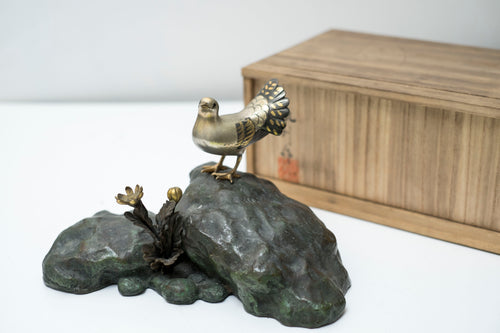


Toshisaku Signed Bronze Dove Okimono on Flowering Rock, Gold-Toned Highlights, 20th Century, Original Kiri Box
Toshisaku Signed Bronze Dove Okimono on Flowering Rock, Gold-Toned Highlights, 20th Century, Original Kiri Box
- Dispatch
- Prepared and sent from Tokyo within 7–14 days, often sooner, or as arranged
- Arrival
- United States · usually 4–7 days after dispatch, insured and tracked Check the Shipping Flowchart here
- Shipping
- EMS recommended, with FedEx, DHL and UPS compared ·
- Import
Duties and customs · View the estimate
A guide for this piece: about $59, based on the 10% US charge on the declared value of goods made in Japan.
The final figure is set by US Customs and depends on where the piece was made and the kind of object it is. Many antiques over a century old carry no ordinary duty; most jewellery and leather goods add a single-digit rate.
With EMS, any charge is collected by your postal service on delivery. For pieces of significant value we can often arrange duties prepaid before dispatch.
Your customs authority: U.S. Customs and Border Protection (CBP), CBP Information Center · +1 877 227 5511 within the United States; +1 202 325 8000 from abroad (Monday to Friday, 8:30 to 17:00 Eastern)
These figures are estimates for your guidance; the charge set by customs may come in over or under them.
How the estimate is reached · Ask for a figure on this piece
- Character
- Scoring underway ·
- Replies
- Within one Tokyo business day · Ask the curator team
- Guarantee
- Authenticity guaranteed · How we grade
Every piece is measured by hand, in centimetres as Japan measures. Please allow 1–2 cm (about ½ inch) for the give of the material and the hand that held the tape.
Where each figure is taken · View the plate

Object, sculpture and ceramics
Couldn't load pickup availability
All sales are final. Please read our refund policy before purchase.
Considered offers only. The Desk replies personally to figures made in good faith; those set far below the asking price receive no reply.
Examined in Tokyo, one price, insured to your door. How buying from Japonista works · Join the Circle, free
A dove pauses on a weathered rock among wildflowers, its bronze body settled in stillness after movement. Signed Toshisaku and kept in its original kiri box, the sculpture unites close observation of nature, expressive metalwork and a Japanese preference for quiet symbolism over display.
The Piece
This substantial Japanese bronze depicts a dove poised on a naturalistic rock formation, surrounded by delicate flowering plants and warmed by gold-toned highlights. The bird stands calmly rather than taking flight; its settled posture, gently modeled feathers and grounded relationship with the rocky base give a feeling of stillness after movement, as though it has paused between one journey and the next. The blossoms soften the weight of the bronze, while the irregular stone-like foundation brings the weathered, organic character associated with wabi-sabi interiors.
The sculpture is built on a graceful contrast between weight and lightness. Bronze gives physical substance and permanence, yet the dove is modeled with a soft, alert presence, balanced naturally over the rock rather than fixed to a pedestal, while the flowers rising around the base add a second, smaller rhythm. From a distance it reads as a clear silhouette; up close, the feather work, the transitions between bird and stone, the modeled flowers and the interplay of darker patinated areas with brighter gold-toned accents reward attention. The bird's posture implies awareness without tension, suiting rooms meant for reflection, hospitality or rest.
Conceived as a fully dimensional object to be viewed from several angles, the piece shows why bronze suits animal sculpture: it carries both delicate feather texture and the heavier mass of rock in a single composition. The dark patina deepens recesses, gold-toned highlights draw the eye to selected contours, flowers and plumage, and changing light reveals different aspects of the modeling, soft daylight favoring the silhouette and directional light the feather work and relief.
Okimono are objects made principally to be observed for their craftsmanship, symbolism and sculptural presence, and this dove belongs naturally within that tradition: compact enough for a shelf, console, alcove or desk, yet substantial enough at nearly 24 cm wide to carry the authority of a freestanding sculpture. Its patinated metal, irregular stone and quiet subject give it a strong wabi-sabi sensibility, an appreciation for natural variation, modest beauty and surfaces that show the passage of time, so it sits naturally beside aged wood, handmade ceramics, linen and stone. The sculpture is undated; its naturalistic construction, gold-toned detailing, signed presentation and original box are consistent with twentieth-century Japanese metalwork, possibly Shōwa period or later, and no narrower date or Meiji-period status is claimed.
Details
- Artist: Signed Toshisaku
- Era: Undated, 20th century; possibly Shōwa period or later
- Origin: Japan
- Material: Bronze; dark patina with gold-toned highlights
- Subject: Dove perched on a flowering naturalistic rock
- Measurements: Width approx. 24 cm / 9.45 in · Depth approx. 13 cm / 5.12 in · Height approx. 13 cm / 5.12 in (approximate; may vary slightly by measuring point)
- Weight: Approx. 1.9 kg / 4.19 lb, including the wooden box
- Included: Original wooden storage box, described as kiri (paulownia) wood
- Style: Naturalistic Japanese decorative metalwork; okimono
Condition
- The sculpture and its original wooden box are offered in their present pre-owned condition, as photographed.
- The bronze may display natural patina, tonal variation, small handling marks, light rubbing or subtle changes to the highlighted areas.
- The wooden box may show storage wear, surface marks, softened edges or natural variation associated with age and use.
- The photographs form an important part of the description and show the exact sculpture, signature, finish, floral details, base and box; colors may vary slightly with lighting and screen settings.
Dove Symbolism
Across modern visual culture the dove has become one of the most recognizable emblems of peace, and its pale plumage, gentle behavior and lifelong pair bonding have given it a wider set of meanings. In Japanese the bird is hato (鳩), and it holds an older place in religious imagery: at shrines dedicated to Hachiman, doves have traditionally been revered as divine messengers, and dove imagery can still be found at Hachiman shrines such as Miyake Hachimangū in Kyoto. Here the dove remains a living bird within a landscape, so peace appears not as a slogan but as a balance between creature, earth, stone and growing flowers; perched high on the rock, it occupies a threshold between earth and open air.
The base is essential to that reading. The rock suggests stability, patience and continuity; the flowers seasonality, change and the brief beauty of living things; the dove, between them, peace, freedom and spiritual presence. Because the symbolism is gentle and widely understood, the piece suits a wedding or anniversary, housewarming, retirement, reconciliation, remembrance or new chapter without asking adherence to any particular faith.
- Peace and reconciliation
- Love and emotional fidelity
- Purity and sincerity
- Freedom and safe passage
- Hope following hardship
- Domestic harmony
- Spiritual protection
- Renewal and new beginnings
Kiri Box and Display
Kiri boxes are valued in Japan because paulownia is lightweight, relatively stable and protective, and they house ceramics, bronzes, lacquer, textiles and tea utensils. The original box protects the bronze in storage and transit, preserves the relationship between object and maker, and distinguishes the work from an unboxed figure; in Japanese collecting culture it becomes part of the artwork's history.
The dove serves as a quiet focal point in a meditation room, study, tea room, minimalist office, wellness studio, remembrance area, natural wood alcove or collector's bronze cabinet. For restraint, set it alone on dark wood, stone or linen; for a seasonal arrangement, pair it with a small ceramic vase, a single flowering branch, an incense vessel or a hanging calligraphy, leaving open space so the silhouette and horizontal rock remain clear.
Authenticity & Care
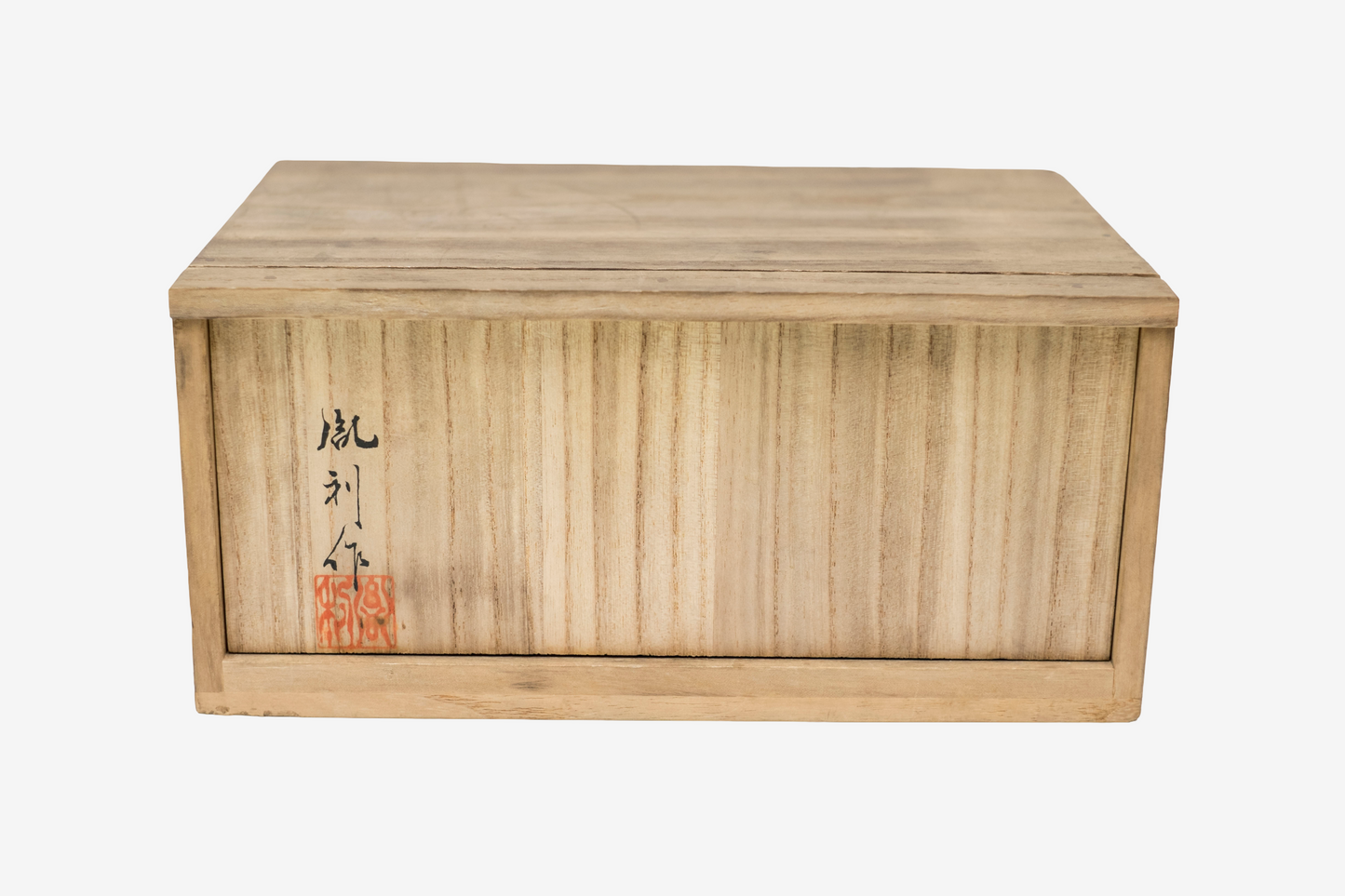
The sculpture bears an artist's signature read as Toshisaku. With no dated certificate or documented biography, it is presented conservatively as a signed Japanese work rather than assigned to a specific school, foundry or movement; any box inscriptions, seals or labels are retained as part of its history. Every piece is examined and documented in Japan before dispatch and is offered with the Japonista authenticity guarantee.
Delivery from Japan
Packed by hand in Japan and shipped insured and tracked by EMS or an equivalent express service. Import duties and taxes, where applicable, are payable on arrival. Every sale is final; please ask anything you wish to know before you buy, and see our published policy.
Considered offers are welcome through Send an Offer, and each one is reviewed personally.
Continue browsing: Okimono
Cabinet of Curiosities
Okimono, netsuke and precious-metal miniatures surface rarely. Tell us the subject, material or carver you collect, and the Hunting Salon™ will search Japan for it. Begin a Hunting Salon™ request →
Collectors also search: japanese bronze dove sculpture · toshisaku bronze · signed japanese bronze bird · bronze dove okimono kiri box · hato dove statue japan · wabi sabi bronze bird · japanese bronze bird on rock


Chosen for you