Tailor Toyo
Tailor Toyo USS Ingersoll DD-652 Reversible Sukajan, Yokosuka Tiger & Serpent Embroidery, Satin, Size M
Tailor Toyo USS Ingersoll DD-652 Reversible Sukajan, Yokosuka Tiger & Serpent Embroidery, Satin, Size M
Couldn't load pickup availability
Have a reasonable price in mind? Submit your best offer and our concierge will review it personally.
One face roars like an old tattoo flash panel, a tiger locked in the coils of a serpent beneath “Yokosuka.” The other reads as a sailor’s embroidered travel record: Mount Fuji, a pagoda, four national flags and the name of the destroyer USS Ingersoll DD-652. Built around a named ship, this vintage-era Tailor Toyo jacket is a textile itinerary of the postwar Pacific.
The Piece
A remarkable vintage-era Tailor Toyo reversible sukajan presenting two complete embroidered compositions within one garment. The crimson-and-silver face is immediate, theatrical and fiercely graphic, at home in the world of Japanese tattoo imagery, rockabilly tailoring and delinquent cinema; the midnight-navy face is historical and narrative, closer to a traditional serviceman’s tour jacket. It is not simply a generic dragon-and-tiger jacket but a garment constructed around a named United States Navy destroyer, Yokosuka port culture and the multinational geography of a Cold War-era Pacific tour.
The crimson back is dominated by an immense orange tiger twisting through the coils of a green, black and gold serpent. The tiger’s mouth is open, teeth exposed and front paws raised in resistance, while the serpent loops through and around it in a continuous spiral of muscle, scales and movement. “Yokosuka” is embroidered in pale script across the shoulders; angular gold lightning strikes across the left of the composition, and a cluster of crimson and pink roses grows from the lower right. Within East Asian visual culture the tiger stands for courage, physical force, authority and protection; because wild tigers are not native to Japan, artists long built the animal from imported paintings, stories and imagination, which produced the expressive tiger of folding screens, tattoos and souvenir jackets. The serpent brings transformation, danger, rebirth, instinct and hidden strength, so the scene becomes a collision of two kinds of power, with danger, beauty and mortality compressed into one emblem.
On the red front, a pale eagle with extended wings descends above a red rose on each side of the chest, a mirrored arrangement that leaves the zipper clear and brings an American emblem into the Japanese composition. Silver satin sleeves frame the red body, narrow red insert panels run along the outer arms, and beige rib-knit trim striped in red and green finishes the neckline, cuffs and waistband.
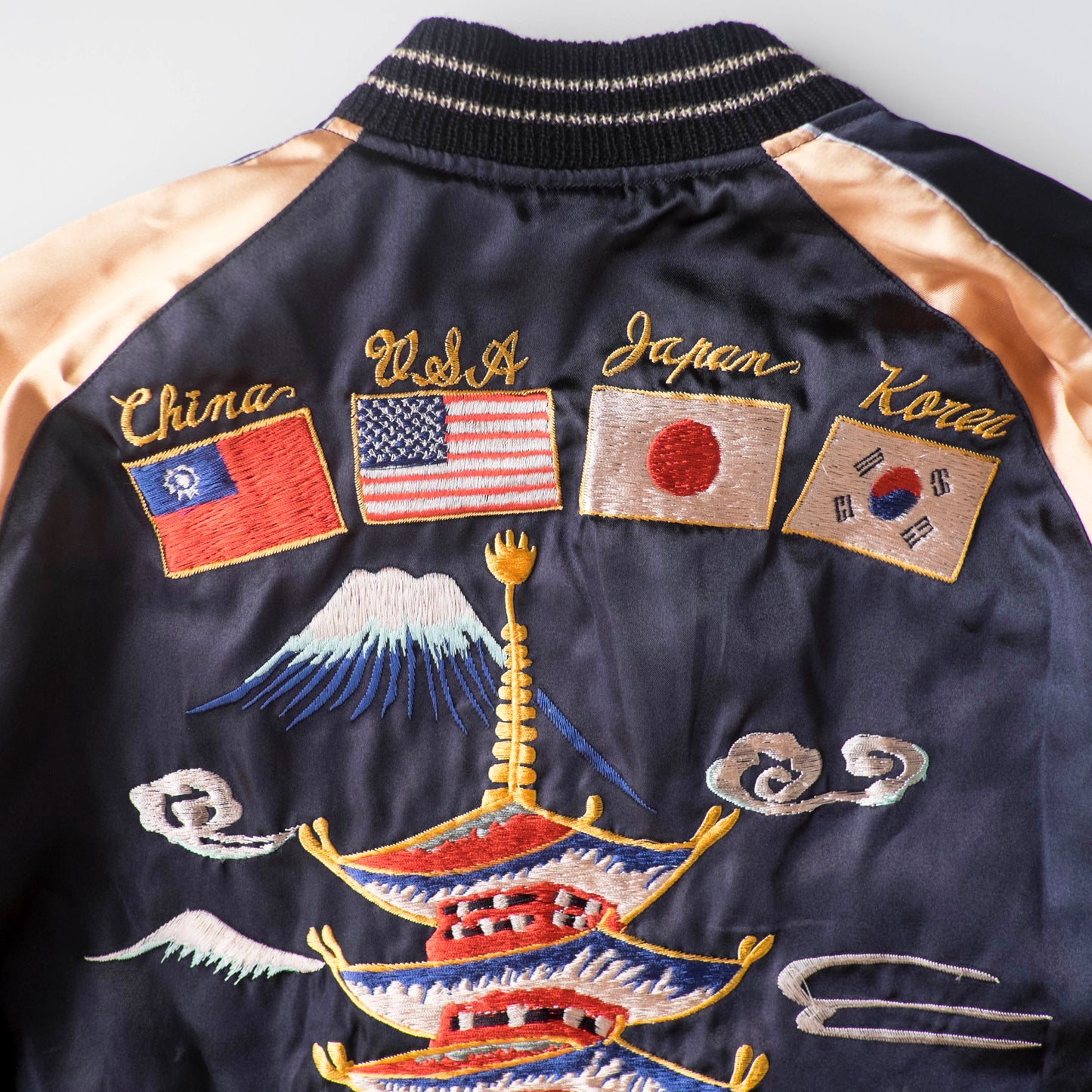
The navy reverse, with champagne-gold sleeves, is organized around the inscription China · U.S.A. · Japan · Korea, each name above its flag: the Republic of China, the United States, Japan and South Korea. Below, Mount Fuji in blue and white rises behind a multilevel pagoda worked in red, gold, blue and white thread, surrounded by pale clouds, pink foliage and flowering trees, and the lower inscription reads U.S.S. Ingersoll DD-652. USS Ingersoll was a United States Navy destroyer that arrived at Yokosuka in September 1953 and operated with Task Force 77 off Korea before continuing through the Formosa region and other ports during a global deployment, so the flags align with the ship’s documented Far Eastern service and work almost like passport stamps. The landscape is idealized rather than a precise location: Fuji for permanence, distance and Japan itself, the pagoda for architecture, spirituality and layered rooflines.
The navy front carries two opposing dragon heads, each emerging above a small red rose with flame-like horns, flowing whiskers and heavily outlined jaws, echoing the eagles of the red side while shifting from American heraldry to East Asian mythology. Black inserts travel from the collar along the raglan seams and outer arms. Both faces are genuinely finished exteriors, each with complete front motifs, large back artwork, functional angled pockets, finished seams, satin body and sleeves and its own rib treatment (cream, red and green stripes on the red side; darker black and pale metallic stripes on the navy side), so that when the jacket is worn partly open, fragments of the opposite artwork show through the center.
Details
- Maker: Tailor Toyo (テーラー東洋), Toyo Enterprise
- Model: Catalogue number not visible in the photographs; design identified by its Yokosuka tiger-and-serpent and USS Ingersoll DD-652 compositions
- Era: Vintage-era Tailor Toyo archive production, likely late twentieth or early twenty-first century; exact year not confirmed
- Origin: Japanese brand
- Material: Smooth, reflective satin with dense machine embroidery; fiber percentage not legible on the label, so presented as satin rather than silk (drape and sheen consistent with acetate or rayon-based textiles). Multicolor embroidery thread, rib-knit trim, woven pocket interiors, textile reinforcement beneath dense embroidery, contrasting piping and sleeve inserts
- Color: Face A: crimson red body with silver sleeves. Face B: midnight navy body with champagne-gold sleeves
- Size: M (tagged; separate size tab)
- Measurements: Chest width, armpit to armpit, 58 cm / 22.8 in (approx. circumference 116 cm / 45.7 in) · Body length 61 cm / 24.0 in · Sleeve length, center back neck to cuff, 80 cm / 31.5 in (approximate, laid flat; raglan construction, so no shoulder seam measurement)
- Construction: Fully reversible; raglan sleeves; reversible metal zipper; angled welt pockets on both faces
- Gender: Unisex
Condition
- Pre-owned vintage condition with natural age-related character; the major tiger, serpent, eagle, dragon, pagoda, flag and USS Ingersoll embroideries remain vivid and visually complete.
- Creasing and rippling throughout both satin faces, light surface marks and tonal variation, and minor fading or uneven sheen from storage and prior wear.
- Minor thread pulls or raised embroidery fibers, possible small snags or loose fibers around the sleeves, and natural puckering around the densest embroidery.
- Gentle abrasion around the pocket openings and zipper areas; light wear and softening to the rib-knit trim; patina and surface variation on the metal zipper.
- No large structural tear or major missing embroidered section is apparent. As a vintage satin garment it does not have the perfectly smooth surface of unworn modern outerwear; the photographs form an essential part of the condition record.
Maker History
Yokosuka is essential to the identity of the sukajan: the port city’s relationship with American naval personnel after the Second World War helped establish the souvenir jacket as a cross-cultural garment. Toyo Enterprise traces the beginning of the souvenir-jacket tradition to the late 1940s; its predecessor was involved in the postwar production and export of embroidered jackets for American military personnel, and Tailor Toyo, its souvenir-jacket division, reproduces archived designs, materials and embroidery styles drawn from historic examples.
The older label style, embroidery character, rib construction and unusual ship-specific design are consistent with Tailor Toyo jackets made before the company’s more recent numbered seasonal releases, likely from its earlier revival production. The most responsible attribution is a vintage-era Tailor Toyo reversible USS Ingersoll DD-652 sukajan, likely of late twentieth or early twenty-first century production, reproducing a substantially earlier postwar and Cold War tour-jacket aesthetic.
Fit Guidance
The jacket keeps the traditional Japanese sukajan silhouette: a moderately broad chest, compact body length, raglan shoulders, gathered ribbed waistband, relaxed upper sleeves and an athletic bomber profile. It may wear relaxed on many Western small frames, regular on many Western medium frames and comparatively fitted on some larger medium frames; the body is intentionally shorter than many contemporary Western jackets, so compare the measurements with a jacket that fits comfortably.
The red face suits black denim, leather trousers, wide charcoal pants, engineer boots, high-top sneakers and plain black tees, from rockabilly and punk to Japanese biker and neo-noir looks. The navy face is quieter, pairing with raw indigo denim, khaki military trousers, cream chinos, loopwheel sweatshirts, chambray, work boots and ivy or amekaji pieces. Displayed flat, each back reads as a separate embroidered composition.
Authenticity & Care
A vintage-style Tailor Toyo woven label inside shows Japanese characters, Mount Fuji and a torii-inspired red emblem, with a separate size tab reading M. This is a later Tailor Toyo reproduction or archive interpretation, not an original jacket commissioned aboard the destroyer. Every piece is examined and documented in Japan before dispatch and is offered with the Japonista authenticity guarantee.
Delivery from Japan
Packed by hand in Japan and shipped insured and tracked by EMS or an equivalent express service. Import duties and taxes, where applicable, are payable on arrival. Returns follow our published policy.
Considered offers are welcome through Send an Offer, and each one is reviewed personally.
Continue browsing: Sukajan Souvenir Jackets · Amekaji & Wagara Fashion
Related pieces: Tailor Toyo Japan map velveteen reversible sukajan · Tailor Toyo TT11592 Misawa Black Dragons sukajan · Tailor Toyo TT11283 USMC Okinawa reversible sukajan
Yokosuka Archive
A particular size, motif or decade in mind? Postwar souvenir jackets and heritage amekaji surface in Japan one at a time. Name the maker, the embroidery and the chest measurement, and the Hunting Salon™ watches for it on your behalf. Request a jacket search →
Collectors also search: tailor toyo uss ingersoll · uss ingersoll dd-652 jacket · tiger and snake sukajan · yokosuka tiger serpent jacket · reversible sukajan size m · navy tour jacket japan · vintage tailor toyo sukajan · mount fuji pagoda sukajan