Rare Vintage, Antiques and Art Collector / Curator / Personal Shopper From Japan
Rare 2007 Tailor Toyo TT11283 Yokota U.S. Air Force Skull Pilot Reversible Sukajan Jacket
Rare 2007 Tailor Toyo TT11283 Yokota U.S. Air Force Skull Pilot Reversible Sukajan Jacket
Couldn't load pickup availability
Have a reasonable price in mind? Submit your best offer and our concierge will review it personally.
“Eddie” 1958–1959 Yokota Air Base Souvenir Jacket with Geisha, Pagoda, Dragons, Mount Fuji and Sakura Embroidery
A remarkable Tailor Toyo TT11283 fully reversible sukajan built around the visual language of an exceptionally personal 1950s military souvenir jacket.
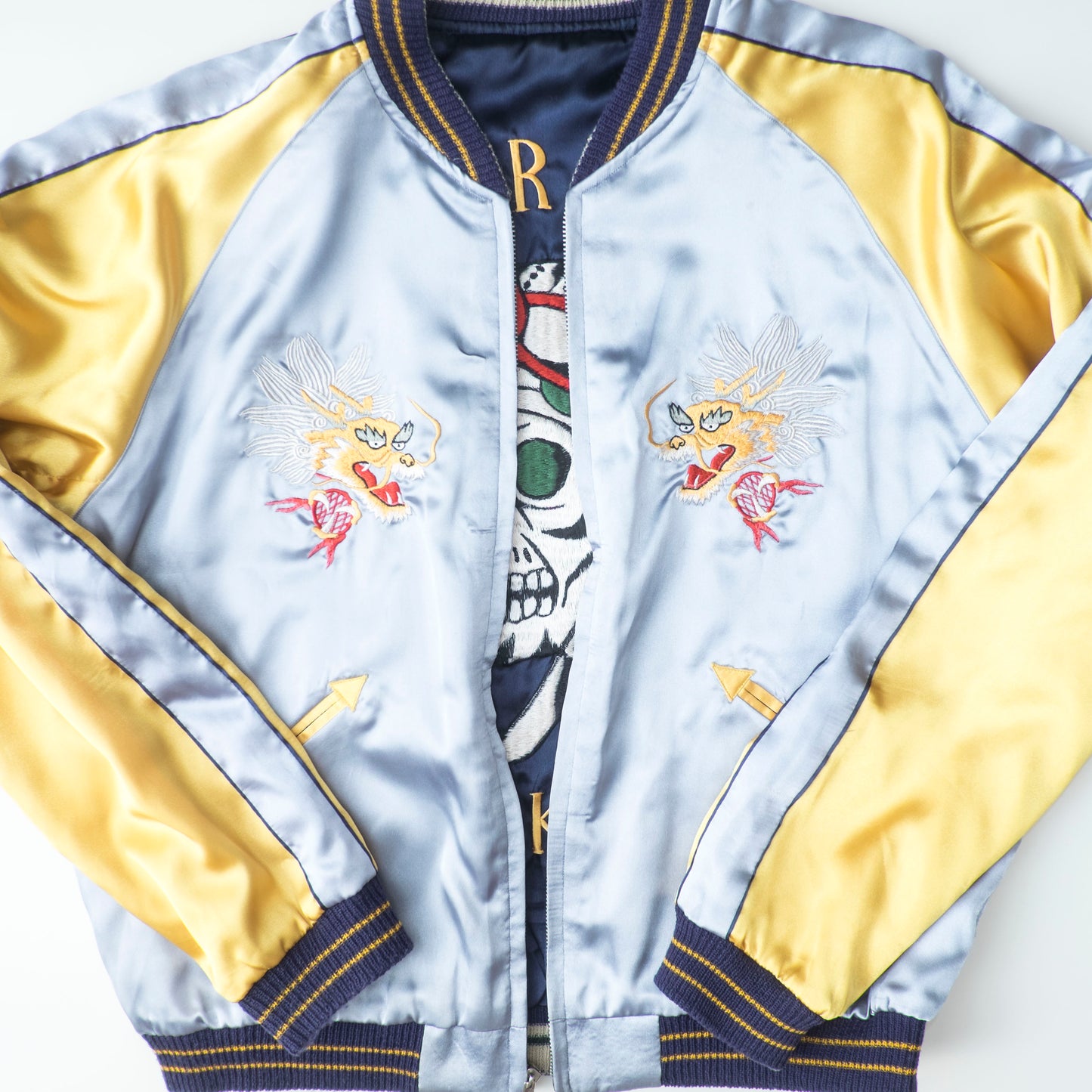
The midnight-navy face recreates a named “Eddie” Yokota Air Base jacket, crowned by a grinning aviator skull beneath the words “U.S. Air Force”, the dates 1958–1959, and “Yokota.” Reverse the garment and the atmosphere changes completely: pale silver-blue satin and golden-yellow sleeves become a luminous Japanese panorama filled with a geisha, dragons, Mount Fuji, a five-story pagoda, cherry blossoms and ornamental clouds.
This discontinued TT11283 configuration is commonly cataloged as a 2007 Tailor Toyo release and is recognized among collectors by its Yokota skull-pilot and Japan-landscape combination.
A Wearable Record of Postwar Japan
This jacket does more than place Japanese imagery on a bomber silhouette. It recreates the cultural collision from which the sukajan emerged.
One side speaks in the language of the American serviceman:
- U.S. Air Force lettering
- Yokota base identification
- The personalized name “Eddie”
- 1958 and 1959 commemorative dates
- A helmeted aviator skull
- Eagle-and-snake military-style imagery
- Restrained navy and dusty-pink satin
The other side becomes an embroidered dream of Japan:
- Mount Fuji
- A five-story pagoda
- A kimono-clad woman
- Japanese dragons
- Sakura blossoms
- Decorative clouds
- Brilliant yellow sleeves
- Pale silver-blue satin
- Embroidered “Japan” script
It feels like a veteran’s memory album compressed into satin and thread: military service on one face, the country experienced beyond the base gates on the other.
Identification
Brand: Tailor Toyo / Toyo Enterprise
Model Number: TT11283
Approximate Release: 2007
Garment Type: Reversible Japanese sukajan / Yokosuka souvenir jacket
Primary Face: Navy body with pale pink sleeves
Reverse Face: Silver-blue body with golden-yellow sleeves
Primary Back Motif: U.S. Air Force Yokota aviator skull, 1958–1959
Reverse Back Motif: Geisha, pagoda, Mount Fuji, dragons and cherry blossoms
Front Motifs: Eagle and snake, “Eddie / エディ,” paired dragons
Construction: Fully reversible satin bomber
Sleeves: Raglan construction
Closure: Reversible metal zipper
Pockets: Angled welt pockets on both wearable faces
Trim: Striped rib-knit collar, cuffs and waistband
Embroidery: Dense multicolor machine embroidery
Era Represented: Late-1950s Yokota Air Base souvenir-jacket culture
Production Era: Early 21st-century Tailor Toyo heritage reproduction
Size: Details to follow shortly; please message us for priority confirmation
Japanese resale and collector records identify this exact combination as TT11283, describing the Yokota skull side together with the geisha and five-story-pagoda reverse.
Face One: U.S. Air Force Yokota 1958–1959
Navy and Dusty-Pink Satin
The darker face uses a deep midnight-navy body with muted blush-pink raglan sleeves. Navy racing stripes run down the sleeves and are edged with fine contrasting piping.
The palette is unusually sophisticated for a military-themed sukajan. Rather than relying on bright red, black or olive, the design balances severe military lettering with soft pink satin, giving the jacket a faded postcard atmosphere.
Cream rib-knit trim with navy and green striping frames the neck, wrists and hem. The aged collegiate palette reinforces the impression of a late-1950s base jacket.
Eddie and the Eagle-Snake Emblem
The front presents two individualized chest designs.
“EDDIE / エディ”
The right chest is embroidered with:
EDDIE
エディ
This bilingual name treatment gives the jacket the intimate character of a personalized tour garment rather than a generic fashion bomber.
The English name records the owner identity associated with the source design, while the katakana translation anchors it within Japan. The pairing feels almost conversational: an American name translated into the visual language of the country where the jacket’s story takes place.
Eagle and Snake
The opposite chest carries a compact emblem of an eagle entangled with a striped snake.
The eagle’s wings, dark brown plumage and open beak introduce military heraldry, while the green, red and white serpent gives the motif the dramatic intensity of traditional tattoo imagery.
The snake curls vertically around the bird, allowing a complex narrative to occupy a relatively small chest panel. It can be read as struggle, danger, conquest or survival, themes that appear repeatedly throughout military souvenir art.
The Yokota Skull-Pilot Back
The primary back composition is the jacket’s thunderclap ⚡
Arched across the shoulders is the inscription:
U.S. AIR FORCE
Below it sits an oversized skull wearing an aviator helmet, ear protection and vivid red flight goggles. The numbers 58 and 59 flank the skull, while YOKOTA is embroidered beneath.
The composition includes:
- White aviator skull
- Deep green eye sockets
- Red-framed goggles
- Green helmet padding
- White flight helmet
- Red buckle and hardware details
- Flowing chin strap
- Gold “U.S. AIR FORCE” lettering
- White 58 and 59 numerals
- Gold YOKOTA inscription
The skull is not rendered as a horror motif alone. Its flight helmet transforms it into a phantom airman, a grinning emblem of danger, speed, mortality and camaraderie.
In the context of a souvenir jacket, the design can be read as a playful memorial to life around an air base. The wearer is represented not through a realistic portrait but through a fearless skeletal pilot who remains permanently on duty.
Meaning of 1958–1959
The numerals appear to commemorate the period represented by the original personalized jacket, rather than the manufacturing date of this Tailor Toyo reproduction.
The late 1950s sit within the formative postwar period when military personnel stationed in Japan commissioned embroidered jackets as wearable records of their assignment, travels and personal identity.
The dates make this design more historically specific than a general “Japan” jacket. The back does not merely reference the U.S. Air Force. It evokes one serviceman’s particular Yokota chapter.
Yokota Air Base Context
Yokota Air Base is located west of central Tokyo and has occupied an important place in Japanese and American military history. The site began as a Japanese military airfield before the postwar period and later became closely associated with U.S. air operations in Japan.
The official base history records major periods of activity spanning the Occupation, Korean War, Cold War and later Pacific operations.
That background gives the embroidered word YOKOTA more weight than an ordinary location name. It connects this garment with the real geography behind the souvenir-jacket tradition.
Reverse Face: An Embroidered Vision of Japan
Silver-Blue and Golden-Yellow Satin
The reverse changes the jacket from a dark military bomber into a radiant piece of Japanese scenic art.
The body is rendered in a pale silver-blue satin that shifts between icy blue, pearl gray and lavender depending on the light. The sleeves are a rich golden yellow, edged with narrow navy piping.
This brighter face feels intentionally optimistic and decorative. Where the Yokota side is bold, personal and slightly macabre, the reverse is romantic, theatrical and filled with traditional travel imagery.
Paired Dragon Front
The chest features two small dragons facing inward.
Each dragon is embroidered in pale gold, silver, pink and red, with:
- Open mouth
- Curled whiskers
- Flowing mane
- Clawed limbs
- Small jewel or flaming-pearl motif
- Soft cloud-like forms
The mirrored placement creates balance around the zipper and gives the wearer a symmetrical guardian pair.
Unlike the more fearsome dragons often found on black sukajan, these have a whimsical, almost illustrated quality. Their pale coloring allows them to float across the silver-blue satin rather than dominate it.
Arrow-shaped pocket trims in golden yellow repeat the sleeve color and point upward toward the dragons.
The Japan Landscape Back
The reverse back is a densely layered panorama crowned by the embroidered word:
Japan
Below it unfolds a stylized collection of recognizable Japanese motifs.
Mount Fuji
A pale blue Mount Fuji rises in the distance, its snow-covered peak rendered in cool blue and white thread.
Fuji acts as the horizon line and visual anchor, establishing the composition as an idealized image of Japan rather than one specific literal view.
Five-Story Pagoda
A red, white and gold pagoda occupies the center.
Its stacked roofs rise vertically through the composition, creating an architectural counterpoint to the distant triangular mountain. It reads like the centerpiece of a mid-century travel postcard.
Kimono-Clad Woman
A woman in a patterned kimono stands to one side holding an open folding fan.
Her garment combines red, pink, purple and black thread with floral and geometric patterning. The figure brings human presence into the landscape and reflects the familiar geisha or maiko imagery popular in postwar souvenir art.
Dragons
Two dragons move through the upper portion of the scene, surrounded by stylized flowers and clouds.
Their placement introduces mythological energy into an otherwise peaceful landscape. They appear not as destroyers, but as spirits inhabiting the air above Fuji and the pagoda.
Cherry Blossoms
Pink and red sakura flowers frame the lower and upper sections.
Cherry blossom imagery contributes a seasonal atmosphere of spring, impermanence and beauty, while also introducing warm color into the cool silver background.
Two Narratives in One Jacket
This jacket offers four distinct presentations:
1. Eddie and Eagle-Snake Front
Personalized, military-influenced and relatively restrained.
2. Yokota Skull-Pilot Back
Graphic, historical and unforgettable.
3. Paired Dragon Front
Balanced, decorative and unmistakably Japanese.
4. Geisha, Pagoda and Fuji Back
A full souvenir landscape dense with Japanese travel iconography.
The contrast is enormous.
The navy face looks like a private Air Force club jacket recovered from a smoky 1950s bar. The silver-and-yellow face feels like an embroidered dream sequence from a vintage Japan travel poster.
That transformation is the heart of this piece.
Tailor Toyo Heritage
Tailor Toyo is the souvenir-jacket division of Toyo Enterprise and has built its identity around recreating and preserving the visual vocabulary of historic Japan jackets.
The brand continues to catalogue sukajan by period, material, construction and original-style subject matter, including military insignia, tigers, dragons, eagles, skulls, ships, maps and Japanese landscapes.
Tailor Toyo’s own historical materials describe sukajan as garments developed from embroidered souvenirs commissioned during the postwar occupation period. The company has also documented details such as traditional embroidery patterns and Yokoburi-style techniques.
This TT11283 should therefore be understood as a heritage revival, not as an original jacket manufactured in 1958 or 1959.
Its value lies in the way it reconstructs a highly specific historical design while remaining a wearable Japanese street-fashion piece from the 2000s.
Period Assessment
Discontinued 2007-Era TT11283
Collector references consistently place TT11283 within Tailor Toyo’s 2007 production period.
The model number was used across several color and motif combinations, making the complete design description important when identifying an example.
This particular configuration is distinguished by:
- Yokota U.S. Air Force skull pilot
- Eddie / エディ chest inscription
- 1958–1959 dates
- Eagle and snake emblem
- Silver-blue and yellow reverse
- Geisha or maiko figure
- Five-story pagoda
- Mount Fuji
- Paired dragons
- Cherry blossoms
It is now an approximately two-decade-old Japanese collector garment rather than a currently produced seasonal jacket.
Materials and Construction
Visible features include:
- Glossy synthetic satin
- Fully reversible construction
- Raglan sleeves
- Reversible metal zipper
- Rib-knit collar
- Rib-knit cuffs
- Rib-knit waistband
- Angled welt pockets on both sides
- Arrowhead pocket decorations
- Contrasting sleeve panels
- Narrow piping
- Dense multicolor embroidery
- Short traditional sukajan silhouette
- Coordinated artwork on all four principal surfaces
TT11283 examples are commonly documented as polyester satin constructions, although the exact fiber composition of this individual jacket should be confirmed from its care label when available.
Embroidery and Graphic Character
The embroidery varies intentionally between the two sides.
The navy face uses thicker lines and bold blocks of white, red, gold and green. Its subjects must be readable at a distance, particularly the skull and the large U.S. Air Force inscription.
The silver face relies on lighter, more delicate thread colors:
- Pale pink
- Lavender
- Light blue
- Ivory
- Gold
- Soft red
- Muted purple
This gives the reverse a faded, ethereal quality.
The different embroidery densities also affect how the satin moves. Areas around the skull, pagoda, dragons and kimono figure naturally show slight puckering and texture, characteristic of heavily embroidered lightweight cloth.
Condition
Pre-Owned Vintage Condition
This jacket dates from the 2000s and displays the natural characteristics expected from a pre-owned satin souvenir jacket.
Visible features in the supplied photographs include:
- General satin creasing and storage wrinkles
- Light surface rippling
- Natural puckering around embroidery
- Minor thread irregularities
- Slight tonal variation under direct light
- Gentle wear to rib-knit trim
- Possible mild discoloration or age toning to pale ribbing
- Light handling wear around cuffs, hem, zipper and pocket openings
- Minor surface rubbing consistent with previous use
The principal embroidery remains vivid and legible. The Yokota skull, Eddie lettering, eagle, snake, dragons, pagoda, geisha and Mount Fuji compositions retain strong definition.
No major tear, catastrophic fabric loss or missing embroidered panel is immediately visible in the supplied images.
Please examine all photographs carefully. They form an essential part of the listing and condition record.
Because satin reflects light dramatically, the colors may appear different under flash, direct sunlight, indoor light or different screens. The body may read as navy, dark indigo or blue-purple, while the reverse may appear silver, pale blue or lavender-gray.
Size and Fit
The exact tagged size and flat measurements will be added shortly.
Please message us if you need confirmation before the measurements are posted.
Tailor Toyo sukajan from this period often have:
- A compact Japanese body length
- Raglan shoulders
- A moderately relaxed chest
- Tapered rib-knit hem
- Shorter proportions than many modern Western bomber jackets
Recommended measurements for comparison include:
- Chest width, pit to pit
- Back length from collar seam
- Raglan sleeve length from center back
- Underarm sleeve length
- Hem width
- Cuff width
Please compare the actual measurements with a well-fitting jacket rather than relying only on a nominal Japanese size.
Visual Presence
The Yokota skull face is pure midnight electricity.
The dusty-pink sleeves soften the military graphics just enough to make the design unusual rather than predictable. The skull appears enormous against the navy satin, while the helmet, goggles and trailing strap give the figure motion.
The reverse is almost the visual opposite. Pale blue and golden yellow brighten the entire silhouette, and the scenic back rewards close inspection with small embroidered stories scattered throughout the landscape.
Worn open, the jacket becomes especially dramatic because the imagery of the opposite face appears around the zipper. The wearer can reveal fragments of the skull beneath the Japanese landscape or flashes of pagoda and sakura beneath the Yokota side.
Styling Possibilities
Yokota Skull Face
Pairs beautifully with:
- Black denim
- Faded indigo jeans
- Olive military trousers
- Engineer boots
- Combat boots
- White T-shirts
- Loopwheel sweatshirts
- Silver jewelry
- Punk and rockabilly styling
- Vintage military accessories
- Japanese motorcycle fashion
Japan Landscape Face
Works especially well with:
- Raw denim
- Cream trousers
- Wide-leg chinos
- White sneakers
- Brown leather footwear
- Neutral knitwear
- Chambray shirts
- Ivy-inspired layers
- Japanese amekaji
- Pastel streetwear
Collector Appeal
This is one of those sukajan that has several collector doors into it at once.
It appeals to:
- Tailor Toyo collectors
- Yokota Air Base memorabilia collectors
- U.S. Air Force history enthusiasts
- Military souvenir-jacket collectors
- Skull and aviator-art collectors
- Japanese amekaji enthusiasts
- Geisha and maiko motif collectors
- Mount Fuji collectors
- Dragon-embroidery collectors
- Vintage Japanese streetwear archives
- Early-2000s fashion collectors
- Reversible bomber enthusiasts
The personalization is particularly important.
Generic tigers and dragons can be found throughout sukajan production. A named Eddie jacket with specific 1958–1959 Yokota inscriptions has a more narrative quality. It feels connected to an individual imagined history rather than only to a decorative trend.
Display Potential
When not worn, the jacket can be displayed as reversible textile art.
The Yokota face would suit:
- Military-history rooms
- Aviation collections
- Tattoo studios
- Rockabilly interiors
- Japanese bars
- Streetwear boutiques
- Air Force memorabilia displays
The reverse would work beautifully in:
- Japanese restaurants
- Amekaji stores
- Fashion archives
- Travel-themed rooms
- Sukajan exhibitions
- Costume collections
- Photography studios
For long-term display, use a broad padded hanger or mannequin. Avoid wire hangers, direct sunlight, damp environments and prolonged pressure against the embroidery.
Purchase, Shipping and Vintage Policy
This is a unique pre-owned Japanese vintage garment offered in its present condition.
Vintage clothing may display fading, discoloration, fabric wear, weakened fibers, loose threads, embroidery irregularities, stains, storage marks, wrinkles, odors, pilling, rib wear, repairs and other evidence of age and previous use.
Please review all photographs carefully and request any additional details needed before purchase. The photographs form an integral part of the listing and condition description.
Because this is a unique pre-owned collectible, all sales are final. Returns, exchanges, cancellations, partial refunds and claims based on fit, personal color perception, expected vintage characteristics or condition details already visible or disclosed cannot be accepted, subject to applicable marketplace protections and consumer law.
Preparation, shipping and handling normally takes 5–10 business days or earlier.
Worldwide shipping is normally arranged through Japan Post EMS or another appropriate tracked international service. Tracking information will be provided after dispatch.
International buyers are responsible for customs duties, import taxes, brokerage charges and other destination-country fees where applicable.
Respectful and realistic offers may be considered. Flexibility depends on rarity, condition, collector interest and replacement availability.
If you are looking for this design or model in another size, please feel free to message us. Although availability cannot be guaranteed, we may be able to locate the same or a closely matching piece in a different size through our sourcing network.
#TailorToyo #TT11283 #YokotaSukajan #YokotaAirBase #USAirForceJacket #SkullPilot #AviatorSkull #EddieJacket #ReversibleSukajan #JapaneseSouvenirJacket #VintageSukajan #JapanJacket #GeishaJacket #MaikoEmbroidery #PagodaJacket #MountFuji #DragonJacket #SakuraEmbroidery #JapaneseBomber #EmbroideredJacket #Amekaji #JapaneseStreetwear #VintageJapanese #SouvenirJacket #WearableArt #MilitaryJacket #AirForceMemorabilia #SukajanCollector #ToyoEnterprise #JapanVintage
tailor toyo, tt11283, yokota sukajan, skull pilot jacket, reversible sukajan, air force jacket, japan souvenir, geisha jacket, dragon embroidery, vintage sukajan, embroidered bomber, amekaji jacket, japanese streetwear
Material Tags
polyester satin, synthetic satin, embroidery thread, rib-knit trim, metal zipper, reversible construction, multicolor embroidery, woven ribbing, satin bomber fabric