Rare Vintage, Antiques and Art Collector / Curator / Personal Shopper From Japan
Rare 戦武 Senbu Reversible Sukajan Jacket – Dairokuten Maou Snake Sword Skull Embroidery Japanese Wagara Souvenir Bomber
Rare 戦武 Senbu Reversible Sukajan Jacket – Dairokuten Maou Snake Sword Skull Embroidery Japanese Wagara Souvenir Bomber
Couldn't load pickup availability
Have a reasonable price in mind? Submit your best offer and our concierge will review it personally.
Dramatic “Sixth Heaven Demon King” Double-Sided Japanese Embroidered Jacket with Serpent-Wrapped Sword, Skull, Flames, Roses, Crossed Weapons & Dark Sengoku Bōsōzoku Art
A ferocious and unusually elaborate reversible Japanese sukajan / souvenir jacket by 戦武 (Senbu), built around the dark Dairokuten Maou / Sixth Heaven Demon King aesthetic and expressed through an extraordinary mixture of Japanese warlord symbolism, skull imagery, serpents, weaponry, flames, flowers, heraldic emblems and tattoo-art embroidery.
This is effectively two statement jackets in one.
One face explodes outward in high-contrast black and ivory, dominated by an enormous vertical composition of a serpent entwined around a sword or blade, skull imagery, fire, flowers and dense Japanese-style ornament. The pale sleeves become additional canvases for elaborate embroidery.
Reverse the jacket and the mood becomes almost entirely nocturnal: an all-black / charcoal tonal face decorated with skulls, roses, crests, crossed weapons and prominent SETTEN MAOU / 6TH OF THE DEVIL lettering.
The result sits somewhere between:
sukajan heritage, Japanese tattoo art, Sengoku warlord iconography, bōsōzoku attitude, gothic streetwear and elaborate wagara embroidery.
It is dark Japanese wearable art at full volume. 💀🐍⚔️🔥
Description
This 戦武 jacket belongs to the more aggressive end of Japanese wagara fashion.
Rather than relying upon the familiar souvenir-jacket vocabulary of Mount Fuji, eagles, tigers or cherry blossoms alone, it creates an entire dark mythology around the figure of the “Sixth Heaven Demon King.”
The imagery is layered rather than literal.
There is no simple portrait occupying the garment.
Instead, the design communicates power through symbols:
- serpent
- sword
- skull
- fire
- crossed weapons
- roses and flowers
- crests
- military-style typography
- dark heraldic graphics
- Japanese lettering
- extensive embroidered sleeve artwork
The jacket therefore works on two levels.
From a distance, it is an immediately powerful black-and-ivory sukajan.
Up close, it becomes a textile puzzle filled with small motifs, words, symbols and visual references.
And because it is reversible, the entire narrative changes when turned inside out.
Opening Story
There is something almost theatrical about the way this jacket reveals itself.
The black-and-ivory side announces itself first.
At the center of the back rises a long weapon, almost functioning as the spine of the whole composition.
Around it coils a serpent.
Below and around it appear skull imagery, flames and floral elements, while the surrounding embroidery spreads outward into the shoulders and sleeves.
Nothing is timid.
The pale sleeves deliberately amplify every stitch.
Then the jacket turns.
The high contrast disappears.
Black swallows nearly everything.
What remains is shadow embroidery, gothic lettering, skulls, roses, crossed weapons, heraldic emblems and the words associated with the Maou, the demon king.
The reverse does not feel like a secondary lining.
It feels like a second chapter.
Identification
Brand
戦武
The label visibly carries the Japanese characters 戦武, which may be encountered in Romanized resale descriptions as Senbu.
Garment Type
Reversible Japanese sukajan / souvenir jacket / embroidered bomber jacket
Design Theme
Dairokuten Maou / Sixth Heaven Demon King-inspired Sengoku imagery
Major Motifs
Serpent
Sword / blade
Skull
Flames
Flowers / roses
Crossed weapons
Heraldic emblems
Japanese lettering
“SETTEN MAOU” typography
“6TH OF THE DEVIL” wording
Dark Sengoku / warrior symbolism
Colorway
Face A: black body with ivory / cream sleeves and multicolor embroidery
Face B: predominantly black / charcoal with darker tonal embroidery and restrained accent colors
戦武 / Senbu
The visible 戦武 label fits the jacket exceptionally well.
The two characters themselves evoke martial imagery:
戦 relates to battle or war.
武 relates to the martial or warrior sphere.
Even without treating the name as a literal translation of the brand identity, the typography immediately reinforces the militaristic, Sengoku-inspired character of the garment.
The label artwork itself is elaborate, giving the piece an unmistakably Japanese wagara-fashion presentation rather than the anonymous construction of a generic souvenir jacket.
Face A – Black & Ivory Serpent Sword Side
Monumental Back Composition
The primary black-and-ivory face is built around an enormous vertically organized embroidered back design.
Rather than placing one conventional animal in the center, the composition develops upward around a sword or long blade.
A serpent winds through the structure, creating a continuous sense of movement.
The design is framed by darker floral and flame-like elements and additional ornamental embroidery.
The effect has much in common with irezumi-inspired Japanese tattoo composition, where multiple motifs interlock rather than simply sitting beside one another.
Serpent Symbolism
Snakes occupy an unusually rich position within Japanese imagery.
Depending upon context they can suggest:
- transformation
- regeneration
- danger
- persistence
- hidden power
- supernatural presence
- guardianship
- death and renewal
Their sinuous bodies also translate extraordinarily well into embroidery because they can weave naturally around weapons, flowers and other motifs.
Here the serpent does exactly that.
It does not appear merely beside the weapon.
It interacts with it, wrapping and climbing through the vertical composition.
Sword / Blade Motif
The blade functions as the architectural center of the design.
A sword naturally carries associations with:
- warrior culture
- resolve
- discipline
- conflict
- authority
- mortality
But visually it performs another role.
Its straight vertical axis contrasts against the twisting serpent.
One is rigid.
One is fluid.
That opposition gives the back design tremendous movement even though the garment itself is static.
Skull Imagery
The skull motif pushes the jacket firmly into darker Japanese streetwear territory.
Skulls have long crossed cultural boundaries between:
- Buddhist reflections upon impermanence
- memento mori imagery
- tattoo culture
- rock fashion
- biker clothing
- punk graphics
- contemporary wagara streetwear
Here the skull is not treated as an isolated gothic novelty.
It is integrated into the broader composition of weapons, serpents and flowers, creating a much richer visual language.
Flowers Against Death
One of the strongest aspects of the jacket is the tension between its aggressive subjects and its floral embroidery.
Flowers soften the composition visually, but symbolically they can also intensify it.
Beauty exists beside decay.
Growth beside death.
Soft petals beside sharpened steel.
This sort of contrast is one reason traditional Japanese-inspired tattoo and textile compositions remain so visually compelling.
Flame & Energy Motifs
Flame-like embroidered forms add further movement around the serpent and weapon imagery.
Against the black ground, these curved shapes behave almost like an aura around the central design.
They prevent the composition from becoming merely illustrative.
Instead, the entire back feels active.
Ivory Sleeve Embroidery
The pale sleeves are particularly important.
On many sukajan, the contrasting sleeve is primarily a color block.
Here the ivory fabric serves as an additional embroidered canvas.
The dark thread and multicolor motifs remain clearly visible against the cream ground, making the sleeves visually important even when the wearer is viewed from the side.
The garment therefore has nearly 360-degree visual interest.
Front – Black & Ivory Side
The front maintains the established contrast between a black body and ivory sleeves.
Instead of repeating the enormous back composition, the chest uses more compact emblematic motifs.
Visible decorative elements include:
- crest-like embroidery
- circular or heraldic insignia
- Japanese-inspired symbols
- sleeve embroidery
- strong black / ivory blocking
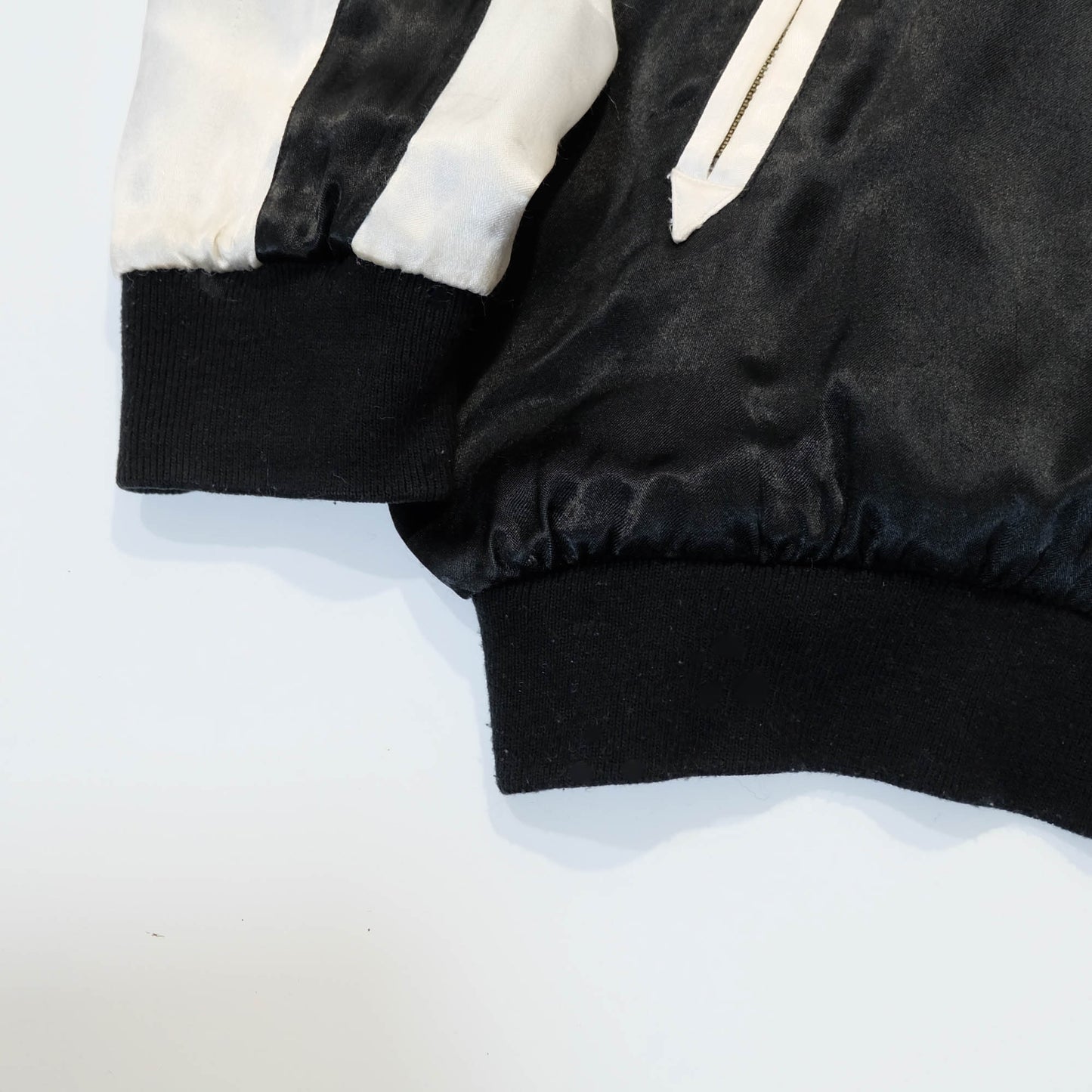
- striped rib-knit collar, cuffs and hem
- metal zip closure
This controlled front prevents the jacket from becoming visually exhausting.
The back remains the main spectacle.
Face B – Black “SETTEN MAOU” Side
Turn the jacket inside out and the visual language changes almost completely.
The second face is overwhelmingly black and charcoal, with the artwork deliberately rendered in lower contrast.
This gives it a stealthier, darker, almost military-gothic presence.
Dark Tonal Back
The reverse back contains an elaborate arrangement of:
- large lettering
- skull imagery
- roses
- heraldic emblems
- crossed weapons
- symmetrical insignia
- ornamental script
- Maou-related wording
The overall impression recalls an imaginary outlaw regiment or supernatural military order.
It is much less colorful than the serpent side but no less complex.
“SETTEN MAOU” Typography
Visible lettering prominently references:
SETTEN MAOU
The wording appears to be a stylized Roman-letter treatment tied to the garment's demon-king theme.
Rather than presenting the lettering simply as a logo, the design integrates it into an entire heraldic arrangement.
This combination of English / Roman lettering and Japanese visual motifs is characteristic of much Japanese subculture fashion, where Western biker, military and tattoo aesthetics are filtered through distinctly Japanese imagery.
“6TH OF THE DEVIL”
Another important visible phrase is:
“6TH OF THE DEVIL”
The English is unconventional, but that unconventional phrasing is itself part of the garment's Japanese street-fashion character.
It functions visually rather than as formal English prose.
The intended atmosphere is unmistakable:
Sixth Heaven / Demon King / dark ruler imagery.
Dairokuten Maou Inspiration
The jacket's Maou imagery strongly evokes the famous Japanese 第六天魔王 / Dairokuten Maō, commonly rendered in English as the “Demon King of the Sixth Heaven.”
Within Japanese popular culture, this phrase has become inseparable from dramatic Sengoku imagery and depictions of overwhelming warlord power.
The garment does not present itself as a museum-style historical reconstruction.
Instead, it transforms that vocabulary into modern fashion:
warrior symbolism becomes skulls,
military authority becomes crests,
battle becomes crossed weapons,
and the supernatural “Maou” becomes gothic embroidered streetwear.
Crossed Weapons
The reverse appears to incorporate a pair of crossed historical-style firearms / weapons into its heraldic artwork.
Crossed weapons are a classic visual device for:
- martial allegiance
- battle readiness
- brotherhood
- military identity
- outlaw insignia
In this context they add a distinctly Sengoku-meets-biker quality to the jacket.
Roses & Floral Gothic Imagery
The reverse also incorporates roses and other floral elements around the darker symbols.
This is another deliberate contradiction.
The skulls and weapons communicate mortality and violence.
The roses introduce beauty and decadence.
Together they recall tattoo art, rock graphics and Japanese motorcycle subculture more than conventional souvenir embroidery.
Heraldic & Crest-Like Details
Several small emblematic motifs appear across the black face.
These resemble military insignia, family-crests, club emblems or fictional heraldry.
That ambiguity is one of the jacket’s strengths.
Rather than requiring the viewer to recognize a single historical symbol, the jacket creates the sensation of belonging to its own imaginary warrior order.
Two Jackets, Two Moods
This is one of those reversible pieces where the two faces genuinely offer different wardrobes.
Black & Ivory Face
More traditional sukajan silhouette
Higher contrast
Large serpent and sword artwork
Japanese tattoo-art energy
More visible embroidery
Strong statement piece
Black Face
Dark tonal presentation
Gothic / biker character
Skulls and roses
Crests and weapons
Graphic typography
More understated from a distance
The reversible construction therefore offers real practical value rather than merely decorative novelty.
Sukajan Heritage
The sukajan developed as a Japanese souvenir jacket tradition known for elaborate embroidery and dramatic East-West visual combinations.
Over decades the category expanded well beyond souvenir imagery.
Modern Japanese brands have reinterpreted the format through:
- samurai themes
- Buddhist imagery
- demons
- skulls
- dragons
- manga
- tattoo art
- Sengoku warriors
- biker graphics
- contemporary subculture references
This 戦武 piece clearly belongs to that later, maximalist branch of the tradition.
It is less about tourism and more about identity.
Bōsōzoku & Japanese Biker Presence
Although this is a sukajan rather than a traditional bōsōzoku tokko-fuku coat, its attitude overlaps strongly with Japanese delinquent and motorcycle fashion.
The similarities lie in:
- oversized lettering
- dramatic back artwork
- martial symbolism
- customized visual identity
- dark intimidation
- crest-like emblems
- large sleeve graphics
- clothing functioning almost as a personal banner
That makes it particularly attractive to collectors of Japanese biker, yankii, punk and rock fashion.
Japanese Tattoo / Irezumi Influence
The serpent side in particular has a tattoo-like compositional structure.
Japanese tattoo imagery traditionally relies heavily upon the interaction of foreground subjects and surrounding elements.
A snake alone can feel illustrative.
A snake interacting with:
a blade,
flowers,
fire,
skulls,
and flowing decorative forms
becomes a complete visual environment.
The jacket applies that philosophy to embroidery.
Embroidery Density
This is not a jacket with a few decorative patches added to a plain shell.
Large portions of the garment are actively embroidered.
The artwork includes:
- large central back embroidery
- substantial sleeve embroidery
- multiple chest motifs
- reverse-side back graphics
- reverse-side front motifs
- text embroidery
- floral embroidery
- skull embroidery
- weapon imagery
- heraldic elements
The amount of visual labor is one of the strongest reasons to consider this piece collectible.
Construction
Visible construction includes:
- fully reversible design
- satin / rayon-style lustrous shell
- raglan-style sukajan silhouette
- metal front zipper
- rib-knit collar
- rib-knit cuffs
- rib-knit waistband
- contrasting sleeves on one face
- tonal black reverse
- slanted front pockets
- extensive direct machine embroidery
Exact fiber percentages should be confirmed from any additional care / composition label if available.
Color Palette
Serpent Side
Black
Ivory / cream
White
Gray
Red
Yellow / gold
Small multicolor accents
Dark Side
Black
Charcoal
Gunmetal gray
Muted brown / bronze
Subtle cream
Restrained accent colors
The two palettes make the reversible format especially successful.
Period Assessment
This piece appears consistent with modern Japanese wagara / sukajan production, rather than an original 1940s–1960s souvenir jacket.
Its graphic density, gothic lettering, embroidered skull treatment, brand identity and fashion-oriented reversible concept are characteristic of later Japanese reinterpretations of the sukajan tradition.
That does not diminish its collector appeal.
Quite the opposite.
Modern wagara pieces can become particularly desirable when the design is discontinued, unusually elaborate, difficult to locate overseas or associated with a memorable theme.
Condition
This is a pre-owned collectible Japanese garment.
From the supplied photographs, the jacket appears visually strong overall, with the embroidery retaining impressive definition and presence.
Natural characteristics associated with pre-owned satin-style sukajan may include:
- light wrinkling
- storage creases
- minor surface pulls or snags
- small embroidery irregularities
- occasional projecting threads
- light rib-knit wear
- gentle zipper patina
- minor signs of previous handling or wear
The glossy textile may also show changing highlights depending upon lighting and fabric direction.
This is normal for satin-like materials and can appear more dramatic in photography.
Please examine all photographs carefully because they form an essential part of the condition description.
Size & Measurements
Tagged size is not sufficiently visible in the supplied photographs.
Please message us for the latest confirmed tagged size and flat-lay measurements.
Recommended measurements include:
Chest / pit-to-pit
Back length
Sleeve length from collar
Hem width
Because traditional Japanese sukajan often use raglan sleeves, conventional shoulder measurements may not be as useful as sleeve length measured from the collar seam.
Japanese-market sizing can differ considerably from contemporary Western sizing.
For this reason, actual measurements should always take priority over the letter size.
Styling
The black-and-ivory side pairs particularly well with:
black denim
distressed jeans
engineer boots
combat boots
high-top sneakers
leather trousers
plain black T-shirts
Japanese biker fashion
rockabilly
punk
Visual Kei-inspired styling
Amekaji streetwear
The all-black face works exceptionally well with:
monochrome outfits
black cargos
wide trousers
dark denim
minimal sneakers
boots
silver accessories
leather layers
Despite the extraordinary artwork, the dark palette makes the jacket surprisingly wearable.
Display Appeal
For collectors who display sukajan rather than wearing them constantly, this jacket is particularly rewarding.
The black-and-ivory serpent face reads beautifully when displayed flat or on a wall because the pale sleeves visually frame the central artwork.
Turned around, the darker side becomes almost an embroidered gothic banner.
It would suit collections built around:
Japanese sukajan
Sengoku imagery
wagara fashion
skulls
snakes
Japanese tattoo art
biker clothing
bōsōzoku culture
Japanese rock fashion
embroidered wearable art
Distinctive Details
What makes this piece especially compelling is the sheer concentration of design:
戦武 / Senbu branding
Fully reversible construction
Dairokuten Maou-inspired theme
Huge serpent and sword back artwork
Skull imagery
Flames
Flowers
Ivory embroidered sleeves
Black tonal reverse
SETTEN MAOU lettering
“6TH OF THE DEVIL” graphics
Roses
Crossed weapons
Heraldic emblems
Dense chest embroidery
Extensive sleeve embroidery
Japanese tattoo-art composition
Sengoku / gothic crossover aesthetic
There is very little unused visual territory.
Yet because the two faces use very different color strategies, the jacket never feels like the same artwork simply repeated twice.
Why This Piece Stands Out
Many contemporary sukajan use one immediately recognizable motif.
Tiger.
Dragon.
Eagle.
Koi.
This jacket is much harder to reduce to one word.
It is a complete visual mythology.
The serpent alone could have carried the jacket.
The skull alone could have carried another.
The Dairokuten Maou concept could have carried a third.
Instead they have been layered together, then paired with an entirely different gothic reverse.
That complexity is what gives the piece unusual collector character.
For the international buyer searching for something darker and less predictable than the standard souvenir-jacket formula, this is an especially memorable example.
Purchase, Shipping and Vintage Policy
This is a genuine pre-owned collectible garment offered in its present as-is condition.
Vintage and pre-owned clothing may naturally exhibit light age-related or use-related characteristics such as creasing, minor surface marks, slight fabric pulls, subtle discoloration, small embroidery irregularities, projecting threads, rib-knit wear, zipper patina or other gentle evidence of previous ownership.
These characteristics should not automatically be interpreted as defects. They form part of the individual history and character of a pre-owned collectible garment.
Please examine every supplied photograph carefully before purchase, as the photographs form an essential part of the description.
Colors may appear slightly different according to lighting, monitor calibration and the reflective nature of the fabric.
Please confirm measurements before purchasing. Japanese tagged sizing does not always correspond directly with modern Western sizing.
Due to the collectible, pre-owned and internationally shipped nature of the garment, returns, exchanges or claims based upon fit, buyer preference, previously disclosed condition, normal vintage characteristics or minor color differences cannot be accepted, subject to applicable Etsy policies and consumer law.
Reasonable and respectful offers may be considered.
Every garment will be carefully protected and packed for international transit.
Worldwide shipping is normally provided through Japan Post EMS or another appropriate tracked international shipping service where necessary.
Preparation, shipping and handling normally takes 5–10 business days or earlier.
Tracking information will be provided following dispatch.
Import taxes, customs duties, brokerage charges and other destination-country fees, where applicable, remain the responsibility of the buyer.
If you are looking for this design or model in another size, please feel free to message us. Although availability cannot be guaranteed, we may be able to locate the same or a closely matching piece in a different size through our sourcing network.
#Senbu #戦武 #Sukajan #JapaneseSukajan #ReversibleSukajan #DairokutenMaou #DemonKing #SnakeJacket #SerpentJacket #SkullJacket #SwordJacket #JapaneseJacket #Wagara #WagaraFashion #JapaneseStreetwear #SouvenirJacket #EmbroideredJacket #JapaneseEmbroidery #TattooArt #IrezumiStyle #BosozokuStyle #JapaneseBiker #SengokuFashion #SamuraiStyle #GothicJacket #RockFashion #WearableArt #JapanVintageFashion #CollectorJacket #JapaneseBomber
senbu sukajan, snake sukajan, skull jacket, demon king jacket, reversible jacket, japanese sukajan, wagara jacket, serpent jacket, sword jacket, sengoku jacket, japanese biker, tattoo art jacket, souvenir jacket
Material Tags
satin textile, embroidery thread, rib knit, metal zipper, reversible shell, embroidered fabric, synthetic textile