Disney
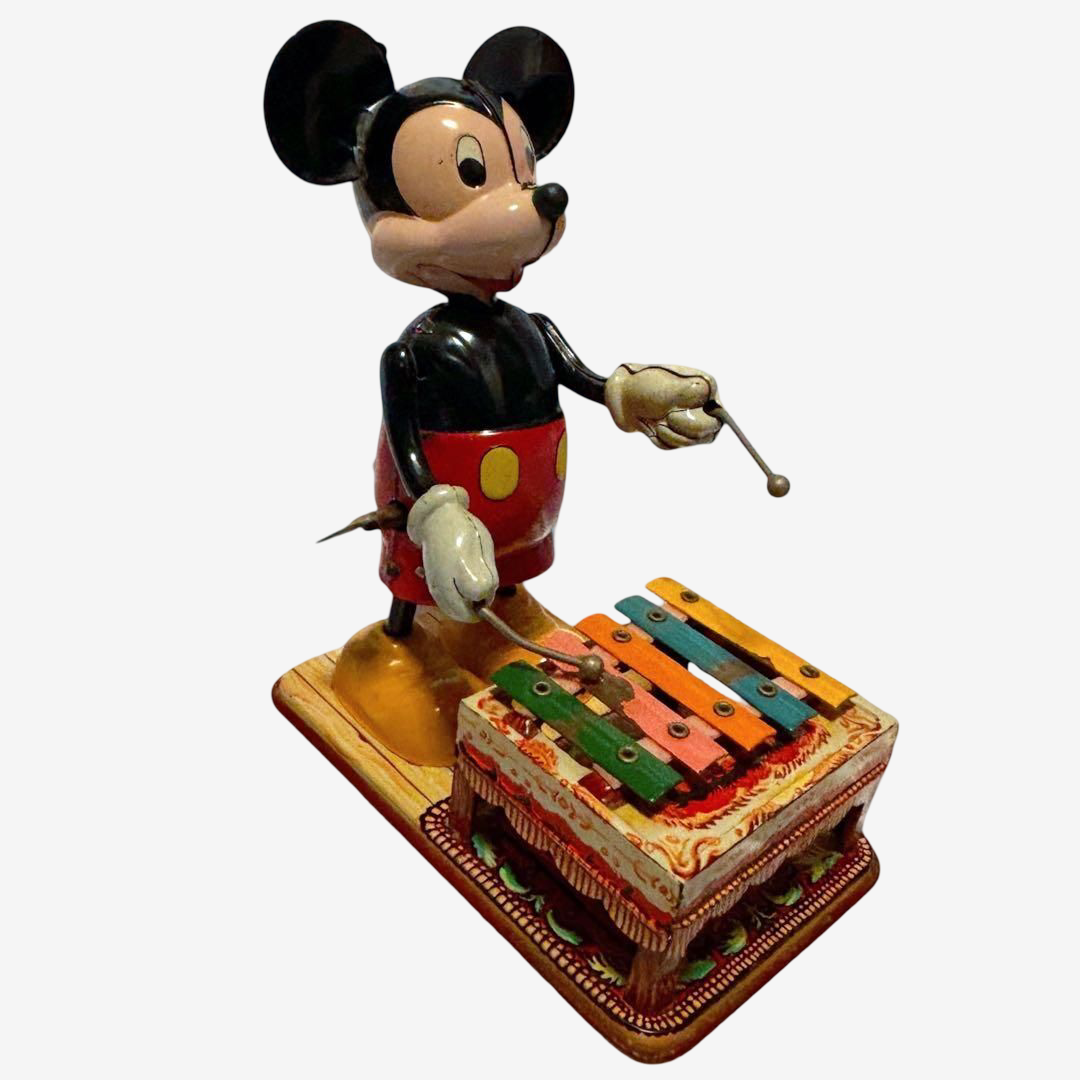
Linemar Mickey Mouse Xylophone Player, Walt Disney Productions Clockwork Tinplate Toy, Japan, 1950s
Linemar Mickey Mouse Xylophone Player, Walt Disney Productions Clockwork Tinplate Toy, Japan, 1950s
This piece has found its collector.
The Hunting Salon™ can search Japan's private collections for another like it. Ask us to find one or browse similar pieces.
Couldn't load pickup availability
Have a reasonable price in mind? Submit your best offer and our concierge will review it personally.
Wind the spring and Mickey strikes his xylophone. Made in Japan in the 1950s under Walt Disney Productions license, this Linemar toy comes from the Louis Marx network whose most desirable mechanical Disney tins carried the LineMar trademark. The clockwork still operates, and the surface wears seven decades honestly.
The Piece
Mickey stands upright behind a brightly colored xylophone, a slender mallet in each gloved hand. Once the key is wound and the mechanism released, the stored spring energy travels through gears and linkages: the body moves through its cycle and the mallets strike the metal bars until the spring unwinds. The sound is entirely physical, metal striking metal, with no speaker or sound chip; the machine produces its own soundtrack. In giving the character something to do, the toy turns a licensed image into a performer, which is why the great Japanese mechanical Disney toys of the 1950s sit between commercial merchandise, toy engineering and popular art.
Linemar functioned within the Louis Marx & Co. manufacturing and import network, using Japanese production for international distribution. Disney's own D23 archive records Marx as a Disney licensee from 1936 through 1961, before a later renewal, and notes that many of the more valuable wind-up and mechanical tin Disney toys were sold under the LineMar trademark. Independent toy-history references describe Linemar as a Japanese manufacturing and import operation associated with Marx, producing both mechanical toys and licensed Disney characters. The name is therefore American commercial history and Japanese manufacturing history at once.
Postwar Japan built a remarkable industry on lithographed tinplate and compact clockwork: thin sheet metal printed, pressed, folded and mechanically joined into surprisingly sophisticated forms, animated without batteries and offered to international buyers as affordable mechanical spectacle. Characters walked, animals danced, robots sparked, vehicles raced, and Mickey played the xylophone. The seams, tabs, printed surfaces and mechanical sounds of these toys preserve an industrial world that has largely disappeared.
The composition is a small theatrical platform. Mickey leans slightly into the performance; his circular ears give the strongest silhouette, the pale face contrasts with the black head and body, red shorts supply the central accent and yellow shoes anchor him to the ornamental printed base. The xylophone's colored bars run as a horizontal counterpoint to the vertical figure, and the mallets bind figure to instrument, turning a standing character into a scene. The sculpted head keeps Mickey's classic mid-century look, with broad face, large ears, black nose, smiling mouth and small red tongue, while cream tones shape the face and gloves.
Music was central to Mickey's identity from the start of his screen career, which coincided with the arrival of synchronized sound in animation. The xylophone therefore places him within one of early animation's defining traditions, movement synchronized with sound, translated here into gears, springs and metal. The mechanism does not reproduce cinematic animation perfectly; it stutters, clicks, strikes and vibrates, and those imperfections make the movement tangible. The toy behaves almost as a miniature automaton, a stored source of energy animating a recognizable figure through a choreographed, repeated task, and its crossover appeal reaches well beyond specialist tin-toy collecting into Disneyana, Linemar and Marx, mechanical and musical toys, animation history and mid-century design.
Details
- Maker: Linemar Toys, Louis Marx & Co. lineage
- Model: Mickey Mouse Xylophone Player (Mechanical Mickey Mouse with Xylophone)
- Line/Series: Licensed by Walt Disney Productions
- Era: 1950s
- Origin: Japan
- Material: Lithographed and painted tinplate with mixed character components
- Color: Black figure with cream face and gloves, red shorts and yellow shoes; multicolored xylophone; ornamental printed base
- Measurements: Height 18 cm (7.1 in) · Width 14.5 cm (5.7 in) · Depth 8.5 cm (3.3 in), approx.
- Included: Toy only; no original box
- Mechanism: Spring-driven zenmai clockwork; Mickey works the two mallets against the metal xylophone keys while the body moves through the cycle
- Markings: “LINEMAR TOYS JAPAN” and “WALT DISNEY PRODUCTIONS” on the reverse
Condition
- Authentic vintage condition with a working spring-driven mechanism; the wind-up presently operates and animates Mickey's xylophone-playing action.
- Extensive age-related surface character throughout, including rubbing, scratches, oxidation, patina, paint loss, discoloration and tonal variation from long-term handling and preservation.
- The Mickey figure, xylophone, mallets, base and mechanical structure remain visually coherent as an ensemble.
- As with any mechanical object of about seven decades, continued operation cannot be guaranteed indefinitely; the mechanism should be exercised conservatively.
- No original retail box accompanies the piece. The photographs give the most complete record of surface preservation and age.
Archive References
A specialist toy archive identifies the same model as a Japan-made Linemar/Marx “Mechanical Mickey Mouse with Xylophone”, marked Linemar and Walt Disney Productions and wind-up operated, with recorded dimensions around 5¾ × 3½ × 6¾ inches; sale-room examples are recorded around 6½ inches in height. Another example, catalogued in 2024 as a 1950s Line Mar Toys Mickey Mouse Mechanical Xylophone Toy, documents the same action: wind the key, release the mechanism, and Mickey plays the xylophone with two mallets.
Original packaging carries substantial weight for Linemar toys. A boxed, near-mint working example with its original box, original rubber parts and minimal wear achieved a strong result in the collector market in 2009. The present piece is best understood as a strong working unboxed survivor rather than measured against the highest-grade boxed examples.
Authenticity & Care
The reverse bears the licensed-production markings “LINEMAR TOYS JAPAN” and “WALT DISNEY PRODUCTIONS”, matching comparable documented examples of the model within the Linemar Disney lineage. Every piece is examined and documented in Japan before dispatch and is offered with the Japonista authenticity guarantee.
Delivery from Japan
Packed by hand in Japan and shipped insured and tracked by EMS or an equivalent express service. Import duties and taxes, where applicable, are payable on arrival. Returns follow our published policy.
Considered offers are welcome through Send an Offer, and each one is reviewed personally.
Continue browsing: Vintage Toys
Related pieces: TPS mounted cavalryman with cannon tin toy · Line Mar Mickey Mouse delivery tricycle toy · Early Japanese Minnie Mouse rocking chair tin toy
Toy Box Requests
Hunting a particular robot, kaiju, figure or model? The Hunting Salon™ searches Japan’s collector shops and private collections, and the Deputy Vault™ secures a piece you have already found. Begin a Hunting Salon™ request →
Collectors also search: linemar mickey mouse xylophone · mechanical mickey mouse with xylophone · 1950s mickey mouse wind up toy · linemar disney tin toy · marx mickey xylophone player · vintage mickey mouse tin toy japan · walt disney productions wind up toy