Crows
CROWS & WORST × Regulus Bōya Harumichi 鷹龍 Hawk-Dragon Reversible Sukajan, Suzuran Crest, 2016, Size L–XL
CROWS & WORST × Regulus Bōya Harumichi 鷹龍 Hawk-Dragon Reversible Sukajan, Suzuran Crest, 2016, Size L–XL
Couldn't load pickup availability
Have a reasonable price in mind? Submit your best offer and our concierge will review it personally.
Built around one of the most recognizable identities in the CROWS universe, this 2016 CROWS & WORST × Regulus “Taka-Ryū” jacket pairs a monumental diving hawk around the kanji 鈴蘭, Suzuran, with a reverse of dragon, waves and a white-robed outlaw. One side speaks through symbols; the other tells a story.
The Piece
Regulus introduced this design in 2016 as the CROWS & WORST × Regulus Bōya Harumichi Model 鷹龍 Sukajan, 鷹龍 reading Taka-Ryū, literally “Hawk and Dragon”, noting that the hawk-and-dragon jacket appears in various scenes, covers and illustrated pages connected with Harumichi. It is a fully embroidered reversible souvenir jacket, not manga merchandise printed onto an ordinary bomber. CROWS and its successor WORST, created by manga artist Hiroshi Takahashi, became defining works of Japanese delinquent manga, a mythology of rival schools, biker groups, personal codes, loyalty and the pursuit of strength without surrendering individuality. Official franchise material describes Bōya Harumichi as the free-spirited outsider who transferred into Suzuran, whose openness and magnetism formed the informal “Harumichi Family”, and who is remembered not simply as the strongest but as the greatest kind of man.
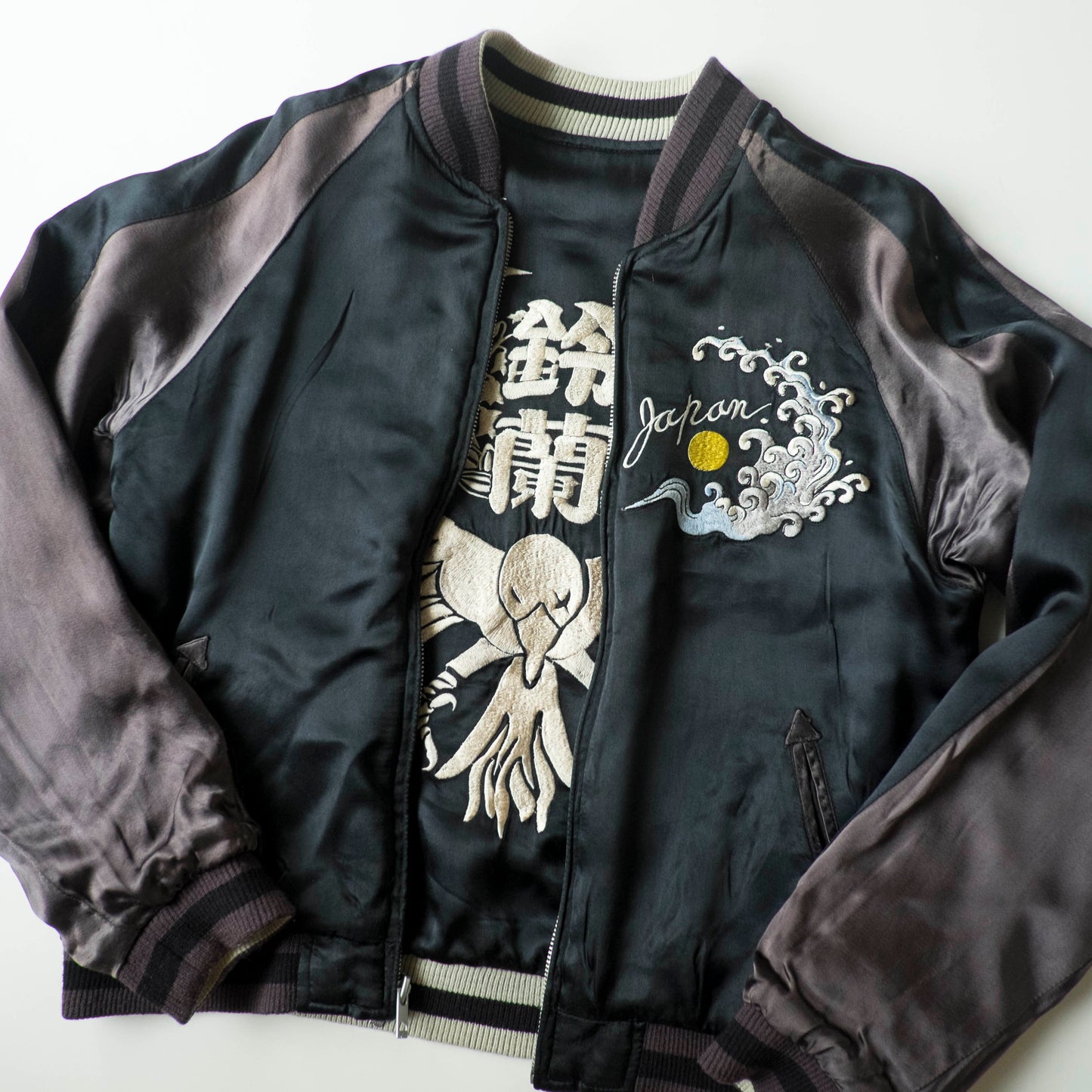
The first face is severe and emblematic. An enormous descending hawk, wings fully extended, feathers layered, flight plumes curved and talons open, fills nearly the entire black satin back, its wings arching around the central 鈴蘭 like a heraldic banner. The thread palette is restrained: aged champagne gold, warm ivory, muted silver and soft taupe with dark outlining; the long outer flight feathers curve upward like blades, while fine linear sections in the inner wings give motion and architectural balance. Suzuran is the notorious boys’ high school at the heart of CROWS, the feared “school of crows” no single leader has ever fully unified, and its kanji are framed by embroidered bell-shaped flowers and leaves, the lily of the valley the name literally means. At the front, a smaller hawk in flight sits on one chest and the 鈴蘭 kanji within lily-of-the-valley foliage on the other, reading like two halves of a formal crest: hawk and school, movement and identity. The hawk, with its associations of precision, fearlessness and decisive force, is caught at the instant before impact, guarding and claiming the school emblem.
Reversed, the monochrome crest gives way to a pictorial scene on black to charcoal satin with smoky brown raglan sleeves that read as muted plum-taupe or graphite in different light. A large green dragon twists through the right half of the back: deep emerald scales, yellow-gold mane and facial hair, a red-and-white striped underside, gray antlers and horns, an open red mouth with white fangs, extended claws and silver-gray fins, emerging from curling waves and cloud-like spray. Opposite sits a severe white-robed figure with long dark hair, a skull-like or heavily shadowed face and an extended rod or staff, drawing on Japanese ghost stories, outlaw heroes, tattoo imagery and ukiyo-e confrontations; calm within a violent landscape, he can be read as Harumichi’s own attitude, relaxed in appearance and unafraid of forces larger than himself. Waves in white, gray and pale blue sweep across the lower composition, curling around rocks and clothing with woodblock-print rhythm and manga-weight black outlining. On the front, embroidered “Japan” script sits above a golden circular sun, a pale crane- or heron-like bird and curling white waves, a small souvenir emblem in the old tour-jacket manner, while the opposite chest stays quiet.
CROWS and WORST belong to Japan’s yankii and delinquent-manga tradition, whose visual vocabulary of altered school uniforms, pompadours, biker clothing, embroidered slogans and reputation became a language for brotherhood, defiance, personal honor, loyalty without submission and the difference between strength and leadership. The sukajan itself grew from the meeting of American military souvenir culture and Japanese embroidery after the Second World War, and later Japanese makers carried it into Amekaji, biker, rockabilly, manga and anime collaborations, tattoo-inspired design and yankii and bosozoku aesthetics. This 2016 jacket belongs to that later evolution, not to the 1940s or 1950s occupation era, keeping the reversible structure and ribbed bomber silhouette while turning the garment into serialized pop-culture mythology: black satin as uniform, Suzuran as crest, the hawk as personal power, the dragon as adversary and alter ego.
Details
- Maker: Regulus, in collaboration with CROWS & WORST
- Model: Bōya Harumichi Model 鷹龍 (Taka-Ryū) Sukajan
- Line/Series: CROWS / WORST, created by Hiroshi Takahashi
- Era: 2016 release
- Material: Smooth satin-finish textile (exact fiber not visible; may be rayon-style, acetate or synthetic satin); dense machine embroidery in polyester or rayon-style thread; rib-knit trim; metal zipper; woven pocket facings
- Color: Hawk face: black ground; champagne gold, ivory, taupe and silver embroidery; black and cream ribbing. Dragon face: black to charcoal ground; smoky brown or muted graphite-plum sleeves; green, yellow, red, white, silver, gray and orange embroidery; charcoal, brown and black ribbing
- Size: Approximately L–XL (relaxed Japanese L or closer Western L to XL fit)
- Construction: Fully reversible with two complete wearable faces; raglan sleeves; central reversible metal zipper; angled welt pockets on both sides; striped rib-knit collar, cuffs and waistband; large-format back and chest embroidery on both faces; lightweight, unpadded; compact Japanese bomber proportions
Condition
- Pre-owned condition with authentic age and wear; the embroidery remains visually powerful and substantially complete throughout the photographed areas.
- The satin shows natural wrinkling, handling creases, pressure lines and directional sheen, most visible across the body panels and sleeves.
- Visible characteristics may include minor thread fuzzing, small raised fibers, occasional embroidery irregularity, light flattening within dense stitching, gentle surface wear, storage creasing, softened rib-knit trim, minor color variation between panels, light puckering around embroidery and age-related wear along pocket edges and zipper areas.
- The Suzuran hawk remains sharply readable, with feathers, kanji, floral surround and talons intact in form; the dragon face remains exceptionally vivid in its scales, waves, robes, facial details and red-white body pattern.
- Zipper, pockets, collar, cuffs and waistband appear present and structurally cohesive; no major tears or structural damage are apparent. The photographs form an essential part of the condition record.
Sizing Guidance
Best suited to approximately modern L–XL, depending on build, desired silhouette and layering. Sukajan are shorter through the torso than most Western bombers, with rounded raglan sleeves and a gathered rib-knit waist designed to sit at the waist; compare with a similar raglan-sleeve bomber that already fits comfortably.
Styling and Display
The monochrome hawk face lets the giant bird dominate with black denim, wide-leg charcoal trousers, vintage military pants, heavy boots or minimal white sneakers, plain black knitwear, CROWS or WORST graphic shirts, silver accessories and Japanese biker styling. The dragon face, warmer for its smoky sleeves and colored embroidery, works with faded indigo or selvedge denim, black cargo trousers, workwear boots, leather accessories, loose white T-shirts, muted gray hoodies and tattoo-inspired streetwear.
Displayed from the hawk side, the jacket becomes an enormous Suzuran crest beside manga artwork, CROWS figures or streetwear archives; from the dragon side, it reads as a complete embroidered illustration. Both backs are fully developed, so neither feels secondary.
Preservation Guidance
Professional cleaning by a specialist familiar with embroidered sukajan is recommended. Do not machine wash, soak, bleach, scrub, wring or tumble dry; avoid ironing over embroidery, satin, zipper or ribbing, and keep concentrated steam off the stitched areas. Protect the embroidery from rough bags, jewelry, hook-and-loop fasteners and abrasive furniture, support sleeves and body evenly when reversing, and store on a broad padded hanger in a breathable cover away from sunlight, smoke, humidity and prolonged compression.
Authenticity & Care
Matches the CROWS & WORST × Regulus Bōya Harumichi Model 鷹龍 sukajan introduced in the Regulus archive in 2016. Every piece is examined and documented in Japan before dispatch and is offered with the Japonista authenticity guarantee.
Delivery from Japan
Packed by hand in Japan and shipped insured and tracked by EMS or an equivalent express service. Import duties and taxes, where applicable, are payable on arrival. Returns follow our published policy.
Considered offers are welcome through Send an Offer, and each one is reviewed personally. Pieces over $1,000 may be reserved over several payments with Layaway Privilege™.
Continue browsing: Sukajan Souvenir Jackets · Amekaji & Wagara Fashion
Related pieces: CROWS × WORST Regulus Japan Tokyo dragon reversible sukajan · Crows × Worst × Dive black Suzuran sukajan · CROWS × WORST Rokubujin dragon and phoenix reversible sukajan
Yokosuka Archive
A particular size, motif or decade in mind? Postwar souvenir jackets and heritage amekaji surface in Japan one at a time. Name the maker, the embroidery and the chest measurement, and the Hunting Salon™ watches for it on your behalf. Request a jacket search →
Collectors also search: crows worst sukajan · boya harumichi jacket · suzuran hawk sukajan · regulus crows jacket · taka ryu hawk dragon sukajan · crows reversible souvenir jacket · yankii manga jacket · l xl sukajan